

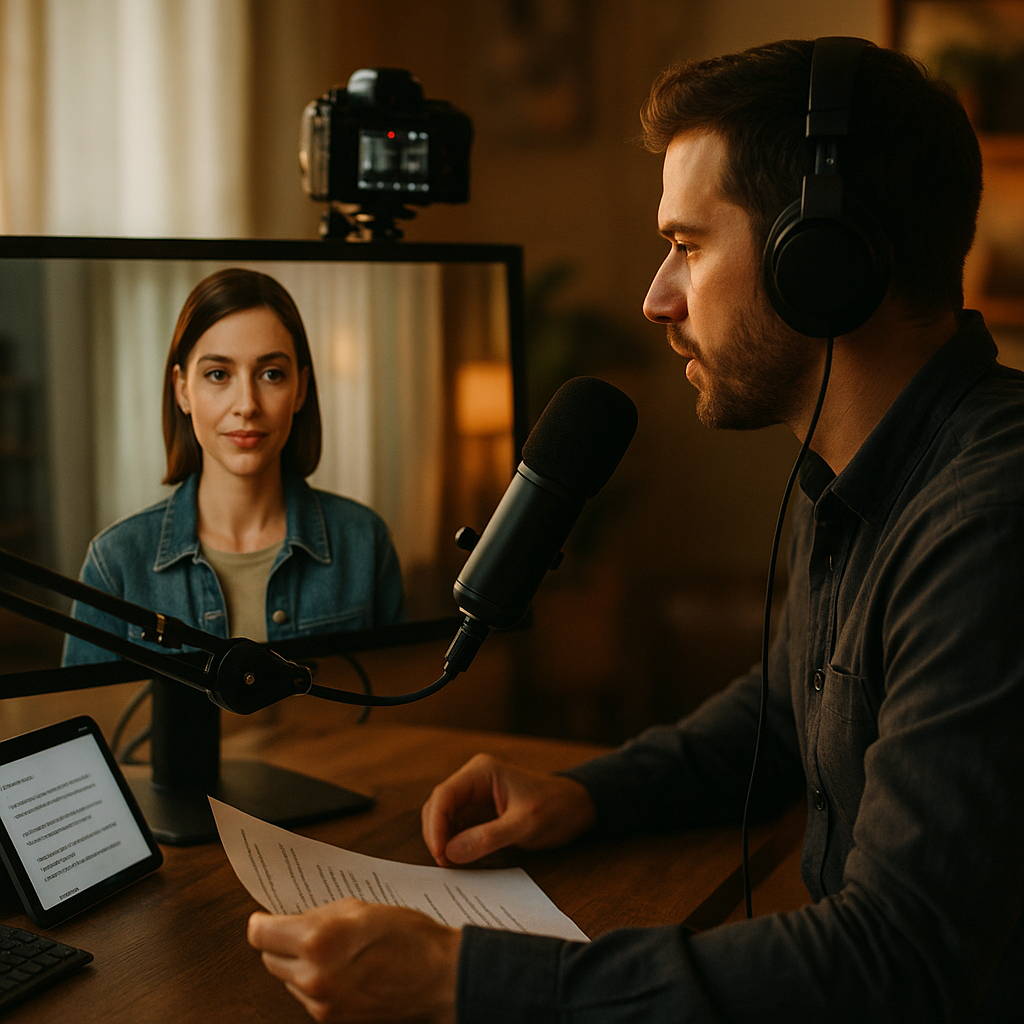
Twitch and TikTok Live are quietly filling up with two-hosts-one-human setups: a creator, a ring light, and a virtual avatar cohost riffing off their every line. An AI co-host livestream isn’t a novelty anymore, it’s becoming a standard production line for brands that need more airtime than their talent roster can cover. The question isn’t whether to try it. It’s whether your creator brief can keep the avatar from stealing the show, or worse, saying something legal can’t unsay.
Why Brands Are Pairing Creators With Avatars Now
Livestream fatigue is real. Creators can only go live so many hours a day before quality drops and burnout sets in. An AI cohost solves the coverage problem: it never loses its voice, never needs a bathroom break, and can run product Q&A on a loop while the human host handles the parts that need actual judgment, like reading a room or handling an awkward customer comment.
Platforms have noticed. TikTok and YouTube have both expanded avatar-friendly livestream tooling, and agencies report growing demand for hybrid formats where a synthetic character supports rather than replaces the creator. That’s the operative word: supports. The moment the avatar becomes the main act, you’ve entered different territory entirely, one covered in our breakdown of AI avatars at scale and the trust costs that come with overusing them.
Brands running hybrid creator-avatar livestreams report roughly 20 to 30 percent longer average watch time than solo-host streams, largely because the avatar keeps pace during lulls the human host would otherwise fill with dead air.
What Actually Goes Wrong Without a Brief
Most failures aren’t technical. They’re procedural. A creator shows up, the avatar’s script wasn’t finalized, and now you’ve got two hosts improvising against each other on a live feed with no edit button. Common breakdowns include:
- Tone mismatch: the avatar is scripted corporate-formal while the creator is casual and unscripted, creating a jarring split personality on screen.
- Overlapping speech: without clear handoff cues, both “hosts” talk over each other, which reads as broken tech rather than a stylistic choice.
- Undisclosed synthetic media: viewers assume the avatar is a filter or a real second presenter, not a generated cohost, raising disclosure risk under FTC guidance.
- Off-brand improvisation: the avatar’s generative responses drift from approved talking points during live Q&A, sometimes into competitor comparisons or unapproved claims.
Every one of these is fixable at the brief stage. None of them are fixable once you’re live.
Briefing the Human Half: Creator Guidance That Keeps the Show Human
The creator is your control point. If they know exactly how to steer the interaction, the avatar’s limitations become invisible to the audience. Your brief should cover:
- Role definition. Spell out who owns what: does the avatar handle FAQ and product specs while the creator handles storytelling and reactions? Ambiguity here is where dead air and awkward overlap start.
- Cue language. Give the creator specific verbal handoffs, like “let’s ask
 about sizing” so the avatar’s response timing feels intentional, not glitchy.
 - Correction protocol. If the avatar misspeaks or drifts off-script, what does the creator say to redirect without breaking the audience’s trust in the segment? A light, humorous redirect works better than an awkward silence.
- Energy matching. Ask creators to slightly mirror the avatar’s pacing during shared segments, then diverge into their natural style during solo segments. This is a subtle skill and worth a rehearsal run before the first live broadcast.
This isn’t unlike briefing a creator for any co-hosted format. If you’ve built interactive livestream segments before, the handoff logic is nearly identical, you’re just swapping a second human for a scripted synthetic presence.
Scripting the Avatar Without Killing Spontaneity
Here’s the tension every brand runs into: avatars need scripts to stay on-brand, but rigid scripts make the whole stream feel canned. The fix is tiered scripting, not full scripting.
- Tier one: locked lines. Product claims, pricing, compliance statements, anything with legal exposure gets word-for-word scripting. No generative flexibility allowed here.
- Tier two: guided responses. FAQ-style content where the avatar can paraphrase within approved boundaries, useful for handling live chat questions without sounding robotic.
- Tier three: open banter. Reactions, small talk, filler between segments. This is where you allow the avatar’s generative model more room, since the stakes of a slightly off-tone joke are lower than a wrong product spec.
Keeping these tiers consistent across every stream is what separates a coherent virtual personality from a glitchy one. We cover this same consistency problem in our avatar creative briefs guide, and it applies directly here: an avatar that behaves differently stream to stream erodes the audience’s sense that it’s a real, dependable “character” at all.
The biggest scripting mistake brands make is treating tier three as an afterthought. Unscripted banter is exactly where avatars are most likely to generate an off-brand or legally risky statement, because it’s the tier nobody rehearsed.
Disclosure Isn’t Optional, and It’s Not Just a Caption
Regulators are paying attention to synthetic media in commercial contexts. The FTC has been explicit that AI-generated endorsers and virtual presenters fall under existing endorsement disclosure rules, and the UK’s ICO has flagged synthetic media transparency as an active area of guidance. Your brief needs to specify, on-screen and verbally, that the cohost is AI-generated. A small “AI” badge in the corner of the frame isn’t enough on its own if the avatar is voicing product claims or answering health, safety, or financial questions.
Practical disclosure checklist for the brief:
- Verbal disclosure at stream open and after every break (“Reminder, [name] is our AI cohost”)
- Persistent on-screen label, not just a one-time intro card
- Platform-specific labeling tools used where available (TikTok and YouTube both offer AI content labels)
- A scripted line for the human creator to use if a viewer asks directly whether the cohost is real
Skipping this isn’t just a compliance risk, it’s a trust risk. Audiences who feel tricked by an undisclosed avatar tend to be vocal about it, and that backlash lands on the creator’s channel as much as the brand’s.
Technical Setup: What the Brief Needs to Specify Before Anyone Goes Live
A creative brief for this format has to double as a light technical spec, because the failure points are as much about latency and rendering as they are about tone. Include:
- Platform and rendering engine being used for the avatar, and whether it runs on a delay relative to the creator’s live feed.
- Backup plan if the avatar’s connection drops mid-stream. Who talks, and what do they say to cover the gap?
- Audio separation so the avatar’s voice track doesn’t clash with the creator’s mic, especially important for platforms that auto-caption live audio.
- Moderation integration, since chat-triggered avatar responses need a filter layer to prevent the model from responding to bait, trolling, or off-topic prompts live.
This is also where format choice matters. A livestream shopping setup has different latency tolerances than a casual Q&A stream, so the brief should name the format explicitly rather than assuming the production team will infer it.
Measuring Whether the Pairing Is Actually Working
Watch time is the obvious metric, but it’s not the only one worth tracking. Compare hybrid streams against solo-creator streams on:
- Average view duration and drop-off points (does engagement dip specifically during avatar-led segments?)
- Chat sentiment during avatar interactions versus creator-led segments
- Conversion rate on pinned links or shoppable moments, similar to the tracking used in pinned comment checkout setups
- Repeat viewership, since novelty often drives first-stream curiosity that doesn’t hold on the second or third broadcast
According to eMarketer, livestream shopping engagement in the U.S. is still growing year over year, which means brands testing hybrid formats now have a widening audience to measure against rather than a shrinking one.
Common Questions Brands Ask Before Their First Hybrid Stream
Is this worth it for a mid-size brand, or only enterprise budgets? Cost has come down enough that mid-tier brands are testing it, particularly for recurring formats like weekly product drops where a scripted avatar segment can run without a full production crew each time. Start small: one segment per stream, not a full avatar-hosted broadcast, until you’ve validated audience reaction.
Should the avatar have its own persona and name, or brand-neutral labeling? A named, consistent persona tends to perform better because audiences build familiarity with it over multiple streams, similar to how a recurring sidekick character works on traditional broadcast. Just keep that persona’s voice and behavior locked to the tiered scripting model above.
Where This Fits Alongside Your Other Formats
Hybrid livestreams don’t replace your existing creator content, they extend it. Brands already running text-to-speech voiceover ads or AI dubbing at scale already have internal comfort with synthetic media production, which makes the leap to a live synthetic cohost less of a cultural hurdle and more of a scripting and disclosure exercise. Treat this as the next format in that same toolkit rather than a separate experiment requiring its own approval chain.
Next step: before your next livestream cycle, draft a one-page tiered script template (locked, guided, open) and a disclosure checklist, then run one low-stakes test stream with a single avatar segment before scaling to a full hybrid format.
FAQs
What is an AI co-host livestream?
It’s a livestream format where a human creator shares hosting duties with a virtual avatar powered by generative AI, typically splitting responsibilities between storytelling (human) and structured information or FAQ delivery (avatar).
Do I need to disclose that the cohost is AI-generated?
Yes. Regulatory guidance from bodies like the FTC treats AI-generated presenters under existing endorsement and disclosure rules, so both verbal and persistent on-screen disclosure are recommended, not optional.
How much of the avatar’s dialogue should be scripted?
Use a tiered approach: fully lock product claims and compliance statements, allow guided paraphrasing for FAQ-style content, and give more generative freedom only to low-stakes banter and reactions.
What’s the biggest risk in this format?
Unscripted or “open” moments, where the avatar responds to live chat without guardrails, are the most common source of off-brand or legally risky statements during a broadcast.
Is this format only viable for large brands with big budgets?
No. Costs have dropped enough that mid-tier brands are testing single-segment hybrid formats, such as one avatar-led Q&A block within an otherwise human-hosted stream, before committing to a fully hybrid broadcast.
FAQs
What is an AI co-host livestream?
It’s a livestream format where a human creator shares hosting duties with a virtual avatar powered by generative AI, typically splitting responsibilities between storytelling (human) and structured information or FAQ delivery (avatar).
Do I need to disclose that the cohost is AI-generated?
Yes. Regulatory guidance from bodies like the FTC treats AI-generated presenters under existing endorsement and disclosure rules, so both verbal and persistent on-screen disclosure are recommended, not optional.
How much of the avatar’s dialogue should be scripted?
Use a tiered approach: fully lock product claims and compliance statements, allow guided paraphrasing for FAQ-style content, and give more generative freedom only to low-stakes banter and reactions.
What’s the biggest risk in this format?
Unscripted or “open” moments, where the avatar responds to live chat without guardrails, are the most common source of off-brand or legally risky statements during a broadcast.
Is this format only viable for large brands with big budgets?
No. Costs have dropped enough that mid-tier brands are testing single-segment hybrid formats, such as one avatar-led Q&A block within an otherwise human-hosted stream, before committing to a fully hybrid broadcast.
Top Influencer Marketing Agencies
The leading agencies shaping influencer marketing in 2026
Agencies ranked by campaign performance, client diversity, platform expertise, proven ROI, industry recognition, and client satisfaction. Assessed through verified case studies, reviews, and industry consultations.
Moburst

-
2

The Shelf
Boutique Beauty & Lifestyle Influencer AgencyA data-driven boutique agency specializing exclusively in beauty, wellness, and lifestyle influencer campaigns on Instagram and TikTok. Best for brands already focused on the beauty/personal care space that need curated, aesthetic-driven content.Clients: Pepsi, The Honest Company, Hims, Elf Cosmetics, Pure LeafVisit The Shelf → -
3

Audiencly
Niche Gaming & Esports Influencer AgencyA specialized agency focused exclusively on gaming and esports creators on YouTube, Twitch, and TikTok. Ideal if your campaign is 100% gaming-focused — from game launches to hardware and esports events.Clients: Epic Games, NordVPN, Ubisoft, Wargaming, Tencent GamesVisit Audiencly → -
4

Viral Nation
Global Influencer Marketing & Talent AgencyA dual talent management and marketing agency with proprietary brand safety tools and a global creator network spanning nano-influencers to celebrities across all major platforms.Clients: Meta, Activision Blizzard, Energizer, Aston Martin, WalmartVisit Viral Nation → -
5

The Influencer Marketing Factory
TikTok, Instagram & YouTube CampaignsA full-service agency with strong TikTok expertise, offering end-to-end campaign management from influencer discovery through performance reporting with a focus on platform-native content.Clients: Google, Snapchat, Universal Music, Bumble, YelpVisit TIMF → -
6

NeoReach
Enterprise Analytics & Influencer CampaignsAn enterprise-focused agency combining managed campaigns with a powerful self-service data platform for influencer search, audience analytics, and attribution modeling.Clients: Amazon, Airbnb, Netflix, Honda, The New York TimesVisit NeoReach → -
7

Ubiquitous
Creator-First Marketing PlatformA tech-driven platform combining self-service tools with managed campaign options, emphasizing speed and scalability for brands managing multiple influencer relationships.Clients: Lyft, Disney, Target, American Eagle, NetflixVisit Ubiquitous → -
8

Obviously
Scalable Enterprise Influencer CampaignsA tech-enabled agency built for high-volume campaigns, coordinating hundreds of creators simultaneously with end-to-end logistics, content rights management, and product seeding.Clients: Google, Ulta Beauty, Converse, AmazonVisit Obviously →