


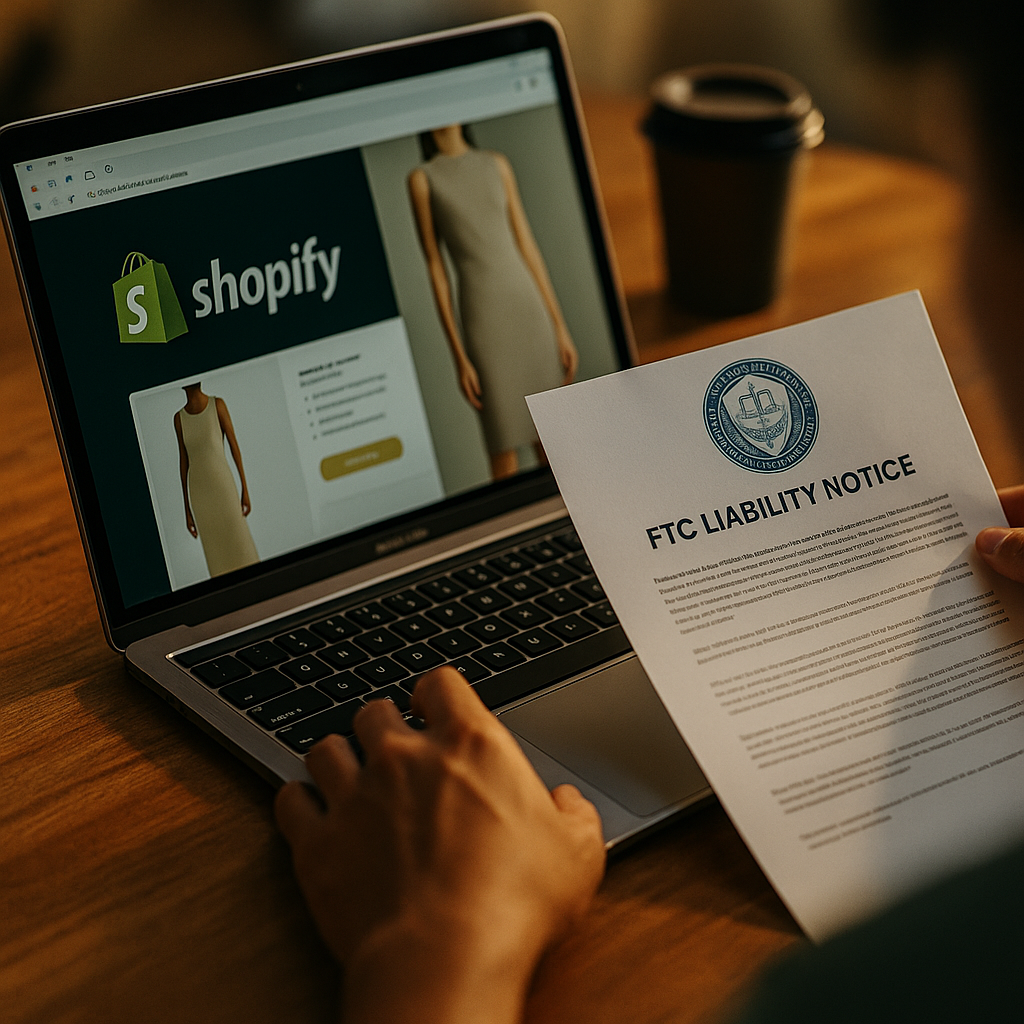
Ninety-two percent of Shopify merchants will have some form of AI shopping assistant touching their storefront within the next year, according to platform integration data circulating among agency partners. So here’s the uncomfortable question nobody in procurement wants to answer: when ChatGPT tells a customer your supplement “cures inflammation” and it doesn’t, who’s on the hook? AI ad agent liability isn’t a hypothetical anymore. It’s a Tuesday.
The New Storefront Nobody Fully Controls
Shopify’s integration with OpenAI’s commerce tools lets shoppers ask ChatGPT to find, compare, and buy products directly inside the chat window. No product page. No brand-controlled copy. Just a language model synthesizing your catalog, your reviews, and whatever it scraped about your category, then presenting it as a recommendation.
That’s a fundamentally different exposure than a banner ad or a sponsored post. A human copywriter who overstates a claim can be retrained, disciplined, or fired. An AI agent generating responses on the fly doesn’t have a performance review. It has a training corpus and a prompt, and neither of those are things your legal team drafted or approved.
Brands have spent years building disclosure and substantiation muscle around influencer content. We’ve covered the substantiation burden extensively, including how AI generated reviews already sit in a regulatory gray zone. The AI shopping agent problem is that gap, scaled to every single product in your catalog, running continuously, with no editorial review cycle at all.
An AI shopping agent doesn’t get retrained after a bad answer. It just keeps answering, at scale, until someone notices the pattern in chargebacks or complaints.
Why “The Model Said It, Not Us” Won’t Fly
The FTC has been unambiguous for years: if a claim reaches a consumer through your product ecosystem and influences a purchase, the advertiser bears responsibility for its accuracy, regardless of the messenger. That principle predates generative AI by decades. It’s the same logic that makes brands liable when a creator makes an unsubstantiated claim in a sponsored post, which we detailed in our look at how TikTok Shop commissions shift FTC risk back onto the brand even when a third party pulled the trigger on the actual statement.
Swap “creator” for “AI agent” and the reasoning holds. The FTC doesn’t care whether the misleading claim came from a 22 year old with a ring light or a large language model with a system prompt. It cares whether a consumer was deceived and whether the advertiser had reasonable control over the message. Spoiler: courts and regulators are increasingly finding that brands do have reasonable control, because they chose to integrate the tool, they fed it the product data, and they profited from the resulting sale.
Who’s Actually Liable? A Four Party Problem
Strip away the hype and you’ve got four potential parties in any AI ad agent misrepresentation, and untangling them is the whole game:
- The brand. Owns the product, the catalog data, and typically the merchant of record status. Almost always primary liability in FTC eyes.
- The platform (Shopify). Provides the commerce infrastructure and checkout flow. Liability here depends heavily on how much editorial control Shopify’s terms claim over agent outputs.
- The AI vendor (OpenAI). Trains and operates the model generating the actual language. Its terms of service almost certainly disclaim responsibility for output accuracy, shifting the burden downstream.
- The agency or MarTech integrator. Built the feed, wrote the prompts, configured the guardrails. Often contractually indemnified, often the first name mentioned in a brand’s internal postmortem.
Here’s the pattern that should worry every CMO: three of those four parties have contract language actively disclaiming liability for AI output. Read OpenAI’s usage policies and Shopify’s merchant terms closely and you’ll find broad disclaimers about accuracy and fitness for purpose. That leaves the brand holding the liability by default, not by choice, simply because nobody else contractually agreed to hold it.
The Consent and Data Layer Makes It Worse
AI shopping agents don’t just generate claims, they also pull consumer data to personalize recommendations. That intersects directly with consent frameworks that many brands still haven’t tightened up. If your product feed integration passes customer browsing behavior into a third party model without a clean data processing agreement, you’re compounding an FTC deception risk with a privacy compliance gap. We’ve written about how data processing agreements need updating for creator platform integrations, and the same logic applies, arguably with higher stakes, to AI commerce agents that are ingesting live transactional data.
Building the Risk Framework: Five Controls That Actually Matter
Legal teams love frameworks that sound rigorous but change nothing operationally. Here’s one built for people who actually have to ship a Shopify integration by next quarter.
1. Audit the Claim Surface Before You Launch
Every product description, review snippet, and structured data field feeding your AI agent is a potential deception vector. Run a claims audit on your catalog the same way you’d audit influencer scripts before a campaign. If a human copywriter wouldn’t be allowed to say it without substantiation on file, don’t let it live in a data field an AI agent can synthesize into a stronger claim than you intended.
2. Contractually Push Liability Where It Belongs
Your agreements with integration partners and agencies should include explicit indemnification for AI generated claims, not just standard IP and confidentiality boilerplate. If your MarTech vendor configured the prompt logic, they should carry contractual responsibility for outputs that deviate from approved claims. This mirrors the indemnification tightening we’ve recommended around non-disparagement clauses in creator contracts: if you don’t name the risk in the contract, you own it by default.
3. Log Everything the Agent Says
You cannot defend a claim you can’t produce. Regulators expect substantiation on file, and “the AI generated it dynamically” is not a defense, it’s an admission that you have no retention system. Build logging into the integration from day one, capturing prompts, outputs, and the product data that informed each response. This is the same discipline we’ve pushed around influencer content retention for FTC audits, applied to a machine that talks to more customers per hour than any single creator ever could.
If your AI agent generates ten thousand product recommendations a day and you can’t reproduce a single one after the fact, you don’t have an AI strategy. You have an unlogged liability machine.
4. Set Guardrails on Claim Categories, Not Just Keywords
Basic keyword blocklists (“cure,” “guaranteed,” “clinically proven”) catch the obvious stuff but miss the subtler deception that happens when an agent combines two true statements into a false implication. Health, financial, and efficacy claims need category level guardrails reviewed by whoever handles regulatory compliance, not just the growth team optimizing conversion rate.
5. Insure for the Gap Nobody Else Will Cover
Standard media liability policies were written before agentic commerce existed. Talk to your broker specifically about AI generated content exposure, the same way brands have had to update coverage for creator campaigns generally. We’ve covered how cyber liability insurance gaps show up in creator campaign risk, and AI commerce agents represent an even newer, less priced category that most existing policies simply don’t contemplate yet.
What Regulators Are Actually Watching
The FTC has signaled repeatedly, including in guidance referenced on ftc.gov, that deceptive practices enforcement extends to any mechanism that influences a purchase decision, technology neutral by design. That’s deliberate. Regulators don’t want a loophole where brands can outsource deception to a chatbot and claim the chatbot did it. Expect enforcement actions in this space to accelerate once complaint volume around AI shopping misrepresentation reaches a critical mass, likely triggered by a high profile health or financial services case rather than a retail one.
Meanwhile, industry data from sources like eMarketer shows conversational commerce adoption climbing faster than most brands’ compliance functions can keep pace with. That gap between adoption speed and governance maturity is exactly where liability tends to land hardest, and it’s the same pattern we’ve seen play out with influencer disclosure enforcement over the past several years.
Brand teams should also watch how AI answer engines themselves are being scrutinized for substantiation, a topic closely related to the ChatGPT commerce integration risk. Our coverage of AI answer engine citations lays out how the substantiation burden is shifting even for organic search style answers, not just paid placements.
The Operational Fix Most Teams Skip
Assign explicit ownership. Not a committee, not a shared Slack channel, an actual named role responsible for reviewing AI agent outputs on a recurring cadence. Treat it like influencer content review: sampling, spot checks, and escalation paths when something looks off. Tools from platforms like HubSpot and monitoring services from Sprout Social already offer frameworks for content governance that can be adapted to AI generated commerce claims, even though they weren’t built specifically for this use case yet.
The brands that get ahead of this won’t wait for a regulator or a viral complaint to force the issue. They’ll build the audit trail, tighten the contracts, and assign ownership now, while the enforcement landscape is still being written rather than after the first consent decree makes headlines.
Frequently Asked Questions
Who is legally responsible when an AI shopping agent gives a customer false product information?
In most cases, the brand carries primary liability because it controls the product data feeding the agent and profits from the resulting transaction, even though the AI vendor and platform also share operational responsibility depending on contract terms.
Does Shopify take on liability for what ChatGPT says about a merchant’s products?
Shopify’s merchant terms generally position the platform as infrastructure, not the source of the claim, which means liability typically flows back to the merchant unless a specific indemnification clause states otherwise.
Can a brand be fined for an AI generated claim it never manually wrote?
Yes. The FTC has consistently held that liability attaches to whoever benefits from a deceptive claim reaching a consumer, regardless of whether a human or an algorithm generated the language.
What should be in a contract with an AI integration vendor to reduce risk?
Explicit indemnification for output accuracy, logging and retention requirements, and defined claim review responsibilities are the three clauses most brands are missing today.
How often should brands audit AI agent outputs for compliance?
A recurring cadence, ideally weekly during early rollout and monthly once stable, with immediate escalation triggers for any health, financial, or efficacy related claims.
Frequently Asked Questions
Who is legally responsible when an AI shopping agent gives a customer false product information? In most cases, the brand carries primary liability because it controls the product data feeding the agent and profits from the resulting transaction, even though the AI vendor and platform also share operational responsibility depending on contract terms.
Does Shopify take on liability for what ChatGPT says about a merchant’s products? Shopify’s merchant terms generally position the platform as infrastructure, not the source of the claim, which means liability typically flows back to the merchant unless a specific indemnification clause states otherwise.
Can a brand be fined for an AI generated claim it never manually wrote? Yes. The FTC has consistently held that liability attaches to whoever benefits from a deceptive claim reaching a consumer, regardless of whether a human or an algorithm generated the language.
What should be in a contract with an AI integration vendor to reduce risk? Explicit indemnification for output accuracy, logging and retention requirements, and defined claim review responsibilities are the three clauses most brands are missing today.
How often should brands audit AI agent outputs for compliance? A recurring cadence, ideally weekly during early rollout and monthly once stable, with immediate escalation triggers for any health, financial, or efficacy related claims.
Top Influencer Marketing Agencies
The leading agencies shaping influencer marketing in 2026
Agencies ranked by campaign performance, client diversity, platform expertise, proven ROI, industry recognition, and client satisfaction. Assessed through verified case studies, reviews, and industry consultations.
Moburst

-
2

The Shelf
Boutique Beauty & Lifestyle Influencer AgencyA data-driven boutique agency specializing exclusively in beauty, wellness, and lifestyle influencer campaigns on Instagram and TikTok. Best for brands already focused on the beauty/personal care space that need curated, aesthetic-driven content.Clients: Pepsi, The Honest Company, Hims, Elf Cosmetics, Pure LeafVisit The Shelf → -
3

Audiencly
Niche Gaming & Esports Influencer AgencyA specialized agency focused exclusively on gaming and esports creators on YouTube, Twitch, and TikTok. Ideal if your campaign is 100% gaming-focused — from game launches to hardware and esports events.Clients: Epic Games, NordVPN, Ubisoft, Wargaming, Tencent GamesVisit Audiencly → -
4

Viral Nation
Global Influencer Marketing & Talent AgencyA dual talent management and marketing agency with proprietary brand safety tools and a global creator network spanning nano-influencers to celebrities across all major platforms.Clients: Meta, Activision Blizzard, Energizer, Aston Martin, WalmartVisit Viral Nation → -
5

The Influencer Marketing Factory
TikTok, Instagram & YouTube CampaignsA full-service agency with strong TikTok expertise, offering end-to-end campaign management from influencer discovery through performance reporting with a focus on platform-native content.Clients: Google, Snapchat, Universal Music, Bumble, YelpVisit TIMF → -
6

NeoReach
Enterprise Analytics & Influencer CampaignsAn enterprise-focused agency combining managed campaigns with a powerful self-service data platform for influencer search, audience analytics, and attribution modeling.Clients: Amazon, Airbnb, Netflix, Honda, The New York TimesVisit NeoReach → -
7

Ubiquitous
Creator-First Marketing PlatformA tech-driven platform combining self-service tools with managed campaign options, emphasizing speed and scalability for brands managing multiple influencer relationships.Clients: Lyft, Disney, Target, American Eagle, NetflixVisit Ubiquitous → -
8

Obviously
Scalable Enterprise Influencer CampaignsA tech-enabled agency built for high-volume campaigns, coordinating hundreds of creators simultaneously with end-to-end logistics, content rights management, and product seeding.Clients: Google, Ulta Beauty, Converse, AmazonVisit Obviously →