


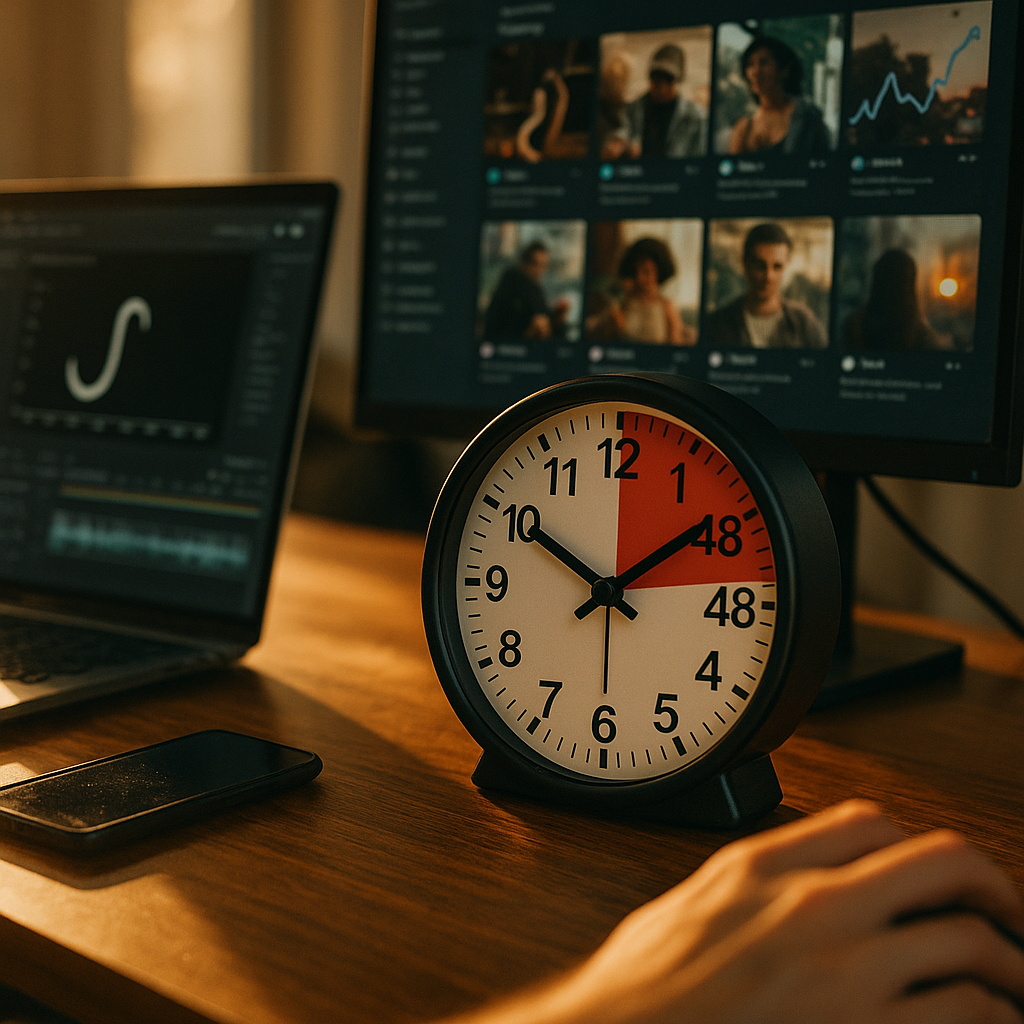
Seventy two hours. That is roughly how long a trending audio or hook format stays profitable before saturation kills its performance. Brands waiting on a formal brief, a full shoot day, and three rounds of legal review are already dead on arrival. Hook replication at scale is not a nice to have anymore. It is the difference between riding a trend and watching a competitor ride it instead.
The Trend Window Is Shrinking, Not Growing
Five years ago, a marketing team could spot a trend on Monday and still catch meaningful reach by Friday. That math no longer works. Platform algorithms now reward novelty so aggressively that the same hook format can go from fresh to exhausted in a matter of days, sometimes hours on TikTok specifically. Research from Sprout Social consistently shows engagement on trend-jacked content decaying fast once a format saturates a feed.
Most brand teams are structurally built for the old timeline. They have creative briefs that take a week to approve, agency handoffs that add days, and legal reviews that treat every asset like a Super Bowl spot. None of that survives contact with a 48 hour window.
What Is Hook Replication at Scale, Really?
It is not copying content. It is copying the mechanism. A hook, the opening one to three seconds of a video, is the single biggest driver of watch time and completion rate. When a hook structure is working (a specific pattern interrupt, a POV framing, a text overlay style) the goal is to identify that mechanism fast and rebuild it across multiple creators, products, and formats before the format fatigues.
Think of it like a production line for creative mechanics rather than a single viral video. You are not chasing one hit, you are systematizing the conditions that produce hits.
The brands winning trend cycles right now aren’t the ones with the biggest budgets. They’re the ones who cut the distance between “we spotted this” and “we have twelve assets live” down to two days or less.
The 48 Hour Production Clock
Break the window into four phases and assign a hard deadline to each one. Slippage in phase one compounds through the rest of the timeline, so treat detection as the most time-sensitive step, not the shoot.
- Hours 0 to 6, detection and validation: Social listening flags the hook, someone senior confirms it is not a fad that dies by morning, and a lightweight brief goes out immediately.
- Hours 6 to 18, scripting and casting: Scripts mirror the proven hook structure exactly, then get sent to a pre-vetted creator pool. No open casting calls, no follower minimums slowing things down.
- Hours 18 to 36, shoot and edit: Creators film same-day using a locked shot list. Editors work from templates rather than starting from a blank timeline.
- Hours 36 to 48, distribution and testing: Assets go live in small batches with rapid performance checks, not a single big-bang launch.
Notice how little of this timeline is spent on the shoot itself. Most brands lose time in the gaps between phases, not inside them.
Who Should Own the Trend to Asset Pipeline?
This is where a lot of programs quietly fail. Trend detection usually sits with social or community teams. Asset production sits with creative or an agency. Creator sourcing sits with influencer marketing. When those three functions operate on separate calendars, the 48 hour window closes before anyone agrees on next steps.
The fix is a single accountable owner for the entire pipeline, someone who can greenlight a script, pull a creator from an existing roster, and push an asset to publish without waiting for a status meeting. Brands that have already mapped this kind of workflow, as detailed in TikTok creator ops playbooks, move faster because the handoffs are pre-negotiated, not improvised under deadline pressure.
Building a Hook Library Before the Clock Starts
You cannot build infrastructure during a live trend cycle. It has to exist before the trend hits. That means three things sitting ready at all times.
First, a roster of creators who can turn around content same-day without a lengthy vetting process. A follower free casting approach helps here, because it widens the pool beyond a handful of big-name partners who are always booked.
Second, editing templates that let you swap footage into a proven structure in minutes rather than hours. CapCut speed edit templates exist specifically for this kind of rapid turnaround, cutting production time without sacrificing the pacing that made the original hook work.
Third, rights and usage agreements settled in advance, not negotiated asset by asset. A UGC rights registry means legal review is a lookup, not a fire drill, which matters enormously when you have eighteen hours to hit publish.
Where Brands Blow the Budget
Over-briefing is the most common failure. A five-page creative brief that reads like a legal document kills momentum before scripting even starts. Creators need three things: the hook, the product beat, and the call to action. Everything else slows them down.
The second failure is reshooting instead of clipping. Teams sitting on a backlog of existing footage often ignore it and schedule a brand new shoot, adding a full day they don’t have. Reformatting existing assets, the same logic behind a multi platform master edit approach, is almost always faster and cheaper than starting from zero.
The third is skipping validation entirely and mass-producing off a hook that was already fading. Before committing full production budget, run a fast comparative check, similar to the method used in Canvas style hook testing, so spend follows signal rather than a hunch.
Compliance Still Applies, Even at Speed
Moving fast is not an excuse to skip disclosure requirements. FTC guidance on endorsements applies whether an asset took three weeks or three hours to produce, and regulators have shown no leniency for “we were moving quickly.” Build a disclosure checklist into the brief template itself so creators aren’t improvising compliance language on hour thirty of a rushed timeline. The FTC’s endorsement guidelines are the baseline every brief should reference, regardless of how tight the turnaround is.
Speed without a compliance checkpoint isn’t agility, it’s exposure. A ten minute review baked into hour thirty of the workflow costs far less than a corrective disclosure campaign later.
Testing Before You Scale Spend
Once assets are live, resist the urge to pour budget behind the first one that gets traction. Trend-based content is volatile by nature, early numbers can mislead. Running a quick split comparison, the kind of method covered in coverage of HubSpot’s benchmarking research on creative testing, gives a clearer read within hours rather than days. Platforms like TikTok Ads Manager now surface early signal metrics fast enough to inform a same-day budget shift, which fits neatly inside a 48 hour cycle.
Data from eMarketer continues to show that creator-led content outperforms brand-produced video on cost per engagement, but only when the format stays current. A perfectly executed asset built on a dead trend still underperforms a rough one built on a live trend. Timing beats polish every time in this specific game.
The Takeaway
Stop treating trend response as a special project and start treating it as a standing operational capability: pre-vetted creators, pre-approved templates, pre-negotiated rights, and one owner accountable for the full 48 hours. Build that infrastructure once, and every future trend cycle becomes a repeatable execution, not a scramble.
Frequently Asked Questions
What does hook replication at scale mean in influencer marketing?
It refers to identifying the mechanics behind a high-performing content hook and rebuilding that structure across multiple creators and formats quickly, rather than copying a single piece of content.
How fast should brands react to a trending hook?
Ideally within 48 hours from detection to live asset. Trend performance decays quickly, and formats that felt fresh on day one often feel saturated by day four.
Do we need new creators for every trend, or can we reuse our existing roster?
A pre-vetted, follower free roster works best because it removes the sourcing delay entirely. Reusing creators who already understand your brand voice also cuts scripting and approval time.
How do we stay compliant when moving this quickly?
Build disclosure requirements directly into the brief template so creators include them by default, and keep a rights registry so legal review is a quick lookup rather than a fresh negotiation each time.
What tools actually speed up the 48 hour workflow?
Editing template systems like CapCut, pre-approved creator databases, and platform-native testing tools such as TikTok Ads Manager all remove the manual steps that typically slow trend response down.
Frequently Asked Questions
What does hook replication at scale mean in influencer marketing?
It refers to identifying the mechanics behind a high-performing content hook and rebuilding that structure across multiple creators and formats quickly, rather than copying a single piece of content.
How fast should brands react to a trending hook?
Ideally within 48 hours from detection to live asset. Trend performance decays quickly, and formats that felt fresh on day one often feel saturated by day four.
Do we need new creators for every trend, or can we reuse our existing roster?
A pre-vetted, follower free roster works best because it removes the sourcing delay entirely. Reusing creators who already understand your brand voice also cuts scripting and approval time.
How do we stay compliant when moving this quickly?
Build disclosure requirements directly into the brief template so creators include them by default, and keep a rights registry so legal review is a quick lookup rather than a fresh negotiation each time.
What tools actually speed up the 48 hour workflow?
Editing template systems like CapCut, pre-approved creator databases, and platform-native testing tools such as TikTok Ads Manager all remove the manual steps that typically slow trend response down.
Top Influencer Marketing Agencies
The leading agencies shaping influencer marketing in 2026
Agencies ranked by campaign performance, client diversity, platform expertise, proven ROI, industry recognition, and client satisfaction. Assessed through verified case studies, reviews, and industry consultations.
Moburst

-
2

The Shelf
Boutique Beauty & Lifestyle Influencer AgencyA data-driven boutique agency specializing exclusively in beauty, wellness, and lifestyle influencer campaigns on Instagram and TikTok. Best for brands already focused on the beauty/personal care space that need curated, aesthetic-driven content.Clients: Pepsi, The Honest Company, Hims, Elf Cosmetics, Pure LeafVisit The Shelf → -
3

Audiencly
Niche Gaming & Esports Influencer AgencyA specialized agency focused exclusively on gaming and esports creators on YouTube, Twitch, and TikTok. Ideal if your campaign is 100% gaming-focused — from game launches to hardware and esports events.Clients: Epic Games, NordVPN, Ubisoft, Wargaming, Tencent GamesVisit Audiencly → -
4

Viral Nation
Global Influencer Marketing & Talent AgencyA dual talent management and marketing agency with proprietary brand safety tools and a global creator network spanning nano-influencers to celebrities across all major platforms.Clients: Meta, Activision Blizzard, Energizer, Aston Martin, WalmartVisit Viral Nation → -
5

The Influencer Marketing Factory
TikTok, Instagram & YouTube CampaignsA full-service agency with strong TikTok expertise, offering end-to-end campaign management from influencer discovery through performance reporting with a focus on platform-native content.Clients: Google, Snapchat, Universal Music, Bumble, YelpVisit TIMF → -
6

NeoReach
Enterprise Analytics & Influencer CampaignsAn enterprise-focused agency combining managed campaigns with a powerful self-service data platform for influencer search, audience analytics, and attribution modeling.Clients: Amazon, Airbnb, Netflix, Honda, The New York TimesVisit NeoReach → -
7

Ubiquitous
Creator-First Marketing PlatformA tech-driven platform combining self-service tools with managed campaign options, emphasizing speed and scalability for brands managing multiple influencer relationships.Clients: Lyft, Disney, Target, American Eagle, NetflixVisit Ubiquitous → -
8

Obviously
Scalable Enterprise Influencer CampaignsA tech-enabled agency built for high-volume campaigns, coordinating hundreds of creators simultaneously with end-to-end logistics, content rights management, and product seeding.Clients: Google, Ulta Beauty, Converse, AmazonVisit Obviously →