


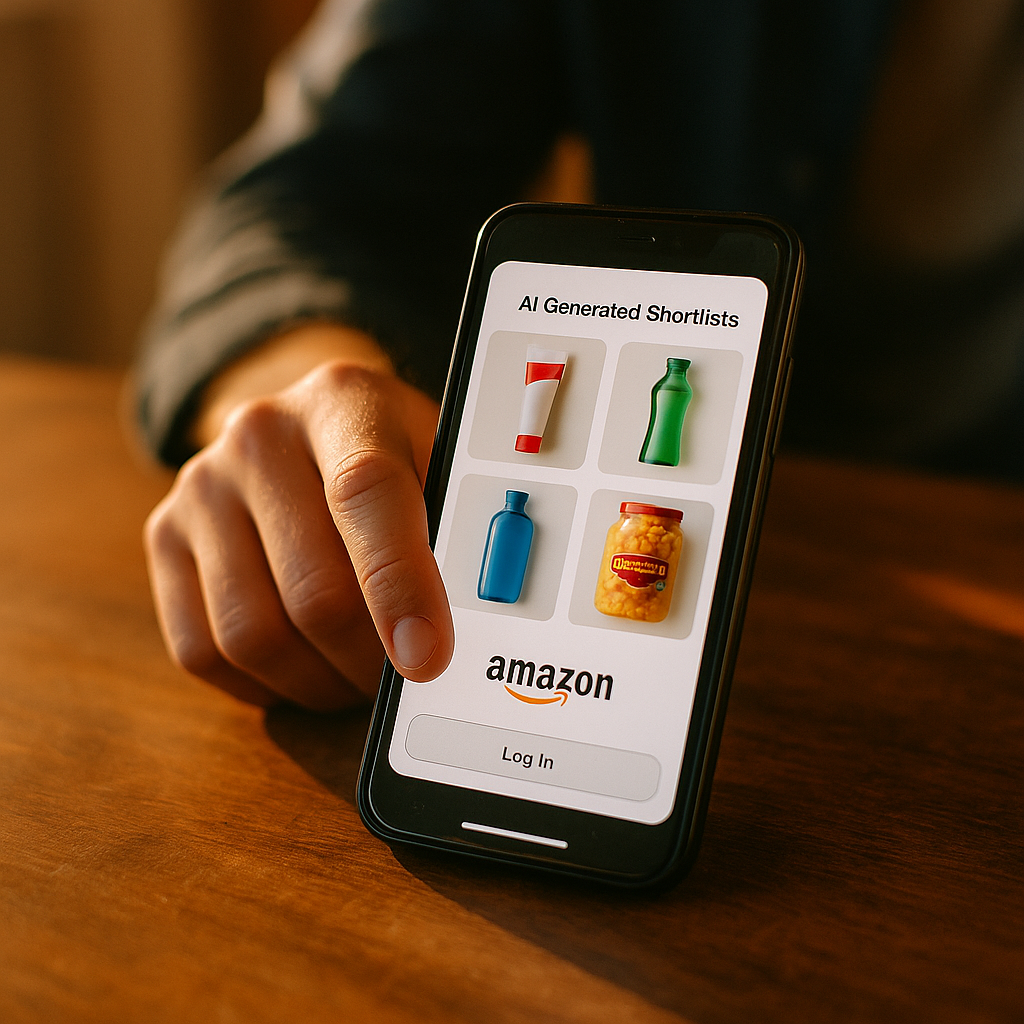
Here’s an uncomfortable number: a growing share of purchase research now ends inside an AI answer, with zero clicks back to any brand’s website. By the time a prospect types a follow up question into ChatGPT or Perplexity, three or four brands have already been silently shortlisted. Yours is either on that list or it doesn’t exist. AI generated shortlists are quietly replacing the search results page as the place where buying decisions start, and most marketing teams haven’t noticed the shift yet.
The Shortlist Already Happened
Think about the last time you asked an AI assistant for “best project management tools for a 50 person team” or “top skincare brands for sensitive skin.” You got three to five names, a short rationale for each, and maybe a nudge toward one favorite. No ten blue links. No scrolling. No comparison shopping across eight open tabs.
That’s the new default. Research from eMarketer has repeatedly flagged the rise of zero click behavior as consumers lean on generative answers instead of traditional search. The buyer isn’t browsing anymore. They’re accepting a pre-filtered list and moving straight to a decision.
If an AI model doesn’t mention your brand in its first answer, you don’t get a second chance in that conversation. There’s no page two to climb.
This is a fundamentally different battlefield than keyword rankings. It’s not about who optimizes a landing page best anymore. It’s about who the model trusts enough to recommend without being asked twice. We’ve covered how zero click search forces creator content to work harder just to get cited at all, and shortlists are the sharpest expression of that pressure.
How Do AI Models Actually Build a Shortlist?
Large language models don’t “choose” brands the way a human editor does. They predict the most statistically probable, contextually relevant answer based on patterns learned during training and, increasingly, on live retrieval from the web. Three forces shape who makes the cut:
- Training data saturation: brands mentioned frequently and consistently across reputable sources during the model’s training window get baked in as “known good” answers.
- Retrieval augmented grounding: tools like ChatGPT with browsing, Perplexity, and Google’s AI Overviews pull live content to supplement or verify what the model already “knows.” This is where retrieval augmented generation grounds AI copy in whatever source material it can find and trust in real time.
- Entity confidence: the model needs to be sure your brand name maps cleanly to one specific company, product, or service, not a vague cluster of similar-sounding competitors.
Miss any one of these and you’re invisible, even if your product is objectively better than whoever made the list. That’s not fair. It’s also not going anywhere.
Entity Clarity Beats Keyword Density
Old school SEO rewarded brands that repeated a phrase enough times to rank. AI shortlisting rewards clarity about what you are, who you serve, and why you’re credible. A brand with messy, contradictory descriptions across its site, directories, and press mentions confuses the model’s entity resolution. A brand with a clean, consistent, well-structured identity gets recommended with confidence.
This is exactly why entity schema markup helps AI engines trust content enough to cite it, and why so many teams are now auditing their brand knowledge graph the way they once audited backlink profiles.
The New Metric: Share of Model, Not Share of Voice
Marketing teams have measured share of voice for decades: mentions, impressions, sentiment. That metric is going stale. What matters now is share of model, how often your brand surfaces as a named answer when someone asks an AI assistant a buying question in your category.
A handful of platforms have started tracking this directly. Tools reviewed in our breakdown of Semrush, XFunnel, and Ortto for AI mention accuracy show wildly different results depending on how a brand structures its content and how often third parties validate its claims. The takeaway for brand leaders: you cannot improve what you don’t measure, and most teams still aren’t measuring their presence inside AI answers at all.
Ask yourself right now: if a prospect asked ChatGPT to recommend three vendors in your category today, would your name come up? If you don’t know the answer, that’s the first gap to close.
Why Compliance and Brand Safety Can’t Sit This One Out
Here’s where it gets risky. AI models hallucinate. They sometimes attach the wrong pricing, outdated claims, or even a competitor’s feature set to your brand name inside a shortlist answer. Nobody from your legal or compliance team reviewed that output before it reached a buyer. Our piece on AI hallucination risk putting brand citations under audit lays out how often this happens and why brands are starting to treat AI answer monitoring as a compliance function, not just a marketing nice to have.
There’s also a subtler risk: bias in how AI tools discover and recommend creators or vendors in the first place. If you’re running influencer programs, the matching layer that recommends talent to brands (or brands to buyers) deserves scrutiny. We’ve examined this in AI creator discovery and the bias questions it raises, and the same logic applies in reverse when AI tools are recommending brands to consumers.
An AI shortlist with an error in it isn’t a minor SEO glitch. It’s a false claim reaching a buyer at the exact moment they’re deciding who to trust, with your brand’s name attached.
GEO Isn’t Optional Anymore, It’s a Budget Line
Generative engine optimization (GEO) has moved from “interesting experiment” to “line item finance expects you to justify.” The confusion between AEO and GEO has already wasted budget at plenty of organizations that treated the two as interchangeable. They’re not. Answer engine optimization is about structuring content to answer specific questions well. GEO is broader: it’s the entire discipline of making your brand legible, trustworthy, and citable to generative systems across the board.
If you’re trying to get budget approved, don’t pitch it as an SEO refresh. Pitch it with numbers finance actually trusts, the kind laid out in a solid GEO budget framework: projected share of model gains, competitive gap analysis, and risk cost avoided from hallucinated citations. CFOs respond to downside protection as much as upside opportunity.
And if you’re selling into other businesses, this matters even more urgently. Procurement teams are increasingly running their vendor research through AI tools before a single RFP goes out. We’ve documented how zero click procurement forces B2B brands into AI answers, which means your sales team might be losing deals to a shortlist they never knew existed.
Ownership Gaps Are the Silent Killer
One of the most common failure points isn’t bad content. It’s no one owning the problem. Marketing assumes IT handles schema. IT assumes marketing handles brand narrative. Legal assumes nobody’s monitoring AI output because it’s “not a real channel yet.” Meanwhile, GEO ownership gaps leave brands invisible in exactly the answers that matter most.
Assign this now. Someone on your team needs explicit responsibility for monitoring and improving how AI systems describe your brand. It doesn’t need to be a new hire. It needs to be a named owner with a recurring cadence, not a quarterly afterthought.
What Brands Can Actually Do About It
You can’t bribe an algorithm the way you once could buy a top search ad slot. But you can influence the inputs that shape AI confidence in your brand. A few concrete moves:
- Audit your entity salience. Run regular checks to confirm AI tools can identify your brand accurately and consistently. Our guide to entity salience audits walks through how to do this without expensive tooling.
- Strengthen third party validation. Models weight independent mentions heavily. Reviews, press coverage, and creator UGC that gets cited in AI answers carry more weight than brand-owned claims. This is the logic behind turning creator UGC into AI proof.
- Fix structural signals. Schema markup, consistent NAP (name, address, phone) data, and a clean knowledge graph presence all reduce the model’s uncertainty about who you are.
- Monitor, don’t assume. Set a monthly cadence to check how major AI tools describe your category and whether you’re in the answer at all.
- Treat hallucinations as incidents. Build a lightweight escalation process for when AI tools misstate facts about your brand, the same way you’d handle a factual error in press coverage.
None of this is glamorous. It’s closer to technical hygiene than brand storytelling. But hygiene is what gets you on the list before the pitch even starts.
FAQs
What is an AI generated shortlist in marketing terms?
It’s the small set of brands, usually three to five, that an AI assistant like ChatGPT, Gemini, or Perplexity recommends in response to a buying question, without the user clicking through to search results first.
How is this different from traditional SEO ranking?
Traditional SEO competes for position on a results page the user actively scans. AI shortlisting is a single generated answer the user is far more likely to accept at face value, with no visible competitors to compare against.
Can brands pay to appear on an AI shortlist?
Not directly, at least not yet. Appearance depends on training data patterns, live retrieval signals, and entity confidence rather than a paid placement system, though that could evolve as platforms monetize AI answers.
How often should a brand check its AI shortlist presence?
Monthly is a reasonable baseline for most categories, with more frequent checks around product launches, rebrands, or known periods of heavy AI tool updates.
What’s the biggest risk of ignoring AI shortlisting?
Becoming invisible to a growing share of buyers who never reach your website, combined with the risk of AI tools misrepresenting your brand without anyone catching it in time.
Visible FAQ Block
(Duplicate FAQ content rendered below as structured data for search engines.)
Pick one category question your buyers are likely asking an AI tool right now, run it across ChatGPT, Gemini, and Perplexity, and see whether your brand shows up. If it doesn’t, that’s your first GEO ticket, not a someday project.
Top Influencer Marketing Agencies
The leading agencies shaping influencer marketing in 2026
Agencies ranked by campaign performance, client diversity, platform expertise, proven ROI, industry recognition, and client satisfaction. Assessed through verified case studies, reviews, and industry consultations.
Moburst

-
2

The Shelf
Boutique Beauty & Lifestyle Influencer AgencyA data-driven boutique agency specializing exclusively in beauty, wellness, and lifestyle influencer campaigns on Instagram and TikTok. Best for brands already focused on the beauty/personal care space that need curated, aesthetic-driven content.Clients: Pepsi, The Honest Company, Hims, Elf Cosmetics, Pure LeafVisit The Shelf → -
3

Audiencly
Niche Gaming & Esports Influencer AgencyA specialized agency focused exclusively on gaming and esports creators on YouTube, Twitch, and TikTok. Ideal if your campaign is 100% gaming-focused — from game launches to hardware and esports events.Clients: Epic Games, NordVPN, Ubisoft, Wargaming, Tencent GamesVisit Audiencly → -
4

Viral Nation
Global Influencer Marketing & Talent AgencyA dual talent management and marketing agency with proprietary brand safety tools and a global creator network spanning nano-influencers to celebrities across all major platforms.Clients: Meta, Activision Blizzard, Energizer, Aston Martin, WalmartVisit Viral Nation → -
5

The Influencer Marketing Factory
TikTok, Instagram & YouTube CampaignsA full-service agency with strong TikTok expertise, offering end-to-end campaign management from influencer discovery through performance reporting with a focus on platform-native content.Clients: Google, Snapchat, Universal Music, Bumble, YelpVisit TIMF → -
6

NeoReach
Enterprise Analytics & Influencer CampaignsAn enterprise-focused agency combining managed campaigns with a powerful self-service data platform for influencer search, audience analytics, and attribution modeling.Clients: Amazon, Airbnb, Netflix, Honda, The New York TimesVisit NeoReach → -
7

Ubiquitous
Creator-First Marketing PlatformA tech-driven platform combining self-service tools with managed campaign options, emphasizing speed and scalability for brands managing multiple influencer relationships.Clients: Lyft, Disney, Target, American Eagle, NetflixVisit Ubiquitous → -
8

Obviously
Scalable Enterprise Influencer CampaignsA tech-enabled agency built for high-volume campaigns, coordinating hundreds of creators simultaneously with end-to-end logistics, content rights management, and product seeding.Clients: Google, Ulta Beauty, Converse, AmazonVisit Obviously →