


Only 12% of brands know whether ChatGPT, Gemini, or Perplexity mention them accurately, let alone favorably. That gap is why Generative Engine Optimization audits are becoming as routine as a quarterly SEO review. If you can’t score your visibility inside AI answers, you can’t defend the budget protecting it.
Why “We’re Not Ranking” No Longer Means What It Used To
For two decades, brand visibility meant blue links. Now a growing share of research, comparison shopping, and even B2B procurement happens entirely inside AI chat interfaces, with zero clicks back to a website. Zero click search isn’t a side effect of AI adoption, it’s the default behavior for a huge segment of users.
That shift breaks traditional measurement. Google Search Console tells you nothing about whether Claude cited your product in a “best project management tools” answer. Rank trackers don’t capture whether an AI engine described your brand accurately or borrowed outdated pricing from a three-year-old blog post. Marketers need a new instrument panel, and a structured audit is it.
If your brand can’t be measured inside AI answers, it effectively doesn’t exist to the growing share of buyers who never click through to a website.
What a GEO Audit Actually Measures
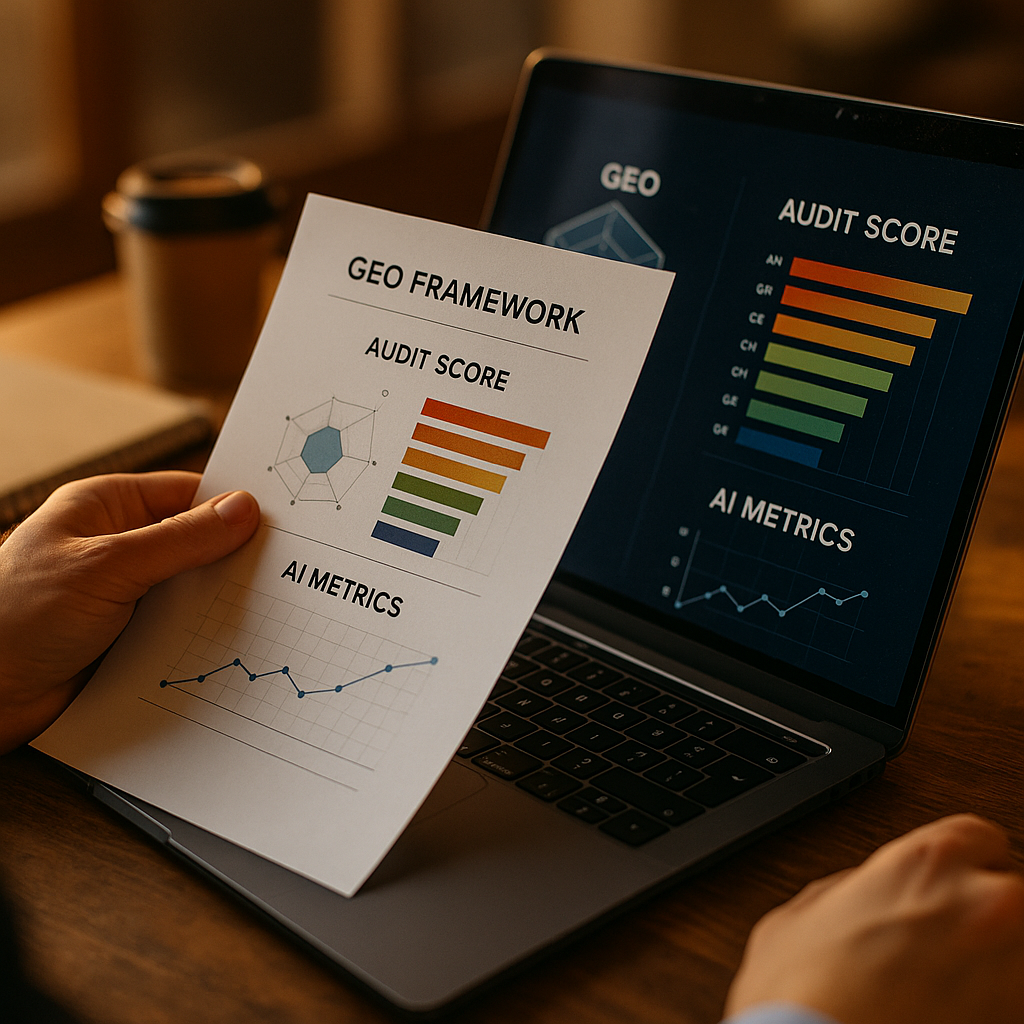
A generative engine optimization audit isn’t a vague “check if we show up in ChatGPT” exercise. It’s a repeatable process that scores brand presence across multiple AI surfaces using consistent criteria, so results are comparable month over month, platform to platform. Done right, it produces a single composite score plus diagnostic sub scores that point directly to fixable problems.
Think of it as the AI era equivalent of a technical SEO audit, except instead of crawling pages for broken links, you’re querying engines for broken perception.
The Six Dimensions Worth Scoring
Most mature GEO audit frameworks converge on six measurable dimensions. Weight them based on your category and buying journey, but don’t skip any.
- Citation frequency: How often does your brand appear in response to category-relevant prompts, across a standardized query set of 50 to 100 prompts?
- Entity clarity: Does the engine describe your brand, products, and positioning correctly, or does it conflate you with a competitor?
- Source authority alignment: Which sources is the engine pulling from when it mentions you, and are those sources ones you actually control or influence?
- Sentiment accuracy: Is the tone of AI generated mentions neutral, positive, or subtly negative, and does it match your actual market reputation?
- Answer completeness: When you’re cited, are key details (pricing, features, differentiators) included or omitted in ways that undersell you?
- Schema and structured data health: Is your site feeding machine readable signals that make it easy for engines to parse and trust your claims?
Each dimension gets scored 0 to 100, then weighted into a composite brand visibility score. A B2B SaaS company might weight source authority and answer completeness heavily, because procurement teams quote AI answers directly in vendor shortlists. A DTC brand might weight sentiment and citation frequency, because discovery happens earlier in the funnel.
Building the Scoring Rubric Step by Step
Here’s where most teams get it wrong: they try to score AI visibility with a single number pulled from one tool, once. That’s not an audit, that’s a snapshot, and snapshots mislead.
- Define the prompt universe. Pull real queries from customer support tickets, sales call transcripts, and keyword research. Include comparison prompts (“X vs Y”), problem based prompts (“best tool for…”), and direct brand prompts.
- Query across engines, not just one. ChatGPT, Gemini, Perplexity, and Copilot all pull from different retrieval layers and weight sources differently. A brand that scores well on Perplexity can be invisible on Gemini. Perplexity’s citation behavior in particular rewards quotable, structured content over generic marketing copy, which changes what “winning” looks like there.
- Score each response against the six dimensions. Use a consistent rubric so a junior analyst and a senior strategist produce comparable scores. Document disagreements, they usually reveal ambiguity worth fixing in your source content.
- Weight dimensions by business priority. There’s no universal formula here. A category with high purchase risk (enterprise software, financial products) should weight accuracy and completeness above raw frequency.
- Benchmark against named competitors. A score of 68 means nothing in isolation. A score of 68 against a category leader’s 41 is a very different story than 68 against an 89.
This is the same discipline that underpins entity salience audits, which focus specifically on whether AI engines recognize your brand as a distinct, well-defined entity at all before worrying about sentiment or completeness. Salience is the floor. Everything else is optimization on top of it.
Tooling: What’s Actually Usable Right Now
The GEO tooling market is maturing fast but unevenly. Some platforms built for traditional rank tracking have bolted on AI monitoring features with mixed accuracy. Independent testing comparing Semrush, XFunnel, and Ortto for AI mention accuracy found meaningful variance in how reliably each tool captured and attributed citations, which matters if you’re reporting these numbers to finance or the C-suite.
Whatever stack you choose, cross-check automated scores against manual spot checks at least monthly. Automated tools are good at scale, less good at nuance, and nuance is exactly where sentiment and entity clarity problems hide.
Where Scores Break Down (And Why It’s Usually Not a Content Problem)
When a brand scores poorly, the instinct is to write more content. That’s often the wrong fix. In practice, low scores trace back to three root causes more often than thin content.
First, structured data gaps. If your product specs, pricing, and company facts aren’t encoded in schema markup, AI crawlers have to infer them from unstructured text, and inference introduces errors. Entity schema markup gives engines a verified, structured source to pull from instead of guessing.
Second, knowledge graph inconsistency. If Wikidata, Crunchbase, and your own site disagree on founding date, headquarters, or leadership, engines default to whichever source has the strongest authority signal, which may not be you. Knowledge graph validation closes those gaps before they calcify into bad citations.
Third, outright hallucination. Sometimes the engine simply fabricates a claim, a feature, a stat, a quote, that was never true. This is the scariest failure mode because it’s invisible until a customer calls to ask why your product doesn’t do the thing ChatGPT said it does. Ongoing hallucination risk monitoring needs to be a permanent line item in your audit cadence, not a one time cleanup project.
Most AI visibility problems aren’t content gaps, they’re trust gaps: the engine doesn’t have a clean, authoritative signal to cite, so it improvises.
Turning Scores Into a Budget Conversation
A scoring framework is only useful if it changes decisions. Once you have a baseline composite score, map it against spend categories: content production, digital PR, schema implementation, creator seeding. Low scores in source authority alignment usually point to a digital PR and backlink problem, not a copywriting problem. Low scores in sentiment accuracy might trace back to unaddressed review site complaints the engine is surfacing as context.
This connects directly to budget defense. If finance asks why GEO needs its own line item separate from traditional SEO, the audit score trend is your evidence. A GEO budget framework built on these scores turns an abstract “AI visibility” ask into a number finance can track quarter over quarter, same as any other channel.
It also helps clarify a confusion that trips up a lot of teams: GEO and answer engine optimization aren’t quite the same discipline, and conflating them wastes budget on the wrong fixes. The AEO vs GEO distinction matters when you’re deciding whether to invest in structured answer formatting versus broader entity authority building.
Creator Content Has a Role Here Too
Don’t overlook earned creator content as a GEO lever. AI engines increasingly weight third party, user generated content when it’s specific, structured, and widely corroborated across platforms. Creator UGC functioning as AI proof is one of the most underused tactics in a GEO strategy, largely because it sits organizationally between the influencer team and the SEO team, and nobody owns the handoff.
That ownership gap is worth naming directly, because it’s the single most common reason audits produce insights nobody acts on. Research into GEO ownership gaps consistently finds that brands with clear accountability for AI visibility outperform those where it’s “everyone’s job,” which in practice means nobody’s.
For additional context on how AI retrieval systems ground their answers in source material, it’s worth understanding retrieval augmented generation at a technical level, since that’s the mechanism most of these audits are ultimately trying to influence.
Industry data backs the urgency here. eMarketer’s research on AI search adoption shows generative engines capturing a growing share of informational queries each year, while Statista’s consumer survey data indicates trust in AI generated answers is rising fastest among younger, high intent buyers. Meanwhile, guidance from Google’s Search Central documentation continues to emphasize structured, verifiable content as the baseline for any kind of machine readable trust, generative or otherwise. If you need a primer on building that operational discipline from scratch, HubSpot’s content strategy resources remain a solid starting point for the content hygiene work underneath any GEO program.
FAQs
What is a Generative Engine Optimization audit?
It’s a structured evaluation of how AI engines like ChatGPT, Gemini, and Perplexity represent a brand in their answers, scored across dimensions like citation frequency, accuracy, and sentiment rather than traditional search rankings.
How often should a brand run a GEO audit?
Monthly for a lightweight check and quarterly for a full scoring exercise is a reasonable cadence, since AI engines update their retrieval sources and model versions frequently enough that scores can shift between cycles.
What’s a good GEO visibility score?
There’s no universal benchmark since scoring rubrics vary by team, but the number that matters most is your score relative to named competitors in the same prompt set, tracked over time rather than in isolation.
Can existing SEO tools handle GEO scoring?
Some can with added modules, but accuracy varies significantly by platform, so most teams benefit from cross-checking automated tool output against manual prompt testing before reporting numbers internally.
Who should own the GEO audit process inside a marketing team?
It works best as a shared function between SEO and brand or PR, with a single named owner accountable for the score, since split ownership is the most common reason audit findings never turn into action.
Next step: Run your first six dimension audit this quarter using a 50 prompt test set, benchmark it against two named competitors, and assign one owner to act on the lowest scoring dimension before you add a single new content asset.
FAQs
What is a Generative Engine Optimization audit?
It’s a structured evaluation of how AI engines like ChatGPT, Gemini, and Perplexity represent a brand in their answers, scored across dimensions like citation frequency, accuracy, and sentiment rather than traditional search rankings.
How often should a brand run a GEO audit?
Monthly for a lightweight check and quarterly for a full scoring exercise is a reasonable cadence, since AI engines update their retrieval sources and model versions frequently enough that scores can shift between cycles.
What’s a good GEO visibility score?
There’s no universal benchmark since scoring rubrics vary by team, but the number that matters most is your score relative to named competitors in the same prompt set, tracked over time rather than in isolation.
Can existing SEO tools handle GEO scoring?
Some can with added modules, but accuracy varies significantly by platform, so most teams benefit from cross-checking automated tool output against manual prompt testing before reporting numbers internally.
Who should own the GEO audit process inside a marketing team?
It works best as a shared function between SEO and brand or PR, with a single named owner accountable for the score, since split ownership is the most common reason audit findings never turn into action.
Top Influencer Marketing Agencies
The leading agencies shaping influencer marketing in 2026
Agencies ranked by campaign performance, client diversity, platform expertise, proven ROI, industry recognition, and client satisfaction. Assessed through verified case studies, reviews, and industry consultations.
Moburst

-
2

The Shelf
Boutique Beauty & Lifestyle Influencer AgencyA data-driven boutique agency specializing exclusively in beauty, wellness, and lifestyle influencer campaigns on Instagram and TikTok. Best for brands already focused on the beauty/personal care space that need curated, aesthetic-driven content.Clients: Pepsi, The Honest Company, Hims, Elf Cosmetics, Pure LeafVisit The Shelf → -
3

Audiencly
Niche Gaming & Esports Influencer AgencyA specialized agency focused exclusively on gaming and esports creators on YouTube, Twitch, and TikTok. Ideal if your campaign is 100% gaming-focused — from game launches to hardware and esports events.Clients: Epic Games, NordVPN, Ubisoft, Wargaming, Tencent GamesVisit Audiencly → -
4

Viral Nation
Global Influencer Marketing & Talent AgencyA dual talent management and marketing agency with proprietary brand safety tools and a global creator network spanning nano-influencers to celebrities across all major platforms.Clients: Meta, Activision Blizzard, Energizer, Aston Martin, WalmartVisit Viral Nation → -
5

The Influencer Marketing Factory
TikTok, Instagram & YouTube CampaignsA full-service agency with strong TikTok expertise, offering end-to-end campaign management from influencer discovery through performance reporting with a focus on platform-native content.Clients: Google, Snapchat, Universal Music, Bumble, YelpVisit TIMF → -
6

NeoReach
Enterprise Analytics & Influencer CampaignsAn enterprise-focused agency combining managed campaigns with a powerful self-service data platform for influencer search, audience analytics, and attribution modeling.Clients: Amazon, Airbnb, Netflix, Honda, The New York TimesVisit NeoReach → -
7

Ubiquitous
Creator-First Marketing PlatformA tech-driven platform combining self-service tools with managed campaign options, emphasizing speed and scalability for brands managing multiple influencer relationships.Clients: Lyft, Disney, Target, American Eagle, NetflixVisit Ubiquitous → -
8

Obviously
Scalable Enterprise Influencer CampaignsA tech-enabled agency built for high-volume campaigns, coordinating hundreds of creators simultaneously with end-to-end logistics, content rights management, and product seeding.Clients: Google, Ulta Beauty, Converse, AmazonVisit Obviously →