


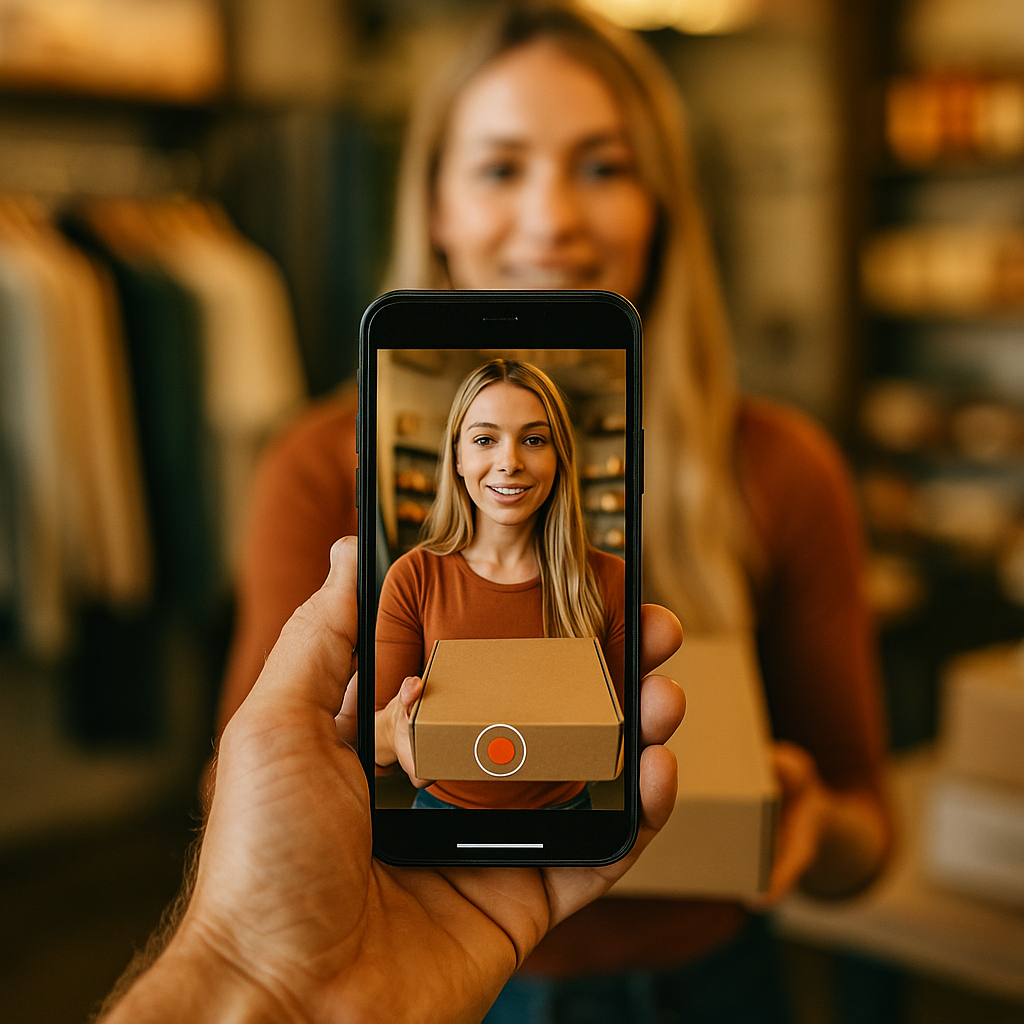
Ads interrupt. Stories invite. A 2024 Sprout Social analysis found that consumers are 2.4 times more likely to trust content that feels personal over content that feels promotional, and nothing feels more personal than seeing the world through someone else’s eyes. That’s the entire premise behind POV storytelling scripts: creator content shot and written so the viewer isn’t watching a pitch, they’re living a moment. For brands drowning in ad fatigue, that shift from spectator to participant is the difference between a skip and a save.
What Makes a POV Script Different From Standard UGC
Most creator briefs ask for a talking head holding a product, smiling into a ring light, reciting three benefits. That’s fine. It’s also forgettable. A POV script flips the camera (literally and narratively) so the audience occupies the creator’s perspective instead of watching them from the outside.
Think “you just opened the package” instead of “I’m opening the package.” Think “your hands are shaking before the interview” instead of “here’s a product for interview nerves.” The grammar shift sounds small. It isn’t. Second person framing activates mirror neurons in a way third person narration simply doesn’t, which is why first person framing in POV ads consistently outperforms standard UGC on cost per acquisition in paid testing.
The format isn’t new to entertainment (found footage horror has used it for decades) but it’s relatively new as a disciplined, repeatable brief for brand content. That discipline matters, because without a script structure, “POV” devolves into a shaky camera gimmick with no narrative payoff.
The Empathy Mechanism: Why First Person Framing Works
Empathy isn’t a soft metric marketers can afford to ignore anymore. It’s measurable in watch time, comment sentiment, and ultimately conversion. When a viewer sees a scenario unfold from the inside (nervous hands, a racing thought, a relieved exhale) their brain doesn’t process it as an advertisement. It processes it as a memory being formed in real time.
Content shot in true POV framing generates meaningfully higher completion rates than third person creator videos covering the identical script, because the viewer has no visual “exit” from the character’s perspective.
That’s not a minor edge. In a feed where the average scroll decision happens in under two seconds, anything that extends watch time by even half a beat compounds across thousands of impressions. Platforms reward that retention with distribution. Advertisers reward it with lower CPMs. Everyone wins except the competitor still shooting static product shots on a kitchen counter.
There’s a risk side too, and it’s worth naming early. POV only builds empathy when the scenario is believable. A faked crisis or manufactured vulnerability reads as manipulative fast, and audiences are sharper at spotting that than most brand teams assume. The FTC’s endorsement guidance also treats emotionally manipulative, undisclosed dramatizations as a disclosure risk, not just a brand reputation one.
Anatomy of a POV Storytelling Script
A workable POV script has five components. Skip one and the format collapses into a gimmick.
- The anchor emotion. Pick one feeling the viewer should walk away with (relief, curiosity, validation, mild panic resolved). Scripts chasing two emotions at once dilute both.
- The sensory detail. POV lives or dies on specificity. “You reach for your phone” is weak. “Your thumb hovers over the decline button, then you see the price drop notification” is strong.
- The silent beat. Every strong POV script has at least one pause where nothing is said, just shown. This is where empathy actually lands, not during the narration.
- The product moment, undramatized. The product should appear the way it would in real life, not with a spotlight cue. Over-staging breaks the illusion instantly.
- The resolution cut. POV scripts need a clean exit, usually a smash cut or a text overlay, rather than a trailing fade that lets the spell wear off.
Pair this structure with a sound strategy. Dialogue-light POV content often performs best with ambient audio and minimal voiceover, which overlaps with lessons from sound-only demo testing: the audio layer carries more emotional weight than most briefs account for.
Scripting Without Sounding Scripted
Here’s the paradox every brand manager runs into: the whole appeal of POV is that it feels unscripted, but you still need a script to brief creators and get usable deliverables across a roster of ten or fifty creators. The fix isn’t abandoning the script. It’s changing what the script specifies.
Instead of dialogue lines, write scene directions. Instead of “say this,” write “feel this, then react.” Give creators the emotional beat and the sensory detail, then let their natural phrasing fill the gaps. Creators who’ve built an audience know their own cadence better than any brief writer does, and forcing verbatim lines into a POV format is the fastest way to make it look fake.
This is also where text over b-roll techniques come in handy as a hybrid. A short POV sequence paired with minimal on-screen text can carry narrative context without forcing a creator to narrate over their own immersive footage, which often breaks the first person illusion.
Where POV Scripts Earn Their Keep in the Funnel
POV isn’t a top-of-funnel-only or bottom-of-funnel-only format. It flexes, but the script needs to change with the funnel stage, a principle covered in more depth in funnel stage content mapping.
At awareness stage, POV scripts work best built around a relatable problem moment, no product visible until the final two seconds. At consideration stage, the product enters earlier and the empathy hook centers on a decision point (“you’re comparing two options”). At conversion stage, POV scripts shift toward unboxing or first-use moments, which is also where the POV camera angle lifts add-to-cart rate most reliably, because the viewer is essentially rehearsing their own purchase before they’ve made it.
Don’t run the same POV script across every funnel stage and expect uniform performance. That’s one of the most common briefing mistakes brand teams make when they first adopt the format: treating “POV” as a style rather than a stage-specific narrative tool.
Compliance Doesn’t Disappear Just Because the Camera Angle Changed
POV content has a disclosure wrinkle that flat UGC doesn’t. Because the viewer is positioned as the protagonist, some brands get tempted to skip the “this is sponsored” framing on the theory that it breaks immersion. Resist that temptation. It breaks the law instead.
Disclosure requirements don’t soften because the content is immersive. If anything, regulators scrutinize emotionally persuasive formats more closely, not less.
The workaround most compliant teams use is building disclosure into the hook itself rather than treating it as a bolt-on caption, a technique detailed in transformation reveal scripts with built-in disclosure. A text overlay in the first two seconds (“ad” or “partner”) doesn’t meaningfully reduce empathy if it’s designed in from the start rather than stapled on in post. Review the FTC endorsement guide before scaling any immersive format across a creator roster, because enforcement has only gotten more active, not less.
Production Reality: What This Actually Costs
POV content has a reputation for being cheap because it looks raw. That reputation is half true. Shooting POV doesn’t require a studio, but it does require more takes than standard UGC, because small framing errors (a visible hand, a reflection, an off-angle shot) break the illusion completely. Budget for roughly 20 to 30 percent more shoot time than you would for a standard talking head UGC brief.
Editing is lighter, though. POV footage often needs fewer cuts and less graphic overlay work than polished brand video, which is part of why tools built for fast turnaround, like the workflow outlined in CapCut AI editing stacks, pair well with POV briefs. Less editing overhead means faster iteration, and faster iteration means you can test more emotional hooks per week.
According to eMarketer, creator content budgets continue shifting away from single hero assets toward higher-volume, faster-turnaround formats, a trend POV scripting is well suited to ride given its lower post-production demands.
Measuring Empathy Without Guessing
You can’t put “empathy” in a dashboard column, but you can proxy it. Watch time past the three-second mark, completion rate, and comment sentiment (not just comment volume) are the three signals most teams track when testing POV against standard UGC. If comments start including personal anecdotes (“this happened to me too”), that’s a stronger empathy signal than a like count will ever give you.
Platforms themselves are nudging toward this kind of measurement. Meta’s ad tools and TikTok’s ad platform both now surface retention curves at a granular level, which makes it straightforward to pinpoint exactly where a POV script loses the viewer, and iterate the script rather than reshooting blind.
FAQs
What is a POV storytelling script in creator marketing?
It’s a content brief written in second person perspective, directing a creator to film from inside a scenario rather than narrating about it, so the viewer experiences the moment as if it were happening to them.
How is POV content different from regular UGC?
Standard UGC shows a creator talking about a product from the outside. POV content places the camera and narrative inside the creator’s perspective, which tends to generate stronger empathy and retention because the viewer has no visual separation from the character.
Do POV scripts still need FTC disclosure?
Yes. Disclosure requirements apply regardless of camera angle or narrative style. The most effective approach builds the disclosure into the opening hook rather than adding it as an afterthought caption.
Where do POV scripts work best in the marketing funnel?
They flex across every stage if the script adapts. Awareness stage POV should focus on a relatable problem with minimal product visibility, while conversion stage POV should center on unboxing or first-use moments that mirror the viewer’s own imagined purchase.
Is POV content more expensive to produce than standard UGC?
Shoot time typically runs higher because framing errors require more takes, but editing time is often lower since POV footage needs fewer cuts and less graphic overlay, which balances the overall production cost.
Start small: brief one creator on a single POV scenario, test it against your best-performing standard UGC asset, and compare completion rate before scaling the format across your roster.
Top Influencer Marketing Agencies
The leading agencies shaping influencer marketing in 2026
Agencies ranked by campaign performance, client diversity, platform expertise, proven ROI, industry recognition, and client satisfaction. Assessed through verified case studies, reviews, and industry consultations.
Moburst

-
2

The Shelf
Boutique Beauty & Lifestyle Influencer AgencyA data-driven boutique agency specializing exclusively in beauty, wellness, and lifestyle influencer campaigns on Instagram and TikTok. Best for brands already focused on the beauty/personal care space that need curated, aesthetic-driven content.Clients: Pepsi, The Honest Company, Hims, Elf Cosmetics, Pure LeafVisit The Shelf → -
3

Audiencly
Niche Gaming & Esports Influencer AgencyA specialized agency focused exclusively on gaming and esports creators on YouTube, Twitch, and TikTok. Ideal if your campaign is 100% gaming-focused — from game launches to hardware and esports events.Clients: Epic Games, NordVPN, Ubisoft, Wargaming, Tencent GamesVisit Audiencly → -
4

Viral Nation
Global Influencer Marketing & Talent AgencyA dual talent management and marketing agency with proprietary brand safety tools and a global creator network spanning nano-influencers to celebrities across all major platforms.Clients: Meta, Activision Blizzard, Energizer, Aston Martin, WalmartVisit Viral Nation → -
5

The Influencer Marketing Factory
TikTok, Instagram & YouTube CampaignsA full-service agency with strong TikTok expertise, offering end-to-end campaign management from influencer discovery through performance reporting with a focus on platform-native content.Clients: Google, Snapchat, Universal Music, Bumble, YelpVisit TIMF → -
6

NeoReach
Enterprise Analytics & Influencer CampaignsAn enterprise-focused agency combining managed campaigns with a powerful self-service data platform for influencer search, audience analytics, and attribution modeling.Clients: Amazon, Airbnb, Netflix, Honda, The New York TimesVisit NeoReach → -
7

Ubiquitous
Creator-First Marketing PlatformA tech-driven platform combining self-service tools with managed campaign options, emphasizing speed and scalability for brands managing multiple influencer relationships.Clients: Lyft, Disney, Target, American Eagle, NetflixVisit Ubiquitous → -
8

Obviously
Scalable Enterprise Influencer CampaignsA tech-enabled agency built for high-volume campaigns, coordinating hundreds of creators simultaneously with end-to-end logistics, content rights management, and product seeding.Clients: Google, Ulta Beauty, Converse, AmazonVisit Obviously →