


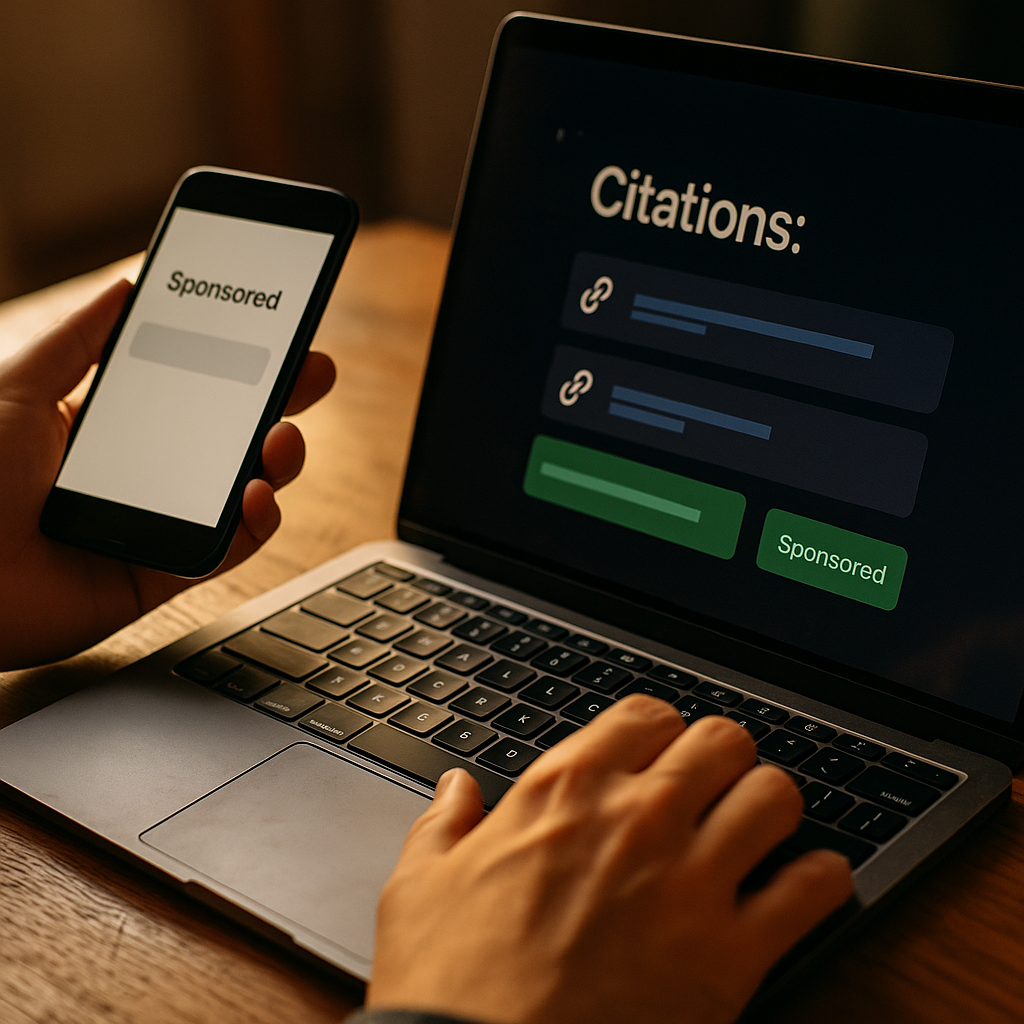
Ask ChatGPT or Perplexity for a product recommendation today, and there’s a decent chance the answer traces back to a sponsored creator post, minus the #ad tag that made it legal in the first place. That’s the quiet crisis hiding inside AI answer engine citations: the disclosure that satisfied the FTC on Instagram or TikTok often never makes it into the summarized answer a user actually reads.
The Citation Blind Spot: When Chatbots Skip the Disclosure
Here’s the mechanics problem nobody flagged early enough. A creator posts a paid review, discloses properly in the caption, maybe even says “sponsored” out loud in the video. Then an AI answer engine crawls that content, extracts the claim, and serves it inside a conversational response as if it were neutral editorial opinion. The disclosure lives on the original post. It does not travel with the citation.
This matters because answer engines like ChatGPT Search, Perplexity, and Google’s AI Overviews are increasingly the first touchpoint for product research, not the tenth. eMarketer’s research on AI search adoption shows a meaningful share of consumers now skip traditional search results entirely in favor of a single synthesized answer. If that answer is built from sponsored content stripped of its disclosure, the brand behind the original post inherits a compliance gap it didn’t create but absolutely owns.
A disclosure that only exists in the source post and not in the AI-generated summary isn’t a disclosure anymore. It’s a technicality the FTC has already shown it won’t accept.
Why This Isn’t a Theoretical Risk Anymore
Brands love to treat emerging-channel compliance as “wait and see.” That posture doesn’t survive contact with how fast answer engines are scaling. Industry estimates from Statista’s AI search usage data point to double-digit monthly growth in chat-based search sessions, and commerce queries (best, top, vs, review) are exactly the category these tools handle most confidently. Those are also the queries most likely to surface sponsored creator content as a source.
Think about what that means operationally. A single piece of creator content can now be seen in at least four contexts: the native platform post, a repurposed ad unit, a syndicated UGC placement, and an AI-generated summary pulled by a third-party crawler you don’t control. We’ve already covered how repurposing creates liability in UGC rights and paid media reuse, but AI citation adds a layer nobody signed a contract for: a machine deciding which three sentences of your campaign represent the whole truth.
The FTC Hasn’t Carved Out an AI Exception
Let’s be clear about something: the Federal Trade Commission has never said disclosure rules pause when a large language model is doing the reading. The FTC’s Endorsement Guides require that material connections be clear and conspicuous to the consumer, full stop. It doesn’t matter whether that consumer encountered the endorsement on a feed, a search result, or a chatbot reply. If the connection isn’t disclosed in whatever format the audience actually sees, the brand is exposed.
This isn’t a new legal theory, either. The agency’s recent enforcement posture, detailed in our breakdown of the FTC endorsement sweep, shows regulators willing to pursue brands for disclosure failures even when the creator technically complied on-platform. Extend that logic to AI citations and the exposure is obvious: if the summarized answer omits “sponsored” or “paid partnership,” the brand carries the liability regardless of what the original post said.
Building Disclosure That Survives Scraping
So what actually works? The fix isn’t legal, it’s technical and contractual, and most brands haven’t touched either yet.
- Put disclosure in the text, not just the overlay. Sticker tags and on-screen graphics get ignored by crawlers that read alt text, captions, and transcripts. “This video is sponsored by [Brand]” typed into the caption or spoken in the audio transcript is far more likely to persist through an AI summary than a visual badge.
- Use structured markup where it exists. Schema.org and emerging attribution standards give AI crawlers a machine-readable signal about sponsorship status. The IAB AI attribution standard is the clearest attempt so far at giving brands a pre-launch checklist for this exact gap.
- Consider llms.txt directives. Similar to robots.txt, this emerging convention lets publishers and brands specify how AI crawlers should treat sponsored content. It’s not universally honored yet, but early adoption signals good-faith compliance effort, which matters if regulators ever ask what you did to prevent misleading citations.
- Repeat the disclosure at natural break points in long-form content, since AI summarizers often extract from the middle of a transcript, not just the opening line.
None of this is glamorous. It’s the digital equivalent of putting the warning label on every page of the manual instead of just the cover. But that redundancy is precisely what makes disclosure “clear and conspicuous” when a machine, not a human editor, decides what gets quoted.
Contract Clauses You Need in the Next Creator Agreement
Most influencer contracts still describe disclosure requirements in terms written for Instagram circa several years ago: hashtag placement, caption length, platform-native tools. That language doesn’t address AI discoverability at all. Brands need to update agreements to require:
- Disclosure language embedded in spoken audio and closed captions, not solely visual overlays.
- Creator cooperation with any brand-side structured data or llms.txt tagging initiatives.
- A right for the brand to audit how third-party AI tools are summarizing the creator’s sponsored content, with a remediation path if disclosure is dropped.
- Clear allocation of responsibility if an AI platform’s citation strips disclosure despite proper creator compliance.
That last point is the one most legal teams skip, and it’s the one that determines who absorbs the risk when (not if) a regulator or watchdog group flags a chatbot answer built on undisclosed sponsored content. Our piece on agency vicarious liability for creator disclosures walks through how that responsibility typically gets allocated across brand, agency, and creator, and the AI citation scenario fits squarely into that same framework.
Monitoring: You Can’t Fix What You Can’t See
Here’s an uncomfortable truth. Most brands have zero visibility into how often their sponsored creator content shows up inside AI answer engine responses. There’s no dashboard equivalent of a Google Search Console for ChatGPT citations yet, though tools are emerging to track brand mentions across generative search surfaces. Until that tooling matures, manual spot-checking is the baseline expectation, not a nice-to-have.
Run a quarterly audit: pick your highest-spend sponsored campaigns, query the major answer engines with the commercial-intent terms those campaigns targeted, and check whether disclosure language survives in the output. If it doesn’t, that’s a prompt to revisit tagging strategy before the next campaign launches, not after a complaint arrives.
If you can’t show a good-faith process for monitoring how AI engines cite your sponsored content, you’re relying entirely on luck to avoid an enforcement action.
This connects directly to broader state-level movement on AI transparency. Several states have already passed rules requiring explicit AI-content labeling, covered in our analysis of state AI disclosure laws, and deepfake-adjacent labeling requirements explored in our deepfake disclosure laws coverage. The regulatory direction is unmistakable: more disclosure obligations, applied across more surfaces, with less tolerance for “the platform did it, not us” defenses.
What About AI-Generated Testimonials Feeding Into Citations?
There’s a second-order problem worth naming. Some brands are now using AI tools to generate or heavily edit creator testimonials before publishing. When those AI-assisted testimonials get cited by a separate answer engine, you’ve got a compounded disclosure failure: the testimonial’s AI origin isn’t flagged, and the sponsorship isn’t flagged either. We’ve detailed the first half of that problem in our look at AI-generated testimonials and FTC disclosure gaps, and it’s worth reading alongside this piece if your content pipeline touches generative editing tools at any stage.
Operational Checklist Before Your Next Campaign Brief
Practical, not theoretical. Before the next sponsored creator campaign goes live, run it through this filter:
- Does the disclosure exist in spoken, written, and captioned form, not just a visual tag?
- Have you tested whether major answer engines preserve that disclosure when summarizing the content?
- Does the creator contract address AI-citation risk explicitly, including remediation and liability allocation?
- Is there a monitoring cadence, even manual, for checking how sponsored content shows up in chat search results?
- Does your insurance coverage account for this exposure? Review it against our breakdown of AI content E&O insurance gaps, since standard media liability policies often weren’t written with answer-engine citation in mind.
Platforms like Sprout Social and HubSpot are beginning to build AI-visibility tracking into their broader social and content analytics suites, which is a good sign the market recognizes this gap exists. Until that tooling is mature and standardized, though, the compliance burden sits with the brand’s internal process, not a third-party dashboard.
None of this requires panic. It requires treating AI answer engine citation the way you already treat platform-native disclosure: as a design requirement baked into the content brief, not an afterthought bolted on after a creator hits publish. Build disclosure into the transcript, audit the citation, and update the contract. Do those three things now, and you’ll be ahead of a regulatory curve that’s clearly coming for this exact gap.
FAQs
What are AI answer engine citations in the context of creator content?
They’re the sourced snippets or links that tools like ChatGPT Search, Perplexity, and Google AI Overviews pull from creator posts to build a conversational answer. The citation often includes the claim but not the surrounding context, including sponsorship disclosure.
Does the FTC require disclosure to appear inside an AI-generated answer, or just on the original post?
The FTC’s Endorsement Guides require clear and conspicuous disclosure wherever the consumer actually encounters the endorsement. If a consumer only sees the AI summary and not the original post, the disclosure needs to survive into that summary, or the brand is still exposed.
Who is liable if an AI platform strips disclosure from a properly tagged creator post?
Liability typically still lands on the brand and potentially the agency, since the FTC holds advertisers responsible for ensuring disclosures reach consumers, regardless of which third-party tool processed the content. Contracts should explicitly address this risk allocation.
Can structured data or llms.txt actually prevent disclosure from being dropped?
They help but don’t guarantee it. Structured markup and llms.txt directives give AI crawlers a machine-readable signal about sponsorship, improving the odds disclosure persists, but adoption across answer engines is still inconsistent.
How often should brands audit how their sponsored content appears in AI search results?
A quarterly audit of high-spend campaigns against commercial-intent queries is a reasonable baseline until automated monitoring tools for generative search mature further.
Does this affect only chatbots, or also traditional search features like AI Overviews?
Both. Any surface that summarizes and synthesizes content rather than linking directly to the original source carries the same disclosure-stripping risk, including AI Overviews embedded in standard search results.
Top Influencer Marketing Agencies
The leading agencies shaping influencer marketing in 2026
Agencies ranked by campaign performance, client diversity, platform expertise, proven ROI, industry recognition, and client satisfaction. Assessed through verified case studies, reviews, and industry consultations.
Moburst

-
2

The Shelf
Boutique Beauty & Lifestyle Influencer AgencyA data-driven boutique agency specializing exclusively in beauty, wellness, and lifestyle influencer campaigns on Instagram and TikTok. Best for brands already focused on the beauty/personal care space that need curated, aesthetic-driven content.Clients: Pepsi, The Honest Company, Hims, Elf Cosmetics, Pure LeafVisit The Shelf → -
3

Audiencly
Niche Gaming & Esports Influencer AgencyA specialized agency focused exclusively on gaming and esports creators on YouTube, Twitch, and TikTok. Ideal if your campaign is 100% gaming-focused — from game launches to hardware and esports events.Clients: Epic Games, NordVPN, Ubisoft, Wargaming, Tencent GamesVisit Audiencly → -
4

Viral Nation
Global Influencer Marketing & Talent AgencyA dual talent management and marketing agency with proprietary brand safety tools and a global creator network spanning nano-influencers to celebrities across all major platforms.Clients: Meta, Activision Blizzard, Energizer, Aston Martin, WalmartVisit Viral Nation → -
5

The Influencer Marketing Factory
TikTok, Instagram & YouTube CampaignsA full-service agency with strong TikTok expertise, offering end-to-end campaign management from influencer discovery through performance reporting with a focus on platform-native content.Clients: Google, Snapchat, Universal Music, Bumble, YelpVisit TIMF → -
6

NeoReach
Enterprise Analytics & Influencer CampaignsAn enterprise-focused agency combining managed campaigns with a powerful self-service data platform for influencer search, audience analytics, and attribution modeling.Clients: Amazon, Airbnb, Netflix, Honda, The New York TimesVisit NeoReach → -
7

Ubiquitous
Creator-First Marketing PlatformA tech-driven platform combining self-service tools with managed campaign options, emphasizing speed and scalability for brands managing multiple influencer relationships.Clients: Lyft, Disney, Target, American Eagle, NetflixVisit Ubiquitous → -
8

Obviously
Scalable Enterprise Influencer CampaignsA tech-enabled agency built for high-volume campaigns, coordinating hundreds of creators simultaneously with end-to-end logistics, content rights management, and product seeding.Clients: Google, Ulta Beauty, Converse, AmazonVisit Obviously →