


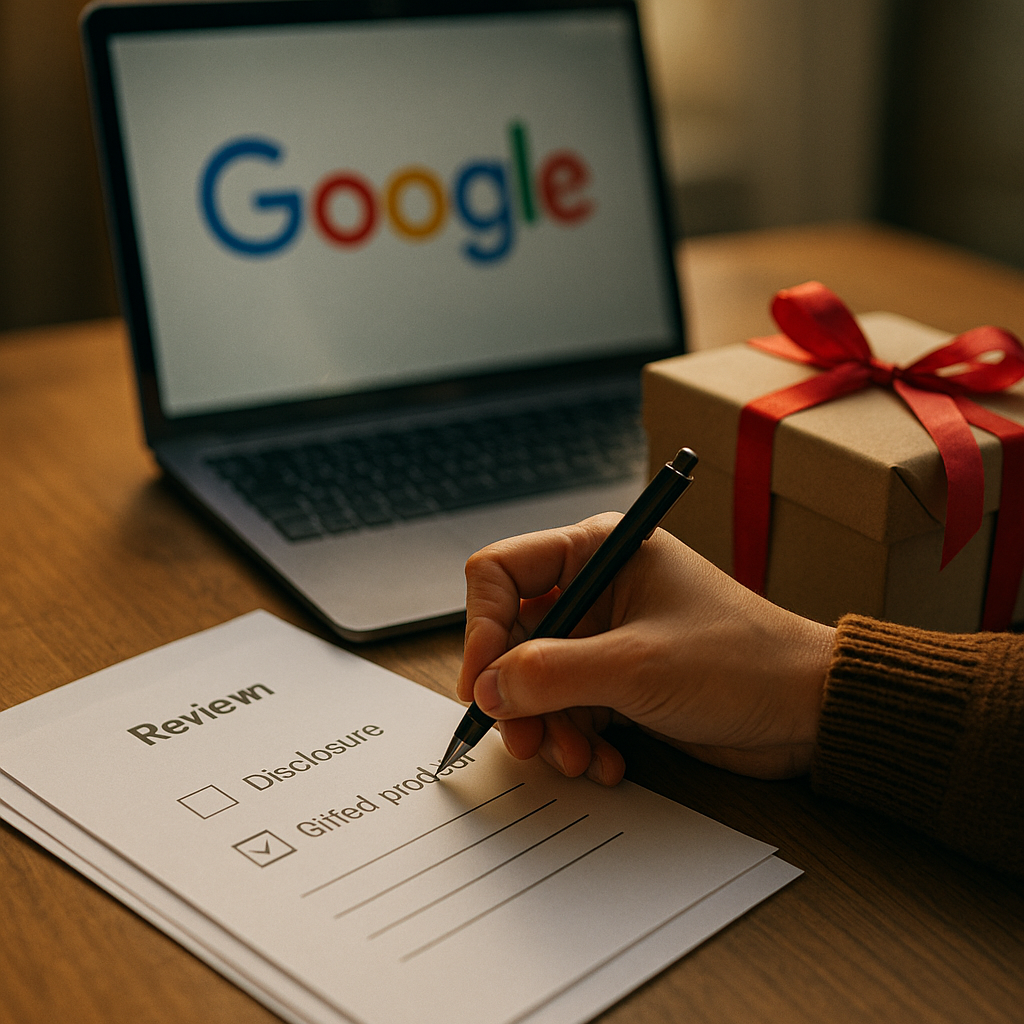
Roughly one in three online reviews involves some form of compensation, free product, or incentive, and almost none of them say so clearly. That gap just got a lot harder to hide. Google’s new incentivized review guidelines target the exact loophole brands have leaned on for years: sending creators free product, calling it “gifting,” and treating that as categorically different from a paid endorsement. It isn’t, and Google’s search quality raters are now trained to spot the difference.
If your influencer program still treats gifted content as a disclosure gray area, this update should move it to the top of your compliance checklist.
What Google’s Update Actually Changes
Google’s search quality rater guidelines have long flagged undisclosed paid reviews as a trust signal problem. The new language extends that scrutiny explicitly to gifted, loaned, or discounted products, not just cash payments. Reviews and review-adjacent content (think “honest review” videos, unboxing posts, and comparison blogs) that received free or discounted product without clear disclosure can now be scored as low-quality or even manipulative under Google’s helpful content and E-E-A-T framework.
This matters because search visibility was always the quiet reward for gifting campaigns. Brands sent product, creators posted “glowing but technically unpaid” reviews, and those reviews often ranked well because they read as organic. Google is closing that arbitrage.
Google now treats “I got this for free” the same way the FTC treats “I was paid to say this”: both require disclosure, and both affect how the content is ranked or trusted.
Why Gifted Content Was Always a Disclosure Gap
The FTC has been explicit for years that free products count as “material connections” requiring disclosure, per its endorsement guides. Yet a huge share of brand gifting programs operated on a wink-and-nod basis: no contract, no explicit “please disclose” instruction, no monitoring of whether creators actually tagged #gifted or #ad. Brands liked the deniability. If a creator forgot to disclose, that was the creator’s problem, not the brand’s, right?
Not anymore, and honestly, not even before this update if you look at recent enforcement patterns. Our coverage of the FTC endorsement sweep showed regulators increasingly naming brands, not just creators, in enforcement actions. Google’s update adds a second layer of consequence: even if the FTC never comes knocking, your search rankings and content trust scores can still take a hit.
That double exposure, legal and algorithmic, is why “we just send free product, we don’t pay them” is no longer a defensible compliance posture.
Where Brands Get This Wrong
- Assuming gifting is low-risk by default. Legal teams often reserve scrutiny for paid partnerships and wave gifting programs through with minimal oversight.
- No disclosure language in gifting agreements. Many brands send product with a pitch email, not a contract, which means there’s no documented instruction to disclose.
- Treating “unboxing” content as organic UGC. If product was sent for review purposes, it’s not organic, regardless of whether cash changed hands.
- No audit trail. When a regulator or a Google quality rater asks “was this disclosed,” brands without records can’t prove either way.
The SEO Stakes: Why Rankings Are Now Part of the Compliance Conversation
Marketing and legal teams have historically operated in separate lanes. Legal worried about FTC exposure; SEO worried about rankings. Google’s update forces those lanes to merge. If a brand’s influencer-driven review content gets flagged as undisclosed incentivized content, it can lose visibility in search, and that’s a direct hit to organic traffic that many brands now rely on for product discovery.
Review content is disproportionately important for commerce brands. Comparison posts, “best of” roundups, and creator review videos often rank for high-intent, bottom-funnel queries. That’s exactly the content Google’s update targets. Losing rankings there isn’t a cosmetic SEO problem, it’s a revenue problem.
Consider the operational reality: a brand running a gifting program across fifty or a hundred micro-creators has effectively zero control over how each piece of content gets indexed, let alone whether it carries proper disclosure language. According to eMarketer research on influencer marketing spend, gifting and seeding programs remain one of the fastest-growing categories of creator investment precisely because they’re cheap and scalable. That scalability is also what makes them hardest to audit.
Scale without disclosure oversight isn’t efficiency, it’s accumulated risk waiting for an algorithm update or a regulator to surface it.
What “Closing the Gap” Looks Like in Practice
Brands that want to stay ahead of this shift need a few concrete operational changes, not just a memo reminding creators to use #gifted.
1. Build Disclosure Requirements Into Gifting Agreements
Every gifted product should come with a written agreement, even a short one, specifying exactly what disclosure language is required and where it must appear (caption, video, on-screen text). Verbal instructions don’t hold up, and “I told them in a DM” is not an audit trail.
2. Monitor, Don’t Just Instruct
Instructing creators to disclose is step one. Verifying they actually did it is step two, and most brands skip it. A lightweight monitoring process, even a monthly spot-check of gifted-content posts, closes a lot of exposure. This pairs well with the broader record-keeping shift we covered in record law audit readiness coverage: regulators and platforms increasingly expect brands to prove compliance, not just claim it.
3. Separate “Gifted for Content” From “Gifted as Goodwill”
Not every free product triggers disclosure obligations. A birthday gift to a longtime customer who happens to be a creator is different from product sent specifically in exchange for content. Brands need internal criteria to distinguish the two and document which bucket each shipment falls into.
4. Train Creators on Platform-Specific Disclosure Mechanics
A hashtag buried at the bottom of a caption doesn’t satisfy FTC guidance, and it increasingly won’t satisfy Google’s quality signals either. Creators need to use platform-native disclosure tools (Instagram’s paid partnership label, YouTube’s “includes paid promotion” toggle) in addition to, not instead of, written disclosure.
5. Treat AI-Assisted Reviews With Extra Caution
If creators use AI tools to draft review scripts or captions based on gifted product, that adds another disclosure layer. Our piece on AI generated testimonials covers how regulators are starting to scrutinize AI-assisted endorsement content specifically, and Google’s helpful content guidelines already penalize low-effort, AI-generated review content that lacks genuine first-hand experience.
How This Connects to the Broader Compliance Landscape
Google’s move doesn’t exist in isolation. It’s part of a pattern where platforms, regulators, and state legislatures are all independently tightening disclosure expectations, and the overlap between them is where brand risk concentrates. State-level AI disclosure rules, for instance, now intersect with FTC endorsement requirements in ways that catch brands off guard, a dynamic explored in our state AI disclosure laws coverage. Agencies running creator programs on behalf of brands face their own version of this exposure, which we broke down in agency vicarious liability reporting.
The throughline across all of it: disclosure is no longer a creator-side afterthought. It’s a brand-side operational requirement with legal, platform, and now search visibility consequences.
Brands that already run disciplined contract and disclosure processes for paid partnerships should extend the same rigor to gifting. The incremental cost of doing so is small compared to losing organic rankings on high-converting review content or facing an FTC inquiry that names the brand directly.
Building an Audit-Ready Gifting Program
Start by inventorying every active gifting relationship: who received product, when, what content was expected, and whether disclosure was confirmed. Most brands discover this list is longer and messier than expected, often spread across influencer marketing platforms, PR teams, and individual marketer relationships that never went through a central system.
From there, standardize the agreement template, add a disclosure confirmation step before content goes live where possible, and build a quarterly audit into your workflow rather than treating it as a one-time cleanup. Tools that already track sponsored content disclosures can usually be extended to flag gifted-product posts too, it’s a configuration question more than a new-tool question.
For brands managing creator programs internationally, note that disclosure expectations vary by jurisdiction even as Google’s guidelines apply globally to search quality. The UK’s ICO and advertising standards bodies have their own gifting disclosure expectations that don’t perfectly mirror FTC rules, so multi-market brands need localized disclosure language, not a single global template.
FAQs
Frequently Asked Questions
Does Google’s update apply to all gifted products, or just high-value items?
It applies regardless of product value. The guidance focuses on whether the product was provided in exchange for content or review, not on the dollar amount. A ten-dollar sample and a thousand-dollar gadget carry the same disclosure obligation if both were sent for review purposes.
How is this different from existing FTC disclosure rules?
The FTC addresses legal liability and consumer protection. Google’s update addresses search quality and ranking signals. They reinforce each other: undisclosed gifted content can now trigger both regulatory risk and reduced search visibility, which is a new combined exposure brands haven’t had to manage before.
Can a brand be penalized if a creator fails to disclose correctly?
Yes, in both the legal and algorithmic sense. The FTC has pursued brands directly for inadequate creator disclosure, and Google’s quality signals evaluate the content itself regardless of who’s technically at fault. This is why monitoring and documented agreements matter more than instructions alone.
Does this affect UGC repurposed in paid ads, or only organic posts?
Google’s search quality guidelines primarily concern organic content and rankings. However, repurposing gifted-content UGC into paid media raises separate disclosure and rights questions, which overlap with broader usage rights issues covered in our UGC paid media rights analysis.
What’s the simplest first step for a brand with an existing gifting program?
Audit current gifting relationships, add written disclosure requirements to every agreement going forward, and spot-check a sample of recent gifted-content posts to confirm disclosure actually happened. That three-step baseline addresses most of the immediate exposure.
The brands that treat this as a compliance checkbox will patch it with a hashtag policy and move on. The ones that treat it as an operational rebuild, contracts, monitoring, and documented audit trails, will be the ones still ranking for review content next year while competitors quietly lose visibility.
Top Influencer Marketing Agencies
The leading agencies shaping influencer marketing in 2026
Agencies ranked by campaign performance, client diversity, platform expertise, proven ROI, industry recognition, and client satisfaction. Assessed through verified case studies, reviews, and industry consultations.
Moburst

-
2

The Shelf
Boutique Beauty & Lifestyle Influencer AgencyA data-driven boutique agency specializing exclusively in beauty, wellness, and lifestyle influencer campaigns on Instagram and TikTok. Best for brands already focused on the beauty/personal care space that need curated, aesthetic-driven content.Clients: Pepsi, The Honest Company, Hims, Elf Cosmetics, Pure LeafVisit The Shelf → -
3

Audiencly
Niche Gaming & Esports Influencer AgencyA specialized agency focused exclusively on gaming and esports creators on YouTube, Twitch, and TikTok. Ideal if your campaign is 100% gaming-focused — from game launches to hardware and esports events.Clients: Epic Games, NordVPN, Ubisoft, Wargaming, Tencent GamesVisit Audiencly → -
4

Viral Nation
Global Influencer Marketing & Talent AgencyA dual talent management and marketing agency with proprietary brand safety tools and a global creator network spanning nano-influencers to celebrities across all major platforms.Clients: Meta, Activision Blizzard, Energizer, Aston Martin, WalmartVisit Viral Nation → -
5

The Influencer Marketing Factory
TikTok, Instagram & YouTube CampaignsA full-service agency with strong TikTok expertise, offering end-to-end campaign management from influencer discovery through performance reporting with a focus on platform-native content.Clients: Google, Snapchat, Universal Music, Bumble, YelpVisit TIMF → -
6

NeoReach
Enterprise Analytics & Influencer CampaignsAn enterprise-focused agency combining managed campaigns with a powerful self-service data platform for influencer search, audience analytics, and attribution modeling.Clients: Amazon, Airbnb, Netflix, Honda, The New York TimesVisit NeoReach → -
7

Ubiquitous
Creator-First Marketing PlatformA tech-driven platform combining self-service tools with managed campaign options, emphasizing speed and scalability for brands managing multiple influencer relationships.Clients: Lyft, Disney, Target, American Eagle, NetflixVisit Ubiquitous → -
8

Obviously
Scalable Enterprise Influencer CampaignsA tech-enabled agency built for high-volume campaigns, coordinating hundreds of creators simultaneously with end-to-end logistics, content rights management, and product seeding.Clients: Google, Ulta Beauty, Converse, AmazonVisit Obviously →