


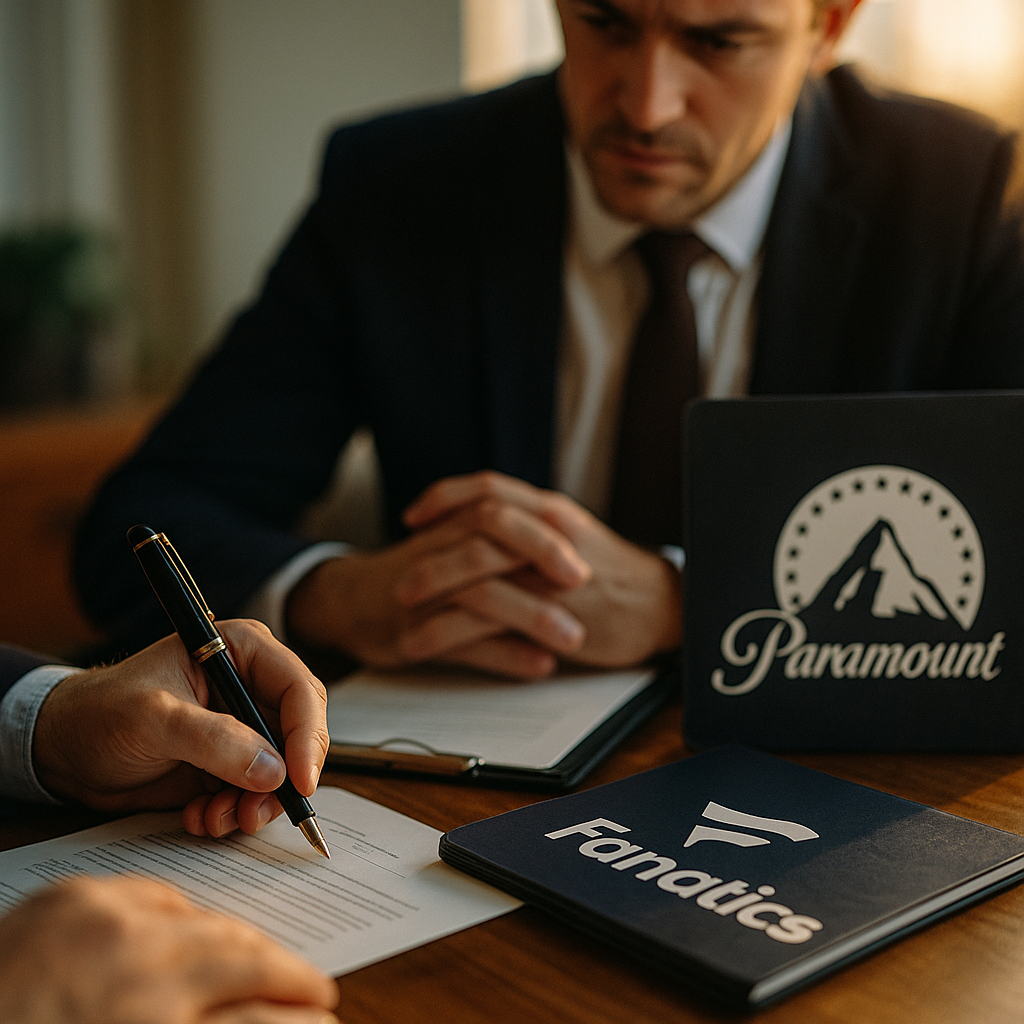
A nine-figure licensing dispute between Paramount and Fanatics just settled quietly, with terms sealed and no admission of wrongdoing from either side. So why are procurement and legal teams at brands with zero sports merchandise exposure suddenly rereading their creator contracts? Because the Paramount Fanatics licensing settlement is less about jerseys and bobbleheads than it is about who owns what when a creator, a licensor, and a brand all touch the same piece of intellectual property. That ambiguity is exactly the gap plenty of influencer agreements still leave wide open.
What Actually Happened
Strip away the trademark filings and the dispute boils down to something every marketer has lived through in miniature: two parties believed they held overlapping rights to commercialize the same branded content, and neither side’s paperwork was airtight enough to settle it without litigation. Paramount licensed intellectual property tied to its entertainment properties. Fanatics built commercial products around that IP, including limited-run merchandise tied to athlete and creator likenesses. When the scope of “licensed use” got interpreted differently by each party’s legal team, the result was years of dispute resolution and a settlement that, by most trade estimates, cost both sides more in legal fees and reputational friction than either anticipated when the original deal was signed.
That’s the part that should make brand marketers uncomfortable. This wasn’t a rogue actor ignoring a contract. It was two sophisticated, well-lawyered organizations disagreeing about scope, duration, and derivative use rights written into an agreement that presumably felt clear at signing. If Paramount and Fanatics can end up in a multi-year fight over licensing boundaries, what happens when a mid-market DTC brand signs a creator deal drafted on a template nobody updated since last year?
If two enterprise legal departments can spend years disputing licensing scope on a signed contract, a brand relying on a boilerplate creator agreement is not protected just because a document exists.
Why This Is a Creator Economy Story, Not Just a Sports Licensing One
Influencer deals increasingly mirror traditional licensing arrangements. Brands pay for the right to use a creator’s name, likeness, and content across paid media, retail packaging, affiliate storefronts, and sometimes physical merchandise. That’s a licensing relationship whether or not anyone calls it one. And licensing relationships carry a specific category of risk: scope creep. A usage right that was negotiated for a 90 day organic campaign quietly becomes the asset running in a paid social boost eighteen months later. A creator’s likeness approved for a single product line shows up on a co-branded capsule collection nobody cleared with legal.
According to eMarketer, brand spend on creator partnerships continues to climb into double-digit billions annually, and a growing share of that spend now involves some form of commercial licensing: merchandise tie-ins, retail media placements, co-branded product drops. The more commercial surface area a creator deal touches, the more it resembles the exact kind of multi-party licensing structure that just cost Paramount and Fanatics years of litigation exposure.
This is the same territory covered in our breakdown of creator franchise IP contracts, where format ownership disputes between creators and brands have become one of the fastest-growing sources of deal friction. The Paramount Fanatics case just proves the principle at enterprise scale.
The Indemnification Gap Nobody Wants to Talk About
Here’s the uncomfortable question every brand counsel should be asking right now: if a creator’s content gets licensed into a third-party product, merchandise line, or syndication deal, and that usage later gets disputed, who eats the cost? In a shocking number of creator agreements, the honest answer is “unclear.” Indemnification language gets copied from template to template without anyone stress-testing it against a real dispute scenario.
Three failure points show up again and again in creator contract reviews:
- Undefined derivative use. The contract covers the original piece of content but says nothing about repurposing, merchandising, or third-party licensing of that asset later.
- One-way indemnification. The creator agrees to indemnify the brand, but the brand offers no reciprocal protection if its own licensing partner (a retailer, a platform, a product manufacturer) misuses the creator’s likeness.
- Silent on duration. Usage rights that never specify an end date or renewal trigger, which is precisely the kind of ambiguity that fueled the Paramount Fanatics dispute.
Brands that have already tightened this language tend to borrow heavily from models used in CTV creator contracts, where cross-platform rights ambiguity was already a known problem before streaming and social merged into the same media buy.
Merchandise and Licensing Deals Carry Product Liability Risk Too
It’s worth separating two distinct risks that often get lumped together: IP/licensing disputes (who owns the right to use the asset) and product liability (who’s responsible if the resulting product harms a consumer or triggers a recall). The Paramount Fanatics settlement lives mostly in the first category, but any brand extending a creator partnership into physical merchandise needs to think about both.
We’ve covered the product side extensively in our piece on product recall liability, and the throughline is the same: brands routinely absorb financial and reputational risk for commercial decisions made several contractual layers away from their own legal team. A licensing dispute over a creator’s name on a hoodie is a headache. A licensing dispute combined with a defective product recall is a crisis communications nightmare, and plenty of brands have found that out the hard way.
What Brand and Agency Teams Should Actually Do Differently
None of this means brands should stop licensing creator IP into merchandise, retail, or co-branded products. That ship has sailed, and frankly the revenue upside is real. It means the contract hygiene needs to catch up to the deal complexity. A few moves worth prioritizing this quarter:
- Audit existing creator agreements for silent scope. Pull the last 12 months of signed deals and flag any contract that doesn’t explicitly define merchandise, derivative, and third-party licensing rights.
- Add renewal and sunset clauses to every usage grant. No more “in perpetuity” language that sounds convenient until a dispute forces you to defend it in front of outside counsel.
- Build mutual indemnification into licensing-adjacent deals. If a creator’s content flows into a product, retail partner, or syndication deal, both sides should carry defined liability, not just the creator.
- Get insurance coverage reviewed against licensing exposure specifically. General media liability policies often don’t anticipate merchandise or licensing disputes, a gap detailed in our guide to creator marketing insurance.
- Vet licensing partners the way you’d vet a creator. Scoring frameworks built for creator scoring and vendor vetting apply just as well to the merchandise and licensing vendors standing between your brand and the creator’s audience.
Legal teams at major media companies run this kind of audit routinely, and even they got burned here. Mid-market marketing teams running leaner legal review processes have even more reason to tighten things up now rather than after a dispute lands.
A Quick Note on Likeness Rights and AI-Generated Merchandise
One wrinkle that didn’t exist the last time most licensing templates were written: AI tools now make it trivially easy to generate merchandise mockups, product renders, and promotional assets using a creator’s likeness without the creator ever touching the design process. That raises the same scope questions the Paramount Fanatics case surfaced, just with an AI layer stacked on top. Our coverage of UGC actor likeness rights digs into how fast this gap is widening, particularly for brands running AI-assisted product visualization before a licensing agreement is even finalized. If your creator contracts don’t already address AI-generated derivative works, add it to the list from the previous section.
Regulators are paying attention too. The FTC has signaled increasing scrutiny of endorsement and licensing arrangements where consumers can’t easily tell what’s organic, what’s paid, and what’s a formal product partnership. Add licensing disputes into that mix and you’ve got a compliance exposure, not just a contract one.
FAQs
Common questions marketing and legal teams are asking after the settlement news broke.
Frequently Asked Questions
What was the core issue in the Paramount Fanatics licensing settlement?
The dispute centered on disagreement over the scope and duration of licensing rights tied to branded intellectual property used in commercial merchandise, a disagreement that escalated into years of litigation before settling on undisclosed terms.
Does this settlement directly change creator contract law?
No. It’s a private settlement with sealed terms, not a court ruling that sets binding precedent. Its relevance to marketers is practical, not legal: it illustrates how scope ambiguity in licensing agreements creates expensive disputes, a risk that applies directly to creator and influencer contracts.
What contract language should brands review after this case?
Prioritize clauses covering derivative use, merchandise and retail licensing rights, duration and renewal terms, and mutual indemnification. These are the exact categories of ambiguity that tend to surface in licensing disputes like this one.
Does general creator marketing insurance cover licensing disputes?
Not always. Many media liability policies are built around content usage and endorsement risk, not merchandise or third-party licensing disputes. Brands extending creator deals into physical products should confirm coverage specifically addresses licensing exposure.
How does AI-generated content complicate creator licensing risk?
AI tools make it easy to generate product mockups or promotional assets using a creator’s likeness without formal sign-off, which widens the same scope and consent gaps that fueled the Paramount Fanatics dispute, just with less human review in the loop.
The practical move this week: pull your three highest-revenue creator contracts, check whether merchandise and derivative use rights are explicitly scoped, and fix the silent gaps before a dispute forces the issue.
Top Influencer Marketing Agencies
The leading agencies shaping influencer marketing in 2026
Agencies ranked by campaign performance, client diversity, platform expertise, proven ROI, industry recognition, and client satisfaction. Assessed through verified case studies, reviews, and industry consultations.
Moburst

-
2

The Shelf
Boutique Beauty & Lifestyle Influencer AgencyA data-driven boutique agency specializing exclusively in beauty, wellness, and lifestyle influencer campaigns on Instagram and TikTok. Best for brands already focused on the beauty/personal care space that need curated, aesthetic-driven content.Clients: Pepsi, The Honest Company, Hims, Elf Cosmetics, Pure LeafVisit The Shelf → -
3

Audiencly
Niche Gaming & Esports Influencer AgencyA specialized agency focused exclusively on gaming and esports creators on YouTube, Twitch, and TikTok. Ideal if your campaign is 100% gaming-focused — from game launches to hardware and esports events.Clients: Epic Games, NordVPN, Ubisoft, Wargaming, Tencent GamesVisit Audiencly → -
4

Viral Nation
Global Influencer Marketing & Talent AgencyA dual talent management and marketing agency with proprietary brand safety tools and a global creator network spanning nano-influencers to celebrities across all major platforms.Clients: Meta, Activision Blizzard, Energizer, Aston Martin, WalmartVisit Viral Nation → -
5

The Influencer Marketing Factory
TikTok, Instagram & YouTube CampaignsA full-service agency with strong TikTok expertise, offering end-to-end campaign management from influencer discovery through performance reporting with a focus on platform-native content.Clients: Google, Snapchat, Universal Music, Bumble, YelpVisit TIMF → -
6

NeoReach
Enterprise Analytics & Influencer CampaignsAn enterprise-focused agency combining managed campaigns with a powerful self-service data platform for influencer search, audience analytics, and attribution modeling.Clients: Amazon, Airbnb, Netflix, Honda, The New York TimesVisit NeoReach → -
7

Ubiquitous
Creator-First Marketing PlatformA tech-driven platform combining self-service tools with managed campaign options, emphasizing speed and scalability for brands managing multiple influencer relationships.Clients: Lyft, Disney, Target, American Eagle, NetflixVisit Ubiquitous → -
8

Obviously
Scalable Enterprise Influencer CampaignsA tech-enabled agency built for high-volume campaigns, coordinating hundreds of creators simultaneously with end-to-end logistics, content rights management, and product seeding.Clients: Google, Ulta Beauty, Converse, AmazonVisit Obviously →