


Brands are paying anywhere from $8 to $140 to acquire a single customer through creator content, and most marketers have no idea where their number actually falls. That gap is the problem. Without a real cost per acquisition benchmark for creator campaigns, finance teams approve budgets on vibes, not data. This article breaks down what current numbers actually show, by platform, vertical, and campaign structure, so you can stop guessing and start defending your spend.
Why CAC Became the Metric That Matters Most
Three years ago, most influencer programs reported on reach and engagement. Nobody asked what a follower actually cost to acquire as a customer. That era is over. Finance leaders now sit in the same budget meetings as marketing, and they want a number that ties back to revenue, not vanity metrics. The shift mirrors a broader trend covered in GMV overtakes engagement as the core KPI, where gross merchandise value replaced likes as the scoreboard brands actually care about.
CAC matured alongside that shift because it answers the one question every CFO asks: what did this cost us, per customer, compared to our other channels? Paid search has had this answer for two decades. Influencer marketing is just catching up.
What the 2026 Benchmarks Actually Show
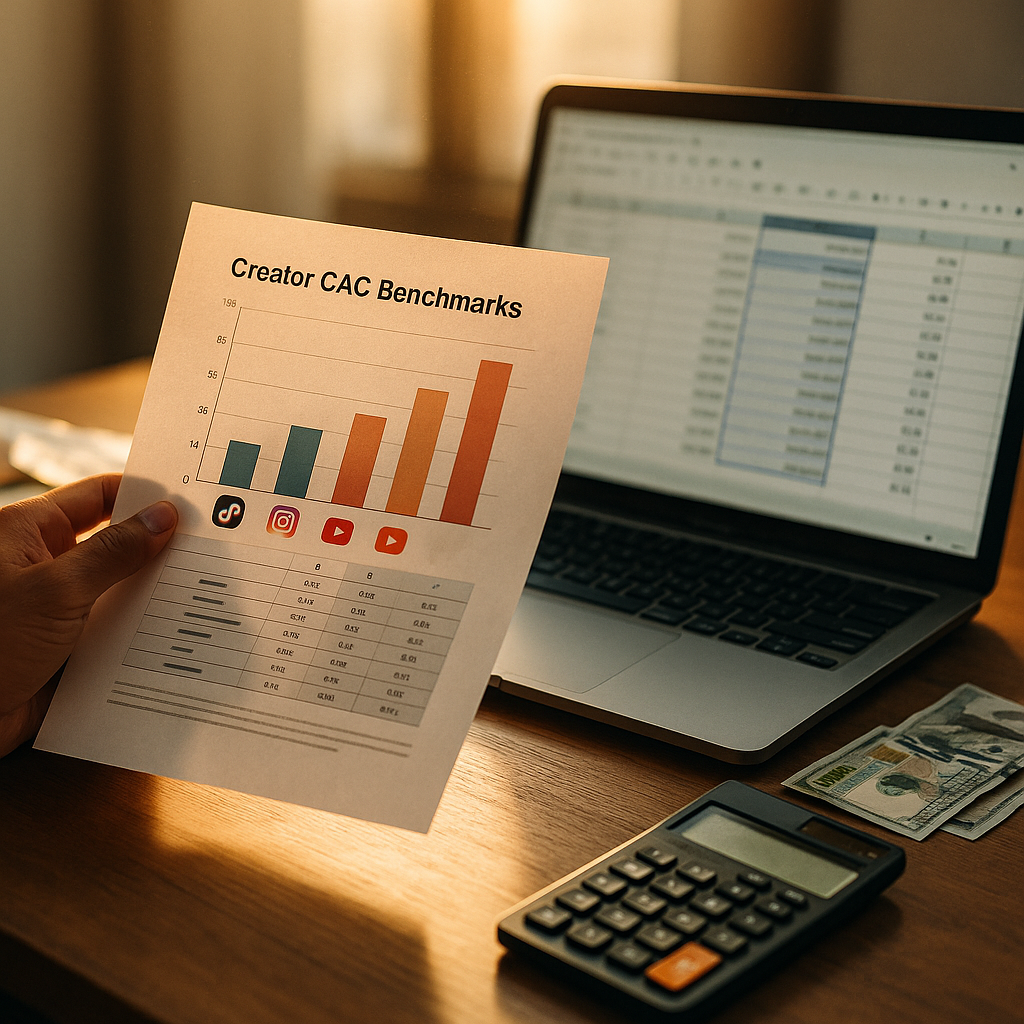
Pulling from recent platform disclosures, agency reporting, and brand-side data shared at industry events, here’s where CAC tends to land by channel type:
- TikTok Shop affiliate campaigns: $12 to $35 CAC for consumer packaged goods, often lower for beauty and supplements where impulse purchase behavior is strong.
- Instagram and YouTube long-form creator partnerships: $45 to $90 CAC, reflecting higher production costs and longer consideration cycles.
- Livestream commerce events: $18 to $40 CAC when hosted by mid-tier creators with engaged, repeat audiences.
- Nano and micro-influencer seeding programs: $20 to $55 CAC, with wide variance depending on product category and whether gifting alone drives conversion.
- Celebrity or mega-influencer campaigns: frequently exceed $100 CAC, which is why fewer brands lead with them for direct response goals.
Supplement and wellness brands continue to post some of the tightest numbers in the category. Coverage in supplement brands chase lower CAC with TikTok Shop pivot showed how trust-driven categories benefit from creator formats that feel like recommendations rather than ads. A related piece, supplement category wins TikTok Shop on trust and margin, breaks down why margin structure in that vertical absorbs CAC volatility better than thinner-margin categories like apparel.
The single biggest predictor of CAC in 2026 isn’t platform or creator tier, it’s whether the brand built a repeatable system or ran a one-off campaign. Systems beat spikes, every time.
Platform Choice Still Drives the Biggest Swing
TikTok Shop continues to post the lowest average CAC among major platforms, largely because the shoppable format collapses the path from discovery to checkout. Reports referenced in TikTok Shop creators claim 75 percent of 23.4B GMV show just how concentrated commerce activity has become on that single platform. If your brand isn’t testing there, you’re likely paying a premium elsewhere for the same outcome.
That said, platform concentration carries its own risk. The analysis in 60 percent TikTok engagement share forces budget reallocation makes the case that over-indexing on one channel leaves brands exposed to algorithm changes, policy shifts, or regional restrictions. Lemon8 is emerging as a secondary option worth testing, particularly for lifestyle and beauty categories, as detailed in Lemon8 creator tools signal ByteDance’s second GMV bet.
Does Creator Tier Actually Change the Math?
Yes, but not in the direction most brands assume. Mega-influencers and celebrities generate reach, not necessarily conversions, which inflates CAC when reach is the only input. Nano and micro-creators, by contrast, tend to produce lower CAC per acquisition because their audiences trust them more and their rates are lower. The catch: nano programs require more operational overhead. Managing fifty small creators instead of two large ones means more contracts, more content review, more payout logistics.
Brands solving for this at scale increasingly tie creator payouts to actual performance rather than flat fees. The approach outlined in neobanks tie creator payouts to funded accounts, not posts shows how performance-based compensation structures naturally keep CAC in check because brands only pay when the acquisition actually happens.
CAC Alone Isn’t the Full Picture
A low CAC that comes attached to high churn is a trap. Plenty of brands have celebrated a $15 acquisition cost only to discover that customer unsubscribed or returned the product within thirty days. That’s why CAC needs a companion metric: payback period. The deeper breakdown in CAC payback period becomes influencer budgets’ gatekeeper metric argues that payback period, not CAC in isolation, is becoming the real gatekeeper for budget approval in finance conversations.
Think of it this way: a $60 CAC with a 20-day payback period is a far better investment than a $20 CAC with a 95-day payback period, especially if your brand runs on tight cash flow. Finance teams increasingly ask for both numbers before signing off on creator budgets, and marketers who show up without payback data are losing those arguments.
Attribution Gaps Are Skewing the Numbers
Here’s an uncomfortable truth: a meaningful share of reported CAC benchmarks are wrong, not because the campaigns underperformed, but because the attribution models can’t see the full customer journey. Last-click models in particular undercount creator influence, since most buyers discover a product through a video, then search for it later, then purchase through an entirely different channel.
The piece last-click attribution fails creator-driven buying journeys lays this out clearly: if you’re measuring CAC with last-click logic, your creator channel is probably getting under credited, and your CAC number is artificially high. Multi-touch attribution models, while imperfect, generally paint a more honest picture. Brands relying on platforms like HubSpot for closed-loop reporting or Sprout Social for cross-channel analytics tend to catch these gaps earlier than teams running attribution manually in spreadsheets.
This also explains why so many CMOs still can’t produce a confident ROI figure for creator spend. The data in 61 percent of CMOs cannot measure ROI as spend keeps rising suggests the measurement problem, not the channel itself, is the real obstacle to scaling creator budgets confidently.
AI Is Starting to Tighten the Range
One reason 2026 benchmarks are more reliable than prior years is AI-assisted media buying and creator matching. Brands using predictive tools to forecast which creators are likely to convert, rather than relying on follower count or past brand deals, are seeing tighter, more consistent CAC ranges. The trend is covered broadly in IAB finds AI now drives five of six marketer priorities, and regionally in 70 percent of APAC leaders let AI steer budget decisions.
Practically, this means fewer brands are burning budget on creators who look good on paper but convert poorly. AI models trained on historical conversion data can flag that mismatch before a single dollar goes out the door. For brands still manually vetting creators based on engagement rate alone, this is a measurable disadvantage. Platforms like TikTok Ads Manager and Meta Business Suite have both expanded predictive creator-matching features in the past year, narrowing the guesswork considerably.
A Quick Gut Check for Your Own Numbers
Before you benchmark your own CAC against anyone else’s, ask these three questions:
- Is your attribution window long enough to capture delayed conversions from video discovery?
- Are you including production and management overhead in the “cost” side of the equation, or only media spend?
- Does your CAC number account for repeat purchase rate, or does it treat every acquisition as a one-time event?
Most brands fail at least one of these checks. Fixing the gap usually matters more than chasing a lower raw number.
Building a Program That Beats the Benchmark
Benchmarks are a starting point, not a ceiling. Brands consistently beating category averages tend to share a few traits: they test creators in small batches before scaling spend, they reuse high-performing creative instead of producing from scratch every cycle, and they track payback period alongside CAC from day one. The approach in reusable creative libraries cut production costs in half is a direct lever here. Lower production cost per asset pulls CAC down even if conversion rates stay flat, since the cost side of the equation shrinks.
Governance matters too. As creator spend grows as a share of total marketing budget, finance scrutiny grows with it. The threshold discussed in 44 percent creator spend threshold forces finance rigor shows that once creator spend crosses roughly that share of budget, companies start requiring the same rigor they apply to paid media, including documented CAC targets by campaign type.
FAQs
The questions below come up constantly in brand and agency planning sessions, and they’re worth answering directly.
What is a good CAC for a creator campaign?
There’s no single universal number, but as a general range, brands in consumer packaged goods, beauty, and supplements should aim for $15 to $40 on platforms like TikTok Shop. Categories with longer sales cycles or higher price points, such as apparel or electronics, often see acceptable CAC in the $50 to $90 range. The right benchmark always depends on your margin structure and customer lifetime value.
How do you calculate CAC for influencer marketing?
Add total campaign cost, including creator fees, platform fees, content production, and management overhead, then divide by the number of new customers acquired directly attributable to that campaign. The tricky part is attribution. Multi-touch models generally produce more accurate figures than last-click tracking alone.
Why does CAC vary so much between platforms?
Shoppable formats like TikTok Shop collapse the path between discovery and purchase, which tends to lower CAC. Platforms built more around brand awareness, like long-form YouTube content, often carry higher CAC because the conversion path is longer and harder to track.
Should brands prioritize low CAC over payback period?
No. A low CAC paired with a long payback period can strain cash flow just as much as a higher CAC with fast payback. Both metrics should be reviewed together before scaling any creator program.
Does creator tier affect CAC significantly?
Yes. Nano and micro-creators generally produce lower CAC due to stronger audience trust and lower fees, while mega-influencers and celebrities tend to drive higher CAC because their value leans more toward reach and brand awareness than direct conversion.
Next step: Pull your last two quarters of creator campaign data, recalculate CAC using a multi-touch attribution window, and compare it against the payback period. If the gap between your reported CAC and your recalculated CAC is wide, that’s your real budget risk, not the benchmark itself.
FAQs
What is a good CAC for a creator campaign?
There’s no single universal number, but as a general range, brands in consumer packaged goods, beauty, and supplements should aim for $15 to $40 on platforms like TikTok Shop. Categories with longer sales cycles or higher price points, such as apparel or electronics, often see acceptable CAC in the $50 to $90 range. The right benchmark always depends on your margin structure and customer lifetime value.
How do you calculate CAC for influencer marketing?
Add total campaign cost, including creator fees, platform fees, content production, and management overhead, then divide by the number of new customers acquired directly attributable to that campaign. The tricky part is attribution. Multi-touch models generally produce more accurate figures than last-click tracking alone.
Why does CAC vary so much between platforms?
Shoppable formats like TikTok Shop collapse the path between discovery and purchase, which tends to lower CAC. Platforms built more around brand awareness, like long-form YouTube content, often carry higher CAC because the conversion path is longer and harder to track.
Should brands prioritize low CAC over payback period?
No. A low CAC paired with a long payback period can strain cash flow just as much as a higher CAC with fast payback. Both metrics should be reviewed together before scaling any creator program.
Does creator tier affect CAC significantly?
Yes. Nano and micro-creators generally produce lower CAC due to stronger audience trust and lower fees, while mega-influencers and celebrities tend to drive higher CAC because their value leans more toward reach and brand awareness than direct conversion.
Top Influencer Marketing Agencies
The leading agencies shaping influencer marketing in 2026
Agencies ranked by campaign performance, client diversity, platform expertise, proven ROI, industry recognition, and client satisfaction. Assessed through verified case studies, reviews, and industry consultations.
Moburst

-
2

The Shelf
Boutique Beauty & Lifestyle Influencer AgencyA data-driven boutique agency specializing exclusively in beauty, wellness, and lifestyle influencer campaigns on Instagram and TikTok. Best for brands already focused on the beauty/personal care space that need curated, aesthetic-driven content.Clients: Pepsi, The Honest Company, Hims, Elf Cosmetics, Pure LeafVisit The Shelf → -
3

Audiencly
Niche Gaming & Esports Influencer AgencyA specialized agency focused exclusively on gaming and esports creators on YouTube, Twitch, and TikTok. Ideal if your campaign is 100% gaming-focused — from game launches to hardware and esports events.Clients: Epic Games, NordVPN, Ubisoft, Wargaming, Tencent GamesVisit Audiencly → -
4

Viral Nation
Global Influencer Marketing & Talent AgencyA dual talent management and marketing agency with proprietary brand safety tools and a global creator network spanning nano-influencers to celebrities across all major platforms.Clients: Meta, Activision Blizzard, Energizer, Aston Martin, WalmartVisit Viral Nation → -
5

The Influencer Marketing Factory
TikTok, Instagram & YouTube CampaignsA full-service agency with strong TikTok expertise, offering end-to-end campaign management from influencer discovery through performance reporting with a focus on platform-native content.Clients: Google, Snapchat, Universal Music, Bumble, YelpVisit TIMF → -
6

NeoReach
Enterprise Analytics & Influencer CampaignsAn enterprise-focused agency combining managed campaigns with a powerful self-service data platform for influencer search, audience analytics, and attribution modeling.Clients: Amazon, Airbnb, Netflix, Honda, The New York TimesVisit NeoReach → -
7

Ubiquitous
Creator-First Marketing PlatformA tech-driven platform combining self-service tools with managed campaign options, emphasizing speed and scalability for brands managing multiple influencer relationships.Clients: Lyft, Disney, Target, American Eagle, NetflixVisit Ubiquitous → -
8

Obviously
Scalable Enterprise Influencer CampaignsA tech-enabled agency built for high-volume campaigns, coordinating hundreds of creators simultaneously with end-to-end logistics, content rights management, and product seeding.Clients: Google, Ulta Beauty, Converse, AmazonVisit Obviously →