


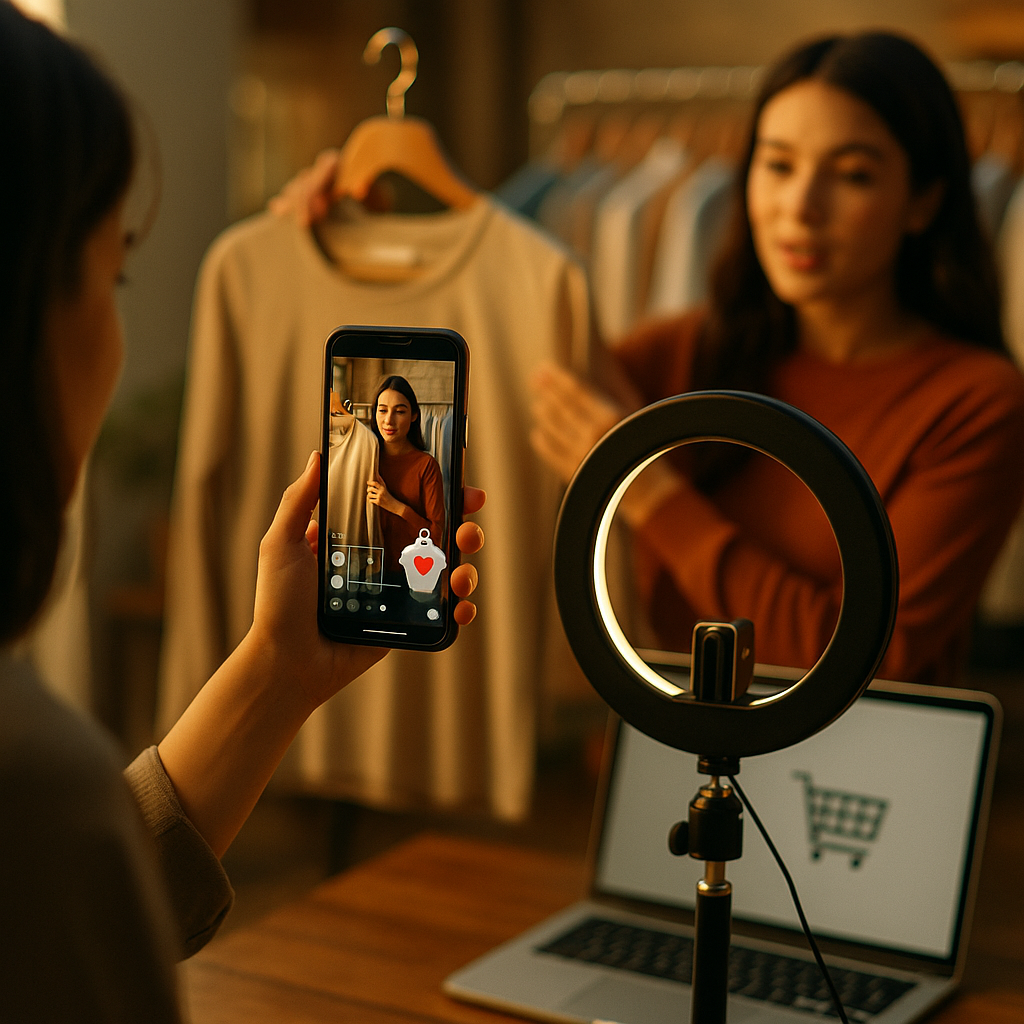
Half of all influencer campaigns now include a live shopping component. That is not a niche tactic anymore, it is the default. When live commerce crosses the 50 percent threshold, the question stops being “should we test this” and becomes “why haven’t we scaled it yet.”
The Number Behind the Headline
Brands have been circling live shopping for years, usually treating it as a seasonal stunt or a TikTok experiment. That phase is over. Recent campaign audits from agencies tracking creator deliverables show live or livestream-linked commerce segments now appear in more than half of active influencer briefs, up sharply from a year ago. Platforms like TikTok Shop, Amazon Live, and Instagram’s shopping tools have made the technical lift easy enough that even mid-tier brands run live sessions monthly instead of quarterly.
What changed? Mostly friction. Checkout used to require viewers to leave the stream, hunt for a product link, and complete a purchase elsewhere. Drop-off rates were brutal. Now the purchase happens inside the same screen, same session, same thumb-scroll. That single fix did more for conversion than any amount of creative polish ever could.
Live commerce isn’t winning because it’s novel. It’s winning because it collapses the distance between “I want that” and “I bought that” to a single tap.
Why Brands Are Shifting Budget Toward Live Formats
Three forces are pushing budget toward live, and none of them are about hype.
- Attribution clarity. Static posts force marketers to guess at influence. Live commerce ties a sale to a specific minute in a specific stream, which gives finance teams something they actually trust.
- Inventory velocity. Retailers use live sessions to clear seasonal stock or launch limited drops, generating urgency that a feed post can’t replicate.
- CFO pressure. As display budgets shrink and get rerouted toward creator spend, marketers need formats that convert quickly to justify the reallocation. Live commerce does exactly that.
There is also a simpler explanation: marketers are tired of debating reach versus engagement versus “vibes.” A live sale either happened or it didn’t. That binary clarity is catnip for teams facing the kind of attribution scrutiny now standard at industry events, a shift covered in recent conference agenda changes.
Which Platforms Are Actually Driving the Volume?
TikTok Shop remains the loudest player, particularly for beauty, fashion, and impulse-purchase categories. Amazon Live has quietly built a loyal base among CPG and home goods brands that already lean on Amazon’s fulfillment infrastructure. Instagram and YouTube have both expanded live shopping tools, though adoption there still trails TikTok by a wide margin.
Category maturity matters here. CPG spend benchmarks show packaged goods brands adopting live formats slower than beauty or apparel, largely because of supply chain lag and SKU complexity. A beauty brand can restock a bestselling serum in days. A grocery brand negotiating shelf space can’t move that fast, so live drops feel riskier when demand spikes and inventory can’t follow.
For reference on platform-specific shopping tools and ad integrations, Meta’s business resources and TikTok’s advertising hub both publish updated specs worth bookmarking: Meta Business and TikTok Ads.
The Creator Side: New Skills, New Leverage
Live commerce rewards a different creator skill set than a polished brand deal. Hosting a sixty-minute live sale requires improvisation, product knowledge, and the ability to handle comment-section chaos in real time. Not every creator with a large following can do this well. Some of the biggest names in the creator economy have actually struggled here, while mid-tier hosts with QVC-style energy have thrived.
This is part of why micro influencers continue to beat macro accounts on engagement. Live commerce doesn’t care about follower count nearly as much as it cares about trust and watch-time retention. A host with 40,000 loyal followers who stay on a stream for twenty minutes will often outsell a celebrity with ten times the audience and a thirty-second drop-in.
That shift in leverage shows up in contracts too. Brands are now paying for live hosting hours and GMV splits rather than flat posting fees, a structural change echoed in how creator tier ratios reshape budget math across campaigns.
Risk Doesn’t Disappear Just Because Conversion Improves
Live commerce introduces its own compliance headaches. Disclosure rules don’t pause because a creator is improvising on camera. FTC guidance still requires clear and conspicuous disclosure of material connections, and that gets harder to enforce when a host is talking for sixty straight minutes without a script. Brands should review current guidance directly at the FTC’s website before scaling live programs, rather than assuming static-post disclosure habits transfer cleanly.
There’s also the product claims problem. A scripted post goes through legal review. A live stream often doesn’t, and creators under pressure to keep momentum sometimes overstate efficacy or results. This mirrors concerns already raised around livestreaming’s broader risk control gaps, where brands scaled faster than their legal and compliance teams could keep pace.
The brands winning at live commerce aren’t the ones with the biggest budgets. They’re the ones who built compliance checkpoints into the live format before scaling it, not after a crisis forced the issue.
Marketplace sprawl compounds this. As more creators run live sessions across more platforms simultaneously, tracking disclosure consistency becomes a genuine operational burden, something explored in depth around marketplace expansion and compliance risk. If your legal team isn’t reviewing live commerce the same way they review scripted content, you have a gap.
What This Means for Budget Planning
If live commerce is crossing 50 percent of campaigns, it needs its own line item, not a footnote inside “content creation.” Teams still budgeting for live sessions the way they budget for static posts are underfunding the production support these formats actually require: lighting, tech checks, backup hosts, and real-time moderation.
It also changes how brands should think about creator rosters. Running fewer, deeper live partnerships tends to outperform spreading thin across dozens of one-off streams, a pattern consistent with brands that halved creator rosters in favor of creative diversity. Live commerce specifically rewards repetition. Audiences return to hosts they already trust, and that trust compounds across sessions in a way a single scripted post never could.
Budget conversations should also account for platform fees, which vary meaningfully. TikTok Shop, Amazon Live, and Instagram all take different cuts and offer different promotional support, so a GMV-based creator deal on one platform won’t translate cleanly to another. Marketers comparing performance across platforms should normalize for these fee structures before declaring a “winner,” something benchmarking tools from eMarketer and Statista can help contextualize against broader e-commerce trends.
A Quick Gut Check for Your Own Program
- Does your legal review process cover live, unscripted content, or only pre-approved scripts?
- Are you tracking GMV per host, per hour, not just per campaign?
- Have you budgeted for production support, or are you treating live sessions as “free” because there’s no edit involved?
- Are your top live hosts actually your top follower-count creators, or have you discovered different talent entirely?
None of this works without the right agency and creator partnerships lined up ahead of time. Deal structures negotiated at events like IMCX’s recent LA sessions increasingly include live commerce clauses baked into standard contracts rather than negotiated as one-off add-ons, which is a sign of how normalized this format has become.
Next step: Pull your last two quarters of campaign briefs and tag which ones included a live component. If it’s already north of 40 percent, stop treating live commerce as experimental and start budgeting, staffing, and compliance-reviewing it like the primary channel it has become.
Frequently Asked Questions
What counts as live commerce in an influencer campaign?
Live commerce refers to any campaign component where a creator sells products in real time through a livestream, typically with in-platform checkout, as opposed to a static post linking to a separate purchase page.
Why is live commerce converting better than traditional influencer posts?
In-stream checkout removes the friction of leaving the platform to complete a purchase, and the real-time format creates urgency through limited-time offers and live Q&A that static content can’t replicate.
Which platforms lead in live commerce adoption?
TikTok Shop currently leads in volume, particularly in beauty and fashion categories, with Amazon Live strong in CPG and home goods, and Instagram and YouTube expanding their shopping tools at a slower pace.
How should brands budget differently for live commerce?
Live commerce requires its own line item covering production support, host fees or GMV splits, and compliance review, rather than being folded into general content creation budgets.
What compliance risks come with live commerce specifically?
Unscripted live content makes consistent FTC disclosure harder to enforce, and product claims made spontaneously during a stream rarely go through the same legal review as scripted posts.
Top Influencer Marketing Agencies
The leading agencies shaping influencer marketing in 2026
Agencies ranked by campaign performance, client diversity, platform expertise, proven ROI, industry recognition, and client satisfaction. Assessed through verified case studies, reviews, and industry consultations.
Moburst

-
2

The Shelf
Boutique Beauty & Lifestyle Influencer AgencyA data-driven boutique agency specializing exclusively in beauty, wellness, and lifestyle influencer campaigns on Instagram and TikTok. Best for brands already focused on the beauty/personal care space that need curated, aesthetic-driven content.Clients: Pepsi, The Honest Company, Hims, Elf Cosmetics, Pure LeafVisit The Shelf → -
3

Audiencly
Niche Gaming & Esports Influencer AgencyA specialized agency focused exclusively on gaming and esports creators on YouTube, Twitch, and TikTok. Ideal if your campaign is 100% gaming-focused — from game launches to hardware and esports events.Clients: Epic Games, NordVPN, Ubisoft, Wargaming, Tencent GamesVisit Audiencly → -
4

Viral Nation
Global Influencer Marketing & Talent AgencyA dual talent management and marketing agency with proprietary brand safety tools and a global creator network spanning nano-influencers to celebrities across all major platforms.Clients: Meta, Activision Blizzard, Energizer, Aston Martin, WalmartVisit Viral Nation → -
5

The Influencer Marketing Factory
TikTok, Instagram & YouTube CampaignsA full-service agency with strong TikTok expertise, offering end-to-end campaign management from influencer discovery through performance reporting with a focus on platform-native content.Clients: Google, Snapchat, Universal Music, Bumble, YelpVisit TIMF → -
6

NeoReach
Enterprise Analytics & Influencer CampaignsAn enterprise-focused agency combining managed campaigns with a powerful self-service data platform for influencer search, audience analytics, and attribution modeling.Clients: Amazon, Airbnb, Netflix, Honda, The New York TimesVisit NeoReach → -
7

Ubiquitous
Creator-First Marketing PlatformA tech-driven platform combining self-service tools with managed campaign options, emphasizing speed and scalability for brands managing multiple influencer relationships.Clients: Lyft, Disney, Target, American Eagle, NetflixVisit Ubiquitous → -
8

Obviously
Scalable Enterprise Influencer CampaignsA tech-enabled agency built for high-volume campaigns, coordinating hundreds of creators simultaneously with end-to-end logistics, content rights management, and product seeding.Clients: Google, Ulta Beauty, Converse, AmazonVisit Obviously →