


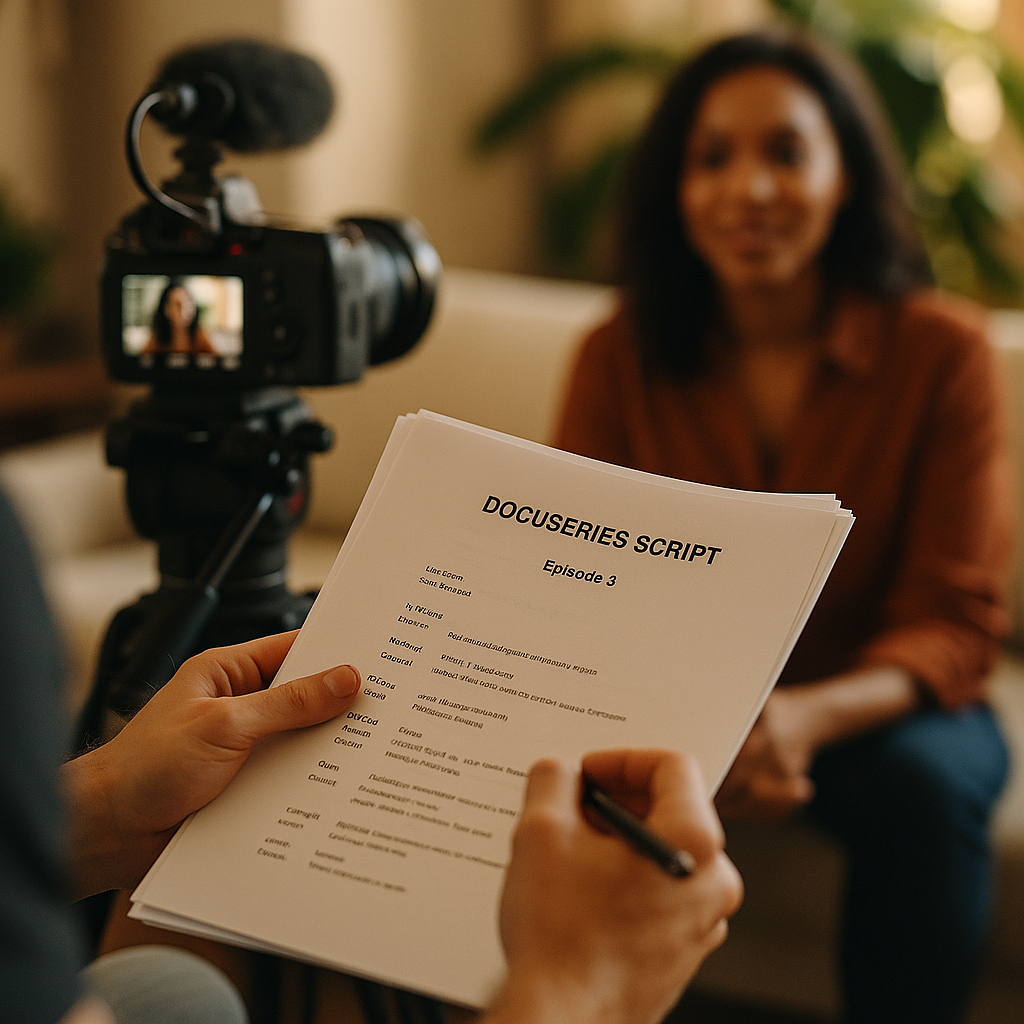
Only 34% of consumers trust brand content on social media, according to Edelman’s trust research, yet long-form branded documentaries routinely outperform traditional ads on watch time and sentiment. The docuseries format is the antidote to one-off UGC clips that vanish from memory in seconds. Done right, it turns a brand into a character people choose to follow across episodes, not a logo interrupting their feed.
This isn’t about hiring a film crew and hoping for the best. It’s a scripting discipline, one that treats each episode like a chapter in a larger argument for why your brand deserves attention. Let’s break down how to structure it.
Why Single Videos Can’t Carry Trust Anymore
A 60-second ad can generate a click. It rarely generates belief. Trust is cumulative, built through repeated exposure to consistent values, voices, and proof points. A docuseries delivers that repetition without feeling repetitive, because each episode introduces a new angle: the founder’s origin, the supply chain visit, the customer who almost quit before your product changed something, the hard question nobody expected you to answer on camera.
Brands already know this instinctively when they invest in origin story content, but a docuseries extends that logic across three to six episodes instead of one. The format rewards patience. According to HubSpot’s content marketing research, longer-form branded content consistently drives higher engagement depth than short promotional clips, precisely because it gives viewers time to form an opinion rather than just register an impression.
A docuseries isn’t a longer ad. It’s a trust ledger, where every episode either adds credibility or spends it.
The Four-Episode Arc That Actually Works
Most brand docuseries fail because they front-load the sales pitch and leave nothing for the audience to discover. The sequencing matters more than the production budget. Here’s the arc that consistently performs across agency case studies we’ve tracked:
- Episode 1, The Tension. Open with a real problem, not a brand hero shot. Why does this product category frustrate people? What did the founder get wrong before getting it right?
- Episode 2, The Build. Show the process. Manufacturing, testing, sourcing, failed prototypes. Imperfection here reads as authenticity, not weakness.
- Episode 3, The Proof. Bring in customers, employees, or independent experts. This is where social proof does the heavy lifting your copywriting can’t.
- Episode 4, The Stakes. What happens next for the brand, the category, or the customer? End on momentum, not a hard sell.
Notice what’s missing: a dedicated “buy now” episode. That’s intentional. The conversion happens in the comments, the pinned links, the retargeting sequence after someone’s watched episode three. The docuseries job is belief, not checkout.
Scripting Each Episode: Structure Over Spontaneity
Documentary feels unscripted. It almost never is. Every strong brand docuseries episode runs on a loose but deliberate skeleton: a cold open with a question or tension, a middle section that develops context through interviews or b-roll narration, and a closing beat that either resolves the tension or deliberately leaves it open for the next episode.
Write the questions before you write the answers. If you’re interviewing a founder or customer, draft five to seven questions designed to surface emotion, not just facts. “Walk me through the day you almost shut down” produces better footage than “tell me about your company’s history.” The scripting work happens in pre-production, in the question design, far more than in post-production narration.
This is similar in spirit to how founder duet videos manage authenticity and risk simultaneously: you’re giving someone real estate to speak candidly while still controlling the frame through smart question design.
Pacing: The Episode Length Debate
Should episodes run three minutes or fifteen? The honest answer is it depends on platform and intent. A YouTube-hosted docuseries can sustain eight to twelve minutes per episode because the platform rewards watch time and the audience has opted in for depth. A series distributed primarily through Instagram or TikTok needs each episode cut to three minutes max, with a vertical-first edit that still respects the narrative arc.
Don’t force one runtime across every platform. Shoot long, cut multiple versions. The YouTube cut can be the “director’s version” while the social cuts become trailers that drive traffic back to the full episode. This dual-format approach also protects your production investment since one shoot funds multiple deliverables.
Platforms don’t dictate your story. They dictate your edit. Shoot once, cut for context, not for convenience.
What Makes Audiences Actually Believe You?
Three things, consistently: unresolved tension, named sources, and visible imperfection.
Unresolved tension means not every episode wraps with a bow. Leave a question hanging into the next installment. Named sources means putting real names and titles on screen, not “customer” or “employee,” because specificity reads as verification. Visible imperfection means keeping in the stumble, the pause, the moment someone admits uncertainty. Polished perfection is what makes viewers suspicious in the first place.
This echoes a pattern we’ve seen work well in myth-busting content, where admitting what the brand got wrong builds more credibility than claiming it never erred. A docuseries has room to do this across episodes instead of cramming correction and claim into fifteen seconds.
Disclosure and Compliance Aren’t Optional Scenes
A multi-episode series involving paid creators, sponsored interviews, or compensated customer testimonials falls squarely under FTC disclosure guidance. Every episode needs clear, unambiguous disclosure, not a single disclaimer buried in episode one’s description box. If a customer featured in episode three received product or payment for their appearance, that needs its own on-screen or verbal disclosure in that episode, not a blanket statement viewers never see.
Brands operating across UK audiences should also reference ICO guidance on data handling if the series involves collecting viewer information through gated episode access or email-gated content drops.
Build disclosure into the script, not as an afterthought stapled onto the edit. A line like “I was given this product to test honestly” delivered naturally by the subject does more for trust than a fine-print overlay nobody reads. Compliance and authenticity aren’t in tension here. Handled well, disclosure actually reinforces the honesty the whole format is trying to project.
Distribution: Sequencing Episodes for Retention
Release cadence matters as much as content. Dropping all episodes at once mimics a binge model that works for entertainment platforms but rarely for brand content, where you want sustained conversation across weeks. A weekly release, paired with teaser clips on social that function like trailers, keeps the series alive in feeds longer and gives your paid media team fresh creative to test each week rather than one asset exhausted in days.
Consider pairing the docuseries with supporting micro-content. A branded microdrama approach to teaser cuts, where each clip ends on a cliffhanger pointing to the full episode, has proven effective at driving click-through without giving away the payoff.
For brands in premium or luxury categories, pacing should lean even slower. The restraint-driven approach used in quiet luxury content applies directly here: fewer cuts, longer silences, less urgency in the voiceover. A rushed docuseries about a luxury brand undercuts the exact credibility it’s trying to build.
Measuring What a Docuseries Actually Moves
Standard view counts undersell this format. Track completion rate per episode, the drop-off point between episodes (if episode two loses 40% of episode one’s audience, your pacing or tension is off), branded search lift during the release window, and sentiment in comments across the full arc rather than per clip. Sprout Social’s engagement benchmarks are a useful baseline for what “good” looks like on social-native cuts, but the real signal for a docuseries is whether episode four’s audience is larger or more engaged than episode one’s, since that tells you the story is compounding trust rather than just accumulating views.
Also watch for a lift in unprompted mentions, creators or press referencing specific episode moments without being asked. That’s the clearest sign the series escaped the brand’s own channels and entered organic conversation, which is the entire point of investing in multi-episode format over a single polished ad.
Finally, treat the full series as a repurposing asset. Interview footage from episode three can seed a review series later, and b-roll from the build episode often outperforms stock footage in future paid creative. A well-scripted docuseries isn’t a single campaign. It’s a content reserve.
Start with four episodes, not six. Script the questions before the cameras roll, sequence disclosure into the narrative rather than bolting it on, and measure episode-over-episode retention before you greenlight a second season.
FAQs
How many episodes should a brand docuseries have?
Three to six episodes is the sweet spot. Fewer than three doesn’t allow the tension-build-proof-stakes arc to develop, and more than six risks audience fatigue unless you have a genuinely large budget and story to sustain it.
What’s the ideal length per episode?
For YouTube-hosted series, eight to twelve minutes works well. For social-native distribution on Instagram or TikTok, cut dedicated three-minute versions rather than forcing one runtime across every platform.
Do paid creator appearances in a docuseries need disclosure in every episode?
Yes. FTC guidance requires clear disclosure in each episode where compensation, free product, or a material relationship exists, not just a single blanket disclaimer in the series description.
How is a docuseries different from a mini documentary origin story?
A mini documentary is typically one self-contained piece. A docuseries spreads the same storytelling discipline across multiple episodes released over weeks, allowing trust to build cumulatively rather than all at once.
What metrics actually prove a docuseries is working?
Episode-over-episode retention, branded search lift during the release window, unprompted mentions from creators or press, and comment sentiment trends across the full arc matter more than raw view counts on any single episode.
Top Influencer Marketing Agencies
The leading agencies shaping influencer marketing in 2026
Agencies ranked by campaign performance, client diversity, platform expertise, proven ROI, industry recognition, and client satisfaction. Assessed through verified case studies, reviews, and industry consultations.
Moburst

-
2

The Shelf
Boutique Beauty & Lifestyle Influencer AgencyA data-driven boutique agency specializing exclusively in beauty, wellness, and lifestyle influencer campaigns on Instagram and TikTok. Best for brands already focused on the beauty/personal care space that need curated, aesthetic-driven content.Clients: Pepsi, The Honest Company, Hims, Elf Cosmetics, Pure LeafVisit The Shelf → -
3

Audiencly
Niche Gaming & Esports Influencer AgencyA specialized agency focused exclusively on gaming and esports creators on YouTube, Twitch, and TikTok. Ideal if your campaign is 100% gaming-focused — from game launches to hardware and esports events.Clients: Epic Games, NordVPN, Ubisoft, Wargaming, Tencent GamesVisit Audiencly → -
4

Viral Nation
Global Influencer Marketing & Talent AgencyA dual talent management and marketing agency with proprietary brand safety tools and a global creator network spanning nano-influencers to celebrities across all major platforms.Clients: Meta, Activision Blizzard, Energizer, Aston Martin, WalmartVisit Viral Nation → -
5

The Influencer Marketing Factory
TikTok, Instagram & YouTube CampaignsA full-service agency with strong TikTok expertise, offering end-to-end campaign management from influencer discovery through performance reporting with a focus on platform-native content.Clients: Google, Snapchat, Universal Music, Bumble, YelpVisit TIMF → -
6

NeoReach
Enterprise Analytics & Influencer CampaignsAn enterprise-focused agency combining managed campaigns with a powerful self-service data platform for influencer search, audience analytics, and attribution modeling.Clients: Amazon, Airbnb, Netflix, Honda, The New York TimesVisit NeoReach → -
7

Ubiquitous
Creator-First Marketing PlatformA tech-driven platform combining self-service tools with managed campaign options, emphasizing speed and scalability for brands managing multiple influencer relationships.Clients: Lyft, Disney, Target, American Eagle, NetflixVisit Ubiquitous → -
8

Obviously
Scalable Enterprise Influencer CampaignsA tech-enabled agency built for high-volume campaigns, coordinating hundreds of creators simultaneously with end-to-end logistics, content rights management, and product seeding.Clients: Google, Ulta Beauty, Converse, AmazonVisit Obviously →