


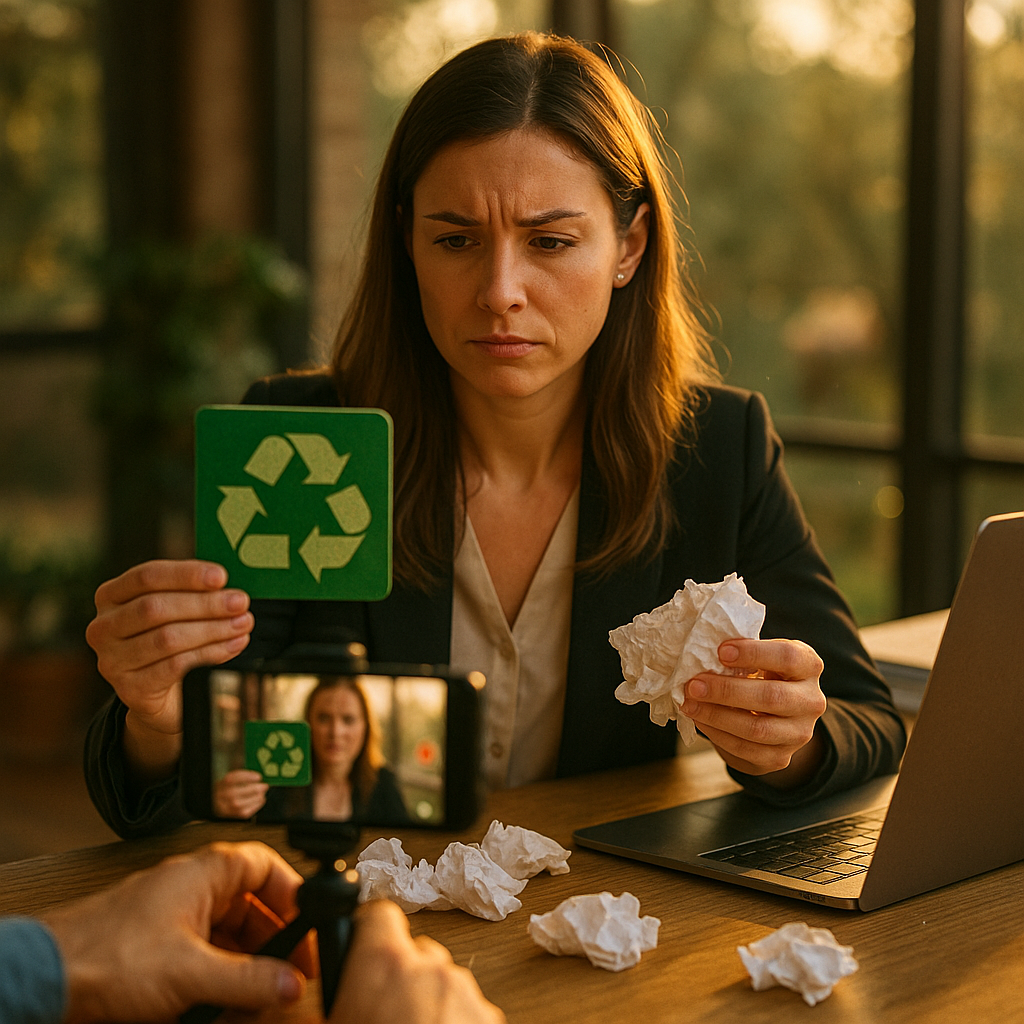
The FTC fined companies more than $2.9 million for environmental marketing violations in a single recent enforcement wave, and creator content was named explicitly in the complaint language. If your influencer program touches sustainability claims, carbon neutrality, or “clean” product language, you’re sitting on greenwashing liability whether you meant to or not. Most brands have no idea how exposed they are.
Why ESG Claims in Creator Content Are a Legal Minefield
Influencer marketing runs on enthusiasm. Creators exaggerate. That’s the job. A beauty influencer calls a serum “clean,” a fashion brand’s ambassador says a collection is “carbon neutral,” a home goods creator claims a product is “100% sustainable.” None of that language is neutral anymore. The FTC’s Green Guides, last substantively revised years ago but now under active review for an update, treat unsubstantiated environmental claims as deceptive advertising regardless of who utters them.
Here’s the part brands miss: the FTC doesn’t care whether the creator or the brand wrote the script. Under existing endorsement guidance, the advertiser is on the hook for creator claims made on its behalf, paid or gifted. That means a single TikTok caption calling your packaging “eco-friendly” without substantiation can become a federal matter with your company’s name on it, not the creator’s.
If a creator’s ESG claim wouldn’t survive a journalist’s fact-check, it won’t survive regulatory scrutiny either. Treat every sustainability word as a legal claim, not a vibe.
What Counts as a Greenwashing Claim? More Than You Think
Marketers tend to picture greenwashing as big, obvious lies. “This plastic bottle saves the ocean.” But regulators increasingly scrutinize soft language too. Words like “natural,” “green,” “conscious,” “planet-friendly,” and even “better for the environment” all require substantiation under FTC guidance if they imply a specific environmental benefit.
- Absolute claims: “Zero waste,” “carbon neutral,” “100% recyclable.” These need hard data, not marketing copy.
- Comparative claims: “More sustainable than leading brands.” Requires a defined, documented comparison.
- Certification claims: Referencing B Corp, Fair Trade, or similar labels when the certification has lapsed or never applied to the specific product.
- Implied claims: Green packaging, leaf icons, earthy color palettes paired with vague language. Visual cues can trigger the same scrutiny as text.
A creator doesn’t need to say “we tested this” to make an implied scientific claim. If they say a product “doesn’t harm the planet,” that’s a testable assertion in regulators’ eyes, and testable assertions need evidence on file.
The Brand’s Liability Doesn’t End with the Creator’s Post
This is where legal teams get nervous, and rightly so. Brand liability for ESG claims typically flows through three channels: the underlying product claim, the disclosure of material connection, and the amplification of the content through paid media.
If a brand whitelists or boosts a creator’s post making an unsubstantiated sustainability claim, that spend arguably strengthens the regulatory case against the brand, because now it’s not organic opinion, it’s paid advertising with the brand’s fingerprints on distribution. This overlaps heavily with existing disclosure obligations covered in our piece on whitelisting distribution rights. Any ESG claim that gets whitelisted deserves a second legal review pass before it ever touches an ad account.
There’s also a reputational dimension that outlasts any fine. Greenwashing accusations travel fast on the same platforms where the original claim lived. A $50,000 FTC penalty is often the smaller cost; the viral callout thread that follows is the one that actually damages brand equity.
Building a Pre-Approval Workflow for Sustainability Language
Most compliance failures aren’t malicious. They’re operational. Nobody built a checkpoint, so claims slip through in creator briefs, revised scripts, or live ad-libs. Fixing this doesn’t require a legal department overhaul, it requires a specific, narrow workflow for environmental language.
- Maintain a claims library. Document every substantiated environmental claim your brand can legally make, with the underlying data attached. Creators pull language only from this approved list.
- Flag ESG keywords in briefs. Any brief mentioning sustainability, carbon, recyclability, or ethical sourcing routes automatically to legal or compliance review, not just marketing sign-off.
- Review final cuts, not just scripts. Creators improvise. The gap between an approved script and a published video is where most liability lives. Build this into the same review cadence used for other regulated categories, similar to the approach outlined in compliance sign off workflows built for financial disclosures.
- Archive everything with timestamps. If a claim is ever challenged, you need proof of what was approved, when, and against what evidence.
Brands already running structured legal review for other high-risk categories, like finance or health, should treat ESG claims with the same rigor. The frameworks in our finfluencer legal review coverage translate almost directly, just swap “investment advice” for “environmental benefit.”
Disclosure Isn’t Optional, and It’s Not Just About #ad
There’s a second disclosure layer that brands routinely forget: when a creator is compensated specifically to promote an ESG initiative, the material connection disclosure needs to be unmistakable, and the claim itself needs its own substantiation trail. One without the other doesn’t satisfy regulators.
Platforms complicate this further. A carousel caption might carry a disclosure, but if the creator repeats the claim in a Story, a pinned comment, or a livestream without the same disclosure, you’ve got a gap. This mirrors issues we’ve covered around real-time disclosure compliance in livestream commerce, where claims move faster than legal review can keep up.
AI-generated content adds another layer of risk here too. If a brand uses AI tools to generate creator-style UGC making environmental claims, the FTC’s position on AI disclosure obligations, discussed in our analysis of AI generated UGC disclosure, applies with equal force. A synthetic creator claiming “sustainably sourced” carries the same liability as a human one.
Contracts: Where Most ESG Protection Gets Left Out
Pull up your current creator agreement. Does it include specific language requiring creators to use only brand-approved environmental claims? Most don’t. Standard influencer contracts cover usage rights, exclusivity, and payment terms, but ESG-specific indemnification language is rare, even at agencies that otherwise run tight compliance operations.
At minimum, contracts should include:
- A requirement that creators use only pre-approved sustainability language, with no ad-libbing on environmental claims.
- An indemnification clause specifying what happens if a creator makes an unauthorized claim that triggers regulatory action.
- A correction clause requiring immediate takedown or amendment if a claim is challenged, similar to the rapid-response structure described in our creator correction protocol piece.
- Insurance verification, since general liability coverage often excludes deceptive advertising claims. Brands and agencies should check whether errors and omissions insurance extends to environmental marketing disputes specifically.
Agencies licensing talent on a brand’s behalf carry their own exposure here too. The liability-sharing questions we raised in our piece on talent agency licensing apply directly: who vets the claim, who approves final cut, and who eats the penalty if it goes wrong.
What Regulators Are Actually Watching For Right Now
Regulatory attention on environmental marketing has intensified, not softened. The FTC has signaled ongoing review of the Green Guides with an eye toward digital and social-specific guidance, and state attorneys general have shown willingness to act independently of federal timelines. The FTC’s own guidance remains the baseline reference point, but brands operating internationally should also track the UK’s approach through the Information Commissioner’s Office, since EU and UK regulators have moved faster on environmental claim enforcement in some sectors than their U.S. counterparts.
Industry data backs up the urgency. Surveys tracked by eMarketer consistently show sustainability messaging rising in creator briefs year over year, even as brands’ actual verification processes lag behind. That gap between claim volume and claim verification is exactly where enforcement actions get built.
The brands getting burned aren’t the ones making bold green claims on purpose. They’re the ones who let creators fill the substantiation gap with enthusiasm instead of evidence.
A Quick Gut Check for Your Current Program
Ask yourself three questions about your active influencer campaigns right now. Can you produce documentation for every environmental claim a creator has made about your product in the last quarter? Does your legal team see ESG-related briefs before they go to creators, or only after content publishes? And do your contracts actually name environmental claims as a specific compliance category, or are they buried under generic “truthful advertising” boilerplate?
If you answered no to any of these, you have a gap worth closing before a regulator or a journalist finds it first. For brands scaling across multiple markets, this also intersects with broader disclosure consistency challenges covered in our global disclosure template library, since an ESG claim that’s compliant in one jurisdiction may not clear the bar in another.
Next step: Audit your last 90 days of creator content for environmental language, cross-reference each claim against documented substantiation, and build a standing legal checkpoint for any brief that mentions sustainability before a single video gets shot.
FAQs
Can a brand be held liable for a creator’s ESG claim it didn’t write?
Yes. The FTC generally treats the advertiser as responsible for endorsement claims made on its behalf, regardless of whether the brand scripted the exact language, especially when the brand paid for or amplified the content.
What environmental words trigger the most regulatory scrutiny?
Absolute terms like “carbon neutral,” “zero waste,” and “100% recyclable” draw the most attention because they imply specific, testable facts. Softer terms like “eco-friendly” or “green” still require substantiation but are judged on overall impression rather than a single word.
Do creator contracts need separate ESG claim language?
Yes. Most standard influencer contracts don’t address environmental claims specifically. Brands should add clauses requiring pre-approved sustainability language, indemnification for unauthorized claims, and a rapid correction process.
Does whitelisting a creator’s post increase ESG liability?
It can. Paying to distribute organic content that includes an unsubstantiated environmental claim strengthens the argument that the brand is directly responsible for the advertising claim, not just the creator’s personal opinion.
How often should ESG claims in creator content be reviewed?
Treat sustainability claims like any regulated category: review at the brief stage, review the final cut before publishing, and spot-check published content quarterly since creators often add unscripted commentary in Stories, comments, or livestreams.
Top Influencer Marketing Agencies
The leading agencies shaping influencer marketing in 2026
Agencies ranked by campaign performance, client diversity, platform expertise, proven ROI, industry recognition, and client satisfaction. Assessed through verified case studies, reviews, and industry consultations.
Moburst

-
2

The Shelf
Boutique Beauty & Lifestyle Influencer AgencyA data-driven boutique agency specializing exclusively in beauty, wellness, and lifestyle influencer campaigns on Instagram and TikTok. Best for brands already focused on the beauty/personal care space that need curated, aesthetic-driven content.Clients: Pepsi, The Honest Company, Hims, Elf Cosmetics, Pure LeafVisit The Shelf → -
3

Audiencly
Niche Gaming & Esports Influencer AgencyA specialized agency focused exclusively on gaming and esports creators on YouTube, Twitch, and TikTok. Ideal if your campaign is 100% gaming-focused — from game launches to hardware and esports events.Clients: Epic Games, NordVPN, Ubisoft, Wargaming, Tencent GamesVisit Audiencly → -
4

Viral Nation
Global Influencer Marketing & Talent AgencyA dual talent management and marketing agency with proprietary brand safety tools and a global creator network spanning nano-influencers to celebrities across all major platforms.Clients: Meta, Activision Blizzard, Energizer, Aston Martin, WalmartVisit Viral Nation → -
5

The Influencer Marketing Factory
TikTok, Instagram & YouTube CampaignsA full-service agency with strong TikTok expertise, offering end-to-end campaign management from influencer discovery through performance reporting with a focus on platform-native content.Clients: Google, Snapchat, Universal Music, Bumble, YelpVisit TIMF → -
6

NeoReach
Enterprise Analytics & Influencer CampaignsAn enterprise-focused agency combining managed campaigns with a powerful self-service data platform for influencer search, audience analytics, and attribution modeling.Clients: Amazon, Airbnb, Netflix, Honda, The New York TimesVisit NeoReach → -
7

Ubiquitous
Creator-First Marketing PlatformA tech-driven platform combining self-service tools with managed campaign options, emphasizing speed and scalability for brands managing multiple influencer relationships.Clients: Lyft, Disney, Target, American Eagle, NetflixVisit Ubiquitous → -
8

Obviously
Scalable Enterprise Influencer CampaignsA tech-enabled agency built for high-volume campaigns, coordinating hundreds of creators simultaneously with end-to-end logistics, content rights management, and product seeding.Clients: Google, Ulta Beauty, Converse, AmazonVisit Obviously →