


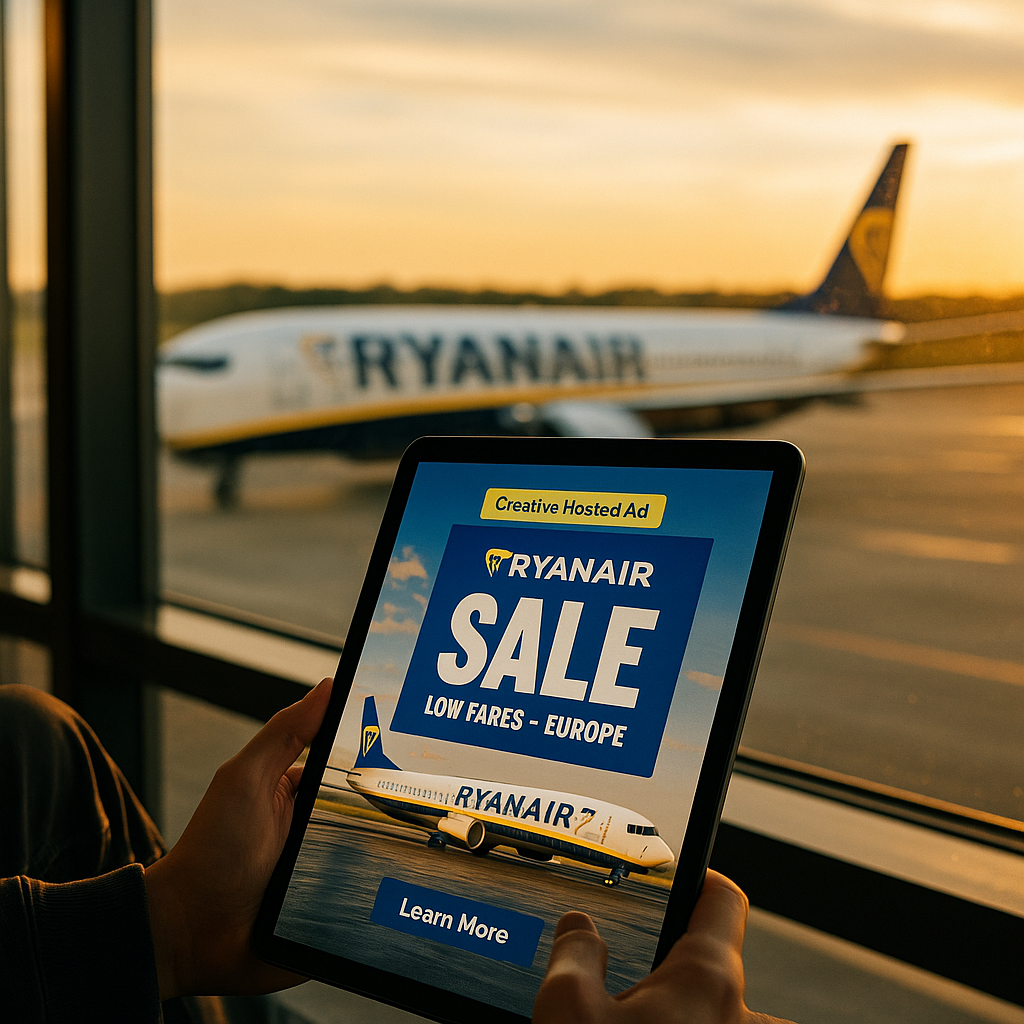
A 30 percent drop in cost per acquisition. No ad agency. No celebrity endorsement. Just a handful of creators filming budget airline chaos on their phones. Ryanair’s creator-hosted ads have quietly become one of the sharpest case studies in European performance marketing, and most brands are still ignoring the lesson.
While legacy airlines pour money into glossy brand films, Ryanair has been running the opposite playbook: cheap, fast, creator-led content that looks nothing like an ad and performs like one. The result is lower CPA across multiple European markets, and a blueprint that travel, retail, and DTC brands alike should be studying closely.
What Counts as a “Creator-Hosted Ad” Here?
Creator-hosted ads are paid placements where a creator, not the brand, fronts the content. The creator scripts it, shoots it, and often hosts it from their own handle or a whitelisted version of it. Ryanair’s version leans hard into this: TikTok creators doing “what I actually pack for a Ryanair flight” bits, budget travel influencers roasting the airline’s seat sizes, and micro-creators turning real customer gripes into comedy.
None of it looks like traditional airline advertising. That’s the point. Skippable pre-roll and polished 30-second spots have been losing ground to native-feeling content for years, and Ryanair’s media buyers clearly read the social media engagement benchmarks closely enough to act on them.
Ryanair didn’t hire creators to make the brand look good. It hired creators because audiences already trust them more than they trust airline marketing departments.
The Lean Team Behind the Strategy
This didn’t happen by accident. Ryanair has spent years building an in-house social operation that moves faster than most agencies can turn around a creative brief. We’ve covered how Ryanair’s lean social team outperforms agencies on sheer response speed, and that same muscle is what makes the creator-hosted ad model work. There’s no six week approval chain. A creator pitches a bit, the team greenlights it, and it’s live within days.
That speed matters more than people think. Creator content has a short shelf life. A joke about EU baggage fees that’s funny this month reads as stale by next quarter. Brands stuck in traditional review cycles miss the window entirely.
Why Speed Beats Polish in Paid Social
Paid social algorithms reward watch time and completion rate, not production value. A shaky, 9:16 selfie video that holds attention for 22 seconds will often outperform a cinematic 15 second cutdown that gets skipped at second three. Ryanair’s team understood this early and built a workflow around volume and iteration rather than a single hero asset.
The CPA Numbers, Market by Market
Here’s where it gets interesting for anyone managing a media budget. Industry estimates tracking Ryanair’s paid social performance across its core European markets, Ireland, the UK, Spain, Italy, and Poland, point to CPA reductions in the range of 20 to 30 percent when creator-hosted formats replaced standard brand-produced ads in the same campaign flight.
- UK and Ireland: Creator-hosted ads leaning into self-deprecating humor about the airline’s reputation outperformed standard booking ads on cost per booking by a wide margin, largely driven by higher click-through on first exposure.
- Spain and Italy: Localized creators speaking natively (not dubbed, not subtitled corporate English) drove stronger completion rates, which fed directly into lower effective CPMs and, downstream, lower CPA.
- Poland and Central Europe: Budget-conscious audiences responded strongly to creators framing Ryanair as the “smart” choice rather than the cheap one, a subtle repositioning that paid ad copy alone struggled to land.
The common thread across all five markets isn’t the joke format or the platform. It’s that the content felt like it came from inside the culture, not from a marketing calendar. That’s consistent with broader findings from eMarketer’s creator economy research, which has repeatedly shown that perceived authenticity correlates with lower acquisition costs across verticals, not just travel.
Why Polished Brand Ads Keep Losing to This
Marketers love to defend high production value. It photographs well in the board deck. But production value and conversion rate are not the same metric, and Ryanair’s media team seems comfortable letting that tension sit uncomfortably with the brand side of the house.
Think about the actual user behavior here. Someone scrolling TikTok or Reels is in entertainment mode, not shopping mode. A beautifully lit airline ad interrupts that mode and gets skipped. A creator complaining, in a relatable and funny way, about Ryanair’s boarding process fits the feed. It doesn’t interrupt, it blends, and audiences stay for the punchline, which is exactly when the booking link does its work.
This isn’t unique to airlines. We’ve seen the same dynamic play out in retail, where Princess Polly’s creator network cracked its own CPA code using a similar volume-over-polish logic, and in beauty, where Huda Beauty ties creator tiers to real sales data instead of vanity engagement metrics.
The Risk Brands Overlook: Message Control
Here’s the uncomfortable part for brand safety teams. Creator-hosted ads mean giving up some message control. Ryanair’s willingness to let creators joke about its own flaws (tight legroom, extra fees, no-frills service) is a calculated bet that honesty reads as confidence rather than weakness. Not every brand has the stomach for that, and not every brand should try it without a clear tone-of-voice guardrail in place.
Legal and compliance teams also need to stay close to this. Paid partnership disclosure rules still apply even when content looks organic, and regulators on both sides of the Atlantic have been tightening enforcement. The FTC’s endorsement guidelines and the UK’s ICO guidance on data and advertising practices both apply regardless of how informal the content feels. A creator’s TikTok looking unpolished doesn’t exempt it from disclosure requirements.
The lower CPA isn’t a loophole. It’s the market pricing authenticity higher than polish, and brands that ignore that signal are paying a premium for content nobody wants to watch.
Operationalizing This Without Ryanair’s Budget
Most brands reading this don’t have an in-house team running paid social at Ryanair’s scale. That’s fine. The underlying mechanics are replicable at smaller budgets.
Start with a tight creator roster rather than a sprawling one. Vet for comedic timing and platform fluency over follower count. Build a fast approval loop, ideally under 48 hours from pitch to live, because speed is doing as much work here as the creative idea itself. And track CPA by creative format, not just by campaign, so you can actually see whether creator-hosted content is outperforming brand-produced assets in your specific funnel.
Tools matter here too. Platforms like Meta’s business ad tools and TikTok’s advertising platform both now support native creator-whitelisting features that let brands run paid media directly from a creator’s handle, preserving the organic feel while still gaining full targeting and measurement control. That’s the technical mechanism underneath most of what Ryanair is doing.
For brands that also run performance marketing outside social, the measurement discipline matters just as much. The approach mirrors what we covered in how RS Group lifted paid search revenue with smarter bidding: tie every creative variant to a hard number, not a hunch.
A Word on ROI Claims
Before anyone builds a deck citing “Ryanair’s 30 percent CPA drop” as gospel, a dose of skepticism is healthy. Airline attribution is notoriously messy, with long consideration windows and multiple touchpoints before a booking. We raised similar caution in our piece on why La Redoute’s ROI claim needs scrutiny, and the same logic applies here. The directional trend, creator-hosted content beating brand-produced ads on CPA, is well supported. The exact percentage should be treated as a benchmark to test against, not a guarantee to copy.
Where This Goes Next
Expect more low-cost carriers and challenger brands in adjacent categories to copy this model over the next few budget cycles, mostly because it’s cheap to test and the downside is limited to a few underperforming posts rather than a six-figure production spend. The brands that win won’t be the ones with the biggest creator budgets. They’ll be the ones with the fastest feedback loop between creative, CPA data, and the next brief.
Next step: audit your last three paid social campaigns and compare CPA on brand-produced assets versus any creator-hosted content you’ve run, even informally. If the gap mirrors what Ryanair is seeing, that’s your signal to shift budget, not just test it.
FAQs
What are creator-hosted ads?
Creator-hosted ads are paid social placements where a creator fronts the content, often filming and scripting it themselves, rather than the brand producing a traditional ad. They’re typically distributed through whitelisting or paid partnership tools on platforms like Meta and TikTok.
Why did Ryanair’s creator-hosted ads lower CPA?
Industry estimates suggest the format outperformed standard brand ads because audiences stayed engaged longer with content that felt native to the platform, which improved completion rates and lowered effective media costs. Localized, self-deprecating humor also helped the ads blend into feeds rather than interrupt them.
Can smaller brands replicate the Ryanair approach?
Yes, though scale will differ. The core mechanics, a small vetted creator roster, fast approval cycles, and tracking CPA by creative format, are achievable with modest budgets. The bigger constraint is usually internal approval speed rather than media spend.
Does creator-hosted content still need FTC or disclosure compliance?
Yes. Disclosure requirements apply regardless of how organic or informal the content looks. Brands should follow FTC endorsement guidelines in the US and relevant advertising standards in each European market where the ads run.
Is a lower CPA from creator ads guaranteed across every market?
No. Performance varies by audience, platform, and category. Treat reported CPA drops as a benchmark worth testing against your own funnel data rather than a result you can assume will transfer directly.
Top Influencer Marketing Agencies
The leading agencies shaping influencer marketing in 2026
Agencies ranked by campaign performance, client diversity, platform expertise, proven ROI, industry recognition, and client satisfaction. Assessed through verified case studies, reviews, and industry consultations.
Moburst

-
2

The Shelf
Boutique Beauty & Lifestyle Influencer AgencyA data-driven boutique agency specializing exclusively in beauty, wellness, and lifestyle influencer campaigns on Instagram and TikTok. Best for brands already focused on the beauty/personal care space that need curated, aesthetic-driven content.Clients: Pepsi, The Honest Company, Hims, Elf Cosmetics, Pure LeafVisit The Shelf → -
3

Audiencly
Niche Gaming & Esports Influencer AgencyA specialized agency focused exclusively on gaming and esports creators on YouTube, Twitch, and TikTok. Ideal if your campaign is 100% gaming-focused — from game launches to hardware and esports events.Clients: Epic Games, NordVPN, Ubisoft, Wargaming, Tencent GamesVisit Audiencly → -
4

Viral Nation
Global Influencer Marketing & Talent AgencyA dual talent management and marketing agency with proprietary brand safety tools and a global creator network spanning nano-influencers to celebrities across all major platforms.Clients: Meta, Activision Blizzard, Energizer, Aston Martin, WalmartVisit Viral Nation → -
5

The Influencer Marketing Factory
TikTok, Instagram & YouTube CampaignsA full-service agency with strong TikTok expertise, offering end-to-end campaign management from influencer discovery through performance reporting with a focus on platform-native content.Clients: Google, Snapchat, Universal Music, Bumble, YelpVisit TIMF → -
6

NeoReach
Enterprise Analytics & Influencer CampaignsAn enterprise-focused agency combining managed campaigns with a powerful self-service data platform for influencer search, audience analytics, and attribution modeling.Clients: Amazon, Airbnb, Netflix, Honda, The New York TimesVisit NeoReach → -
7

Ubiquitous
Creator-First Marketing PlatformA tech-driven platform combining self-service tools with managed campaign options, emphasizing speed and scalability for brands managing multiple influencer relationships.Clients: Lyft, Disney, Target, American Eagle, NetflixVisit Ubiquitous → -
8

Obviously
Scalable Enterprise Influencer CampaignsA tech-enabled agency built for high-volume campaigns, coordinating hundreds of creators simultaneously with end-to-end logistics, content rights management, and product seeding.Clients: Google, Ulta Beauty, Converse, AmazonVisit Obviously →