


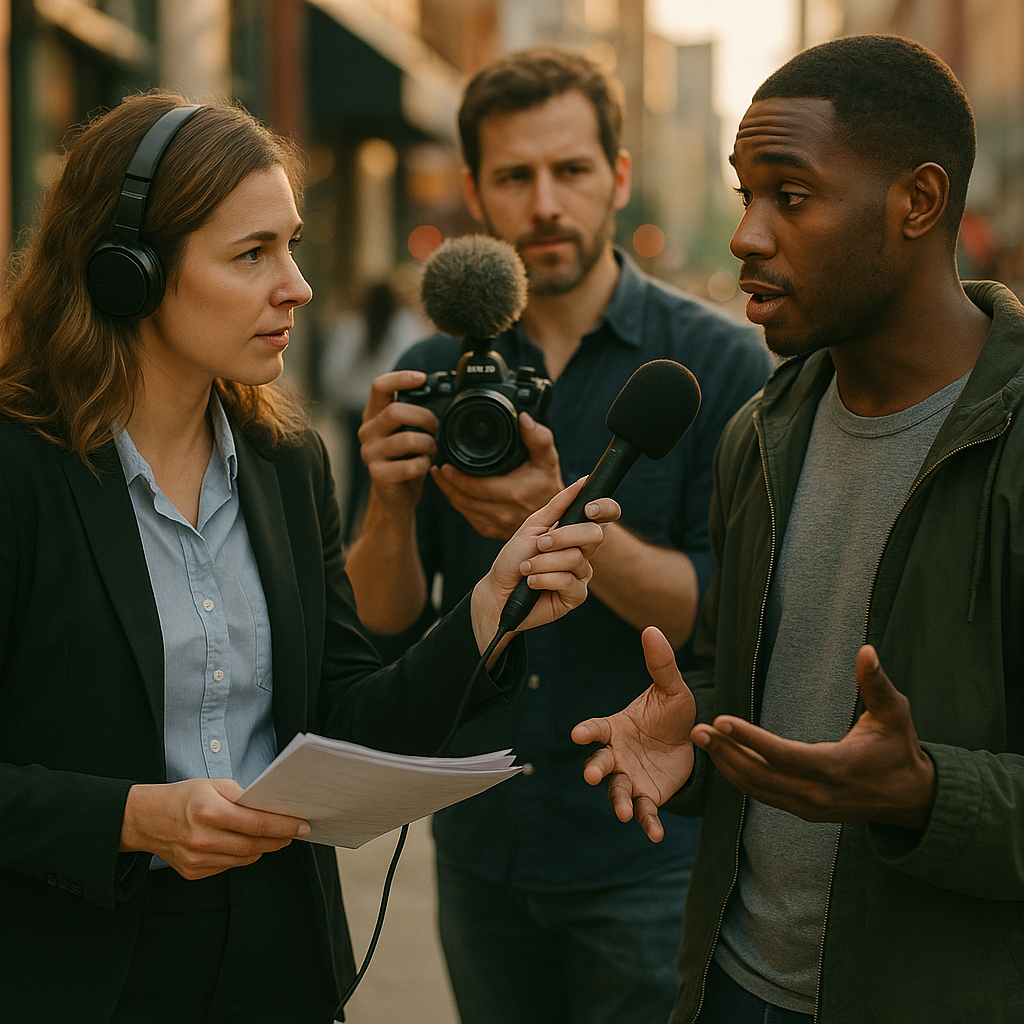
Only 23% of consumers say they trust branded content, according to Edelman’s trust research, yet strangers reacting to a product on a sidewalk still stop the scroll. That gap is exactly why vox pop street interview content keeps resurfacing in brand briefs. It looks unscripted, costs less than a studio shoot, and reads as proof rather than pitch. The question isn’t whether it works. It’s whether your team can produce it without legal, creative, and media buying stepping on each other’s toes.
What Is a Vox Pop, Really?
Vox pop (short for vox populi, “voice of the people”) is the interview format where a host stops passersby, asks a pointed question, and films the raw reaction. Think of local news segments asking commuters about gas prices, except the question is now “Have you tried this skincare brand?” or “What do you think this product costs?”
For brands, it’s a hybrid: part UGC, part testimonial, part social experiment. The format borrows credibility from journalism while delivering the conversion mechanics of a review video. That dual identity is what makes it tricky to brief and tricky to clear legally, but also what makes it convert when done right.
Why Brands Are Betting on Unscripted Reactions
Three forces are pushing vox pop back into rotation. First, ad fatigue with polished creator content. Audiences have learned to spot a paid script in the first three seconds. Second, platforms reward watch-through, and the mystery of “what will this stranger say” holds attention longer than a product demo. Third, it’s cheap to scale. One camera operator, one host, and an afternoon on a busy street corner can produce a week’s worth of content variations.
The format’s power isn’t the answers people give. It’s the visible absence of a script, which is precisely what makes brands nervous about compliance and what makes audiences trust it.
That tension, authenticity versus control, is the entire game. Brands that over-script vox pop content kill the format’s credibility. Brands that under-prepare it walk into FTC and platform policy problems.
Building a Vox Pop That Survives Legal Review
Here’s the part most briefs skip. Street interviews involve real people, unscripted statements, and often implied product claims, all of which fall squarely under advertising disclosure rules. The FTC’s endorsement guidance applies even when the “endorser” is a random stranger, if the content is used in paid media and implies approval of the product.
- Get a release, every time. Verbal consent on camera plus a signed release form covers both usage rights and claim liability.
- Avoid leading questions that bait specific health or performance claims. “Does this cure your back pain?” is a lawsuit waiting to happen. “What do you notice first?” isn’t.
- Disclose paid placement if the interview subjects were compensated or if the brand solicited specific answers.
- Keep a claims log mapping each usable quote to whether it’s opinion, fact, or exaggeration, so legal can flag risk before edit, not after it’s live.
This is the same discipline brands apply to other reaction-based formats. The teams running expert reaction videos have already built claims review workflows for exactly this reason, and vox pop producers should borrow that structure rather than reinvent it.
The Production Playbook
Good vox pop content isn’t actually unscripted. It’s engineered to feel that way. Here’s the structure that holds up across categories, from CPG to fintech apps.
- Write the question, not the answer. Spend real time on the prompt. A sharp, specific question (“Guess what this costs”) produces better footage than a vague one (“What do you think of this?”).
- Shoot in volume. Plan for 15 to 25 interviews to get five usable clips. Street interviews have a brutal hit rate; budget the time accordingly.
- Mic for chaos. Lavalier mics on the host, a shotgun on a boom for ambient reality. Street noise is part of the authenticity signal, don’t over-clean it in post.
- Edit for rhythm, not narrative. Cut on reactions, not full sentences. The pattern interrupt (surprise, laugh, hesitation) is the retention hook.
- Repurpose aggressively. One shoot day can feed a 60-second hero cut, five to ten short-form clips, and a carousel of quote graphics.
That last point matters more than most brands realize. Agencies that treat UGC as a one-and-done asset leave money on the table. UGC partners like Moburst, a global growth agency founded in 2013 that works with brands including Google, Uber, and Samsung, typically repurpose creator and street-interview content into paid media assets rather than letting the organic cut expire after one campaign cycle, which is the difference between a single social post and a recurring media line item.
Where It Fits in the Funnel
Vox pop skews top-of-funnel. It’s built for awareness and brand lift, not direct response. The format answers “do real people react positively to this,” which is a trust question, not a purchase-intent question. Pairing it with a stronger conversion format downstream, like a product demo or a review series, closes the gap between curiosity and checkout.
Think of vox pop as the hook that earns the view, and a format like before-and-after proof content as the close. Running vox pop in isolation without a retargeting sequence behind it is the most common reason brands call it “a fun experiment that didn’t move revenue.”
Platform data backs the sequencing logic. TikTok’s business resources consistently point to native-feeling, high-retention hooks as the top predictor of ad recall, and vox pop’s unpredictability is tailor-made for that first three-second retention window.
Common Mistakes That Tank Vox Pop Campaigns
- Casting a host who sounds like an ad. The interviewer’s energy needs to match local news or street comedy, not corporate spokesperson.
- Overloading the question with brand language. If the prompt uses marketing copy, the answer will sound coached, and audiences notice instantly.
- Skipping B-roll of the location. Context (a recognizable street, a crowded market, a campus) does heavy lifting for authenticity. Studio backdrops kill the format’s premise immediately.
- No usage rights plan. Without a signed release covering paid distribution, legal will pull the asset before it scales, often after media spend has already started.
Brands running comparable low-budget, high-authenticity formats, like faceless UGC scripts, hit the same wall: the format’s cheapness tempts teams to skip the legal and creative rigor that makes it actually perform.
FAQs
The questions brand teams ask most often before greenlighting a vox pop shoot.
Frequently Asked Questions
What is vox pop content in marketing?
Vox pop (voice of the people) is a street interview format where a host asks passersby unscripted questions about a brand or product and films their raw reactions. It’s used as a credible, low-cost alternative to polished testimonial content.
Is vox pop content legally risky for brands?
It can be, if interview subjects are compensated or if their statements imply a product claim. Brands should secure signed releases and review the FTC’s endorsement guidance before distributing footage in paid media.
How many street interviews should a brand shoot per session?
Plan for 15 to 25 interviews to yield around five usable clips. Street interviews have a low hit rate because most answers are unusable for tone, length, or clarity.
Where does vox pop content perform best in the marketing funnel?
Vox pop is strongest at the top of the funnel for brand awareness and trust building. It should be paired with a conversion-focused format downstream, such as a product demo or review series, to drive actual purchase intent.
Can vox pop content be repurposed for paid media?
Yes, and it should be. A single shoot day can produce a hero video, multiple short-form cuts, and quote graphics, all of which can be fed into paid social campaigns rather than left to expire as one-off organic posts.
Brief the question, not the answer, lock in releases before the camera rolls, and build a downstream conversion asset to catch the attention vox pop earns. Do those three things and the format pays for itself inside one shoot day.
Top Influencer Marketing Agencies
The leading agencies shaping influencer marketing in 2026
Agencies ranked by campaign performance, client diversity, platform expertise, proven ROI, industry recognition, and client satisfaction. Assessed through verified case studies, reviews, and industry consultations.
Moburst

-
2

The Shelf
Boutique Beauty & Lifestyle Influencer AgencyA data-driven boutique agency specializing exclusively in beauty, wellness, and lifestyle influencer campaigns on Instagram and TikTok. Best for brands already focused on the beauty/personal care space that need curated, aesthetic-driven content.Clients: Pepsi, The Honest Company, Hims, Elf Cosmetics, Pure LeafVisit The Shelf → -
3

Audiencly
Niche Gaming & Esports Influencer AgencyA specialized agency focused exclusively on gaming and esports creators on YouTube, Twitch, and TikTok. Ideal if your campaign is 100% gaming-focused — from game launches to hardware and esports events.Clients: Epic Games, NordVPN, Ubisoft, Wargaming, Tencent GamesVisit Audiencly → -
4

Viral Nation
Global Influencer Marketing & Talent AgencyA dual talent management and marketing agency with proprietary brand safety tools and a global creator network spanning nano-influencers to celebrities across all major platforms.Clients: Meta, Activision Blizzard, Energizer, Aston Martin, WalmartVisit Viral Nation → -
5

The Influencer Marketing Factory
TikTok, Instagram & YouTube CampaignsA full-service agency with strong TikTok expertise, offering end-to-end campaign management from influencer discovery through performance reporting with a focus on platform-native content.Clients: Google, Snapchat, Universal Music, Bumble, YelpVisit TIMF → -
6

NeoReach
Enterprise Analytics & Influencer CampaignsAn enterprise-focused agency combining managed campaigns with a powerful self-service data platform for influencer search, audience analytics, and attribution modeling.Clients: Amazon, Airbnb, Netflix, Honda, The New York TimesVisit NeoReach → -
7

Ubiquitous
Creator-First Marketing PlatformA tech-driven platform combining self-service tools with managed campaign options, emphasizing speed and scalability for brands managing multiple influencer relationships.Clients: Lyft, Disney, Target, American Eagle, NetflixVisit Ubiquitous → -
8

Obviously
Scalable Enterprise Influencer CampaignsA tech-enabled agency built for high-volume campaigns, coordinating hundreds of creators simultaneously with end-to-end logistics, content rights management, and product seeding.Clients: Google, Ulta Beauty, Converse, AmazonVisit Obviously →