


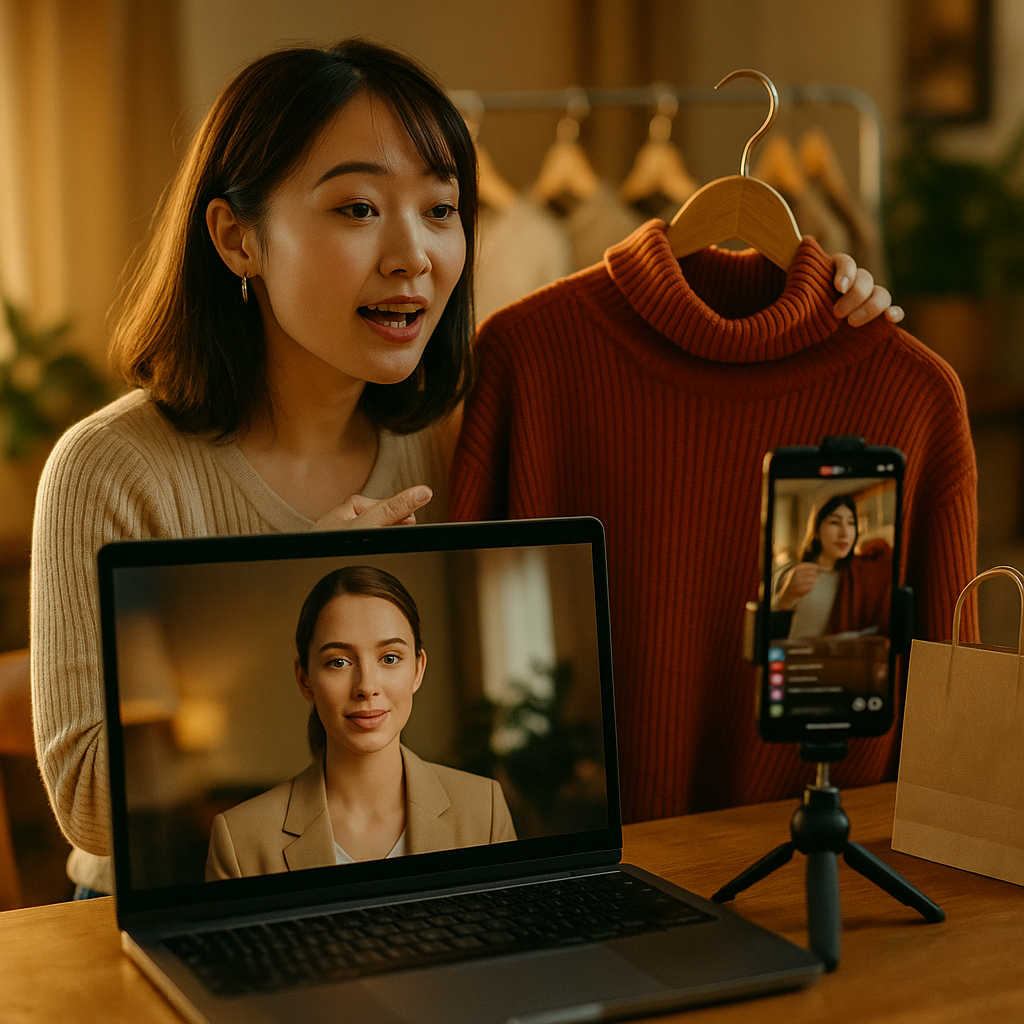
Alibaba’s Taobao reportedly ran over 100,000 hours of AI-hosted livestreams in a single quarter, and conversion rates on several of those streams matched human-hosted sessions. That number should make every brand marketer stop scrolling. AI avatar livestream shopping isn’t a novelty anymore. It’s a channel. But most brands are shipping avatars with scripts that sound like a customer service IVR system reading a catalog, and viewers bounce in under eight seconds.
The Uncanny Valley Problem Nobody’s Solving
Here’s the uncomfortable truth: the visual fidelity of AI avatars has outpaced the writing that powers them. Brands spend six figures on a photorealistic digital host, then hand it a script written like a product spec sheet. The avatar looks human. It doesn’t sound human. That mismatch is worse than an obviously synthetic host, because viewers feel tricked rather than simply informed.
Livestream shopping lives or dies on perceived spontaneity. Shoppers tolerate scripted ads. They do not tolerate a “live” host who clearly never deviates, never reacts to the chat scrolling beside them, never stumbles over a word. The format promises presence. If the script can’t deliver that illusion convincingly, the whole channel underperforms regardless of how good the rendering engine is.
An avatar that recites specs perfectly is less persuasive than one that hesitates for half a second before answering a tough question. Imperfection reads as authenticity, and scripting for it on purpose is the actual skill.
What Makes a Script Feel Human (Not Robotic)
Human hosts win trust through micro-behaviors most brands never bother to write down. Filler words. Self-correction. A joke that doesn’t quite land, followed by a laugh at their own expense. If you’re briefing an AI avatar host, you need to script these deliberately, because the model won’t invent them on its own unless prompted.
- Conversational scaffolding over bullet delivery: write the script as if transcribing a real conversation, with restarts and asides, not a teleprompter reading of talking points.
- Reaction windows: build in 3 to 5 second pauses scripted for “live” chat acknowledgment, even if the comment being responded to is pre-selected from a bank of likely questions.
- Opinion, not just information: “I actually wasn’t sold on this until I tried it in low light” sounds like a person. “This product features enhanced low-light performance” sounds like a press release.
- Vocal variance cues: mark where the avatar should speed up, slow down, or drop volume. Monotone delivery is the single fastest way to lose a shopper’s attention.
This approach overlaps heavily with the discipline covered in emotion controlled AI actors work, where tone becomes a scripting variable rather than an afterthought. The same logic applies here: tone isn’t something you fix in post, it’s something you write into the brief from line one.
Can an Avatar Handle Live Objections?
This is where most brands get nervous, and rightly so. A scripted avatar answering a real, unpredictable customer question in a live chat is a genuine risk surface. The fix isn’t improvisation (most platforms don’t support true real-time generative response at broadcast quality yet). The fix is objection mapping.
Before any stream goes live, pull the twenty most common objections from past customer service tickets, return reasons, and comment threads. Script tight, natural-sounding responses to each one, written in the same conversational register as the rest of the host’s dialogue. Queue them to trigger on keyword detection in the chat. Done well, viewers never know they’re watching a response bank. Done poorly, the avatar answers a question nobody asked, and the illusion collapses instantly.
The same groundwork used in myth busting video scripts transfers directly here. You’re pre-empting skepticism with rehearsed honesty instead of reactive defensiveness.
A Scripting Framework That Actually Scales
Most AI avatar livestream failures trace back to treating the script as a single document instead of a modular system. Here’s the structure that holds up across multi-hour streams:
- Cold open (30 to 45 seconds): a human-sounding hook, not a brand tagline. Think “okay, I need to be honest about something before we start” rather than “welcome to our exclusive live event.”
- Core demo loop: a repeatable 4 to 6 minute segment covering one product angle, built so it can be looped and reshuffled without feeling like a rerun. This is the same logic behind speed run demo videos, compressed enough to hold attention, modular enough to repeat.
- Social proof interjection: scripted mentions of real (or realistic, clearly labeled synthetic) customer reactions, timed to coincide with sales spikes or viewer count milestones.
- Objection handling block: the keyword-triggered response bank described above.
- Urgency close: scarcity or time-bound framing, delivered with the same conversational tone, not a jarring shift into hard-sell mode.
Brands running this on TikTok Shop or Amazon Live should treat the script library as a living asset, not a one-off production. Refresh the demo loop segments monthly based on what’s converting, the same way you’d rotate creative in a paid social campaign. Platforms like TikTok Shop and Meta’s commerce tools both reward sustained watch time, and stale scripts kill watch time faster than almost anything else.
Disclosure Isn’t Optional, and It’s Not Just a Caption
Regulators are paying attention to synthetic hosts, and the FTC’s guidance on endorsement and disclosure rules applies whether the host is a person or a digital render. The disclosure needs to be clear and conspicuous, not buried in a bio or flashed for half a second in small text.
Script the disclosure into the dialogue itself where possible. A line like “I’m an AI host, and everything I’m showing you is real product footage” does more work than an on-screen badge viewers tune out within minutes. This mirrors the approach used in expert reaction videos, where credibility is built into the script rather than assumed from the format.
Disclosure that’s scripted as part of the host’s personality builds more trust than disclosure that’s bolted on as a compliance afterthought, and it costs you almost nothing in watch time.
Measuring What Actually Matters
Vanity metrics mislead here more than almost any other format. Peak concurrent viewers looks great on a slide deck. It tells you nothing about whether the script is working. Track these instead:
- Watch time per demo segment: if viewers drop off at the same point in every stream, that segment’s script needs a rewrite, not a different avatar voice.
- Chat-to-conversion lag: how quickly does a scripted objection response translate into add-to-cart behavior? This tells you whether your response bank is actually persuasive.
- Repeat viewer rate: human-hosted streams build loyal recurring audiences. If your AI host isn’t generating any, the personality isn’t landing, regardless of sales numbers.
- Cost per completed watch hour: compare against human-hosted livestream benchmarks from eMarketer or Statista to know if the AI format is actually cheaper at equivalent engagement, not just cheaper on paper.
Brands that treat this like a performance channel rather than a tech demo are the ones seeing durable ROI. The ones treating it as a PR stunt tend to quietly kill the program within two quarters.
Where This Format Is Headed
Expect hybrid formats to become the norm: a human host for the first and last ten minutes of a stream, flanking hours of AI-hosted mid-stream content. This solves the trust problem at the entry and exit points, where viewers are most skeptical, while letting the avatar carry the repetitive middle stretch that burns out human hosts anyway. It’s a sensible compromise, and it borrows heavily from techniques used in POV narrative ads, where perspective shifts are scripted deliberately to maintain engagement across a longer runtime.
Frequently Asked Questions
Do viewers actually trust AI avatar hosts on livestream shopping platforms?
Trust depends heavily on disclosure and script quality rather than visual realism alone. Streams that clearly disclose the host is AI and that use conversational, imperfect dialogue tend to retain viewers and convert at rates close to human-hosted streams. Streams that try to pass the avatar off as human, or that rely on stiff, bullet-point delivery, see much higher drop-off.
How long should an AI avatar livestream shopping script run before it needs refreshing?
Most brands see fatigue set in after three to four weeks of running the same core script loop, even with demo segment rotation. Refresh the objection handling bank monthly and the demo loop segments at least every four to six weeks based on watch time drop-off points.
What’s the biggest compliance risk with AI avatar livestream hosts?
Inadequate or buried disclosure is the primary risk. Regulators expect clear, conspicuous AI disclosure, not a small badge or a one-time mention at the start of a multi-hour stream. Scripting disclosure into the host’s recurring dialogue reduces this risk significantly.
Can AI avatars handle unscripted questions during a live shopping stream?
Not reliably at broadcast quality in most current setups. The safer and more common approach is objection mapping: pre-scripting responses to the most likely questions and triggering them via keyword detection in the live chat, which preserves the live feel without the risk of an uncontrolled response.
Is AI avatar livestream shopping cheaper than running human-hosted livestreams?
Often yes on a cost-per-hour basis, since avatars can run 24/7 without fatigue or staffing costs. But cost efficiency only matters if engagement and conversion hold up, so brands should compare cost per completed watch hour rather than raw production cost alone.
Next step: audit your current livestream script for one thing only, where does it sound like a document versus a conversation, and rewrite that section first before touching the avatar model or platform settings.
FAQs
Do viewers actually trust AI avatar hosts on livestream shopping platforms?
Trust depends heavily on disclosure and script quality rather than visual realism alone. Streams that clearly disclose the host is AI and that use conversational, imperfect dialogue tend to retain viewers and convert at rates close to human-hosted streams. Streams that try to pass the avatar off as human, or that rely on stiff, bullet-point delivery, see much higher drop-off.
How long should an AI avatar livestream shopping script run before it needs refreshing?
Most brands see fatigue set in after three to four weeks of running the same core script loop, even with demo segment rotation. Refresh the objection handling bank monthly and the demo loop segments at least every four to six weeks based on watch time drop-off points.
What’s the biggest compliance risk with AI avatar livestream hosts?
Inadequate or buried disclosure is the primary risk. Regulators expect clear, conspicuous AI disclosure, not a small badge or a one-time mention at the start of a multi-hour stream. Scripting disclosure into the host’s recurring dialogue reduces this risk significantly.
Can AI avatars handle unscripted questions during a live shopping stream?
Not reliably at broadcast quality in most current setups. The safer and more common approach is objection mapping: pre-scripting responses to the most likely questions and triggering them via keyword detection in the live chat, which preserves the live feel without the risk of an uncontrolled response.
Is AI avatar livestream shopping cheaper than running human-hosted livestreams?
Often yes on a cost-per-hour basis, since avatars can run 24/7 without fatigue or staffing costs. But cost efficiency only matters if engagement and conversion hold up, so brands should compare cost per completed watch hour rather than raw production cost alone.
Top Influencer Marketing Agencies
The leading agencies shaping influencer marketing in 2026
Agencies ranked by campaign performance, client diversity, platform expertise, proven ROI, industry recognition, and client satisfaction. Assessed through verified case studies, reviews, and industry consultations.
Moburst

-
2

The Shelf
Boutique Beauty & Lifestyle Influencer AgencyA data-driven boutique agency specializing exclusively in beauty, wellness, and lifestyle influencer campaigns on Instagram and TikTok. Best for brands already focused on the beauty/personal care space that need curated, aesthetic-driven content.Clients: Pepsi, The Honest Company, Hims, Elf Cosmetics, Pure LeafVisit The Shelf → -
3

Audiencly
Niche Gaming & Esports Influencer AgencyA specialized agency focused exclusively on gaming and esports creators on YouTube, Twitch, and TikTok. Ideal if your campaign is 100% gaming-focused — from game launches to hardware and esports events.Clients: Epic Games, NordVPN, Ubisoft, Wargaming, Tencent GamesVisit Audiencly → -
4

Viral Nation
Global Influencer Marketing & Talent AgencyA dual talent management and marketing agency with proprietary brand safety tools and a global creator network spanning nano-influencers to celebrities across all major platforms.Clients: Meta, Activision Blizzard, Energizer, Aston Martin, WalmartVisit Viral Nation → -
5

The Influencer Marketing Factory
TikTok, Instagram & YouTube CampaignsA full-service agency with strong TikTok expertise, offering end-to-end campaign management from influencer discovery through performance reporting with a focus on platform-native content.Clients: Google, Snapchat, Universal Music, Bumble, YelpVisit TIMF → -
6

NeoReach
Enterprise Analytics & Influencer CampaignsAn enterprise-focused agency combining managed campaigns with a powerful self-service data platform for influencer search, audience analytics, and attribution modeling.Clients: Amazon, Airbnb, Netflix, Honda, The New York TimesVisit NeoReach → -
7

Ubiquitous
Creator-First Marketing PlatformA tech-driven platform combining self-service tools with managed campaign options, emphasizing speed and scalability for brands managing multiple influencer relationships.Clients: Lyft, Disney, Target, American Eagle, NetflixVisit Ubiquitous → -
8

Obviously
Scalable Enterprise Influencer CampaignsA tech-enabled agency built for high-volume campaigns, coordinating hundreds of creators simultaneously with end-to-end logistics, content rights management, and product seeding.Clients: Google, Ulta Beauty, Converse, AmazonVisit Obviously →