


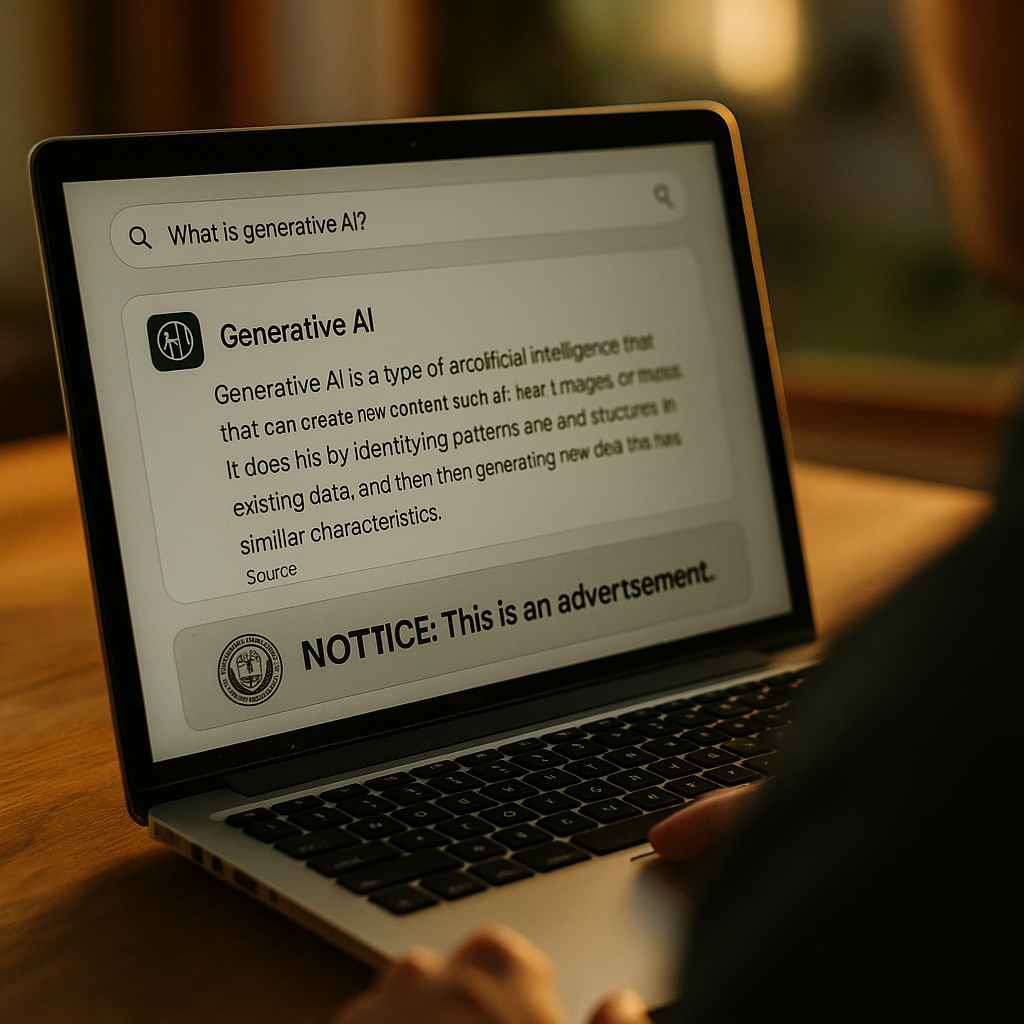
Nobody has paid a fine yet for an undisclosed ChatGPT placement. That doesn’t mean the FTC can’t come after one tomorrow. As brands funnel budget into getting mentioned favorably inside AI answer engines like ChatGPT, Perplexity, and Google’s AI Overviews, the central question marketing and legal teams are asking is simple: does AI answer engine placement disclosure fall under existing endorsement law, or is this a loophole nobody has closed yet?
The Short Answer: The FTC’s Rules Already Cover This
The Federal Trade Commission has never required a platform-specific rule to act. Its Endorsement Guides, most recently updated in 2023, apply to “any form of advertising message” that conveys a connection between a brand and a third party, human or otherwise. If a brand pays, trades product, or offers any other consideration to influence what an AI model surfaces or recommends, and a reasonable consumer wouldn’t otherwise expect that payment, the FTC’s existing material connection standard applies. Full stop.
The novelty isn’t the law. It’s the delivery mechanism. We’ve spent years building disclosure muscle memory around #ad tags on Instagram and spoken disclosures in YouTube intros. AI answer engines don’t have a comment section, a caption field, or a visible sponsorship tag baked into the UI. That absence of an obvious disclosure surface is exactly why brands are tempted to treat this as uncharted territory. It isn’t.
If a brand pays to influence what an AI model says about it, and the consumer can’t tell the difference between an organic answer and a paid one, that’s a material connection problem regardless of which interface delivers the message.
What “Paying for AI Visibility” Actually Looks Like
This isn’t science fiction. Several distinct practices already exist, and each carries different disclosure risk:
- Answer engine optimization (AEO) retainers: Agencies charging brands to structure content so it’s more likely to be cited by ChatGPT, Perplexity, or Google’s AI Overviews. This is closer to SEO than paid placement, since there’s no direct payment to the platform for a specific answer.
- Sponsored data partnerships: Deals where a brand’s product catalog, pricing feed, or review data gets ingested or prioritized by an AI tool’s retrieval system in exchange for licensing fees or revenue share.
- Perplexity’s sponsored answers: Perplexity has already piloted sponsored placements that appear alongside organic AI responses, functionally similar to a paid search ad.
- Creator mediated prompts: Influencers publishing content specifically engineered to train or influence AI outputs about a brand, sometimes under paid contracts that never mention disclosure obligations.
Each of these raises a different flavor of the same question: can the end user tell this was influenced by money? If the answer is no, you have a disclosure gap.
Why This Is Riskier Than Traditional Influencer Disclosure
With a human creator, there’s a person accountable for the post, a visible caption, and a platform with built-in disclosure tools like Instagram’s Paid Partnership label. AI answer engines strip all of that away. The output looks like a neutral, algorithmically generated answer, which is precisely what makes a paid influence on that output more deceptive, not less, in the FTC’s eyes.
Consider the parallel the agency has already drawn with AI generated spokespeople. Our coverage of synthetic endorsers and FTC gaps made clear that removing a human from the endorsement chain doesn’t remove the disclosure obligation. The same logic extends to answer engines. The FTC doesn’t care whether the recommendation came from a person, a virtual influencer, or a large language model. It cares whether consumers were misled about who paid for what they’re seeing.
There’s also a trust dimension that marketers underestimate. According to eMarketer, consumer trust in AI generated recommendations is still fragile, and a single high-profile “gotcha” story about undisclosed paid AI placements could do outsized reputational damage compared to a missed Instagram hashtag. Brands caught quietly buying their way into ChatGPT’s “best of” answers won’t get a warning letter from the FTC first. They’ll get a headline.
What Compliance Actually Requires Right Now
There’s no AI-specific FTC rule to point to, which means brands have to apply the existing framework thoughtfully rather than wait for new guidance that may take years. Here’s a practical checklist for legal and marketing teams evaluating AI visibility spend:
- Document the payment flow. If you’re paying a platform, a data broker, or a third-party optimization vendor to influence AI outputs, that contract needs the same disclosure language you’d put in an influencer agreement. For a template approach, review how brands have standardized this across markets in our global disclosure template library.
- Distinguish SEO-style optimization from paid placement. Structuring your website so AI models cite you more often is not inherently a disclosure trigger, since you’re not paying for a specific favorable mention. It becomes a problem the moment money changes hands for a guaranteed or weighted outcome.
- Audit creator contracts for AI training clauses. If influencers are being paid to produce content explicitly to shape what AI tools say about your brand, that arrangement needs the same disclosure rigor as any sponsored post. This overlaps heavily with the gaps identified in hybrid creator pay structures.
- Treat sponsored AI answers like paid search. When Perplexity or similar platforms label a response as sponsored, your legal exposure is lower because the platform is doing disclosure work for you. The risk concentrates in the gray zone where no such label exists.
- Loop in your insurance and legal review early. As with other emerging liability categories, brands are finding that errors and omissions coverage doesn’t automatically extend to novel disclosure failures unless policies are updated to reflect them.
Where the FTC Is Likely Headed
The FTC hasn’t issued AI answer engine specific guidance, but its pattern is consistent: regulate the behavior, not the technology. Recent enforcement actions against companies using fake reviews and undisclosed AI-generated testimonials signal the agency’s comfort applying existing endorsement principles to new formats without waiting for Congress. Brands betting that AI answer engines are a regulatory blind spot are reading the room wrong.
It’s also worth watching how platform-level transparency rules evolve. Google has already built AI Overviews disclosure norms into its ad policies, and Google’s support documentation increasingly addresses how sponsored content interacts with AI-generated summaries. Expect Perplexity, Bing, and others to follow with explicit sponsored labeling requirements, partly to get ahead of FTC scrutiny themselves.
Meanwhile, state-level deepfake and likeness laws are expanding the liability map in adjacent areas. If your brand is also experimenting with AI-generated endorsers or synthetic spokespeople inside these answer engine strategies, the compliance overlap is real. Our breakdown of state deepfake likeness laws is a useful companion read for any team running both AI visibility campaigns and synthetic media simultaneously.
The Practical Bottom Line for Brand Teams
Treat every dollar spent influencing an AI answer engine’s output the same way you’d treat a paid media buy or a sponsored influencer post. Ask one question before any contract gets signed: would a reasonable consumer assume this recommendation was neutral? If the answer is no, you need a disclosure mechanism, even if the platform hasn’t built one for you yet.
Brands that get ahead of this now, by building AI visibility spend into existing disclosure review workflows, will avoid being the test case the FTC uses to set precedent. Nobody wants to be that headline.
Frequently Asked Questions
Does the FTC have a rule specifically for AI answer engine placements?
No. The FTC applies its existing Endorsement Guides, which cover any paid or incentivized influence over consumer-facing recommendations, regardless of the delivery format. There is no AI-specific rule yet, but the material connection standard already applies.
Is paying for SEO or answer engine optimization the same as a paid placement?
Generally no. Optimizing your content so AI models are more likely to cite you organically is not a disclosure trigger. It becomes one if you’re paying a platform or vendor for a guaranteed or weighted favorable mention.
What happens if a brand pays for a sponsored answer on a platform like Perplexity?
If the platform clearly labels the response as sponsored, that labeling likely satisfies disclosure expectations. Risk increases significantly in situations where no visible sponsorship label exists and consumers can’t distinguish paid from organic AI outputs.
Can influencers be paid to shape what AI tools say about a brand?
Yes, and this arrangement should be treated like any other sponsored content deal. If a creator is compensated to produce content specifically to influence AI training data or outputs, standard endorsement disclosure rules apply to that relationship.
Who is liable if an AI answer engine placement violates disclosure rules?
Liability typically falls on the brand paying for the influence, along with any agency or platform that structured the arrangement. The FTC has consistently held brands accountable even when a third party executed the actual placement.
Top Influencer Marketing Agencies
The leading agencies shaping influencer marketing in 2026
Agencies ranked by campaign performance, client diversity, platform expertise, proven ROI, industry recognition, and client satisfaction. Assessed through verified case studies, reviews, and industry consultations.
Moburst

-
2

The Shelf
Boutique Beauty & Lifestyle Influencer AgencyA data-driven boutique agency specializing exclusively in beauty, wellness, and lifestyle influencer campaigns on Instagram and TikTok. Best for brands already focused on the beauty/personal care space that need curated, aesthetic-driven content.Clients: Pepsi, The Honest Company, Hims, Elf Cosmetics, Pure LeafVisit The Shelf → -
3

Audiencly
Niche Gaming & Esports Influencer AgencyA specialized agency focused exclusively on gaming and esports creators on YouTube, Twitch, and TikTok. Ideal if your campaign is 100% gaming-focused — from game launches to hardware and esports events.Clients: Epic Games, NordVPN, Ubisoft, Wargaming, Tencent GamesVisit Audiencly → -
4

Viral Nation
Global Influencer Marketing & Talent AgencyA dual talent management and marketing agency with proprietary brand safety tools and a global creator network spanning nano-influencers to celebrities across all major platforms.Clients: Meta, Activision Blizzard, Energizer, Aston Martin, WalmartVisit Viral Nation → -
5

The Influencer Marketing Factory
TikTok, Instagram & YouTube CampaignsA full-service agency with strong TikTok expertise, offering end-to-end campaign management from influencer discovery through performance reporting with a focus on platform-native content.Clients: Google, Snapchat, Universal Music, Bumble, YelpVisit TIMF → -
6

NeoReach
Enterprise Analytics & Influencer CampaignsAn enterprise-focused agency combining managed campaigns with a powerful self-service data platform for influencer search, audience analytics, and attribution modeling.Clients: Amazon, Airbnb, Netflix, Honda, The New York TimesVisit NeoReach → -
7

Ubiquitous
Creator-First Marketing PlatformA tech-driven platform combining self-service tools with managed campaign options, emphasizing speed and scalability for brands managing multiple influencer relationships.Clients: Lyft, Disney, Target, American Eagle, NetflixVisit Ubiquitous → -
8

Obviously
Scalable Enterprise Influencer CampaignsA tech-enabled agency built for high-volume campaigns, coordinating hundreds of creators simultaneously with end-to-end logistics, content rights management, and product seeding.Clients: Google, Ulta Beauty, Converse, AmazonVisit Obviously →