


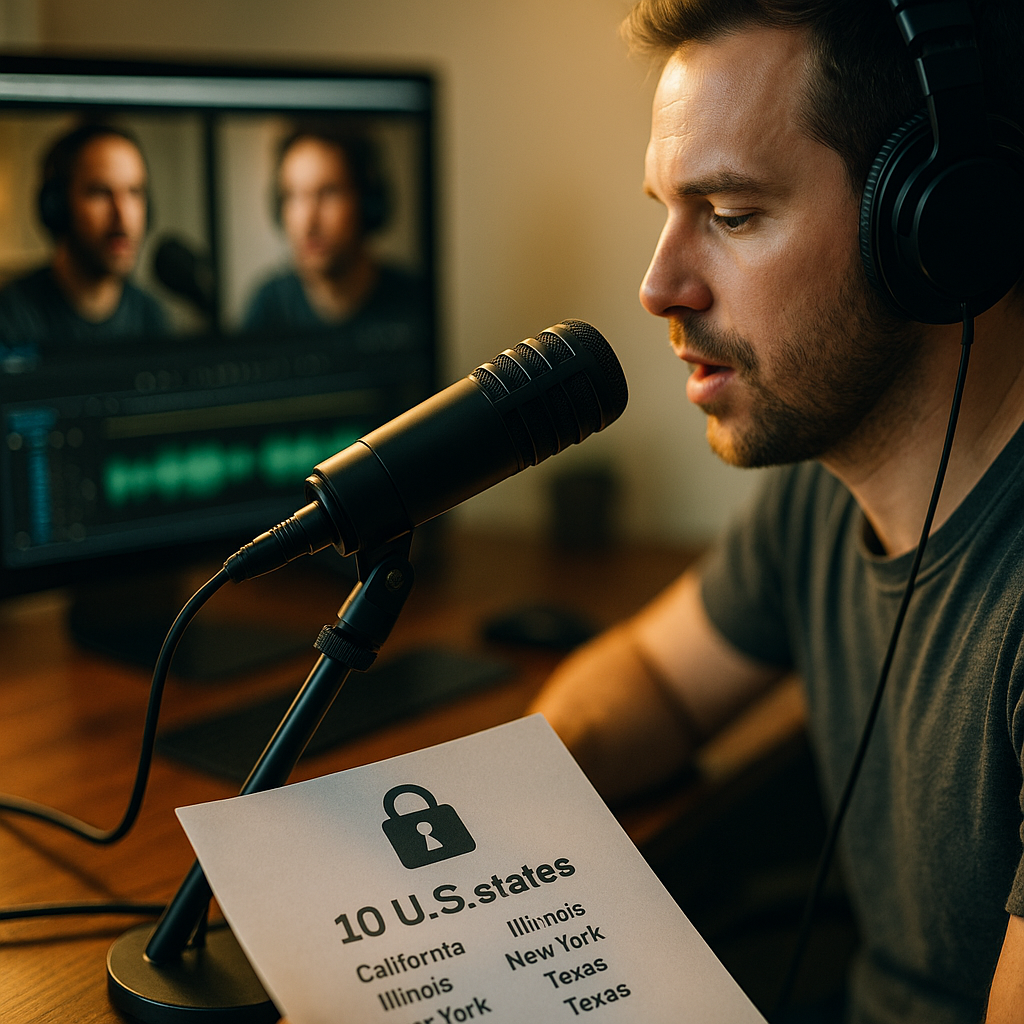
Nineteen states now have codified right-of-publicity statutes, and ten of them explicitly cover voice as a protected attribute. If your team is dubbing creator content into Spanish, French, or Portuguese using AI voice cloning and shipping it without a legal gate, you’re one Tennessee ELVIS Act complaint away from a very expensive lesson in AI voice-cloned creator dubbing liability.
This isn’t hypothetical anymore. Voice cloning tools like ElevenLabs and HeyGen have made multilingual dubbing a checkbox feature, not a production line item. Marketing teams love the speed. Legal teams are terrified of the exposure. And most brands still don’t have a repeatable process that sits between “creative wants to ship” and “this actually cleared review.”
Why Voice Cloning Broke the Old Consent Model
Traditional creator contracts were built for a world where dubbing meant hiring a voice actor or, at most, licensing a translated script read by the original creator. Right-of-publicity clauses covered “likeness” and sometimes “voice,” but nobody anticipated a scenario where a brand clones a creator’s actual vocal signature and generates entirely new speech that creator never said.
That gap matters because right-of-publicity statutes vary wildly on what counts as unauthorized use. California’s statute (Civ. Code § 3344) explicitly names voice. New York’s amended civil rights law does too, post-2021 reforms. Tennessee’s ELVIS Act, passed specifically to address AI voice cloning, gives residents an aggressive private right of action. Meanwhile, states like Texas and Florida lean on broader misappropriation-of-likeness doctrine that courts are still interpreting for synthetic voice cases.
Ten states with materially different right-of-publicity language means a single national dubbing campaign can be compliant in Ohio and actionable in Tennessee — using the exact same audio file.
That’s the core operational problem. You can’t build one clearance workflow and assume it travels. You need a gate that checks jurisdiction-specific triggers before assets go live, not after a cease-and-desist letter arrives.
The Ten-State Patchwork, Simplified
Legal teams tracking this space generally watch: California, New York, Tennessee, Texas, Illinois, Washington, Nevada, Ohio, Kentucky, and Indiana. Each has distinct triggers:
- Consent specificity — some states require consent naming the specific use (dubbing, synthetic voice), not blanket “marketing use” language.
- Commercial purpose threshold — what counts as “commercial use” differs; some carve out news/parody, others don’t.
- Post-mortem rights — several states (Tennessee, Washington, Indiana) extend publicity rights after death, relevant for legacy creator content libraries.
- Statutory damages — California and Tennessee allow statutory damages without proving actual harm, which changes settlement math dramatically.
- Safe harbor for disclosed AI use — a few emerging statutes reduce liability if synthetic voice use is clearly disclosed to viewers.
None of this is exotic legal trivia. It’s the operating reality for any brand running creator content across multiple state audiences, which is basically every brand running paid social at scale.
What an Internal Legal Gate Actually Looks Like
Forget the idea that “legal review” means a lawyer eyeballs a video before it posts. That doesn’t scale, and it doesn’t catch state-specific issues because most in-house counsel isn’t tracking ten statutes’ worth of nuance in their head. A real gate is a structured checkpoint system with defined inputs, decision criteria, and sign-off logic.
Here’s the skeleton we’d recommend building, based on patterns already working for FTC disclosure gates:
Step 1: Consent Capture at the Contract Level
Voice cloning consent has to be its own contract clause, separate from general likeness usage. It should specify: what languages/dialects the clone will produce, whether the creator can revoke consent, compensation tied to synthetic use (not just the original content), and a hard cap on how long the clone can be used post-relationship. Generic “brand may edit and modify content” language will not hold up under Tennessee’s ELVIS Act or California’s statute. For a template structure, see our breakdown of a legal review gate for AI-dubbed creator voice cloning ads, which walks through clause language brands are already adopting.
Step 2: Jurisdiction Tagging Before Production
Before any dubbed asset gets built, tag the target ad markets. If a campaign runs in Tennessee, Kentucky, or Washington, flag it for enhanced review automatically. This should happen in the media plan, not after the creative team has already delivered five language variants. Build a simple decision tree: does the target geo have a named voice-cloning statute? Does it allow statutory damages? Does it require explicit per-use consent? Route accordingly.
Step 3: Disclosure Layer
Several state statutes and the FTC’s general posture both reward clear disclosure. A visible “AI-dubbed voice” label or on-screen disclosure reduces both regulatory and reputational risk. This overlaps heavily with existing synthetic media disclosure work — see our piece on a synthetic performer disclosure clause that already threads NY, CA, and EU AI Act requirements. Building your voice-dubbing disclosure on the same framework saves you from maintaining parallel systems.
Step 4: Legal Sign-Off With a Decision Log
Every asset that clears the gate needs a timestamped decision log: who reviewed it, which statutes were checked, what consent document it maps to, and what disclosure was applied. This isn’t bureaucratic overhead — it’s your defense file if a Tennessee resident’s estate or a California creator’s lawyer comes calling eighteen months later. Courts and regulators respond well to documented process. “We had a system and followed it” is a materially better position than “we moved fast.”
Where Brands Actually Get This Wrong
Three failure patterns show up repeatedly in this category:
First, treating voice cloning consent as covered by the original influencer agreement. It almost never is, unless someone specifically negotiated it. Most 2023-era creator contracts (still in force for many ongoing partnerships) never contemplated synthetic voice generation at all.
Second, applying a single national compliance standard and hoping it’s conservative enough to cover everyone. This sounds efficient but usually means either over-restricting (losing usable content) or under-restricting (missing Tennessee’s aggressive statute because the team defaulted to California’s more familiar framework).
Third, no revocation mechanism. If a creator terminates the relationship or objects to specific dubbed content, can your systems actually pull that asset from every ad account, every regional variant, every retargeting pool? Most brands can’t answer that quickly. That’s a right-of-publicity claim waiting to happen, especially in states with strong post-termination protections.
The single biggest liability isn’t cloning the voice — it’s cloning it once and reusing it indefinitely without a re-consent checkpoint.
Building the Escalation Path
A legal gate is only as good as what happens when something fails it. Define three tiers:
- Tier 1 — Auto-clear: Standard dubbing, consent on file, non-high-risk states, disclosure applied. No escalation needed.
- Tier 2 — Legal review: High-risk state targeting, ambiguous consent language, or creator has raised prior concerns. Requires named legal sign-off within a set SLA (48-72 hours is reasonable).
- Tier 3 — Executive escalation: Post-mortem rights implicated, statutory damages state, or any creator dispute already in motion. Requires GC or outside counsel involvement before anything ships.
This mirrors the tiered structures already working well in livestream compliance contexts — our three-tier escalation protocol for livestream shopping is a useful reference model for how to structure the sign-off cadence without slowing every asset down to a crawl.
Don’t skip building an escalation matrix that aligns this with FTC and state AG exposure too. Voice cloning issues rarely arrive in isolation; they usually show up alongside disclosure gaps or platform policy violations, and your response needs to address all three simultaneously.
The Contract Fix You Need Now
If there’s one action item to take from this piece, it’s this: audit every active creator contract for voice-cloning language before your next dubbing campaign, not after. Pull in your existing script approval clause work and extend it explicitly to synthetic voice generation rights. And if any creator relationships involve equity or long-term revenue share, cross-check against state-level creator equity risk, since voice-clone disputes and compensation disputes tend to surface together in litigation.
Industry data backs the urgency here. eMarketer estimates continued double-digit growth in AI-generated ad content spend, and Statista tracking shows synthetic media adoption climbing across nearly every ad category. Regulators are watching this trajectory closely. The FTC has already signaled interest in AI-generated endorsement content broadly, and state attorneys general move faster than federal rulemaking when a resident files a complaint.
Practical Build Checklist
- Map every active market to its right-of-publicity statute status (named voice protection, statutory damages, post-mortem rights).
- Rewrite creator consent clauses to name synthetic voice cloning explicitly, with compensation and revocation terms.
- Implement a disclosure standard for AI-dubbed voice, reused across FTC and state requirements where possible.
- Build the three-tier escalation path with named owners and SLAs.
- Create a takedown protocol that can pull dubbed assets across every platform within 24 hours of revocation.
- Log every clearance decision — jurisdiction, consent doc, disclosure applied, reviewer name, timestamp.
None of this requires a massive legal budget. It requires a documented process that someone actually owns, and a habit of checking jurisdiction before creative goes into production instead of after.
Start with the audit, not the tooling. Fix your creator contracts for synthetic voice consent this quarter, then layer the jurisdiction-tagging workflow on top — the gate only works if the underlying consent is actually enforceable.
FAQs
What states currently have right-of-publicity statutes covering AI voice cloning?
California, New York, and Tennessee have the most explicit statutory language covering synthetic voice, with Tennessee’s ELVIS Act specifically targeting AI voice cloning. Texas, Illinois, Washington, Nevada, Ohio, Kentucky, and Indiana round out the ten states brands most commonly need to track, though interpretation varies and case law is still developing in several of them.
Does a general influencer contract cover voice cloning consent?
Almost never, unless the contract specifically names synthetic voice generation as a permitted use. Most existing creator agreements were written before voice cloning tools were widely deployed and only cover likeness, image, and standard content usage rights.
What’s the difference between right-of-publicity risk and FTC disclosure risk?
Right-of-publicity risk centers on unauthorized use of a person’s identity attributes, including voice, for commercial gain, and is governed by state law with private rights of action. FTC disclosure risk centers on consumer deception around endorsements and is governed by federal rules. A single dubbed ad can trigger both simultaneously.
How quickly should a brand be able to remove a disputed dubbed asset?
Within 24 to 48 hours across all platforms and regional ad accounts. Longer removal windows increase exposure, particularly in states with statutory damages that don’t require proof of actual harm.
Do disclosure labels reduce right-of-publicity liability?
Disclosure helps with consumer deception claims and regulatory goodwill, but it does not substitute for actual consent. A clearly labeled “AI-dubbed voice” clip using a creator’s cloned voice without proper consent is still a right-of-publicity violation in states with strong statutory protection.
FAQs
What states currently have right-of-publicity statutes covering AI voice cloning?
California, New York, and Tennessee have the most explicit statutory language covering synthetic voice, with Tennessee’s ELVIS Act specifically targeting AI voice cloning. Texas, Illinois, Washington, Nevada, Ohio, Kentucky, and Indiana round out the ten states brands most commonly need to track, though interpretation varies and case law is still developing in several of them.
Does a general influencer contract cover voice cloning consent?
Almost never, unless the contract specifically names synthetic voice generation as a permitted use. Most existing creator agreements were written before voice cloning tools were widely deployed and only cover likeness, image, and standard content usage rights.
What’s the difference between right-of-publicity risk and FTC disclosure risk?
Right-of-publicity risk centers on unauthorized use of a person’s identity attributes, including voice, for commercial gain, and is governed by state law with private rights of action. FTC disclosure risk centers on consumer deception around endorsements and is governed by federal rules. A single dubbed ad can trigger both simultaneously.
How quickly should a brand be able to remove a disputed dubbed asset?
Within 24 to 48 hours across all platforms and regional ad accounts. Longer removal windows increase exposure, particularly in states with statutory damages that don’t require proof of actual harm.
Do disclosure labels reduce right-of-publicity liability?
Disclosure helps with consumer deception claims and regulatory goodwill, but it does not substitute for actual consent. A clearly labeled “AI-dubbed voice” clip using a creator’s cloned voice without proper consent is still a right-of-publicity violation in states with strong statutory protection.
Top Influencer Marketing Agencies
The leading agencies shaping influencer marketing in 2026
Agencies ranked by campaign performance, client diversity, platform expertise, proven ROI, industry recognition, and client satisfaction. Assessed through verified case studies, reviews, and industry consultations.
Moburst

-
2

The Shelf
Boutique Beauty & Lifestyle Influencer AgencyA data-driven boutique agency specializing exclusively in beauty, wellness, and lifestyle influencer campaigns on Instagram and TikTok. Best for brands already focused on the beauty/personal care space that need curated, aesthetic-driven content.Clients: Pepsi, The Honest Company, Hims, Elf Cosmetics, Pure LeafVisit The Shelf → -
3

Audiencly
Niche Gaming & Esports Influencer AgencyA specialized agency focused exclusively on gaming and esports creators on YouTube, Twitch, and TikTok. Ideal if your campaign is 100% gaming-focused — from game launches to hardware and esports events.Clients: Epic Games, NordVPN, Ubisoft, Wargaming, Tencent GamesVisit Audiencly → -
4

Viral Nation
Global Influencer Marketing & Talent AgencyA dual talent management and marketing agency with proprietary brand safety tools and a global creator network spanning nano-influencers to celebrities across all major platforms.Clients: Meta, Activision Blizzard, Energizer, Aston Martin, WalmartVisit Viral Nation → -
5

The Influencer Marketing Factory
TikTok, Instagram & YouTube CampaignsA full-service agency with strong TikTok expertise, offering end-to-end campaign management from influencer discovery through performance reporting with a focus on platform-native content.Clients: Google, Snapchat, Universal Music, Bumble, YelpVisit TIMF → -
6

NeoReach
Enterprise Analytics & Influencer CampaignsAn enterprise-focused agency combining managed campaigns with a powerful self-service data platform for influencer search, audience analytics, and attribution modeling.Clients: Amazon, Airbnb, Netflix, Honda, The New York TimesVisit NeoReach → -
7

Ubiquitous
Creator-First Marketing PlatformA tech-driven platform combining self-service tools with managed campaign options, emphasizing speed and scalability for brands managing multiple influencer relationships.Clients: Lyft, Disney, Target, American Eagle, NetflixVisit Ubiquitous → -
8

Obviously
Scalable Enterprise Influencer CampaignsA tech-enabled agency built for high-volume campaigns, coordinating hundreds of creators simultaneously with end-to-end logistics, content rights management, and product seeding.Clients: Google, Ulta Beauty, Converse, AmazonVisit Obviously →