


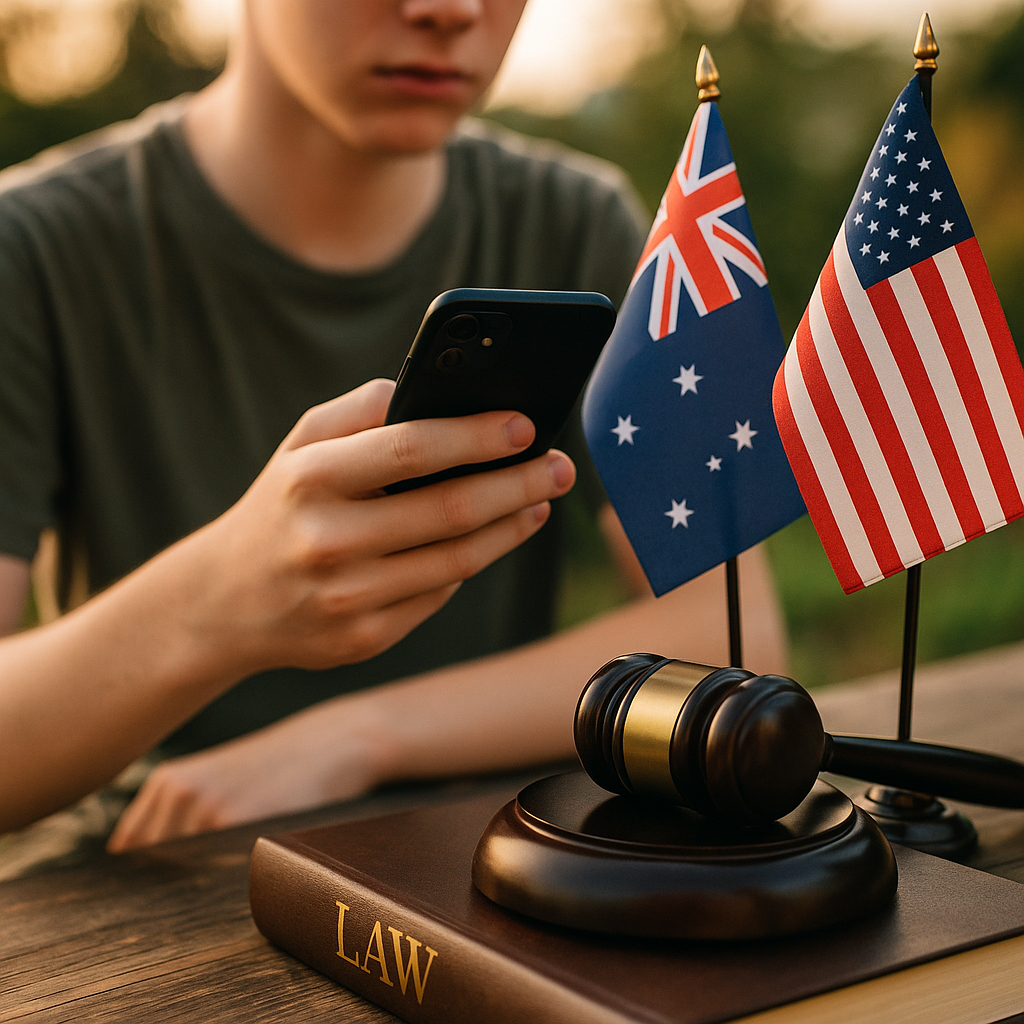
Australia just doubled the maximum fine for platforms that let under-16s onto social media, pushing penalties past AUD 100 million. Meanwhile, half a dozen US states are running their own age-verification experiments, each with different thresholds, consent mechanics, and enforcement teeth. If your youth-adjacent campaign runs in both markets, you’re not dealing with one compliance problem. You’re dealing with two moving targets that occasionally point at each other.
This isn’t an edge case anymore. Any brand touching gaming, beauty, fashion, ed-tech, or family entertainment is running influencer campaigns that skew young whether they intend to or not. Reconciling Australia’s penalty regime with the US state patchwork is now a core operational task, not a legal afterthought.
What Actually Changed in Australia
Australia’s Online Safety amendments raised maximum civil penalties for platforms that fail to prevent under-16 account creation to roughly double the prior ceiling, with regulators explicitly naming influencer-adjacent content funnels as an enforcement priority. The eSafety Commissioner has signaled it will look past the platform layer and into brand-sponsored content that predictably reaches under-16 audiences, even when the platform itself claims age-gating compliance.
That’s the part brand teams keep missing. The penalty targets platforms directly, but the enforcement lens extends to whoever is buying the placement. A brand running a paid partnership with a creator whose audience skews 13-15, on a platform that failed to gate that audience, can find itself named in regulatory correspondence even without a direct statutory penalty. Reputational and contractual fallout follows fast.
Doubling the fine didn’t just raise the stakes for platforms. It raised the evidentiary bar for every brand that can no longer claim ignorance of audience age composition.
The US State Patchwork Isn’t Waiting for Canberra
Meanwhile, Utah, Texas, Louisiana, and a growing list of states have passed or are enforcing age-verification statutes that require platforms to confirm user age before granting access to certain features, or require parental consent for minors below a set threshold. Some laws set the line at 16, some at 18, some create tiered consent requirements between 13 and 17. None of them use the same verification method. Some accept ID upload, some accept device-level signals, some are still litigating whether biometric estimation counts as sufficient.
Here’s the operational headache: a single influencer campaign creative, say, a skincare unboxing or a mobile game sponsorship, might be compliant in Texas, non-compliant in Utah, and sitting in a gray zone in California depending on how the platform implements its own age-assurance layer that quarter. Layer Australia’s stricter, centralized penalty regime on top, and you have three-plus overlapping compliance surfaces for one piece of content.
This is structurally similar to the tension covered in the DSA addictive-design ruling meeting the US state law patchwork, where a stricter foreign regulatory standard forced US-facing campaigns to adopt the higher bar globally rather than fragment creative by jurisdiction. The same logic applies here, just with age thresholds instead of design mechanics.
Why “Just Pick the Strictest Rule” Isn’t Actually Simple
The intuitive fix, build to the strictest jurisdiction, sounds clean until you try to implement it. Australia’s under-16 threshold is stricter numerically than most US state cutoffs of 18-with-consent-exceptions, but the mechanisms differ enough that strictest-by-number doesn’t mean strictest-by-process.
- Age threshold conflict: Australia bans under-16 access outright for in-scope platforms. Some US states allow under-18 access with verified parental consent. Building to “no one under 16” doesn’t satisfy states that require a consent workflow for 16-17 year olds specifically.
- Verification method conflict: Louisiana-style statutes lean toward ID verification. Australia’s approach is platform-side age assurance, not creative-side. A brand can’t verify age itself, it can only choose platforms and targeting settings that reduce exposure risk.
- Consent artifact conflict: US parental consent statutes often require a retained, auditable consent record. Australia’s regime doesn’t ask brands to collect consent, it asks platforms to prevent access. There’s no single consent artifact that satisfies both.
- Enforcement target conflict: Australia penalizes platforms with brand spillover risk. Several US statutes carry direct liability exposure for advertisers who “knowingly” target minors, a much lower bar to trip if your creator brief doesn’t explicitly document audience exclusion intent.
So “strictest rule wins” needs translation into “strictest process per risk category wins,” which is a harder brief to write but the only one that actually holds up.
Building One Global Brief That Survives Both Regimes
The workable model treats this as a documentation and targeting problem, not a creative-restriction problem. You’re not necessarily changing what the ad says. You’re changing what you can prove about who saw it and how you tried to keep it away from under-16 audiences.
Four elements belong in every youth-adjacent campaign brief now, regardless of market:
- Documented audience exclusion intent. Every campaign brief should state explicitly that under-16 audiences are excluded targets, with the platform-level settings used to enforce that (age-based ad targeting exclusions, interest-category suppression, creator audience demographic review before contracting).
- Creator audience composition audits pre-contract. Before signing, pull the creator’s audience age breakdown from platform analytics or a third-party tool. If a creator’s audience skews under-18 by more than a defined threshold, either exclude them from the campaign or require additional platform-side age gating on the specific post.
- Jurisdiction-tagged consent records. For US placements touching states with parental consent statutes, retain the consent artifact the platform generates, not just a checkbox confirmation. For Australia, retain the platform’s age-assurance compliance attestation, since brands can’t self-certify audience age there.
- A single disclosure and targeting standard, built to the tightest common denominator per category. Age threshold: default to 16 globally, even in states allowing 13-15 with consent, because it’s operationally simpler than running a bifurcated targeting matrix. Verification: default to platform-side age assurance plus creator audience audit, since that satisfies Australia’s approach and most US statutes’ spirit even if not every letter.
This isn’t dramatically different from the disclosure-layering approach brands already use for FTC compliance. If you’ve built a dual disclosure checklist for YouTube’s watch-time shift, you already have the muscle memory for running two compliance standards on one piece of content. Age-verification reconciliation is the same exercise with a different regulator.
The Contract Layer Nobody’s Updating Fast Enough
Most influencer contracts still treat age compliance as a boilerplate line, something like “creator will not knowingly target minors.” That language was written for a pre-2026 enforcement environment. It doesn’t hold up against Australia’s platform-side penalty doubling or state statutes that shift liability toward advertisers directly.
Contracts need three specific additions now:
- A warranty clause requiring creators to disclose known audience demographic skew at time of signing, refreshed quarterly for retained creators.
- An indemnification carve-out addressing regulatory penalty exposure tied to under-16 audience reach, distinct from general FTC disclosure indemnification already common in most creator agreements. This is the same structural gap addressed in indemnification clauses for AI shopping agent liability, where new regulatory categories outpaced existing contract templates.
- A platform-compliance representation, where the creator or their management confirms the platform used carries active age-assurance mechanisms in the campaign’s target markets.
None of this is legal boilerplate you can copy-paste from a template built two years ago. The regulatory categories didn’t exist in their current form back then.
If your creator contract’s age-compliance clause was written before Australia’s penalty doubling, it’s already out of date, regardless of what jurisdiction you’re running in.
Where the Data Gaps Still Hurt
The honest problem: audience age data is unreliable everywhere. Platform-reported age brackets rely on self-declared birthdates, and eMarketer research has repeatedly flagged that a meaningful share of teen users misreport age to bypass restrictions. That means your “compliant” targeting exclusion is only as good as the platform’s underlying age-signal accuracy, which nobody can fully audit from the brand side.
This is why creator audience composition review matters more than platform targeting settings alone. A creator whose comment sections and engagement patterns skew visibly younger than their reported demographic split is a signal worth acting on, even if the platform dashboard says otherwise. Treat platform data as a floor, not a ceiling, for your compliance judgment.
Tools like Sprout Social and platform-native analytics dashboards from Meta Business Suite give directional signal, but none of them are built as age-verification instruments. Don’t ask them to do a job they weren’t designed for. Build audits around triangulated signals, not a single dashboard number.
Fake or bot-inflated audiences compound this problem, since inflated follower counts obscure real demographic skew. The same audit discipline used in fake follower risk checks applies directly here, run it before signing, not after a campaign goes live and a regulator asks questions.
Frequently Asked Questions
FAQ Placeholder
Do Australia’s under-16 penalties apply directly to brands, or only platforms?
The statutory penalty targets platforms, not advertisers directly. But eSafety enforcement has extended scrutiny to sponsored content that predictably reaches under-16 audiences, creating reputational and contractual risk for brands even without a direct fine.
Is there a single age threshold that satisfies both Australia and US state laws?
No single number covers every statute cleanly. Defaulting to a 16-and-over targeting exclusion, paired with platform-side age assurance and creator audience audits, satisfies the intent of most regimes even though verification mechanics differ.
What should a creator contract include to address this risk?
Add a creator warranty on known audience demographic skew, an indemnification clause specific to under-16 regulatory exposure, and a representation confirming the platform used has active age-assurance mechanisms in target markets.
Can platform-reported audience age data be trusted for compliance purposes?
Treat it as a starting point, not proof. Self-reported birthdates are unreliable, so pair platform data with creator audience audits and engagement-pattern review before finalizing targeting decisions.
How often should audience composition audits happen for retained creators?
Quarterly, at minimum. Creator audiences shift, especially after viral content skews younger, so a one-time pre-contract check isn’t sufficient for ongoing partnerships.
The Next Move
Stop treating Australia’s penalty and the US state statutes as two separate compliance checklists. Build one brief around audience exclusion intent, creator audit cadence, and jurisdiction-tagged consent records, then let your legal team map it against each specific statute rather than starting from scratch every market launch.
FAQs
Do Australia’s under-16 penalties apply directly to brands, or only platforms?
The statutory penalty targets platforms, not advertisers directly. But eSafety enforcement has extended scrutiny to sponsored content that predictably reaches under-16 audiences, creating reputational and contractual risk for brands even without a direct fine.
Is there a single age threshold that satisfies both Australia and US state laws?
No single number covers every statute cleanly. Defaulting to a 16-and-over targeting exclusion, paired with platform-side age assurance and creator audience audits, satisfies the intent of most regimes even though verification mechanics differ.
What should a creator contract include to address this risk?
Add a creator warranty on known audience demographic skew, an indemnification clause specific to under-16 regulatory exposure, and a representation confirming the platform used has active age-assurance mechanisms in target markets.
Can platform-reported audience age data be trusted for compliance purposes?
Treat it as a starting point, not proof. Self-reported birthdates are unreliable, so pair platform data with creator audience audits and engagement-pattern review before finalizing targeting decisions.
How often should audience composition audits happen for retained creators?
Quarterly, at minimum. Creator audiences shift, especially after viral content skews younger, so a one-time pre-contract check isn’t sufficient for ongoing partnerships.
Top Influencer Marketing Agencies
The leading agencies shaping influencer marketing in 2026
Agencies ranked by campaign performance, client diversity, platform expertise, proven ROI, industry recognition, and client satisfaction. Assessed through verified case studies, reviews, and industry consultations.
Moburst

-
2

The Shelf
Boutique Beauty & Lifestyle Influencer AgencyA data-driven boutique agency specializing exclusively in beauty, wellness, and lifestyle influencer campaigns on Instagram and TikTok. Best for brands already focused on the beauty/personal care space that need curated, aesthetic-driven content.Clients: Pepsi, The Honest Company, Hims, Elf Cosmetics, Pure LeafVisit The Shelf → -
3

Audiencly
Niche Gaming & Esports Influencer AgencyA specialized agency focused exclusively on gaming and esports creators on YouTube, Twitch, and TikTok. Ideal if your campaign is 100% gaming-focused — from game launches to hardware and esports events.Clients: Epic Games, NordVPN, Ubisoft, Wargaming, Tencent GamesVisit Audiencly → -
4

Viral Nation
Global Influencer Marketing & Talent AgencyA dual talent management and marketing agency with proprietary brand safety tools and a global creator network spanning nano-influencers to celebrities across all major platforms.Clients: Meta, Activision Blizzard, Energizer, Aston Martin, WalmartVisit Viral Nation → -
5

The Influencer Marketing Factory
TikTok, Instagram & YouTube CampaignsA full-service agency with strong TikTok expertise, offering end-to-end campaign management from influencer discovery through performance reporting with a focus on platform-native content.Clients: Google, Snapchat, Universal Music, Bumble, YelpVisit TIMF → -
6

NeoReach
Enterprise Analytics & Influencer CampaignsAn enterprise-focused agency combining managed campaigns with a powerful self-service data platform for influencer search, audience analytics, and attribution modeling.Clients: Amazon, Airbnb, Netflix, Honda, The New York TimesVisit NeoReach → -
7

Ubiquitous
Creator-First Marketing PlatformA tech-driven platform combining self-service tools with managed campaign options, emphasizing speed and scalability for brands managing multiple influencer relationships.Clients: Lyft, Disney, Target, American Eagle, NetflixVisit Ubiquitous → -
8

Obviously
Scalable Enterprise Influencer CampaignsA tech-enabled agency built for high-volume campaigns, coordinating hundreds of creators simultaneously with end-to-end logistics, content rights management, and product seeding.Clients: Google, Ulta Beauty, Converse, AmazonVisit Obviously →