


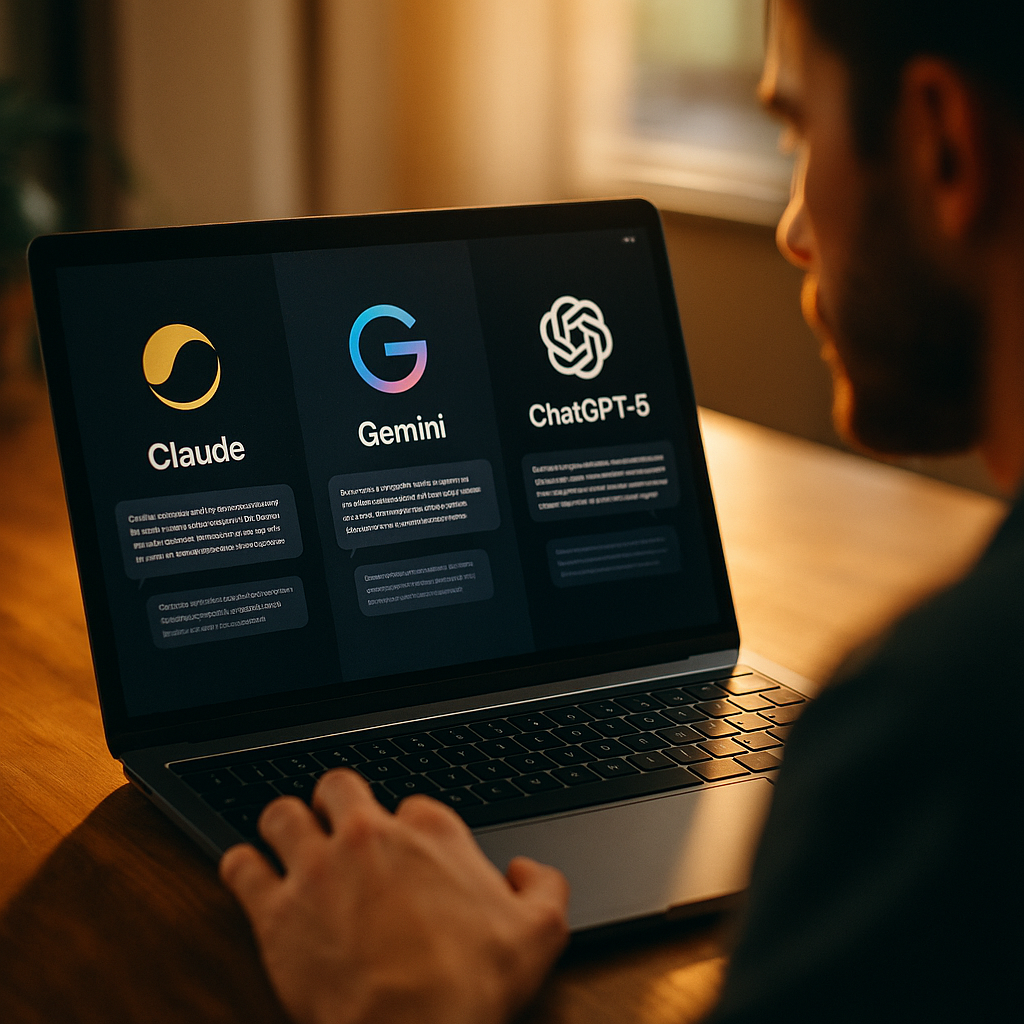
Feed the same 40-page brand voice guide to three leading AI models and ask for a product launch email. You’ll get three different brands. That’s the uncomfortable truth behind marketing copy accuracy in the current LLM landscape: fluency is solved, fidelity is not. We ran a controlled test across Claude, Gemini, and GPT-5 to see which model actually stays in character when the stakes are real.
Why Brand-Voice Fidelity Is the Metric No One’s Measuring
Most marketing teams evaluate AI copy on grammar, speed, and “does it sound human.” Wrong benchmark. The real question for a brand running dozens of campaigns a quarter is: does the output sound like us, consistently, across formats, without a human rewriting half of it?
That distinction matters more as AI-generated drafts move deeper into production workflows. A HubSpot survey on marketing AI adoption found the majority of teams now use generative tools for first-draft copy, but far fewer trust those drafts to ship without heavy editing (HubSpot). Editing time is the hidden cost center. If your team spends 20 minutes fixing tone on every AI draft, you haven’t automated copywriting — you’ve just relocated the labor.
The models that write the most “impressive” copy in isolation are often the worst at holding a brand’s specific voice across ten consecutive outputs.
The Test Setup: Same Brief, Same Guide, Three Models
We built a brand-voice fidelity test using a real (anonymized) mid-market DTC brand’s style guide: a slightly irreverent, Gen Z-adjacent skincare line with strict rules against superlatives, exclamation points, and “girlboss” language. We fed identical prompts to Claude, Gemini, and GPT-5, asking each to produce:
- A product launch email (150 words)
- Three Instagram captions for the same product
- A brand-safe response to a negative review
- An influencer briefing paragraph explaining tone to a creator partner
Each output was scored by two senior copywriters (blind to which model produced what) on a 1-5 scale across four dimensions: lexical match (banned/preferred words), sentence rhythm, humor calibration, and structural consistency. We ran the test three times per model to check for variance, since inconsistency itself is a fidelity failure.
Claude: Best at Holding Constraints, Slowest to Loosen Up
Claude was the most reliable at obeying explicit negative constraints — no exclamation points, no “elevate your routine,” no forced enthusiasm. Across all three runs, it violated zero banned-phrase rules. That’s a meaningful result for compliance-sensitive categories like beauty, finance, or health, where a single off-brand claim can trigger review headaches.
Where Claude struggled: humor. The brand’s voice guide called for dry, slightly self-deprecating wit. Claude’s captions were competent but flat, reading more like a well-behaved intern than the brand’s actual social manager. Two of three copywriters flagged the Instagram captions as “technically correct, personality-light.”
If your brand voice leans heavily on rule enforcement — pharma disclaimers, legal boilerplate, regulated claims — Claude’s conservatism is an asset, not a limitation. That’s consistent with what we’ve seen in broader brand compliance work, where predictability beats cleverness.
Gemini: Strong Structure, Occasional Tone Drift
Gemini produced the most structurally consistent outputs — clean paragraph breaks, predictable CTA placement, reliable formatting for email and social. That consistency is valuable for teams running high-volume production, where format matters as much as phrasing.
But tone drift showed up by the third generation in each run. The negative-review response, in particular, occasionally slipped into a more formal, customer-service register than the brand guide specified — technically polite, but noticeably more “corporate support ticket” than “brand with a personality.” This is a known challenge with models trained across broad enterprise use cases: they default toward safe, generic professionalism unless explicitly steered away from it.
Gemini’s integration with Google’s broader ecosystem is worth noting for teams already using AI search visibility tools — the workflow convenience is real, even if voice fidelity needs an extra editing pass.
GPT-5: Most Naturally Witty, Least Predictable
GPT-5 produced the copy our copywriters rated highest for “sounds like a person wrote this” — the humor calibration was genuinely close to brand-native in two of three runs. That’s a meaningful upgrade in marketing copy accuracy compared to earlier GPT generations, which tended to overdo enthusiasm and adjective density.
The catch: variance. Run-to-run consistency was the weakest of the three models. One run nailed the irreverent tone perfectly; another reintroduced a banned exclamation point and leaned noticeably more sales-y in the launch email. For a single hero piece of content, that unpredictability might not matter — you generate five options and pick the best. For high-volume, low-oversight production (think: hundreds of localized social captions), that variance becomes an operational risk.
The Real-World Stakes: Why This Isn’t Just an Academic Exercise
Brand consistency isn’t a soft metric. eMarketer and Statista data on content marketing consistently show that brand trust correlates directly with perceived consistency across touchpoints (eMarketer). When your Instagram captions sound like a different company than your email marketing, customers notice, even if they can’t articulate why.
There’s also a governance angle. As more brands deploy AI drafting into semi-autonomous workflows — feeding outputs directly into scheduling tools or even AI social posting agents — the margin for tone drift shrinks. A human editor catching an off-brand line before it’s scheduled is a safety net. Remove that human, and model-level fidelity becomes the only safety net you have.
Marketing copy accuracy isn’t about which model writes the “best” sentence. It’s about which model writes the same brand, ten times in a row, without supervision.
What This Means for Your Model Selection Strategy
Don’t pick a single model and standardize your whole content operation on it. That’s the mistake we see most often, usually driven by whichever enterprise contract procurement signed first. Instead, match the model to the risk profile of the content:
- High-compliance content (financial claims, health/beauty efficacy statements, legal disclaimers): favor Claude’s constraint discipline.
- High-volume, format-heavy production (email templates, multi-channel campaign rollouts): Gemini’s structural reliability reduces formatting QA time.
- Hero content and creative concepting (campaign taglines, influencer briefs, one-off viral attempts): GPT-5’s stronger wit is worth the extra review pass.
This is essentially the same logic brands should apply to the fine-tune vs. license decision for marketing LLMs: the cost of a general-purpose model isn’t just the subscription, it’s the editing labor required to fix what it gets wrong. A model that’s 15% cheaper but requires 40% more editing time isn’t actually cheaper.
Build a Voice-Fidelity Test Before You Scale Any Model
Don’t take our test as gospel for your brand. Voice is specific. Build your own fidelity benchmark using the same method: pull your actual style guide, generate the same five content types across models, and score blind. It takes an afternoon and it will save you months of inconsistent output downstream.
This is functionally the same discipline as auditing AI-generated product copy against human-written benchmarks, something we’ve covered in detail when testing AI product copy against human writers. The methodology transfers directly: same brief, blind scoring, multiple runs to catch variance.
One more operational note: whichever model you choose, build a lightweight human QA layer around it rather than trusting raw output. Even Claude’s disciplined outputs benefited from a final human pass for brand-specific idiom and cultural reference checks. No model, yet, replaces a sharp-eyed brand editor. It just changes what that editor spends their time doing.
FAQs
Common questions marketing teams ask before adopting AI copy tools at scale.
Frequently Asked Questions
Which AI model is most accurate for brand voice consistency?
In our test, Claude showed the strongest constraint adherence (avoiding banned phrases and off-brand claims), while GPT-5 produced the most naturally “on-voice” humor when it worked. Gemini delivered the most consistent structure and formatting. The best choice depends on whether your priority is compliance, creativity, or production consistency.
How do you measure marketing copy accuracy across AI models?
Score outputs blind across specific dimensions: lexical match against your style guide’s banned/preferred word lists, sentence rhythm, humor or tone calibration, and structural consistency. Run each prompt multiple times per model to check for variance, since an inconsistent model is a fidelity risk even if individual outputs score well.
Can AI-generated marketing copy be trusted without human review?
Not yet, for anything customer-facing at scale. Even the most disciplined model in our test benefited from a final human pass. Build a lightweight QA layer rather than assuming any single model, no matter how advanced, eliminates the need for editorial oversight.
Should brands use one AI model for all content or mix models?
Mixing models by content risk profile typically performs better than standardizing on one. Use more constrained models for compliance-sensitive copy and more creative models for hero content or campaign concepting, then apply consistent human editorial review across both.
How often should brands re-test AI models for voice fidelity?
Every time a major model version updates, and at minimum quarterly. Model behavior shifts with each release, and a fidelity test that passed with an older version may not hold with the next one.
Top Influencer Marketing Agencies
The leading agencies shaping influencer marketing in 2026
Agencies ranked by campaign performance, client diversity, platform expertise, proven ROI, industry recognition, and client satisfaction. Assessed through verified case studies, reviews, and industry consultations.
Moburst

-
2

The Shelf
Boutique Beauty & Lifestyle Influencer AgencyA data-driven boutique agency specializing exclusively in beauty, wellness, and lifestyle influencer campaigns on Instagram and TikTok. Best for brands already focused on the beauty/personal care space that need curated, aesthetic-driven content.Clients: Pepsi, The Honest Company, Hims, Elf Cosmetics, Pure LeafVisit The Shelf → -
3

Audiencly
Niche Gaming & Esports Influencer AgencyA specialized agency focused exclusively on gaming and esports creators on YouTube, Twitch, and TikTok. Ideal if your campaign is 100% gaming-focused — from game launches to hardware and esports events.Clients: Epic Games, NordVPN, Ubisoft, Wargaming, Tencent GamesVisit Audiencly → -
4

Viral Nation
Global Influencer Marketing & Talent AgencyA dual talent management and marketing agency with proprietary brand safety tools and a global creator network spanning nano-influencers to celebrities across all major platforms.Clients: Meta, Activision Blizzard, Energizer, Aston Martin, WalmartVisit Viral Nation → -
5

The Influencer Marketing Factory
TikTok, Instagram & YouTube CampaignsA full-service agency with strong TikTok expertise, offering end-to-end campaign management from influencer discovery through performance reporting with a focus on platform-native content.Clients: Google, Snapchat, Universal Music, Bumble, YelpVisit TIMF → -
6

NeoReach
Enterprise Analytics & Influencer CampaignsAn enterprise-focused agency combining managed campaigns with a powerful self-service data platform for influencer search, audience analytics, and attribution modeling.Clients: Amazon, Airbnb, Netflix, Honda, The New York TimesVisit NeoReach → -
7

Ubiquitous
Creator-First Marketing PlatformA tech-driven platform combining self-service tools with managed campaign options, emphasizing speed and scalability for brands managing multiple influencer relationships.Clients: Lyft, Disney, Target, American Eagle, NetflixVisit Ubiquitous → -
8

Obviously
Scalable Enterprise Influencer CampaignsA tech-enabled agency built for high-volume campaigns, coordinating hundreds of creators simultaneously with end-to-end logistics, content rights management, and product seeding.Clients: Google, Ulta Beauty, Converse, AmazonVisit Obviously →