


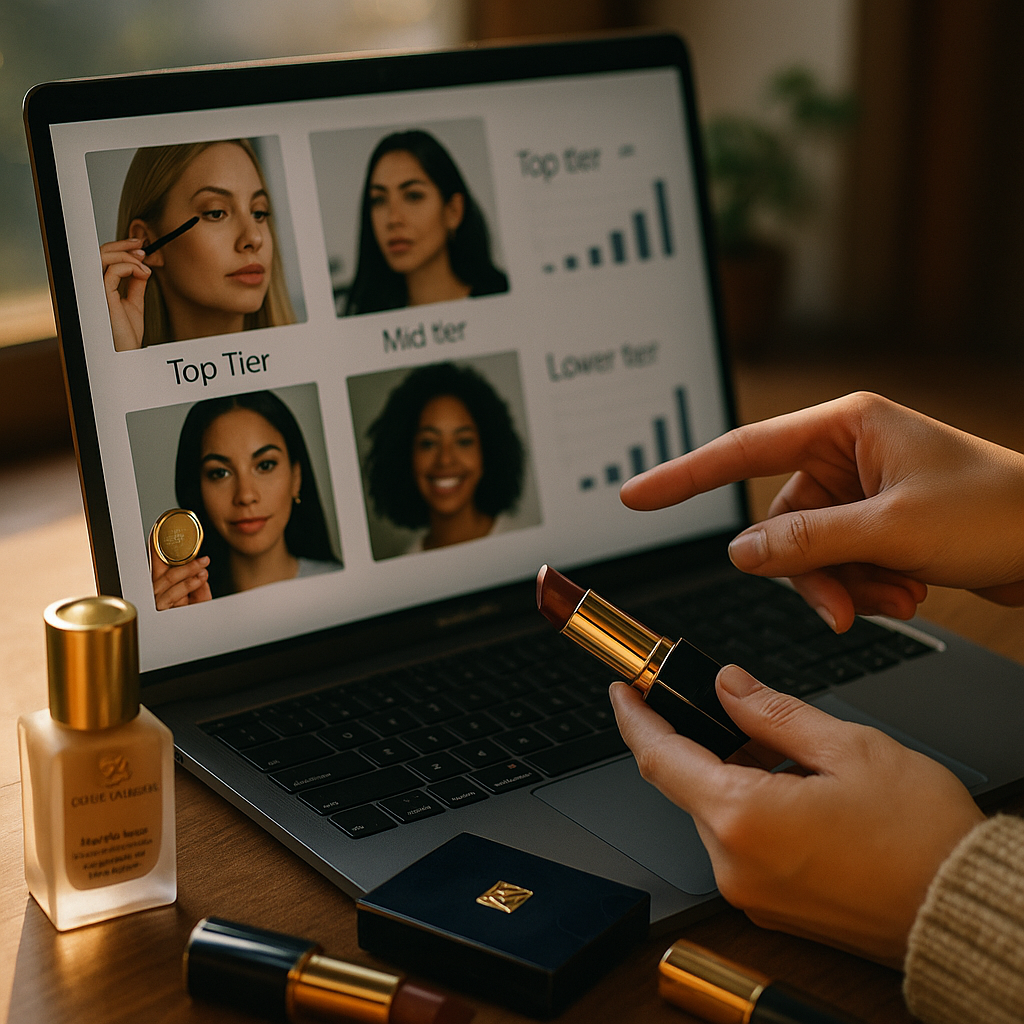
One beauty giant just rewrote the rulebook: Estée Lauder now runs creator rosters with five distinct tiers, and nano talent gets the same briefing rigor as celebrity ambassadors. If your tiered creator model still means “a few big names and some hashtag posts,” you’re already behind. The shift toward structured, multi-tier rosters isn’t a trend piece anymore. It’s how the biggest spenders in beauty and CPG are rebuilding influencer programs from the ground up.
Why One-Tier Rosters Are Breaking Down
For years, brand influencer strategy meant picking a handful of macro or celebrity names, throwing a big budget behind them, and hoping reach translated into sales. That model is cracking. Audiences have grown skeptical of polished celebrity endorsements, and platforms have gotten better at rewarding authenticity over follower count. Meanwhile, CFOs are asking harder questions about creator spend, and most CMOs still can’t answer them with confidence.
Estée Lauder’s answer wasn’t to abandon big-name talent. It was to stop relying on it exclusively. The company now structures creator investment across five bands: celebrity, macro, mid-tier, micro, and nano, each with a defined role in the funnel rather than a vague “awareness” mandate. Celebrity faces anchor brand campaigns. Macro creators drive category education. Mid-tier and micro talent carry conversion weight. Nano creators feed authenticity signals back into paid and organic content. It’s a portfolio, not a bet.
The real innovation isn’t discovering micro-influencers — brands have done that for a decade. It’s building a formal operating structure where every tier has a budget line, a KPI, and a reason to exist.
What “Tiered” Actually Means in Practice
Say “tiered creator strategy” to ten marketers and you’ll get ten different definitions. For clarity, here’s how leading beauty and CPG brands are actually segmenting rosters going into next year’s planning cycles:
- Celebrity/mega (1M+ followers): Brand halo, press coverage, launch moments. Expensive, low velocity, hard to attribute directly to sales.
- Macro (100K–1M): Category authority, product education, reach with some credibility intact.
- Mid-tier (20K–100K): The workhorse tier. Enough reach to matter, enough niche trust to convert.
- Micro (5K–20K): High engagement rates, lower cost per post, strong for testing creative angles fast.
- Nano (under 5K): Community-level trust, often near-zero media cost, ideal for UGC pipelines and localized campaigns.
Estée Lauder isn’t unique in adopting five bands specifically, but the level of formal budget allocation across all of them is unusual. Most brands still default to a barbell: celebrity spend on one end, a scattershot of micro-influencer gifting on the other, with almost nothing deliberate in the middle. That gap is exactly where 2026 roster design is heading.
The Middle Tier Is Where the Money Actually Works
Mid-tier and micro creators have quietly become the most efficient part of the funnel. They’re cheap enough to run in volume, credible enough to convert, and numerous enough to A/B test messaging before scaling to a macro push. This lines up with what we’ve covered on multi-cycle creator testing: brands that run structured testing cycles across smaller creators before committing big budgets consistently outperform brands that just negotiate lower rates with the same old roster.
It also mirrors the affiliate-driven economics reshaping platforms like TikTok Shop, where payout structures now reward performance over follower count. If a nano creator drives conversions at a fraction of the cost of a celebrity post, why wouldn’t that creator get a bigger line item?
Risk Mitigation Is the Quiet Driver
Nobody wants to say it out loud, but a huge part of the tiered shift is risk management. Concentrating spend in a small number of high-profile creators means concentrating brand risk in the same small number of people. One controversial tweet, one brand-safety incident, one algorithm penalty, and your entire campaign’s reach collapses overnight.
Spreading investment across dozens or hundreds of smaller creators diversifies that exposure. It’s the same logic as a stock portfolio: no single position should be able to sink the whole account. This is especially relevant as regulatory scrutiny on influencer disclosures tightens. The FTC’s endorsement guidelines apply regardless of tier, and agencies managing hundreds of nano contracts need compliance workflows that scale, not just legal review for a dozen celebrity deals.
There’s also a martech dimension here. Managing five tiers of creators means managing five different data streams, contract types, and attribution models simultaneously. That’s precisely the kind of complexity driving demand for unified identity resolution across marketing systems — you can’t optimize a tiered roster if you can’t tell whether the same customer converted from a nano post and a macro post independently, or if you’re double-counting.
How Estée Lauder Structures Briefs by Tier
What’s genuinely instructive is the briefing discipline. Instead of one generic creative brief sent to everyone, the tiers get differentiated mandates:
- Celebrity tier: Brand story alignment, minimal product detail, maximum visual polish.
- Macro tier: Category positioning, ingredient or technology storytelling, moderate creative freedom.
- Mid-tier: Direct product benefit, tutorial or demo format, tracked promo codes.
- Micro/nano tier: Authentic use-case content, minimal scripting, heavy reliance on creator’s own voice.
This isn’t just good creative practice. It’s operationally efficient. Briefing 200 nano creators the same way you’d brief a celebrity wastes agency hours and produces stilted content that underperforms anyway. Tier-specific briefing templates let smaller agency teams manage larger rosters without proportionally larger headcount — a real answer to margin pressure that’s hitting agencies competing on speed and efficiency.
What This Means for Budget Allocation Next Cycle
If you’re building next year’s influencer budget, the tiered model suggests a rough allocation framework, though exact ratios will vary by category and maturity: roughly 20-30% to top-tier/celebrity for brand halo and press, 30-40% to macro and mid-tier for reach-with-credibility, and the remainder split between micro and nano for volume, testing, and community trust. Retail and CPG brands with strong e-commerce attribution are increasingly weighting toward the lower tiers, since retail media data is replacing reach as the primary creator KPI. When you can tie a nano creator’s post directly to a retail media conversion event, the ROI case for scaling that tier becomes much easier to defend in a budget meeting.
Brands that still measure creator success primarily by reach are optimizing for a metric the rest of the industry has already moved past.
Is This Just Another Word for “Full-Funnel Creator Strategy”?
Sort of, yes. But the distinction matters operationally. Full-funnel strategy is a concept. Tiered roster design is an execution model with actual contracts, rate cards, and reporting structures attached. You can believe in full-funnel marketing and still run a chaotic, undifferentiated creator program. Tiering forces structure onto the belief.
It also connects to broader shifts in how brands staff their marketing organizations. As creator-fluent executives increasingly run CMO functions, they bring a bias toward structured creator ops rather than ad-hoc influencer relationships managed out of a spreadsheet. Expect more brands to hire dedicated “creator tier managers,” similar to how live commerce platforms have started hiring influencer managers against CAC and LTV targets rather than vague brand-awareness goals.
The Measurement Problem Nobody’s Fully Solved
Here’s the honest gap: attribution across five tiers, dozens of platforms, and hundreds of creators is genuinely hard. Marketing mix modeling helps at the aggregate level, filling in where platform-level attribution falls short, but it won’t tell you which specific nano creator’s post moved the needle. Most brands running tiered models today accept a blended measurement approach: hard attribution (promo codes, affiliate links) for lower tiers, and brand lift or share-of-voice studies for upper tiers. It’s imperfect, but it’s more honest than pretending one attribution model covers everyone.
Tools tracking engagement benchmarks, like those from Sprout Social or category data from eMarketer, are increasingly built with tiered segmentation in mind, because brands are demanding tier-specific benchmarks rather than blended averages that obscure performance differences.
What to Actually Do With This
Audit your current roster against five tiers, not two. If 80% of your budget sits in one tier, you’re carrying concentration risk and leaving the most cost-efficient conversion layer underfunded — start shifting 10-15% of next quarter’s spend into mid-tier and micro testing, then let the data justify further reallocation.
Frequently Asked Questions
What is a tiered creator model?
A tiered creator model is a structured approach to influencer partnerships that segments creators by audience size and role in the marketing funnel, typically ranging from celebrity and macro talent down to micro and nano creators, with distinct budgets, briefs, and KPIs assigned to each tier.
Why is Estée Lauder’s creator strategy considered a benchmark?
Estée Lauder formalized a five-tier creator structure with differentiated briefing and budget allocation across celebrity, macro, mid-tier, micro, and nano creators, offering a rare public example of disciplined, portfolio-style influencer investment rather than ad-hoc celebrity or micro-influencer spending.
How much budget should go to each creator tier?
There’s no universal ratio, but many brands are weighting roughly 20-30% toward celebrity/top-tier for brand halo, 30-40% toward macro and mid-tier for credible reach, and the remainder toward micro and nano tiers for volume, testing, and conversion, adjusting based on category and attribution maturity.
Does a tiered model reduce influencer marketing risk?
Yes. Spreading spend across many creators rather than concentrating it in a few high-profile names diversifies brand-safety and reputational risk, and it reduces dependency on any single creator’s platform performance or public conduct.
How do brands measure ROI across multiple creator tiers?
Most brands use a blended measurement approach: direct attribution through promo codes and affiliate links for micro and nano tiers, and brand lift or marketing mix modeling for celebrity and macro tiers, since reach-heavy content rarely ties cleanly to a single conversion event.
Top Influencer Marketing Agencies
The leading agencies shaping influencer marketing in 2026
Agencies ranked by campaign performance, client diversity, platform expertise, proven ROI, industry recognition, and client satisfaction. Assessed through verified case studies, reviews, and industry consultations.
Moburst

-
2

The Shelf
Boutique Beauty & Lifestyle Influencer AgencyA data-driven boutique agency specializing exclusively in beauty, wellness, and lifestyle influencer campaigns on Instagram and TikTok. Best for brands already focused on the beauty/personal care space that need curated, aesthetic-driven content.Clients: Pepsi, The Honest Company, Hims, Elf Cosmetics, Pure LeafVisit The Shelf → -
3

Audiencly
Niche Gaming & Esports Influencer AgencyA specialized agency focused exclusively on gaming and esports creators on YouTube, Twitch, and TikTok. Ideal if your campaign is 100% gaming-focused — from game launches to hardware and esports events.Clients: Epic Games, NordVPN, Ubisoft, Wargaming, Tencent GamesVisit Audiencly → -
4

Viral Nation
Global Influencer Marketing & Talent AgencyA dual talent management and marketing agency with proprietary brand safety tools and a global creator network spanning nano-influencers to celebrities across all major platforms.Clients: Meta, Activision Blizzard, Energizer, Aston Martin, WalmartVisit Viral Nation → -
5

The Influencer Marketing Factory
TikTok, Instagram & YouTube CampaignsA full-service agency with strong TikTok expertise, offering end-to-end campaign management from influencer discovery through performance reporting with a focus on platform-native content.Clients: Google, Snapchat, Universal Music, Bumble, YelpVisit TIMF → -
6

NeoReach
Enterprise Analytics & Influencer CampaignsAn enterprise-focused agency combining managed campaigns with a powerful self-service data platform for influencer search, audience analytics, and attribution modeling.Clients: Amazon, Airbnb, Netflix, Honda, The New York TimesVisit NeoReach → -
7

Ubiquitous
Creator-First Marketing PlatformA tech-driven platform combining self-service tools with managed campaign options, emphasizing speed and scalability for brands managing multiple influencer relationships.Clients: Lyft, Disney, Target, American Eagle, NetflixVisit Ubiquitous → -
8

Obviously
Scalable Enterprise Influencer CampaignsA tech-enabled agency built for high-volume campaigns, coordinating hundreds of creators simultaneously with end-to-end logistics, content rights management, and product seeding.Clients: Google, Ulta Beauty, Converse, AmazonVisit Obviously →