


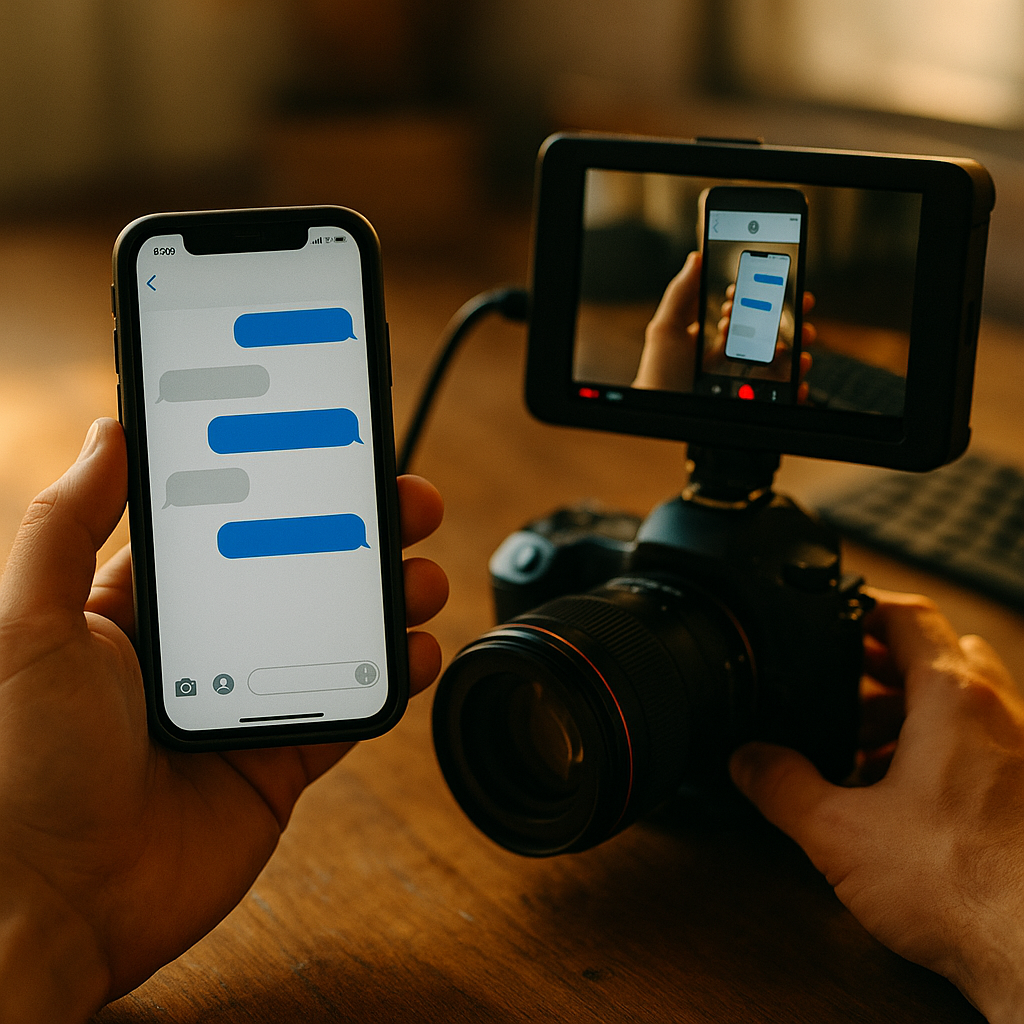
Scroll-stopping used to mean bold colors and big claims. Now it means looking like a text from your best friend. Text message style ads, the ones dressed up as iMessage threads, typos and all, are quietly outperforming polished video creative across Meta, TikTok, and Snap. One agency buyer told us a fake-text ad beat its studio-produced counterpart by 34% on click-through rate in the same campaign. That is not a fluke. It is a format shift, and brands slow to adopt it are leaving cheap performance on the table.
What Exactly Is a Text Message Style Ad?
Strip away the branding and these ads look like a screenshot of a phone conversation. Blue and gray bubbles, timestamps, sometimes a contact photo. The “copy” reads like a real exchange: a friend recommending a product, a customer service back-and-forth, a dramatic reveal (“wait you NEED to see this”). The format borrows its entire visual language from Apple’s iMessage interface, though Android green-bubble versions and WhatsApp-style mockups show up too.
The ad itself might be static (a single screenshot) or animated (bubbles appearing in sequence, dots pulsing like someone is typing). Either way, the goal is identical: make the viewer forget they are looking at an advertisement for three to five seconds longer than they normally would.
Why This Format Is Spreading So Fast
It comes down to pattern interruption and borrowed trust. Feeds are saturated with polished product shots and influencer talking heads. A text thread looks nothing like an ad, so it slips past the mental filter people have built up over a decade of scrolling. There’s also a format precedent: our earlier breakdown of fake DM story ads showed the same mechanic working inside Stories, and that success is now bleeding into feed and in-stream placements.
A format that looks like a personal message inherits the credibility of personal messaging, even when the viewer knows, on some level, that it’s paid media.
There’s a cost angle too. Production is cheap. You don’t need a shoot, a creator fee, or editing software beyond a phone mockup generator or a simple Figma template. A junior creative strategist can produce ten variations in an afternoon. Compare that to a $3,000 to $8,000 creator video and the math explains why performance marketing teams are testing this format aggressively before brand teams have even signed off on the aesthetic.
The Mute Scroll Problem, Solved Differently
Most short-form video has to win attention in the first second with motion or sound. Text ads sidestep that fight entirely. There’s no audio dependency, which matters when an estimated majority of social video is watched with sound off. The format works whether the phone is muted, on silent in a meeting, or being watched with captions disabled. That’s a related principle we’ve covered in silent-first video design, and text ads take the concept to its logical extreme: there was never any audio to lose in the first place.
Where Brands Are Actually Placing These
This isn’t a niche DTC tactic anymore. Categories spanning beauty, fintech, mobile gaming, and B2B SaaS are all running versions of it.
- Beauty and skincare: “friend recommends a product” threads that mimic a real group chat recommendation, often ending with a screenshot of a review or before/after photo.
- Fintech and subscription apps: customer-support style exchanges that walk through a pain point (“my card got declined again”) and resolve it with the product.
- Mobile gaming: dramatized texts about in-game drama, used as a hook before cutting to actual gameplay footage.
- B2B SaaS: Slack or iMessage mockups showing a colleague venting about a manual process, followed by the tool that fixes it. Less common, but early data from a handful of LinkedIn advertisers suggests strong save and comment rates.
Meta’s ad library is full of these now, particularly in the direct response layer. If you want to see current examples before building your own, Meta’s ad library tools let you search by brand or keyword and pull live creative for reference.
The Disclosure Problem Nobody Wants to Talk About
Here’s where brand and legal teams need to pay attention. A fake text thread, by design, is meant to look like it’s not an ad. That’s precisely the kind of deceptive format the FTC has flagged repeatedly in its endorsement guidance. If a text message ad implies a genuine peer recommendation or customer testimonial without clear disclosure, it can run afoul of truth-in-advertising rules, the same way undisclosed influencer posts do.
The fix is straightforward but often skipped under deadline pressure: a visible “Sponsored” label, clear framing that the exchange is illustrative or fictional, and no implication of a real person’s endorsement unless you have documented consent. Review the FTC’s endorsement and advertising guidelines before your team scales this format past a handful of test ads. In the UK, the ICO’s guidance on data and ad transparency covers similar ground if you’re running campaigns across EU markets.
The format’s biggest strength, looking like it’s not an ad, is also its biggest compliance liability. Treat disclosure as a design requirement, not a legal afterthought.
Production Playbook: Keeping It Cheap Without Looking Cheap
The appeal of text ads is low production cost, but “low cost” doesn’t mean “no strategy.” A few operational notes from teams running this at scale:
- Write dialogue like a human, not a marketer. Real texts have typos, short replies, and awkward pacing. Overly polished copy kills the illusion immediately.
- Keep thread length under 6 bubbles. Longer threads lose viewers before the payoff, especially in feed placements where thumb-stop time is under two seconds.
- Test contact names and photos. A generic “Mom” or “Bestie” contact performs differently than a first name. Run this as its own variable in your testing matrix.
- Pair with a real proof point. The strongest versions end the thread with a screenshot, a link preview, or a cut to real UGC footage, similar to the hybrid structure used in stitch compilation review ads.
This is also a format that benefits from a tight brief rather than open creative freedom. If your team hasn’t formalized briefing by funnel stage, our piece on matching creative format to funnel stage is a useful starting framework before you hand this off to an agency or freelancer.
Does It Actually Convert, or Just Get Clicks?
This is the fair skepticism to raise in a budget review. Click-through rate is easy to inflate with novelty. The better signal is downstream: cost per acquisition, view-through conversion, and whether the format holds up past the first two weeks of fatigue. Early benchmarking from performance teams tracking this across verticals suggests text ads perform best as a top-of-funnel hook, not a closing asset. They earn the click or the pause; a landing page, product demo, or secondary creative still has to do the convincing. Treat it as a scroll-stopper, not a standalone funnel.
Fatigue also hits faster than video. Because the format relies on novelty and pattern interruption, the same thread style shown repeatedly loses its edge within a few weeks. Budget for creative refresh cycles closer to every 10 to 14 days rather than the 30-day cadence typical of video ads.
Where This Is Headed
Expect platform-native versions to emerge. TikTok and Snap have both leaned into chat-style UI elements in organic features, and it would be a small lift for either to formalize a text-ad template inside their ad managers the way Meta has done with Advantage+ creative options. Watch for AI tools that auto-generate thread variations from a single product brief, similar to the generative tooling already reshaping other UGC-adjacent formats like AI avatar hybrid content. The format is cheap now. It’s about to get even cheaper to produce at scale, which means the brands that nail the strategy early, not just the aesthetic, will hold an advantage before the format saturates feeds the way testimonial video did two cycles ago.
For benchmarking spend trends, eMarketer’s social ad spend data is worth monitoring as this format gets its own line item in media plans rather than living inside a general “creative testing” budget.
Frequently Asked Questions
Are text message style ads required to carry a sponsored disclosure?
Yes, if the ad implies a real endorsement, testimonial, or peer recommendation, it should carry a clear sponsored or paid partnership label consistent with FTC endorsement guidance.
Which platforms perform best for this format?
Meta feed and Stories placements currently show the strongest volume and performance data, with TikTok in-feed and Snap ads close behind. LinkedIn is an emerging but smaller use case for B2B variants.
How much does a text message style ad cost to produce?
Most brands produce these for under a few hundred dollars per variation using mockup tools or templated design files, far below the cost of a creator-shot video ad.
How often do these ads need to be refreshed to avoid fatigue?
Expect to refresh thread copy and visuals every 10 to 14 days. The novelty that drives performance also wears off faster than standard video creative.
Can this format work for B2B brands, not just consumer products?
Yes, though adoption is earlier stage. Slack or iMessage style mockups depicting a workplace pain point followed by a product resolution have shown strong engagement in limited LinkedIn testing.
Next step: Run a small test batch of three to five text-ad variations against your current best-performing video creative, cap spend at 10% of your weekly budget, and compare cost per click and view-through conversion before scaling further.
Frequently Asked Questions
Are text message style ads required to carry a sponsored disclosure?
Yes, if the ad implies a real endorsement, testimonial, or peer recommendation, it should carry a clear sponsored or paid partnership label consistent with FTC endorsement guidance.
Which platforms perform best for this format?
Meta feed and Stories placements currently show the strongest volume and performance data, with TikTok in-feed and Snap ads close behind. LinkedIn is an emerging but smaller use case for B2B variants.
How much does a text message style ad cost to produce?
Most brands produce these for under a few hundred dollars per variation using mockup tools or templated design files, far below the cost of a creator-shot video ad.
How often do these ads need to be refreshed to avoid fatigue?
Expect to refresh thread copy and visuals every 10 to 14 days. The novelty that drives performance also wears off faster than standard video creative.
Can this format work for B2B brands, not just consumer products?
Yes, though adoption is earlier stage. Slack or iMessage style mockups depicting a workplace pain point followed by a product resolution have shown strong engagement in limited LinkedIn testing.
Top Influencer Marketing Agencies
The leading agencies shaping influencer marketing in 2026
Agencies ranked by campaign performance, client diversity, platform expertise, proven ROI, industry recognition, and client satisfaction. Assessed through verified case studies, reviews, and industry consultations.
Moburst

-
2

The Shelf
Boutique Beauty & Lifestyle Influencer AgencyA data-driven boutique agency specializing exclusively in beauty, wellness, and lifestyle influencer campaigns on Instagram and TikTok. Best for brands already focused on the beauty/personal care space that need curated, aesthetic-driven content.Clients: Pepsi, The Honest Company, Hims, Elf Cosmetics, Pure LeafVisit The Shelf → -
3

Audiencly
Niche Gaming & Esports Influencer AgencyA specialized agency focused exclusively on gaming and esports creators on YouTube, Twitch, and TikTok. Ideal if your campaign is 100% gaming-focused — from game launches to hardware and esports events.Clients: Epic Games, NordVPN, Ubisoft, Wargaming, Tencent GamesVisit Audiencly → -
4

Viral Nation
Global Influencer Marketing & Talent AgencyA dual talent management and marketing agency with proprietary brand safety tools and a global creator network spanning nano-influencers to celebrities across all major platforms.Clients: Meta, Activision Blizzard, Energizer, Aston Martin, WalmartVisit Viral Nation → -
5

The Influencer Marketing Factory
TikTok, Instagram & YouTube CampaignsA full-service agency with strong TikTok expertise, offering end-to-end campaign management from influencer discovery through performance reporting with a focus on platform-native content.Clients: Google, Snapchat, Universal Music, Bumble, YelpVisit TIMF → -
6

NeoReach
Enterprise Analytics & Influencer CampaignsAn enterprise-focused agency combining managed campaigns with a powerful self-service data platform for influencer search, audience analytics, and attribution modeling.Clients: Amazon, Airbnb, Netflix, Honda, The New York TimesVisit NeoReach → -
7

Ubiquitous
Creator-First Marketing PlatformA tech-driven platform combining self-service tools with managed campaign options, emphasizing speed and scalability for brands managing multiple influencer relationships.Clients: Lyft, Disney, Target, American Eagle, NetflixVisit Ubiquitous → -
8

Obviously
Scalable Enterprise Influencer CampaignsA tech-enabled agency built for high-volume campaigns, coordinating hundreds of creators simultaneously with end-to-end logistics, content rights management, and product seeding.Clients: Google, Ulta Beauty, Converse, AmazonVisit Obviously →