


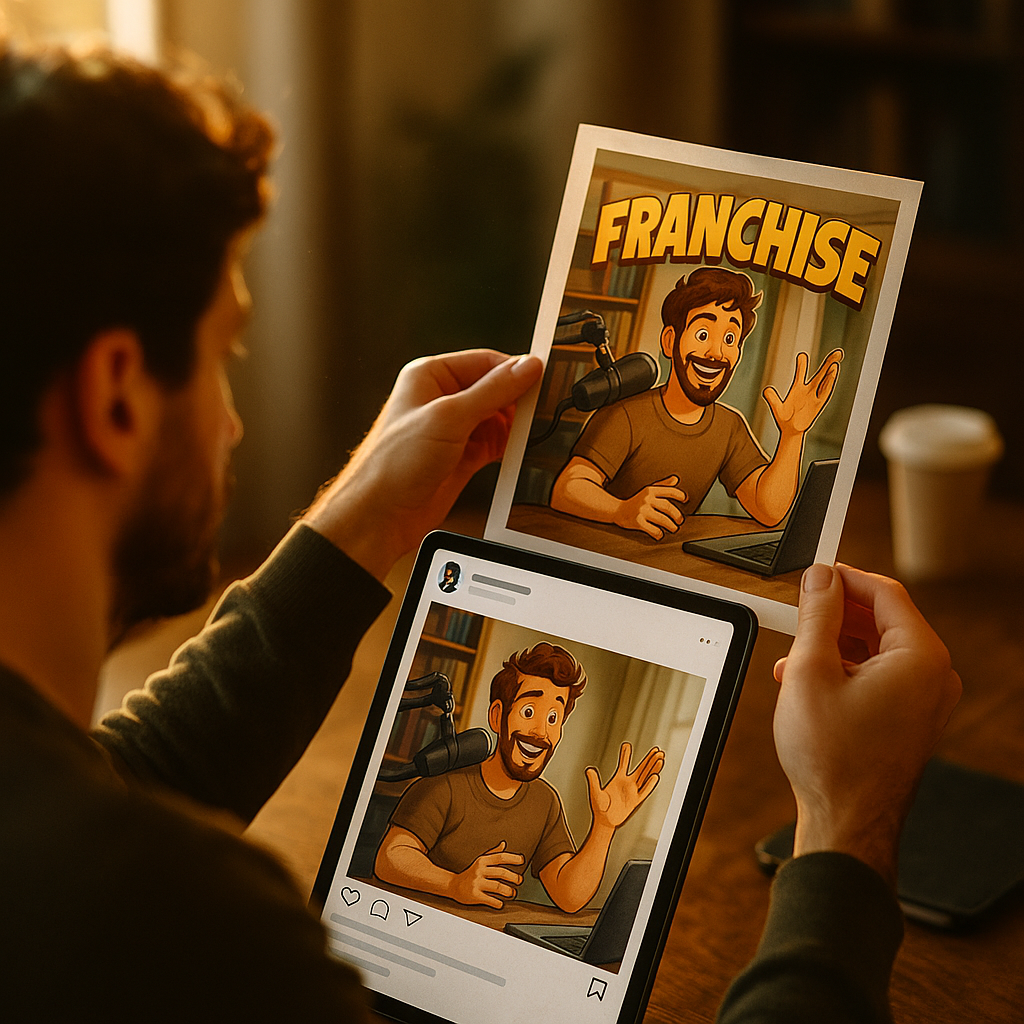
One-off creator posts decay in about 48 hours. A franchise style series doesn’t. It compounds, episode over episode, building an audience that shows up expecting the next installment instead of scrolling past another ad. If your influencer program resets to zero every quarter, you’re not building a brand asset. You’re renting attention and giving it back.
Franchise style series are structured, recurring creator content formats that brands co-develop and co-own with talent, think recurring characters, consistent formats, and serialized hooks that live across TikTok, YouTube, and Instagram. Unlike a single sponsored post, the franchise is the product. The creator is the host. The brand is the studio.
Why One-Off Campaigns Are Leaving ROI on the Table
Most influencer budgets still fund discrete deliverables: three TikToks, one YouTube integration, done. The brief gets approved, the content posts, the report gets filed, and the next quarter starts from scratch. There’s no compounding. No built-in reason for the audience to return. No IP asset sitting on the brand’s balance sheet when the contract ends.
Compare that to a franchise model where a creator hosts a recurring segment, say, a weekly “ask the expert” series or a monthly product stress-test, and the brand owns the format, the title, the visual identity, and often the back catalog. Audiences build habits around recurring content the same way they do around TV shows. That habit is what turns a marketing line item into a retention engine, similar to the mechanics covered in serialized content formats that keep viewers coming back episode after episode.
A franchise format isn’t a content calendar trick. It’s an IP strategy that happens to run through a creator’s feed.
What Makes a Series “Co-Ownable” Instead of Just Branded
Co-ownership is the part most brands get wrong. They’ll pay for a recurring series, then treat it like any other sponsored post: creator posts, brand reposts a clip, contract ends, series disappears. That’s not a franchise. That’s a longer one-off.
True co-ownership means the contract specifies who holds rights to the format, the title, the visual system, and the back catalog if the relationship ends. It means the brand has usage rights to repurpose episodes across paid media, retail screens, or CTV, not just a single platform. And it means both parties have skin in the performance, whether that’s a rev share, a renewal bonus tied to watch-through rate, or equity-style upside if the series takes off.
This is the same logic playing out in original creator series that span TikTok to CTV, where brands are increasingly treating creator formats as licensable IP rather than disposable content. The legal and financial structure matters as much as the creative concept. A great format with a bad contract is still a one-off waiting to happen.
The Anatomy of a Franchise Format
Every durable franchise series shares a few structural elements, regardless of niche. Skip any one of these and the format tends to flatten out after episode three or four.
- A consistent title and visual hook. Viewers need to recognize the series in under a second, through a title card, a signature intro, or a recurring prop.
- A repeatable premise. Each episode should answer the same underlying question in a new way: “What’s in this skincare routine” or “Can this product survive a stress test.”
- A recurring cast. Whether it’s one host or a rotating cast of micro-creators, familiarity drives retention better than novelty alone.
- A cliffhanger or serialization device. Think “part two next week” or a running leaderboard that carries across episodes.
- A clear monetization lane. Product placement, affiliate links, or a shoppable layer baked into the format itself, not bolted on after the fact.
Formats like fan remix challenges already show how scattered UGC can be structured into owned IP. A franchise series just takes that same discipline and applies it to scripted, recurring episodes instead of one-time challenges.
Picking the Right Creator for a Long-Term Franchise
Casting a franchise host is a different calculation than casting a single campaign. You’re not just evaluating reach and engagement rate for one post, you’re assessing whether this person can carry a recurring role without burning out, going off-brand, or outgrowing the format within two quarters.
Look for creators who already run some version of a recurring segment organically. If someone’s audience already expects “Monday mailbag” or “Friday reviews,” you’re not asking them to build a new habit from scratch, you’re slotting a brand into one that already exists. That’s a meaningfully lower lift than launching a brand-new concept cold.
Contract terms should cover exclusivity within category, creative control splits, and an exit clause for underperformance. According to eMarketer, brands running multi-month creator partnerships report notably higher recall lift than those running single-post campaigns, which is the entire economic argument for franchise formats in one data point.
Format Examples That Already Work as Franchises
You don’t need to invent a new content category to franchise it. Most of the highest-performing recurring formats already exist as one-off briefs; the franchise move is simply running them on a schedule with a consistent host and title.
- Retail walkthrough series: A recurring “store tour” format, similar in structure to retail walkthrough hauls, run monthly across new store openings or seasonal resets.
- Comment reply shows: A weekly segment built on comment reply videos that answers the audience’s toughest objections on a fixed cadence, building trust episode by episode.
- Founder check-in series: Recurring founder-led video updates that turn a single executive into a trusted recurring face rather than a one-time guest appearance.
- Recipe or demo franchises: A standing weekly slot built on recipe hack reels or sound-only demo formats, with a new product or twist each episode.
Vertical micro dramas are another proof point worth studying closely. As covered in how vertical micro drama sponsorship deals work, brands are already structuring multi-episode scripted content with defined IP splits, which is essentially the franchise model applied to fiction instead of lifestyle or demo content.
Operationalizing the Franchise: Briefs, Approvals, and Cadence
The operational failure point for most franchise attempts isn’t the creative, it’s the production pipeline. If every episode requires a full new brief cycle and a week of legal review, the series dies from logistics before it dies from audience fatigue.
Build a template brief once, then reuse it per episode with only the variable fields changed (product, hook, call to action). This is the same logic behind job-specific creative briefs that match format to funnel stage rather than reinventing the brief from scratch each time. Pair that with a faster internal approval loop, something closer to the cadence described in speeding up creative approvals, and a weekly or biweekly franchise becomes operationally sustainable instead of a quarterly scramble.
If your approval process can’t move faster than your content cadence, the franchise will collapse under its own schedule before it ever gets a chance to compound.
Set a realistic cadence before launch. Weekly works for lightweight formats like comment reply shows. Biweekly or monthly suits higher-production formats like retail walkthroughs or scripted micro dramas. Match cadence to production capacity, not ambition.
Measuring Whether the Franchise Is Actually Working
Standard campaign metrics undersell franchise performance because they’re built for one-off content, not accumulating series. Track these instead:
- Episode-over-episode retention: Are viewers from episode one still showing up by episode five?
- Series-level watch-through rate: Not just per-video completion, but whether people are clicking into the next episode from a playlist or series tag.
- Branded search lift: A real franchise should generate measurable search volume for the series name itself, a sign the audience sees it as a destination, not an ad.
- Cost per retained viewer: Divide total series spend by the audience segment still engaging after three or more episodes, a far more honest efficiency number than cost per view.
Platforms like Sprout Social and Meta Business Suite both support series or playlist-level reporting now, which makes it easier to pull these numbers without stitching together spreadsheets manually. If your analytics stack can’t report at the series level, you’re measuring a franchise with tools built for one-off ads, and you’ll chronically undervalue the format.
Where This Goes Wrong
The most common failure mode is treating franchise content like a longer campaign instead of an IP investment. Brands cut the series after two episodes because quarter-one ROI looks flat, not realizing franchise economics are backloaded. Episode one rarely outperforms a standalone post. Episode eight usually does, because that’s when retention and search lift start compounding.
The second failure mode is rights ambiguity. If the contract doesn’t explicitly spell out who owns the format after the relationship ends, you’ll either lose the IP when the creator walks or end up in a dispute that kills the series anyway. The FTC’s endorsement guidance is also increasingly relevant here: recurring, co-branded formats draw more regulatory scrutiny than one-off posts, so disclosure consistency across every episode matters more, not less, as the series scales.
Next step: Audit your current creator roster for anyone already running a recurring organic segment, then pitch a co-ownership structure, not a one-off sponsorship, before a competitor locks down the format first.
FAQs
What is a franchise style series in influencer marketing?
It’s a recurring, branded content format co-developed with a creator, built around a consistent title, premise, and cast, designed to run as episodes rather than one-off sponsored posts.
How is a franchise series different from a regular sponsored content deal?
A regular sponsored deal pays for a single deliverable with no expectation of continuation. A franchise series includes a recurring format, shared IP rights, and a cadence that builds audience habit over multiple episodes.
Who owns the content in a co-owned franchise series?
Ownership should be defined explicitly in the contract, typically split between brand usage rights across paid and owned channels, and creator rights to host and promote the series on their own platforms.
How long should a franchise series run before judging performance?
Most franchise formats need at least five to eight episodes before retention and branded search data become meaningful, since the model is backloaded compared to one-off campaign performance.
What’s the biggest risk in launching a franchise style series?
Rights ambiguity. Without a clear contract covering format ownership, title rights, and exit terms, brands risk losing the entire series if the creator relationship ends.
Top Influencer Marketing Agencies
The leading agencies shaping influencer marketing in 2026
Agencies ranked by campaign performance, client diversity, platform expertise, proven ROI, industry recognition, and client satisfaction. Assessed through verified case studies, reviews, and industry consultations.
Moburst

-
2

The Shelf
Boutique Beauty & Lifestyle Influencer AgencyA data-driven boutique agency specializing exclusively in beauty, wellness, and lifestyle influencer campaigns on Instagram and TikTok. Best for brands already focused on the beauty/personal care space that need curated, aesthetic-driven content.Clients: Pepsi, The Honest Company, Hims, Elf Cosmetics, Pure LeafVisit The Shelf → -
3

Audiencly
Niche Gaming & Esports Influencer AgencyA specialized agency focused exclusively on gaming and esports creators on YouTube, Twitch, and TikTok. Ideal if your campaign is 100% gaming-focused — from game launches to hardware and esports events.Clients: Epic Games, NordVPN, Ubisoft, Wargaming, Tencent GamesVisit Audiencly → -
4

Viral Nation
Global Influencer Marketing & Talent AgencyA dual talent management and marketing agency with proprietary brand safety tools and a global creator network spanning nano-influencers to celebrities across all major platforms.Clients: Meta, Activision Blizzard, Energizer, Aston Martin, WalmartVisit Viral Nation → -
5

The Influencer Marketing Factory
TikTok, Instagram & YouTube CampaignsA full-service agency with strong TikTok expertise, offering end-to-end campaign management from influencer discovery through performance reporting with a focus on platform-native content.Clients: Google, Snapchat, Universal Music, Bumble, YelpVisit TIMF → -
6

NeoReach
Enterprise Analytics & Influencer CampaignsAn enterprise-focused agency combining managed campaigns with a powerful self-service data platform for influencer search, audience analytics, and attribution modeling.Clients: Amazon, Airbnb, Netflix, Honda, The New York TimesVisit NeoReach → -
7

Ubiquitous
Creator-First Marketing PlatformA tech-driven platform combining self-service tools with managed campaign options, emphasizing speed and scalability for brands managing multiple influencer relationships.Clients: Lyft, Disney, Target, American Eagle, NetflixVisit Ubiquitous → -
8

Obviously
Scalable Enterprise Influencer CampaignsA tech-enabled agency built for high-volume campaigns, coordinating hundreds of creators simultaneously with end-to-end logistics, content rights management, and product seeding.Clients: Google, Ulta Beauty, Converse, AmazonVisit Obviously →