


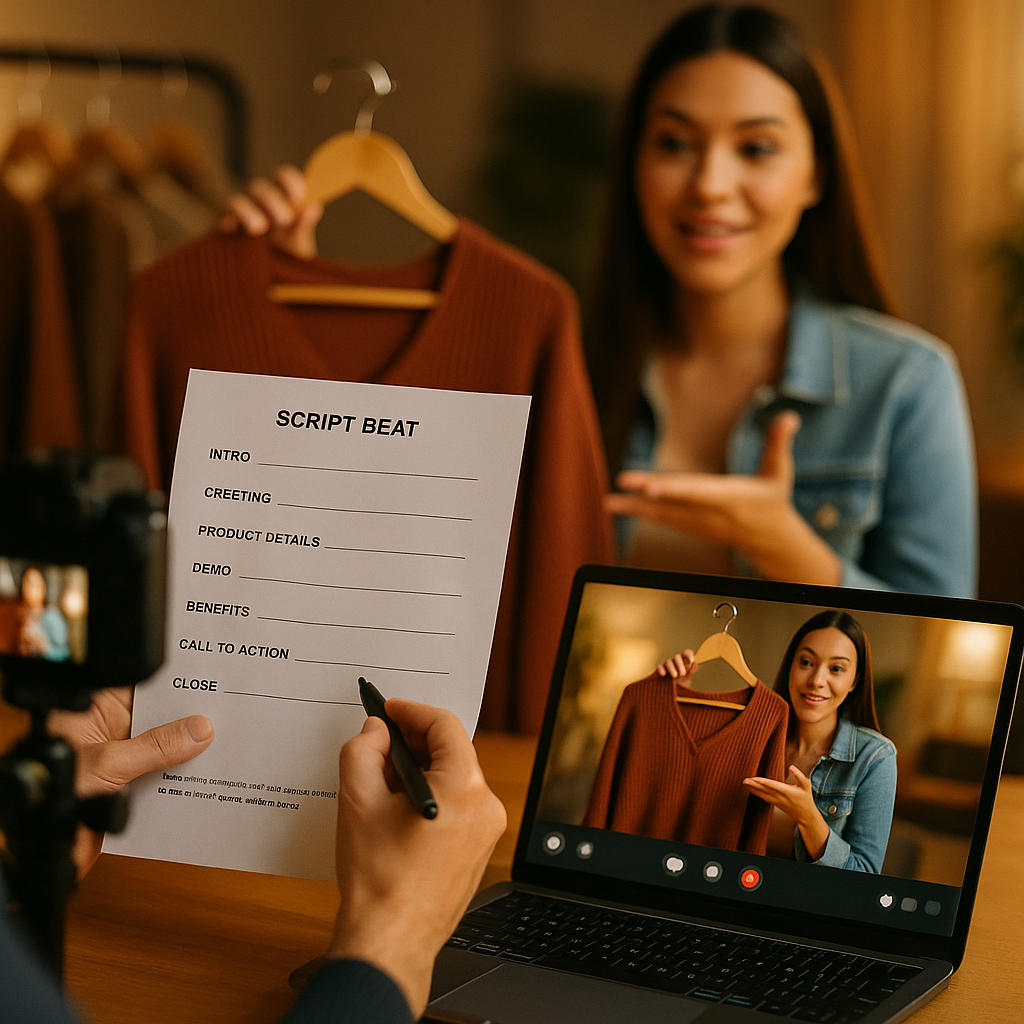
Average viewers decide within 8 seconds whether a live shopping stream is worth staying for. That number should terrify anyone running a live commerce program on a loose outline and a “we’ll wing it” attitude. TikTok Shop hosts in China routinely hit conversion rates north of 10 percent, while most U.S. and European brands limp along at 1 to 3 percent. The gap isn’t the platform. It’s the script.
Why Most Live Commerce Shows Fail Before the First Product Drops
Walk into most brand live shows and you’ll find the same failure pattern: a creator ad-libbing product benefits while scrolling comments, no clear call to action, and a viewer count that bleeds out minute by minute. The host is likeable. The product is fine. But there’s no structure forcing a purchase decision.
Live commerce isn’t a webinar and it isn’t a QVC rerun. It’s a hybrid of entertainment pacing and direct response copywriting, compressed into a format where the audience can leave at any second. That means every segment has to earn the next thirty seconds. A script isn’t optional, it’s the only thing standing between your brand and a stream full of lurkers who never tap “buy.”
A live show without a timed script is just a product demo with worse lighting and no safety net.
What a Converting Script Actually Looks Like
Forget the idea of a word-for-word teleprompter script. Nobody wants a creator reading lines, and audiences smell it instantly. What converts is a beat sheet: a timed sequence of hooks, proof points, objections, and CTAs that the host internalizes and delivers conversationally.
A solid 20 to 30 minute segment generally breaks into five beats:
- The cold open (0 to 90 seconds): A hook that states the offer or the problem immediately. No “hey guys, welcome back” filler.
- The proof block (90 seconds to 5 minutes): Live demo, before/after, or a side-by-side against a competitor.
- The objection flush (5 to 12 minutes): Address the three things viewers are actually thinking, usually price, shipping, and “does it really work on me.”
- The urgency spike (12 to 18 minutes): Limited stock counters, flash discount windows, or a bundle that disappears at the top of the hour.
- The close and loop (18 to 20 minutes): Direct CTA, then a transition back into the cold open for the next product.
Notice this mirrors direct response copy more than it mirrors a talk show. That’s intentional. If you’ve built creative briefs that match format to funnel stage, this is the live equivalent: every beat has a job, and the job is measurable.
The Cold Open Decides Everything
Here’s the uncomfortable truth: most of your audience will never see the objection flush or the urgency spike, because they bounced during the cold open. Platform algorithms on TikTok Shop and Instagram Live reward retention in the first 60 to 90 seconds, pushing well-performing streams to more viewers in real time. A weak open doesn’t just lose that viewer, it actively suppresses your reach for the rest of the session.
Strong cold opens tend to do one of three things:
- State a specific, quantified benefit (“this cut my morning routine from 20 minutes to 6”).
- Create a visual pattern interrupt (pouring, breaking, stacking, before/after reveal).
- Name the skeptic directly (“if you tried [competitor category] and it didn’t work, watch this first”).
The pattern interrupt approach borrows heavily from split screen comparison formats that have already proven themselves in short-form video. If a visual beat works in a 30 second Reel, it works even harder live, because the audience knows it’s unscripted and unedited.
Scripting the Demo So It Doesn’t Feel Like a Pitch
This is where most brand scripts collapse into infomercial territory. The fix isn’t removing the pitch, it’s embedding it inside a demonstration the viewer can verify with their own eyes. Live commerce hosts who convert well treat the product demo the way a recipe hack creator treats an ingredient swap: show the mechanism, not just the claim.
Practical scripting rules that hold up across categories:
- Show, then say. Perform the action first, narrate the benefit second. Viewers trust what they watched over what they were told.
- Use a control. Compare against a generic version, an old product, or “doing it the hard way.” Contrast sells faster than description.
- Narrate the senses. Texture, sound, smell, weight. Audio quality matters more than most brands assume, and it’s the same principle behind sound-led demos outperforming silent UGC.
- Repeat the price three times, minimum. Once in the demo, once after the objection flush, once in the close. Viewers tune in and out constantly, and repetition isn’t redundant here, it’s coverage.
Handling Objections Live, in Real Time
Comments during a live stream are a live focus group, and smart scripts build in pauses specifically to harvest them. Instead of scripting canned objection responses, train hosts to scan for the three or four recurring doubts (shipping cost, sizing, ingredient concerns) and pre-load answers they can deliver the moment those words appear.
This is essentially comment reply content happening in compressed, real-time form, and it’s one of the highest-converting segments of any show because it proves the host isn’t reading a script, even though the underlying structure absolutely is one. Brands running recurring Q&A segments inside live shows have seen comment velocity jump significantly, a pattern also documented in pinned comment Q&A formats on short-form platforms.
The objection segment isn’t a detour from the sales pitch. It’s the moment viewers decide the host is credible enough to trust with their money.
Urgency Without Sounding Like a Scam
Artificial scarcity is a fast way to torch creator credibility and invite regulatory scrutiny. The FTC has repeatedly flagged manipulative countdown timers and fake stock counters as deceptive practices, and the same caution applies under the UK’s advertising rules enforced by bodies working alongside the ICO on data and marketing compliance. Script urgency that’s actually true: real bundle limits, a genuine time-boxed discount tied to the stream’s runtime, or stock levels pulled live from your inventory system.
If you need to manufacture excitement without manufacturing lies, borrow from countdown teaser formats used in pre-launch campaigns. The anticipation mechanic works the same way inside a live show: tell viewers exactly when the offer disappears and hold the line when it does. Breaking your own deadline once destroys urgency for every future show with that audience.
Casting the Right Host for the Script, Not the Other Way Around
A script built for a high-energy QVC-style performer will flop in the hands of a calm, deadpan creator, and vice versa. Before locking a script, brands should map it to the host’s natural delivery style the same way they’d match content format to buyer intent elsewhere in the funnel.
Founders and subject-matter experts tend to crush the objection flush because they carry inherent authority, a dynamic also seen in founder-led video content. Entertainment-first creators tend to win the cold open and urgency spike because they carry energy without needing to prove expertise. The strongest live commerce programs run two-host formats specifically to cover both strengths, rotating who leads each beat.
Measuring What the Script Actually Produced
Retention curves, not just total GMV, tell you whether the script is working. Pull the viewer drop-off graph after every show and map it against your beat sheet. A steep drop during the proof block means the demo wasn’t visual enough. A drop right before the close means the urgency segment didn’t land. According to eMarketer, live shopping audiences in the U.S. have grown steadily, but conversion still lags behind China’s mature market, largely because most Western brands treat the script as optional rather than as the core growth lever it is.
Track these per segment, not just per show:
- Viewer retention at the 2 minute, 10 minute, and 18 minute marks
- Click-through rate on shoppable tags during the proof block versus the urgency spike
- Comment volume during the objection flush (a proxy for engagement depth)
- Add-to-cart timing relative to each scripted CTA
Treat every show as a testable asset the same way you’d treat shoppable sticker placements in short-form video: iterate the beat sheet based on where viewers actually acted, not where the script assumed they would.
Next step: pull your last three live shows, map viewer drop-off against your beat sheet, and rewrite only the segment with the steepest decline. Fix one beat at a time instead of rebuilding the whole script, and you’ll know within a week exactly which change moved the conversion number.
FAQs
How long should a live commerce script segment be?
Most converting segments run 18 to 25 minutes per product, enough time to complete the cold open, proof block, objection flush, and urgency spike without losing viewer attention. Shows with multiple products typically loop this structure rather than stretching a single segment longer.
Should hosts memorize the script word for word?
No. Hosts should internalize the beat sheet, meaning the sequence and timing of hooks, proof, objections, and CTAs, while delivering the actual language conversationally. Word-for-word scripts tend to sound stiff and reduce trust on live formats.
What’s the biggest scripting mistake brands make in live commerce shows?
Skipping the objection flush entirely. Brands often jump from demo straight to urgency and closing, which leaves skeptical viewers with unanswered doubts and lowers conversion even when the product itself performs well on camera.
How do you create urgency without violating advertising regulations?
Use real, time-boxed offers tied to the actual stream duration and genuine inventory levels rather than fake countdown timers or manufactured stock scarcity. Regulatory bodies like the FTC have specifically flagged deceptive urgency tactics in livestream and ecommerce contexts.
Can the same script work across TikTok Shop, Instagram Live, and YouTube?
The beat structure transfers, but pacing needs adjustment. TikTok Shop audiences expect faster cold opens and quicker urgency spikes, while YouTube Live audiences tolerate longer proof blocks and more detailed objection handling.
Top Influencer Marketing Agencies
The leading agencies shaping influencer marketing in 2026
Agencies ranked by campaign performance, client diversity, platform expertise, proven ROI, industry recognition, and client satisfaction. Assessed through verified case studies, reviews, and industry consultations.
Moburst

-
2

The Shelf
Boutique Beauty & Lifestyle Influencer AgencyA data-driven boutique agency specializing exclusively in beauty, wellness, and lifestyle influencer campaigns on Instagram and TikTok. Best for brands already focused on the beauty/personal care space that need curated, aesthetic-driven content.Clients: Pepsi, The Honest Company, Hims, Elf Cosmetics, Pure LeafVisit The Shelf → -
3

Audiencly
Niche Gaming & Esports Influencer AgencyA specialized agency focused exclusively on gaming and esports creators on YouTube, Twitch, and TikTok. Ideal if your campaign is 100% gaming-focused — from game launches to hardware and esports events.Clients: Epic Games, NordVPN, Ubisoft, Wargaming, Tencent GamesVisit Audiencly → -
4

Viral Nation
Global Influencer Marketing & Talent AgencyA dual talent management and marketing agency with proprietary brand safety tools and a global creator network spanning nano-influencers to celebrities across all major platforms.Clients: Meta, Activision Blizzard, Energizer, Aston Martin, WalmartVisit Viral Nation → -
5

The Influencer Marketing Factory
TikTok, Instagram & YouTube CampaignsA full-service agency with strong TikTok expertise, offering end-to-end campaign management from influencer discovery through performance reporting with a focus on platform-native content.Clients: Google, Snapchat, Universal Music, Bumble, YelpVisit TIMF → -
6

NeoReach
Enterprise Analytics & Influencer CampaignsAn enterprise-focused agency combining managed campaigns with a powerful self-service data platform for influencer search, audience analytics, and attribution modeling.Clients: Amazon, Airbnb, Netflix, Honda, The New York TimesVisit NeoReach → -
7

Ubiquitous
Creator-First Marketing PlatformA tech-driven platform combining self-service tools with managed campaign options, emphasizing speed and scalability for brands managing multiple influencer relationships.Clients: Lyft, Disney, Target, American Eagle, NetflixVisit Ubiquitous → -
8

Obviously
Scalable Enterprise Influencer CampaignsA tech-enabled agency built for high-volume campaigns, coordinating hundreds of creators simultaneously with end-to-end logistics, content rights management, and product seeding.Clients: Google, Ulta Beauty, Converse, AmazonVisit Obviously →