


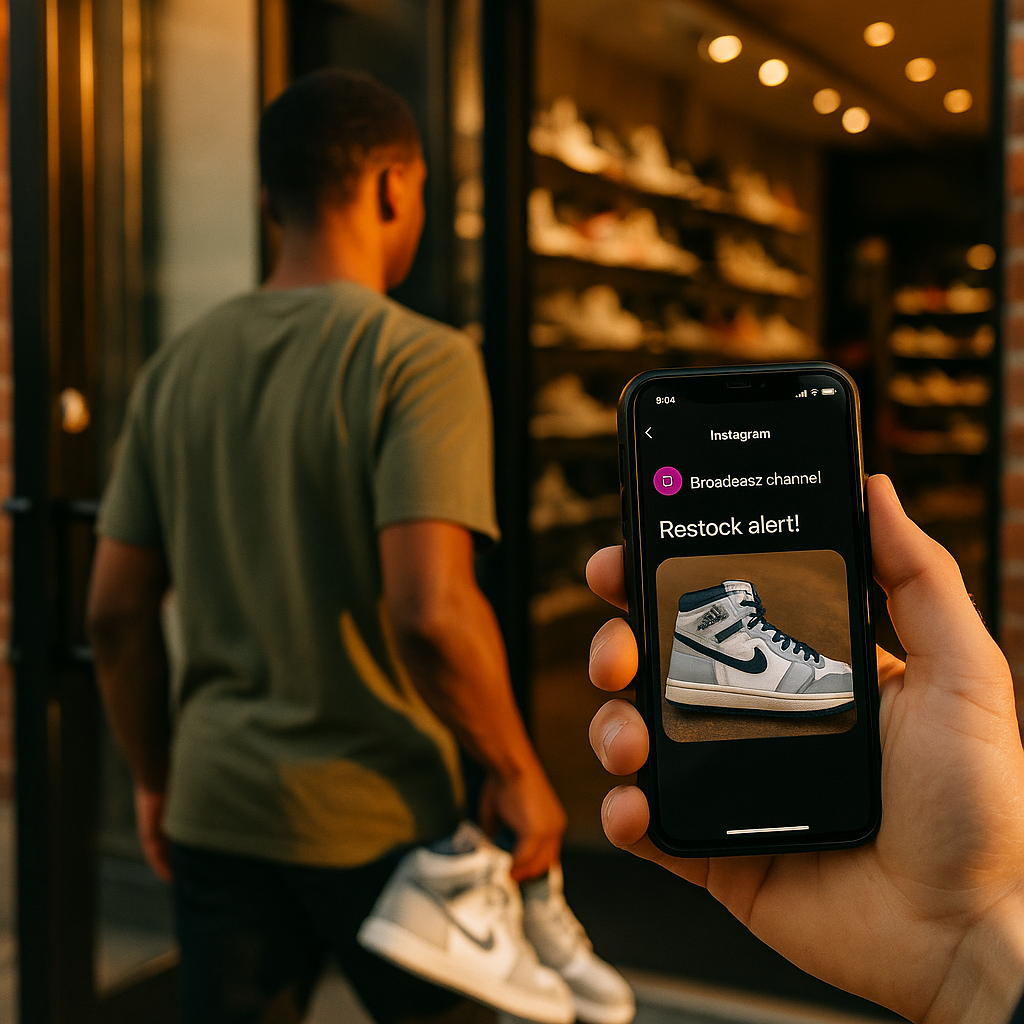
Retailers waiting on Instagram feed posts to move restock inventory are leaving money on the shelf. Instagram Broadcast Channels now sit at 95%+ open rates for early adopters, according to internal benchmarks shared by retail marketers on industry forums, dwarfing email and even push notifications. If your restock alert still lives in a caption buried under an algorithm, you’re playing the wrong game.
This isn’t a channel for brand storytelling. It’s a distribution pipe. Used right, it converts “back in stock” into “walked in the door within the hour.” Here’s how to build that pipe without burning your list’s patience or your compliance team’s goodwill.
Why Broadcast Channels Beat the Feed for Urgency Marketing
Feed posts compete with everything: Reels, ads, your competitor’s product drop, a friend’s vacation photos. Instagram’s algorithm decides who sees your restock post and when, which is a terrible system when the entire value proposition is right now.
Broadcast Channels sidestep that. They’re one-way, subscriber-based, and delivered as push notifications directly to a follower’s phone. No algorithmic gatekeeping, no ranking by engagement signals, no delay. A member joins once, and every message you send lands in their inbox and their notification tray simultaneously.
For retail restock alerts specifically, that immediacy is the entire product. Sneaker drops, limited-run collabs, produce restocks at a specialty grocer, flash inventory at a boutique — these are all time-decay offers. The value of the message drops fast after the first 30 minutes. A channel built for instant delivery is the only format built for that decay curve.
A restock alert that arrives ten minutes after the item sells out isn’t marketing. It’s an apology letter.
Building the Channel: What Actually Drives Same-Day Foot Traffic
Setting up a Broadcast Channel takes five minutes inside the Instagram app. Getting it to actually move people into your store takes more discipline. A few operational rules matter more than the tech setup:
- Segment by location, not just interest. If you run multiple stores, a single national channel dilutes urgency. Someone in Austin doesn’t care that the Denver location restocked. Consider separate channels per region or market, even if it means more admin overhead.
- Pair every alert with a countdown or quantity cue. “12 units in-store, first come first served” performs differently than a generic “we’re back in stock.” Scarcity language needs to be honest, though — more on that below.
- Include a map link or store hours in every message. Don’t assume people know your address or that you close at 6pm on Sundays. Friction kills conversion, and a follower who has to open a second app to find your store might not bother.
- Time the send for commute windows. Lunch-hour and post-work sends (11:30am–1pm, 5pm–6:30pm) consistently outperform morning blasts for retail foot traffic, based on patterns retailers have reported across e-commerce operator communities.
Channels also support polls, voice notes, and reactions from you (not two-way conversation, but light engagement signals). Use a poll sparingly to gauge interest before a restock (“Should we bring back the sold-out colorway?”) — it builds anticipation and gives you a soft signal on demand before you commit inventory.
The Compliance Layer Nobody Wants to Think About
Urgency messaging is where marketers get sloppy, and where regulators pay attention. If you tell subscribers “only 3 left” and that’s not true, you’re not just risking brand trust — you’re risking a FTC deceptive-practices problem. The same principles that govern livestream urgency claims on TikTok Shop apply here: if you can’t verify the claim in real time, don’t make it.
This isn’t a new problem for retail marketers, but Broadcast Channels amplify the stakes because the message feels more personal and immediate than a feed ad. Retailers running TikTok Shop drops have already had to tighten this exact language, and the same guardrails apply to Instagram: your restock alert needs a real inventory number behind it, not a vibe. For a deeper look at how urgency claims are being policed in live commerce, see this compliance breakdown.
Practical fix: connect your Broadcast Channel messaging to your actual POS or inventory management system, even if that connection is manual (a store manager texting the marketing team a real count before every send). Automating this end-to-end is the long-term goal, but a five-minute manual check beats a false “almost gone” claim that gets screenshotted and posted to a consumer complaint thread.
What Kind of Retailers Actually See ROI Here?
Not every retail category benefits equally. Broadcast Channels perform best where three conditions overlap: limited physical inventory, a geographically concentrated audience, and a product category people genuinely want today, not next week.
Sneaker and streetwear retailers were early adopters for obvious reasons — drop culture is built on exactly this urgency mechanic. But the format has expanded well beyond hype categories:
- Specialty grocery and bakery. Limited-batch products (small-batch bread, seasonal produce, allocated wine) map perfectly to restock alerts. A bakery in a single neighborhood doesn’t need a national audience; it needs 500 hyper-local subscribers who’ll walk over in twenty minutes.
- Beauty and fragrance. Cult SKUs that sell out repeatedly (think a specific shade or scent) build sustained subscriber habits. Once someone misses a restock twice, they stay subscribed indefinitely.
- Independent bookstores and record shops. Lower volume, but extremely loyal local audiences who treat restock alerts almost like event invitations.
- Big-box categories with allocation drops — collectibles, trading cards, limited electronics — where the “in stock” window is measured in hours, not days.
If your category is evergreen and always in stock, this format probably isn’t your priority channel. Save the urgency mechanic for when it’s genuinely earned.
Measuring What Matters: Beyond Subscriber Count
Subscriber count is a vanity metric here. What you actually want to track:
- Time-to-visit. How long after a broadcast does foot traffic spike? Use in-store POS timestamps cross-referenced against your send time. A 20–40 minute lag is typical for local retail; anything longer suggests your audience isn’t local enough or the offer isn’t compelling enough.
- Sell-through rate per broadcast. What percentage of the restocked units actually sold within the alert’s effective window (usually 2–4 hours)? This tells you whether the channel is actually driving incremental sales or just accelerating sales that would’ve happened anyway.
- Unsubscribe rate per send. If people are leaving the channel after specific message types, that’s signal. Over-sending “back in stock” alerts for low-interest SKUs trains subscribers to tune you out — the same fatigue problem that plagues reposted content strategies on the feed side.
Instagram doesn’t give you granular attribution inside the app, so most retailers are stitching this together manually with unique discount codes tied to broadcast sends, or a simple “how did you hear about us” prompt at checkout. It’s unglamorous, but it’s the only way to prove the channel earns its place in the budget.
If you can’t tie a broadcast to a POS timestamp, you’re guessing, not measuring.
Where Broadcast Channels Fit in the Broader Retail Stack
Broadcast Channels shouldn’t operate in isolation. Pair them with:
- SMS for your highest-value repeat customers, reserving Broadcast Channels for the broader engaged-follower base.
- Paid social retargeting to nudge subscribers who saw the alert but didn’t convert same-day. This mirrors the layered approach outlined in this multi-platform rollout playbook.
- Micro and nano creators local to your store footprint, who can amplify a restock alert to their own community faster than an organic feed post ever would. The mechanics are similar to what’s outlined in nano creator amplification strategy.
Broadcast Channels are also a useful research tool. Reaction data and poll responses give you a cheap, fast read on demand before you commit to a full production run or a large reorder — something HubSpot’s retail research has flagged as a growing priority for inventory-constrained brands trying to avoid overstock write-downs.
The Setup Checklist
Before your first restock alert goes out, confirm:
- Channel is linked to a business account with Instagram Shopping enabled, if you sell online alongside in-store.
- Store hours, address, and map link are saved as a pinned message at the top of the channel.
- A verified inventory-check process exists between your store team and whoever hits “send.”
- A tracking mechanism (unique code, UTM, or checkout prompt) is in place to attribute visits.
- A posting cadence is set so subscribers aren’t fatigued — quality alerts, not constant noise.
Retailers running loyalty-adjacent programs elsewhere, like the tiered structures emerging in TikTok Shop’s loyalty tier tests, should think about whether Broadcast Channel access itself becomes a perk: early alerts for top spenders, standard timing for everyone else.
Consult Meta’s business platform documentation for the latest technical specs on channel limits and subscriber caps, since Instagram has adjusted these thresholds more than once as adoption has grown.
FAQs
Frequently Asked Questions
How is an Instagram Broadcast Channel different from a regular Instagram post or Story?
Broadcast Channels deliver messages directly as push notifications to subscribers, bypassing algorithmic ranking entirely. A feed post or Story is subject to Instagram’s discovery algorithm and may never reach most followers; a channel message reaches every subscriber who has notifications enabled, immediately.
Do I need a certain follower count to use Broadcast Channels effectively?
No minimum is required to launch one, but effectiveness depends on local relevance, not raw size. A boutique with 800 highly local, engaged subscribers will often outperform a national retailer with 50,000 broadly distributed followers when the goal is same-day foot traffic.
Can I automate restock alerts to Broadcast Channels?
Instagram doesn’t currently offer native API-based automation for Broadcast Channels the way it does for some ad products, so most retailers manage sends manually or through a designated staff workflow. Third-party inventory tools can flag restocks internally to speed up the manual send process.
What’s the legal risk with scarcity language like “only 3 left”?
If the stated inventory number isn’t accurate at the time of sending, retailers risk deceptive-practices scrutiny under FTC guidelines. Always verify real-time stock before using specific quantity claims, and avoid vague urgency language you can’t substantiate.
Should Broadcast Channels replace email or SMS for restock alerts?
They shouldn’t replace those channels outright, but they often outperform them for immediacy. Many retailers use SMS for their highest-value repeat customers and Broadcast Channels for a broader engaged audience, treating email as the slower, more detailed follow-up layer.
Next step: pick one high-turnover SKU category, launch a single-region Broadcast Channel, and track time-to-visit against POS data for 30 days before scaling to additional locations or product lines.
Top Influencer Marketing Agencies
The leading agencies shaping influencer marketing in 2026
Agencies ranked by campaign performance, client diversity, platform expertise, proven ROI, industry recognition, and client satisfaction. Assessed through verified case studies, reviews, and industry consultations.
Moburst

-
2

The Shelf
Boutique Beauty & Lifestyle Influencer AgencyA data-driven boutique agency specializing exclusively in beauty, wellness, and lifestyle influencer campaigns on Instagram and TikTok. Best for brands already focused on the beauty/personal care space that need curated, aesthetic-driven content.Clients: Pepsi, The Honest Company, Hims, Elf Cosmetics, Pure LeafVisit The Shelf → -
3

Audiencly
Niche Gaming & Esports Influencer AgencyA specialized agency focused exclusively on gaming and esports creators on YouTube, Twitch, and TikTok. Ideal if your campaign is 100% gaming-focused — from game launches to hardware and esports events.Clients: Epic Games, NordVPN, Ubisoft, Wargaming, Tencent GamesVisit Audiencly → -
4

Viral Nation
Global Influencer Marketing & Talent AgencyA dual talent management and marketing agency with proprietary brand safety tools and a global creator network spanning nano-influencers to celebrities across all major platforms.Clients: Meta, Activision Blizzard, Energizer, Aston Martin, WalmartVisit Viral Nation → -
5

The Influencer Marketing Factory
TikTok, Instagram & YouTube CampaignsA full-service agency with strong TikTok expertise, offering end-to-end campaign management from influencer discovery through performance reporting with a focus on platform-native content.Clients: Google, Snapchat, Universal Music, Bumble, YelpVisit TIMF → -
6

NeoReach
Enterprise Analytics & Influencer CampaignsAn enterprise-focused agency combining managed campaigns with a powerful self-service data platform for influencer search, audience analytics, and attribution modeling.Clients: Amazon, Airbnb, Netflix, Honda, The New York TimesVisit NeoReach → -
7

Ubiquitous
Creator-First Marketing PlatformA tech-driven platform combining self-service tools with managed campaign options, emphasizing speed and scalability for brands managing multiple influencer relationships.Clients: Lyft, Disney, Target, American Eagle, NetflixVisit Ubiquitous → -
8

Obviously
Scalable Enterprise Influencer CampaignsA tech-enabled agency built for high-volume campaigns, coordinating hundreds of creators simultaneously with end-to-end logistics, content rights management, and product seeding.Clients: Google, Ulta Beauty, Converse, AmazonVisit Obviously →