


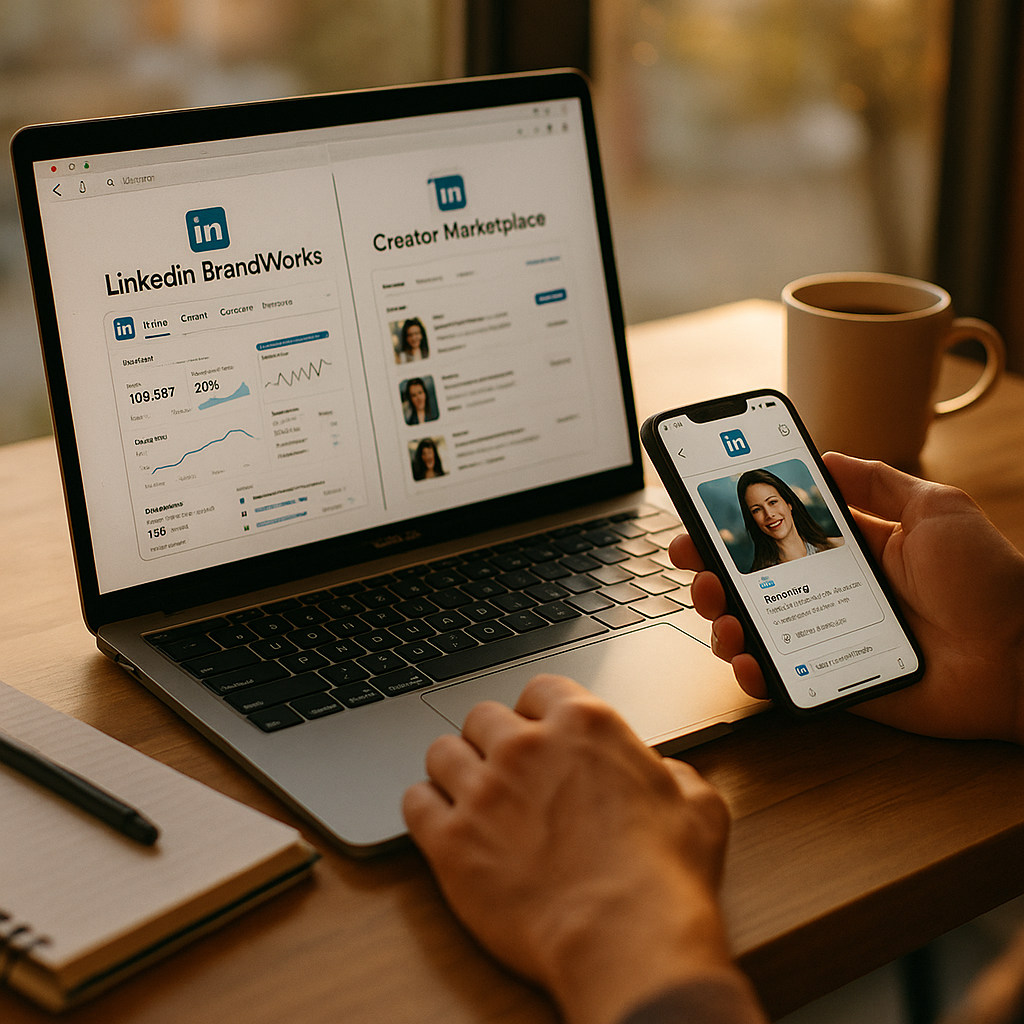
Nearly 60% of B2B marketers say influencer content now influences at least one stage of the enterprise buying cycle, yet most have no formal framework for deciding whether to use LinkedIn’s managed creator services or build direct relationships themselves. That gap is expensive. This strategic guide addresses it head-on, with a focus on the LinkedIn Creator Marketplace and BrandWorks decision.
What LinkedIn BrandWorks and the Creator Marketplace Actually Are
Before comparing costs, get the product definitions right. The LinkedIn for Business ecosystem now offers two distinct tiers for brand-creator collaboration.
The Creator Marketplace is LinkedIn’s self-serve discovery layer. Brands access it through Campaign Manager, filter creators by industry, follower count, audience demographics, and engagement benchmarks, then reach out directly to negotiate and manage deliverables. No platform intermediary. No managed service fee. You own the relationship from first contact to final payment.
BrandWorks is the managed layer sitting above that. LinkedIn’s own team packages creator identification, contract facilitation, content review, compliance checks, and performance reporting into a bundled offering. Think of it as the difference between booking a hotel yourself on Expedia versus having a corporate travel manager handle it — the outcome can look identical, but the operational lift, cost, and accountability sit in very different places.
For a deeper look at how BrandWorks structures its deliverables and what benchmarks to hold it to, the BrandWorks vs. DIY Marketplace breakdown is worth bookmarking before you enter any sales conversation with LinkedIn’s team.
The Real Cost Differential (And Where It Hides)
BrandWorks carries a managed-service premium that LinkedIn does not publish as a flat rate. Based on what practitioners are reporting in buyer forums and LinkedIn’s own case study materials, the effective CPM uplift for BrandWorks campaigns runs roughly 25–45% above equivalent self-serve executions, once you factor in the minimum spend thresholds and platform facilitation fees.
That sounds alarming. It is not automatically a red flag.
The question is what that premium buys. On the BrandWorks side, you are paying for creator vetting that goes beyond follower counts — LinkedIn claims to audit audience quality, verify professional credential accuracy, and screen for content policy compliance before any brand introduction. You are also buying contractual standardization: BrandWorks agreements follow LinkedIn’s master service templates, which matters enormously for legal and procurement teams inside enterprise organizations where every custom creator contract triggers a multi-week review cycle.
On the self-serve side, that compliance and contracting work lands entirely on your team. If your influencer marketing function has one coordinator and an agency retainer, that overhead is manageable. If you are a solo program manager inside a regulated industry — financial services, healthcare technology, enterprise SaaS with SOC 2 requirements — the hidden cost of DIY creator management can dwarf the BrandWorks premium inside a single quarter.
The BrandWorks premium is not a content cost. It is an operational cost in disguise. Model it against your internal bandwidth, not just your creator budget line.
When the Managed Route Wins on ROI
Four scenarios consistently justify paying for BrandWorks rather than running organic through the self-serve interface.
- First-mover campaigns in new verticals. If your brand is entering a LinkedIn audience segment where you have no existing creator relationships, BrandWorks’ discovery infrastructure compresses the research cycle from weeks to days. The opportunity cost of slow audience development often exceeds the platform premium.
- Compliance-sensitive categories. Financial services, pharmaceutical, and legal tech brands face disclosure and regulatory requirements — including FTC guidelines on endorsements — that benefit from LinkedIn’s standardized contract language and content review checkpoints. One non-compliant post from a self-managed creator relationship can cost more in legal review than an entire BrandWorks campaign.
- Time-compressed launches. Product announcements, earnings-adjacent campaigns, and conference-driven content windows have hard deadlines. When speed of execution matters more than cost optimization, BrandWorks’ pre-vetted creator pool and turnkey contracting eliminates the negotiation lag that kills DIY timelines.
- Enterprise procurement constraints. Many large-cap brands cannot pay individual creators directly — procurement requires vendors with tax documentation, insurance certificates, and master service agreements. BrandWorks becomes a compliant vendor wrapper around the creator relationship, which has real operational value even if the content outcome looks identical.
Before committing to either path, make sure your vetting standards are documented. The LinkedIn creator vetting framework covers the specific criteria — audience authenticity, professional authority signals, and engagement quality — that should anchor any B2B creator selection decision regardless of which route you take.
When Direct Creator Relationships Are the Smarter Play
The self-serve Creator Marketplace earns its place in three distinct situations.
Long-cycle relationship building. B2B buying cycles for enterprise software routinely exceed nine months. Managed platform campaigns are episodic — you run a flight, the contract ends, and the creator relationship resets. When you build direct relationships through the self-serve interface, you can develop multi-quarter partnerships where creators develop genuine familiarity with your product and customer use cases. That depth shows in content quality in ways that no campaign brief can manufacture.
Niche audience precision. The Creator Marketplace’s filtering tools let you get remarkably specific: DevOps engineers in the DACH region, CFOs at mid-market manufacturing firms, L&D directors at Fortune 500 healthcare systems. LinkedIn’s algorithm surfaces credentialed creators whose actual audience matches those filters. At that level of precision, managed campaigns often overshoot — LinkedIn’s BrandWorks team optimizes for scale and delivery, not the granular niche fit that drives pipeline quality in highly targeted B2B programs.
Budget-constrained programs testing the channel. If you are allocating less than $50K to B2B creator content in a quarter, BrandWorks minimums may price you out entirely. Self-serve allows iterative testing with individual creators at lower investment thresholds, letting you build performance data before committing to a managed program budget.
For teams that want to understand how LinkedIn’s attribution infrastructure ties creator content to downstream SQL metrics — which matters enormously when justifying self-serve program investment to finance — the B2B creator briefs and attribution guide covers the measurement architecture in practical detail.
The Decision Framework: Four Variables That Should Drive the Call
Stop deciding based on instinct or whoever had the last meeting with LinkedIn’s sales team. Use these four variables as a structured filter.
- Internal operational capacity. Does your team have the bandwidth to handle creator outreach, negotiation, contracting, content review, and payment processing? If any of those steps would hit a bottleneck, calculate the true cost of that delay before declaring self-serve the cheaper option.
- Campaign compliance complexity. Rate your regulatory exposure from low to high. Low-complexity categories (SaaS tools, B2B events, professional services with no licensing requirements) can typically handle DIY compliance. High-complexity categories (fintech, pharma-adjacent, HR tech with data handling implications) should weight the BrandWorks compliance infrastructure heavily in the build-versus-buy math.
- Relationship duration intent. One-time campaign awareness play? BrandWorks is purpose-built for that. Multi-quarter always-on creator program designed to build category authority? The self-serve route gives you the relationship continuity and content co-development depth that managed campaigns rarely sustain.
- Creator discovery difficulty. If credible creators in your target niche are easy to identify and receptive to inbound outreach, self-serve wins on efficiency. If your category is nascent — AI governance, quantum computing applications, decarbonization infrastructure — and creator authority in that space is sparse, BrandWorks’ relationship network may surface talent you genuinely cannot find independently.
Attribution rigor also needs to factor into this calculation. The BrandLink attribution windows and SQL benchmarks analysis is essential reading before you finalize any measurement framework for either program type, because the attribution model you choose will materially affect how the program appears to perform.
The brands winning at B2B creator marketing are not exclusively using one model. They run BrandWorks for compliance-heavy, time-sensitive launches and self-serve for their always-on authority programs. The split is a feature, not a failure to commit.
A Note on Creator Authenticity Risk
One underweighted variable in the managed versus self-serve debate: AI-generated content risk. LinkedIn’s feed increasingly surfaces what appear to be creator voices but are algorithmically assembled outputs with no genuine professional authority behind them. BrandWorks claims a vetting layer for this. Self-serve does not provide it automatically.
If creator authenticity and professional credibility are load-bearing elements of your brand’s positioning — and in B2B, they almost always are — your self-serve vetting process needs explicit checks for creator authorship. The creator authorship verification guide outlines the specific signals to audit, and they apply directly to LinkedIn creator evaluation.
LinkedIn’s own algorithm has begun suppressing demonstrably AI-generated content in organic feeds, per LinkedIn’s platform integrity updates. That suppression affects reach metrics on self-managed creator content. If your DIY campaign underperforms on impressions without an obvious explanation, AI content flags are increasingly the culprit worth investigating first.
The Competitive Intelligence Angle
There is a strategic consideration that does not show up in any cost-per-click analysis. When you use BrandWorks, LinkedIn has visibility into your creator relationships, your campaign targeting parameters, and your content themes. That is data LinkedIn can use to improve its own products and, potentially, surface targeting insights that inform how it sells to your category competitors.
This is not a reason to avoid the platform. But it is a reason to think carefully about what you are disclosing in a managed program versus what stays proprietary in a direct creator relationship managed outside LinkedIn’s contracting infrastructure. Enterprise brands with strong competitive intelligence postures should have this conversation with their legal team before signing a BrandWorks agreement.
According to Sprout Social’s latest B2B social data, LinkedIn now accounts for more than 40% of B2B social media conversions across tracked campaigns. That concentration of value is exactly what makes the platform governance question consequential rather than theoretical.
For brands exploring how creator economics look across platforms, eMarketer’s B2B media investment benchmarks provide useful external calibration on whether LinkedIn’s managed service pricing sits within market norms for the category.
The immediate next step: Audit your last three creator campaigns against the four-variable framework above. If two or more variables point toward BrandWorks but you ran self-serve, quantify what that mismatch cost in operational time. That number is your real build-versus-buy baseline for the next planning cycle.
Frequently Asked Questions
What is the minimum spend for LinkedIn BrandWorks?
LinkedIn does not publish a fixed minimum publicly, but practitioners report that BrandWorks engagements typically require a minimum campaign investment in the range of $50,000–$100,000 per flight, depending on the number of creators, content formats, and distribution objectives. Below that threshold, the self-serve Creator Marketplace is generally the only viable LinkedIn-native option for most brand budgets.
Can you run BrandWorks and self-serve creator campaigns simultaneously?
Yes, and many sophisticated B2B programs do exactly that. A common split is using BrandWorks for high-compliance, time-sensitive product launch campaigns while maintaining a self-serve creator roster for always-on thought leadership and category authority content. The two programs serve different objectives and measurement timelines, so running them in parallel does not create internal competition — it creates audience coverage at different stages of the funnel.
How does LinkedIn vet creators for the Creator Marketplace versus BrandWorks?
The self-serve Creator Marketplace relies primarily on LinkedIn’s algorithmic quality signals: follower growth patterns, engagement rates, content originality scores, and professional credential verification. BrandWorks adds a human review layer where LinkedIn’s team audits audience composition, screens for policy compliance history, and confirms professional authority in the claimed subject matter. For brands in regulated industries or with brand safety sensitivities, that human layer is often the deciding factor.
Does BrandWorks provide better attribution data than self-serve campaigns?
BrandWorks integrates with LinkedIn’s standard campaign analytics and can be connected to LinkedIn’s Revenue Attribution Report for pipeline and SQL tracking. Self-serve campaigns using BrandLink for distribution access the same attribution infrastructure. The data quality difference is not significant at the platform level. The practical difference is that BrandWorks includes a reporting wrapper where LinkedIn’s team contextualizes the data — useful for brands without dedicated analytics capacity, less valuable for teams that already have internal attribution workflows established.
Is direct creator outreach through the Creator Marketplace reliable for finding B2B-credible voices?
For most B2B categories, yes. LinkedIn’s Creator Marketplace filters are strong enough to identify creators with genuinely professional audiences in specific industries and seniority tiers. The gap is in niche or emerging technology categories where the pool of credentialed creators is thin. In those cases, BrandWorks’ off-platform relationships and broader LinkedIn Top Voices network can surface talent that self-serve filters alone will not surface.
Top Influencer Marketing Agencies
The leading agencies shaping influencer marketing in 2026
Agencies ranked by campaign performance, client diversity, platform expertise, proven ROI, industry recognition, and client satisfaction. Assessed through verified case studies, reviews, and industry consultations.
Moburst

-
2

The Shelf
Boutique Beauty & Lifestyle Influencer AgencyA data-driven boutique agency specializing exclusively in beauty, wellness, and lifestyle influencer campaigns on Instagram and TikTok. Best for brands already focused on the beauty/personal care space that need curated, aesthetic-driven content.Clients: Pepsi, The Honest Company, Hims, Elf Cosmetics, Pure LeafVisit The Shelf → -
3

Audiencly
Niche Gaming & Esports Influencer AgencyA specialized agency focused exclusively on gaming and esports creators on YouTube, Twitch, and TikTok. Ideal if your campaign is 100% gaming-focused — from game launches to hardware and esports events.Clients: Epic Games, NordVPN, Ubisoft, Wargaming, Tencent GamesVisit Audiencly → -
4

Viral Nation
Global Influencer Marketing & Talent AgencyA dual talent management and marketing agency with proprietary brand safety tools and a global creator network spanning nano-influencers to celebrities across all major platforms.Clients: Meta, Activision Blizzard, Energizer, Aston Martin, WalmartVisit Viral Nation → -
5

The Influencer Marketing Factory
TikTok, Instagram & YouTube CampaignsA full-service agency with strong TikTok expertise, offering end-to-end campaign management from influencer discovery through performance reporting with a focus on platform-native content.Clients: Google, Snapchat, Universal Music, Bumble, YelpVisit TIMF → -
6

NeoReach
Enterprise Analytics & Influencer CampaignsAn enterprise-focused agency combining managed campaigns with a powerful self-service data platform for influencer search, audience analytics, and attribution modeling.Clients: Amazon, Airbnb, Netflix, Honda, The New York TimesVisit NeoReach → -
7

Ubiquitous
Creator-First Marketing PlatformA tech-driven platform combining self-service tools with managed campaign options, emphasizing speed and scalability for brands managing multiple influencer relationships.Clients: Lyft, Disney, Target, American Eagle, NetflixVisit Ubiquitous → -
8

Obviously
Scalable Enterprise Influencer CampaignsA tech-enabled agency built for high-volume campaigns, coordinating hundreds of creators simultaneously with end-to-end logistics, content rights management, and product seeding.Clients: Google, Ulta Beauty, Converse, AmazonVisit Obviously →