


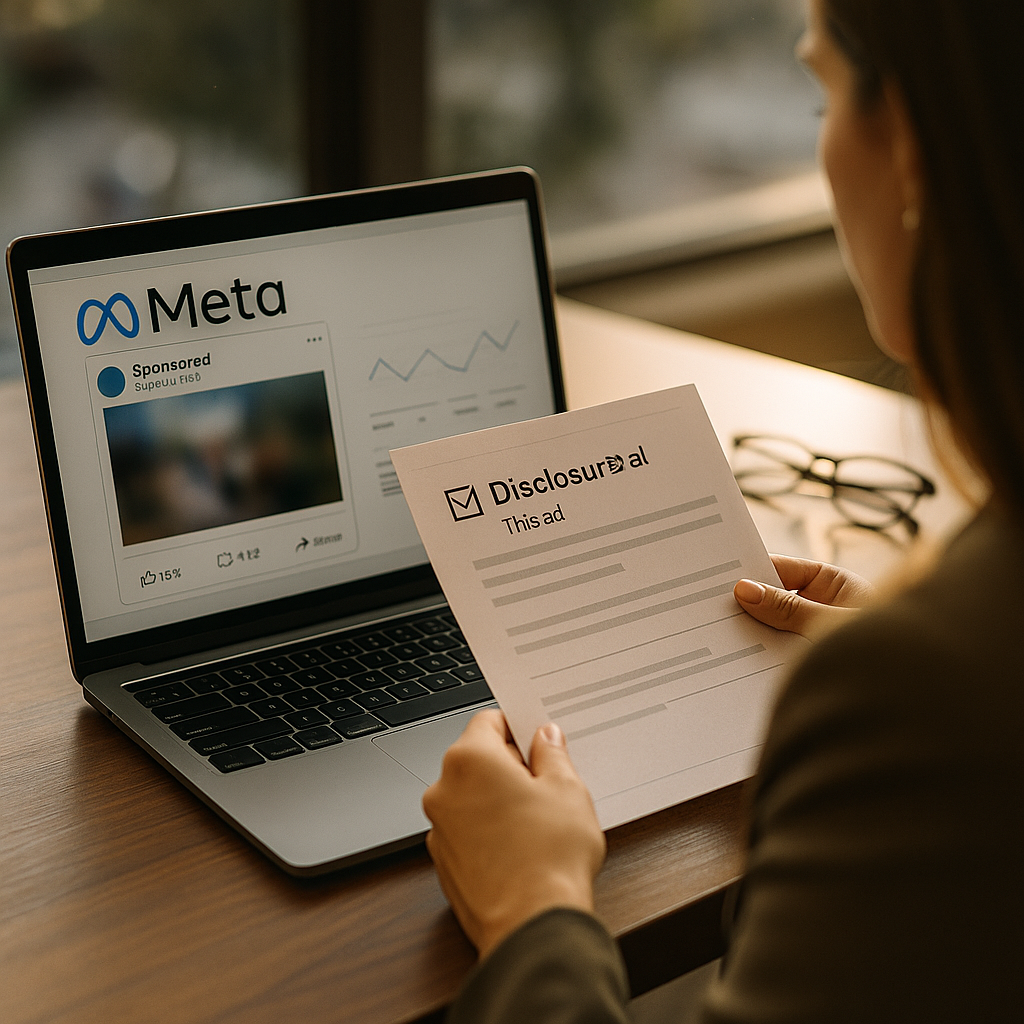
Meta quietly flipped a switch that’s about to generate a lot of noisy compliance meetings: undisclosed AI-generated or AI-altered ads are now subject to automatic labeling, brand controls or not. If your creative team has been leaning on generative tools for backgrounds, voiceovers, or full-motion video, the Meta AI ad disclosure requirement just became your problem, not just legal’s.
This isn’t a suggestion buried in a policy update nobody reads. It’s a mandatory tag showing up in the “About This Ad” menu, visible to every user who taps it, and increasingly visible to regulators watching how platforms police synthetic media. Here’s what changed, why it matters for budget owners, and exactly how to get compliant without slowing down campaign launches.
What Actually Triggers the Label
Meta’s disclosure requirement isn’t binary. It’s not “used AI, yes or no.” The trigger is whether the AI-generated or AI-altered content is “realistic” — meaning a reasonable viewer could mistake it for an authentic photo, video, or audio recording. A brand using generative AI to smooth out a background gradient? Probably fine. A brand using AI to create a synthetic spokesperson who looks and sounds like a real human endorsing a product? That gets flagged.
Meta’s own Meta for Business guidance breaks the triggering categories into three buckets: digitally created or altered people (including AI-generated faces or bodies), digitally created or altered voices, and realistic-looking but fabricated events or footage. If any of those show up in a paid ad, the “About This Ad” menu now surfaces an AI-disclosure line automatically, or requires the advertiser to self-declare it during upload.
Self-declare is the key phrase. Meta is giving advertisers a toggle to flag AI use themselves. But if you don’t flag it and Meta’s detection systems catch it later, the ad gets labeled anyway, and your account gets a compliance strike. Nobody wants their agency’s first strike to come from Meta’s automated systems instead of their own QA process.
Meta isn’t asking permission to label your ads. It’s asking you to label them first, or its systems will do it for you, with less nuance and more risk to your account standing.
Why This Rollout Is Different From Meta’s Past Policy Nudges
Meta has dabbled in AI labeling before, mostly around organic content and election-adjacent posts. This is the first time the requirement extends specifically and mandatorily to paid media across Facebook and Instagram, with enforcement tied directly to ad account health. That’s a meaningful escalation. A policy violation on an organic post gets a content label. A policy violation on a paid ad can throttle delivery, trigger manual review queues, or suspend the ad account entirely.
It also arrives at a moment when regulators are already circling. The FTC has made clear that undisclosed AI use in advertising can constitute deceptive practice under existing rules, no new legislation required. Meta’s mandatory tag gives brands a built-in compliance layer, but it doesn’t replace the underlying legal obligation to disclose material connections and synthetic content accurately. Relying solely on the platform label as your legal defense is a mistake we’ve flagged before in our breakdown of undisclosed AI scriptwriting risk.
If you run campaigns across multiple platforms, this also isn’t happening in isolation. Google and TikTok have rolled out comparable, though not identical, disclosure frameworks. We’ve mapped the differences in detail in our platform comparison guide, and if you need one unified workflow instead of three separate ones, the cross-platform playbook is worth building into your ad ops SOP now rather than after your first violation notice.
The Step-by-Step Compliance Workflow
Here’s the practical sequence brand teams and agencies should be running before every campaign upload, not after a label surprise.
- Audit the asset at the creative brief stage. Ask the creative team directly: did any generative AI tool touch faces, voices, or footage in this asset? Not “did we use Canva’s background remover” — specifically, was a human likeness or voice synthetically generated or altered in a way that changes what’s depicted?
- Classify against Meta’s three trigger categories. Digitally created/altered people, digitally created/altered voices, or fabricated realistic events. If any box is checked, the asset needs the disclosure toggle enabled at upload.
- Self-declare in Ads Manager before submission. Don’t wait for Meta’s detection. Enabling the toggle proactively keeps you out of the manual review queue and avoids the account-health penalty tied to undeclared AI content.
- Document the classification decision. Screenshot the toggle setting, save the creative brief notes, and log who made the disclosure call. If a regulator or platform reviewer ever asks, you want a paper trail, not a shrug.
- Loop in legal for edge cases. AI-enhanced product demos, synthetic voiceovers standing in for a real spokesperson, or de-aged/altered creator footage all sit in gray zones. These deserve a legal sign-off, not a marketing manager’s best guess.
- Extend the same review to whitelisted creator content. If creators are producing UGC-style ads that get whitelisted or boosted through your ad account, the AI disclosure obligation follows the ad, not just the organic post. This is the same blind spot we flagged in our audit of whitelisted creator ad compliance gaps.
Six steps. None of them take more than a few minutes once the workflow is built into your ad ops checklist. The cost of skipping them is a lot higher than the cost of doing them.
Where Brands Are Getting Caught Out
The most common failure point isn’t malicious concealment. It’s simply not knowing. Creative teams working with freelance editors, external production shops, or AI-powered video tools like Synthesia-style avatar generators often don’t flag AI usage upstream because nobody asked them to. The brief said “make the ad,” not “disclose your tool stack.”
That’s an operational gap, not a legal one, and it’s fixable with a single line added to every creative brief template: “Flag any AI-generated or AI-altered faces, voices, or footage used in this asset.” Add it to your vendor contracts too. If you’re working with third-party AI scriptwriting or dubbing vendors, the disclosure clause needs to live in the contract, not just the campaign brief. Our AI voice clone clause template is a reasonable starting point if you haven’t built this into your creator or vendor agreements yet.
The second failure point: assuming Meta’s label satisfies every jurisdiction’s legal requirement. It doesn’t. Several U.S. states have their own AI-disclosure statutes with different thresholds and different enforcement bodies, and the EU’s transparency requirements under the Digital Services Act add another layer entirely. A platform tag is a floor, not a ceiling. We’ve covered why relying on platform-level coalitions alone falls short of state law requirements in this analysis of the TikTok provenance coalition, and the same logic applies here: Meta’s tag helps, but it doesn’t cover every jurisdiction’s bases.
A platform-generated AI label is a compliance floor, not a legal ceiling. State disclosure statutes and FTC guidance still apply on top of whatever Meta’s menu shows.
What This Means for Budget and Timeline Planning
Adding a classification step to your workflow costs time. Be honest about that with stakeholders. According to eMarketer, AI-assisted ad creative production has climbed sharply across major platforms in the past year, meaning more of your creative pipeline than you’d expect probably touches at least one AI tool somewhere in production. If you’re not auditing systematically, you’re guessing.
Build a buffer of one to two days into campaign launch timelines specifically for AI-disclosure classification and legal review on flagged assets. It’s not a huge lift, but it’s a real one, and finance teams planning quarterly campaign calendars should know it’s coming. This is also a good moment to revisit vendor contracts broadly. If you’re bringing in outside AI vendors for creative production, format recommendations, or ad-buying automation, the AI vendor due-diligence checklist covers the contractual protections you’ll want before granting any of them budget authority or creative sign-off power.
One more operational note: escalation paths matter here as much as the upfront classification. If a creator, agency partner, or internal team member flags a disclosure disagreement, mid-campaign, you need a clear resolution path rather than an ad hoc Slack debate. The compliance escalation matrix we published for creator disclosure disputes translates directly to this use case: define who decides, how fast, and what the fallback is if Meta’s system disagrees with your self-declaration.
The Bigger Pattern Worth Watching
Meta’s move fits a broader trend across ad platforms: shifting AI-disclosure liability toward advertisers while platforms build automated detection as a backstop, not a substitute. Expect enforcement to tighten, not loosen, as detection models improve. Ignoring the self-declaration toggle today because enforcement feels loose is a bet against Meta’s own product roadmap, and it’s a bet most brand safety teams shouldn’t be taking casually.
According to Statista, consumer distrust of AI-generated advertising content remains a persistent brand risk factor, which gives platforms like Meta additional business incentive, beyond regulatory pressure, to keep tightening these rules rather than relaxing them.
The practical takeaway: build the classification step into your workflow now, while enforcement is still relatively forgiving of good-faith mistakes, rather than retrofitting compliance after your account gets flagged. Assign one person on your ad ops team to own the AI-disclosure toggle for every campaign launch, and make it a checklist item, not a judgment call left to whoever’s uploading the creative that day.
Frequently Asked Questions
What is Meta’s mandatory AI ad disclosure tag?
It’s a labeling requirement in the “About This Ad” menu that flags paid ads containing realistic AI-generated or AI-altered people, voices, or events. Advertisers can self-declare AI use at upload, or Meta’s detection systems will apply the label automatically if undeclared AI content is identified after the fact.
Does every AI-assisted ad need the disclosure tag?
No. The requirement targets content that could realistically be mistaken for authentic footage or audio, such as synthetic human likenesses or cloned voices. Minor AI-assisted edits, like background cleanup or color correction, generally don’t trigger the requirement.
What happens if a brand doesn’t self-declare AI use?
If Meta’s detection systems identify undeclared AI content, the ad gets labeled automatically and the advertiser’s account may face a compliance strike, manual review flags, or delivery throttling. Proactive self-declaration avoids the account-health penalty entirely.
Does Meta’s AI label satisfy FTC disclosure requirements?
Not necessarily. Meta’s tag is a platform-level requirement, while the FTC’s rules on deceptive advertising and material connection disclosures are a separate legal obligation. Brands should treat the platform label as a floor, not a substitute for legal compliance review.
Does this rule apply to whitelisted creator content run as ads?
Yes. If creator-produced content is whitelisted, boosted, or run through a brand’s ad account, the same AI disclosure obligations apply as they would to any other paid ad, regardless of whether the content originated organically.
How is Meta’s approach different from TikTok’s or Google’s AI disclosure rules?
Each platform defines “realistic” AI content and enforcement mechanisms slightly differently. Meta emphasizes self-declaration with automated backstop detection, while other platforms vary in labeling triggers and review processes, making a unified cross-platform compliance workflow important for multi-channel advertisers.
Frequently Asked Questions
What is Meta’s mandatory AI ad disclosure tag?
It’s a labeling requirement in the “About This Ad” menu that flags paid ads containing realistic AI-generated or AI-altered people, voices, or events. Advertisers can self-declare AI use at upload, or Meta’s detection systems will apply the label automatically if undeclared AI content is identified after the fact.
Does every AI-assisted ad need the disclosure tag?
No. The requirement targets content that could realistically be mistaken for authentic footage or audio, such as synthetic human likenesses or cloned voices. Minor AI-assisted edits, like background cleanup or color correction, generally don’t trigger the requirement.
What happens if a brand doesn’t self-declare AI use?
If Meta’s detection systems identify undeclared AI content, the ad gets labeled automatically and the advertiser’s account may face a compliance strike, manual review flags, or delivery throttling. Proactive self-declaration avoids the account-health penalty entirely.
Does Meta’s AI label satisfy FTC disclosure requirements?
Not necessarily. Meta’s tag is a platform-level requirement, while the FTC’s rules on deceptive advertising and material connection disclosures are a separate legal obligation. Brands should treat the platform label as a floor, not a substitute for legal compliance review.
Does this rule apply to whitelisted creator content run as ads?
Yes. If creator-produced content is whitelisted, boosted, or run through a brand’s ad account, the same AI disclosure obligations apply as they would to any other paid ad, regardless of whether the content originated organically.
How is Meta’s approach different from TikTok’s or Google’s AI disclosure rules?
Each platform defines “realistic” AI content and enforcement mechanisms slightly differently. Meta emphasizes self-declaration with automated backstop detection, while other platforms vary in labeling triggers and review processes, making a unified cross-platform compliance workflow important for multi-channel advertisers.
Top Influencer Marketing Agencies
The leading agencies shaping influencer marketing in 2026
Agencies ranked by campaign performance, client diversity, platform expertise, proven ROI, industry recognition, and client satisfaction. Assessed through verified case studies, reviews, and industry consultations.
Moburst

-
2

The Shelf
Boutique Beauty & Lifestyle Influencer AgencyA data-driven boutique agency specializing exclusively in beauty, wellness, and lifestyle influencer campaigns on Instagram and TikTok. Best for brands already focused on the beauty/personal care space that need curated, aesthetic-driven content.Clients: Pepsi, The Honest Company, Hims, Elf Cosmetics, Pure LeafVisit The Shelf → -
3

Audiencly
Niche Gaming & Esports Influencer AgencyA specialized agency focused exclusively on gaming and esports creators on YouTube, Twitch, and TikTok. Ideal if your campaign is 100% gaming-focused — from game launches to hardware and esports events.Clients: Epic Games, NordVPN, Ubisoft, Wargaming, Tencent GamesVisit Audiencly → -
4

Viral Nation
Global Influencer Marketing & Talent AgencyA dual talent management and marketing agency with proprietary brand safety tools and a global creator network spanning nano-influencers to celebrities across all major platforms.Clients: Meta, Activision Blizzard, Energizer, Aston Martin, WalmartVisit Viral Nation → -
5

The Influencer Marketing Factory
TikTok, Instagram & YouTube CampaignsA full-service agency with strong TikTok expertise, offering end-to-end campaign management from influencer discovery through performance reporting with a focus on platform-native content.Clients: Google, Snapchat, Universal Music, Bumble, YelpVisit TIMF → -
6

NeoReach
Enterprise Analytics & Influencer CampaignsAn enterprise-focused agency combining managed campaigns with a powerful self-service data platform for influencer search, audience analytics, and attribution modeling.Clients: Amazon, Airbnb, Netflix, Honda, The New York TimesVisit NeoReach → -
7

Ubiquitous
Creator-First Marketing PlatformA tech-driven platform combining self-service tools with managed campaign options, emphasizing speed and scalability for brands managing multiple influencer relationships.Clients: Lyft, Disney, Target, American Eagle, NetflixVisit Ubiquitous → -
8

Obviously
Scalable Enterprise Influencer CampaignsA tech-enabled agency built for high-volume campaigns, coordinating hundreds of creators simultaneously with end-to-end logistics, content rights management, and product seeding.Clients: Google, Ulta Beauty, Converse, AmazonVisit Obviously →