


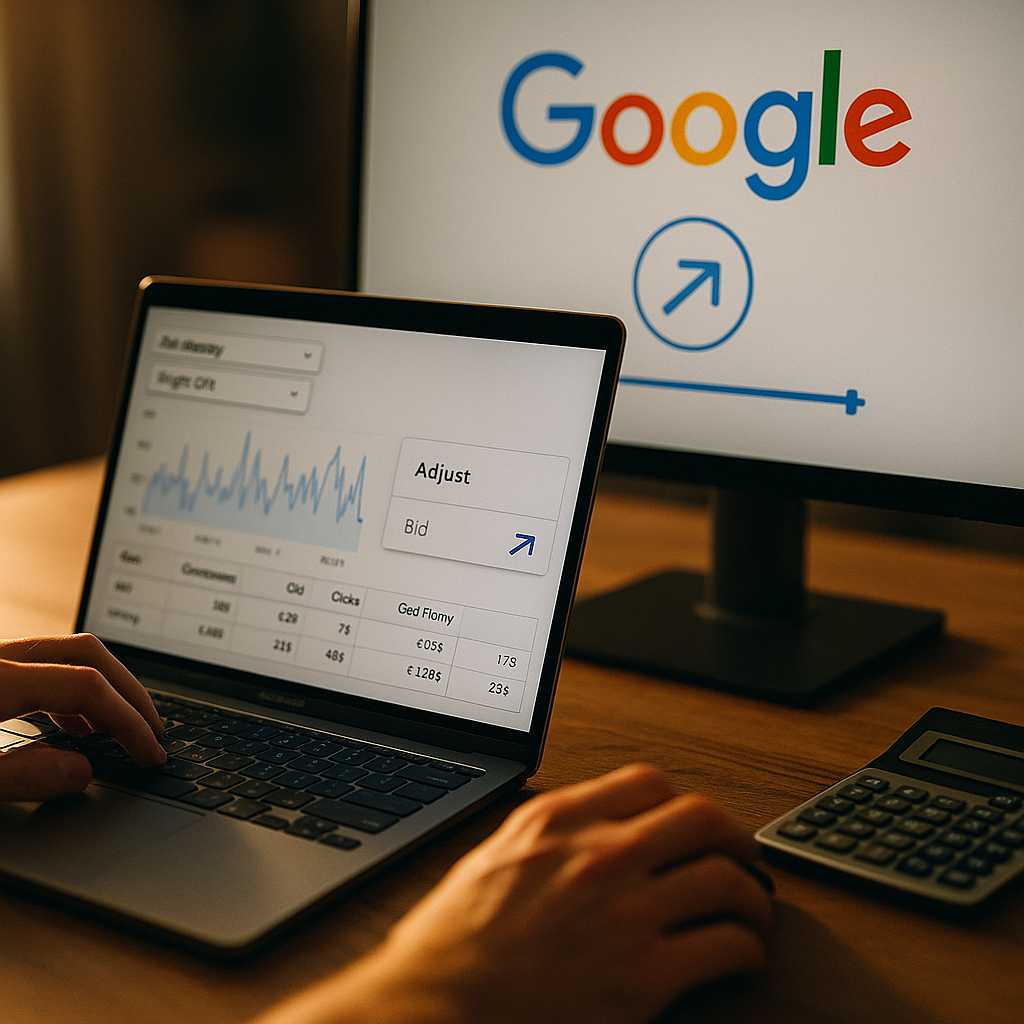
Roughly 80% of Google Ads accounts now run some flavor of automated bidding. So when Google touches the algorithm powering that automation, the tremors reach every dashboard, every KPI report, every budget conversation with a CFO. The Google bidding algorithm update rolling out across YouTube and Search isn’t a cosmetic tweak. It changes how “success” gets defined before you even launch a campaign.
If your team has spent the last few quarters optimizing toward Target ROAS or tCPA, expect friction. The new system leans harder into AI-driven performance goals that blend signals Google previously kept siloed. Here’s what’s actually shifting, and what to do about it before your next budget cycle.
What’s actually changing under the hood
Google frames this as an evolution of Performance Max and Smart Bidding, but the mechanics matter more than the marketing copy. The update consolidates conversion signals across YouTube, Search, Discover, and Gmail into a single predictive layer. Instead of bidding toward a fixed tCPA or ROAS number in isolation, the algorithm now weighs real-time incrementality signals: how likely is this specific auction to produce a conversion that wouldn’t have happened anyway?
That’s a meaningful shift from correlation-based optimization to something closer to causal inference. Google has talked about this direction for years through its Google Ads Help documentation on Smart Bidding, but the compute now exists to act on it at auction speed.
The practical effect: bid strategies that worked because of stable historical patterns may underperform, while accounts with messier but richer first-party data could see gains they didn’t expect.
For YouTube advertisers specifically, this means view-through conversions and watch-time engagement now feed the same optimization loop as Search click-throughs. That’s new. Previously, YouTube campaign performance and Search campaign performance lived in adjacent but distinct optimization tracks. Now they’re informing each other, which is either a gift or a liability depending on how clean your cross-channel attribution already is.
Dashboard changes advertisers will notice first
Forget the algorithm theory for a second. Here’s what actually shows up when you log in Monday morning:
- New “Predicted Performance Confidence” scores attached to each campaign, indicating how much data the AI model has to work with before it trusts its own predictions.
- Consolidated cross-channel conversion paths showing YouTube view-throughs alongside Search last-clicks in a single funnel visualization, rather than two separate reports you’d stitch together manually.
- Recommendation cards nudging advertisers toward broader targeting and expanded creative sets, framed as necessary “fuel” for the new bidding model.
- Volatility flags on campaigns where recent bid adjustments deviate sharply from historical norms, essentially Google’s way of saying, “trust the process, don’t panic and pause.”
That last point deserves scrutiny. Historically, advertisers who panicked and paused campaigns during a learning phase reset progress and paid a performance tax for weeks. The new dashboard is explicitly designed to discourage that behavior. Whether it’s discouraging good instincts or bad ones depends entirely on your account’s data maturity.
Why “AI-driven performance goals” is doing a lot of work in that phrase
Google’s language matters here. It’s not calling these “automated bid strategies” anymore, it’s calling them “AI-driven performance goals.” That’s a rebrand with consequences. A performance goal implies the advertiser sets an outcome and the algorithm figures out the path. Increasingly, that path includes decisions advertisers used to control directly, like which audience segments get prioritized within a broad match campaign, or how budget shifts between YouTube in-stream and Search during a single day.
Marketers who’ve built careers on granular control are going to feel this loss of visibility acutely. The tradeoff Google is offering is better raw performance in exchange for less manual steering. Early tests reported by eMarketer suggest conversion efficiency gains in double digits for advertisers with robust first-party conversion data, but flat or negative results for accounts still relying primarily on Google’s own pixel-based signals.
The first-party data gap just got more expensive
This is the part that should actually change your roadmap, not just your reporting cadence. AI-driven bidding models are only as good as the signals feeding them. Advertisers who’ve invested in server-side conversion tracking, enhanced conversions, and offline conversion imports are going to see the new algorithm perform noticeably better than those still leaning on default pixel tracking.
Put bluntly: if your measurement stack hasn’t been upgraded in the last year, this update will expose that gap in your ROAS numbers before it shows up anywhere else.
Practical steps that matter more now than they did six months ago:
- Audit whether Enhanced Conversions for Web and Enhanced Conversions for Leads are both active, not just one.
- Import offline conversion data (store visits, CRM-qualified leads, phone call conversions) if you haven’t already.
- Reconcile YouTube view-through windows with your actual sales cycle length. A 30-day view-through window is meaningless for a 90-day B2B sales cycle.
- Check consent mode implementation. Modeled conversions still require a baseline of observed data to model from.
None of this is glamorous work. But it’s the difference between the AI having real signal to optimize against versus guessing based on thin, decaying cookie data.
YouTube advertisers: the view-through recalibration
YouTube campaigns are arguably where this update creates the most dashboard disruption. Historically, YouTube performance reporting favored hard metrics: views, watch time, click-throughs. Brand advertisers running upper-funnel awareness campaigns often didn’t connect those metrics to bottom-funnel bidding logic at all.
That separation is dissolving. If you’re running YouTube alongside Search under a shared AI-driven performance goal (which Performance Max increasingly nudges advertisers toward), your YouTube creative and targeting choices now directly influence Search auction behavior, and vice versa. A YouTube ad that drives high-intent brand searches will get rewarded by the bidding algorithm in ways that weren’t previously visible in a single dashboard view.
This is worth pairing with creator-side strategy too. If you’re running YouTube creator partnerships alongside paid media, the same optimization logic increasingly rewards content that drives measurable downstream action. Teams negotiating creator deals should read our breakdown on CPM negotiation frameworks alongside this update, because the bidding shift changes what “good performance” looks like when reporting back to a creator partner. Similarly, if you’re layering CTV into the mix, our guide on CTV creator campaigns covers how living-room viewing complicates attribution even further.
Search advertisers: broad match gets another push
Search advertisers should expect the dashboard to nudge, insistently, toward broad match keywords and expanded audience signals. This isn’t new behavior from Google, but the AI-driven goal framework makes the pitch more aggressive. The logic: broader inputs give the model more auction opportunities to learn from, which theoretically improves the AI-driven performance goal outcome faster.
Skeptical advertisers, and there are plenty, will point out that broader targeting has historically meant less control and more wasted spend for brands without deep enough budgets to generate statistically significant learning data. That skepticism is fair. A local service business running $3,000 a month isn’t going to benefit from the same broad-match expansion that a national retailer with a seven-figure budget can absorb.
The pragmatic move: test broad match expansion in a controlled experiment, not a wholesale account migration. Google’s own Ads experiments tools let you run new bidding structures against a holdout group before committing full budget.
What agencies should tell clients this quarter
If you’re managing paid media for clients, the honest conversation right now isn’t about the algorithm, it’s about data readiness. Clients want to hear that Google added a better AI. What they need to hear is that the AI is only as good as what you feed it, and most accounts aren’t feeding it enough.
Set expectations early:
- Performance may dip for two to four weeks as the model recalibrates against new signal weighting, even on accounts with strong historical performance.
- Reporting cadence should shift from daily obsessing to weekly trend review, since the new confidence scoring means short-term volatility is expected behavior, not a red flag.
- Budget conversations should include a line item for measurement infrastructure (enhanced conversions setup, CRM integration, offline conversion imports) if it isn’t already funded.
Brands running influencer and creator content alongside paid Search and YouTube should also revisit how affiliate and UGC content gets tagged for conversion tracking. If creator-driven traffic isn’t tagged distinctly, the AI-driven bidding model can’t credit it properly, and you lose the ability to prove creator ROI to your own finance team. Our playbook on affiliate brief templates covers tagging discipline that pairs well with this update. For brands active on TikTok Shop alongside Google properties, the same tagging logic applies, see our notes on the discovery stack approach for a parallel example of platform-specific signal hygiene.
Risk and compliance: don’t skip this part
AI-driven bidding that pulls in more first-party and behavioral data raises the compliance stakes. Any advertiser importing offline conversions or CRM data into Google Ads needs a defensible consent trail. Regulatory scrutiny on ad tech data flows hasn’t slowed down, and the FTC has made clear that automated decisioning systems using consumer data don’t get a compliance pass just because a platform built the model.
Practical checklist for legal and compliance teams:
- Confirm consent mode v2 implementation predates any expansion of first-party data sharing with Google.
- Document what conversion data gets shared, and get sign-off from privacy counsel before enabling enhanced conversions for leads, which involves hashed PII.
- Review vendor contracts for creator and affiliate partners to confirm data-sharing clauses align with updated Google Ads terms.
This isn’t scaremongering. It’s the unglamorous groundwork that determines whether your AI-driven performance gains hold up under a privacy audit six months from now.
Next step
Before you let the new algorithm touch live budget, run a 30-day parallel test: keep one campaign on your legacy bid strategy while a matched campaign adopts the new AI-driven goal, then compare not just ROAS but data confidence scores in the dashboard. That comparison, not the sales pitch in your Google rep’s next call, should decide your rollout timeline.
FAQs
What is the Google bidding algorithm update actually changing?
It consolidates conversion signals across YouTube, Search, Discover, and Gmail into a single AI model that optimizes toward broader “performance goals” rather than isolated tCPA or ROAS targets per channel, shifting more targeting and budget decisions away from manual advertiser control.
Will my YouTube and Search campaigns be affected differently?
Yes. YouTube advertisers will see view-through and watch-time data feed directly into Search bidding decisions, while Search advertisers will notice stronger pushes toward broad match and audience expansion as the model seeks more learning signal.
How long does the model take to recalibrate after adopting the new bidding structure?
Most accounts should expect two to four weeks of volatility before performance stabilizes, though this varies based on conversion volume and how much first-party data is already integrated.
Do I need to change my measurement setup before this update affects me?
Strongly recommended. Enhanced conversions, offline conversion imports, and consent mode implementation directly determine how much signal the AI model has to optimize against, so gaps in these areas will show up as underperformance.
Is broad match mandatory under the new system?
Not mandatory, but Google’s dashboard recommendations will push harder toward it. Advertisers should test broad match expansion in a controlled experiment against a holdout campaign rather than migrating an entire account at once.
What compliance risks come with the update?
Expanded data sharing for AI-driven bidding, particularly enhanced conversions using hashed PII, requires documented consent trails and privacy counsel review, especially for accounts integrating CRM or offline conversion data.
FAQs
What is the Google bidding algorithm update actually changing?
It consolidates conversion signals across YouTube, Search, Discover, and Gmail into a single AI model that optimizes toward broader “performance goals” rather than isolated tCPA or ROAS targets per channel, shifting more targeting and budget decisions away from manual advertiser control.
Will my YouTube and Search campaigns be affected differently?
Yes. YouTube advertisers will see view-through and watch-time data feed directly into Search bidding decisions, while Search advertisers will notice stronger pushes toward broad match and audience expansion as the model seeks more learning signal.
How long does the model take to recalibrate after adopting the new bidding structure?
Most accounts should expect two to four weeks of volatility before performance stabilizes, though this varies based on conversion volume and how much first-party data is already integrated.
Do I need to change my measurement setup before this update affects me?
Strongly recommended. Enhanced conversions, offline conversion imports, and consent mode implementation directly determine how much signal the AI model has to optimize against, so gaps in these areas will show up as underperformance.
Is broad match mandatory under the new system?
Not mandatory, but Google’s dashboard recommendations will push harder toward it. Advertisers should test broad match expansion in a controlled experiment against a holdout campaign rather than migrating an entire account at once.
What compliance risks come with the update?
Expanded data sharing for AI-driven bidding, particularly enhanced conversions using hashed PII, requires documented consent trails and privacy counsel review, especially for accounts integrating CRM or offline conversion data.
Top Influencer Marketing Agencies
The leading agencies shaping influencer marketing in 2026
Agencies ranked by campaign performance, client diversity, platform expertise, proven ROI, industry recognition, and client satisfaction. Assessed through verified case studies, reviews, and industry consultations.
Moburst

-
2

The Shelf
Boutique Beauty & Lifestyle Influencer AgencyA data-driven boutique agency specializing exclusively in beauty, wellness, and lifestyle influencer campaigns on Instagram and TikTok. Best for brands already focused on the beauty/personal care space that need curated, aesthetic-driven content.Clients: Pepsi, The Honest Company, Hims, Elf Cosmetics, Pure LeafVisit The Shelf → -
3

Audiencly
Niche Gaming & Esports Influencer AgencyA specialized agency focused exclusively on gaming and esports creators on YouTube, Twitch, and TikTok. Ideal if your campaign is 100% gaming-focused — from game launches to hardware and esports events.Clients: Epic Games, NordVPN, Ubisoft, Wargaming, Tencent GamesVisit Audiencly → -
4

Viral Nation
Global Influencer Marketing & Talent AgencyA dual talent management and marketing agency with proprietary brand safety tools and a global creator network spanning nano-influencers to celebrities across all major platforms.Clients: Meta, Activision Blizzard, Energizer, Aston Martin, WalmartVisit Viral Nation → -
5

The Influencer Marketing Factory
TikTok, Instagram & YouTube CampaignsA full-service agency with strong TikTok expertise, offering end-to-end campaign management from influencer discovery through performance reporting with a focus on platform-native content.Clients: Google, Snapchat, Universal Music, Bumble, YelpVisit TIMF → -
6

NeoReach
Enterprise Analytics & Influencer CampaignsAn enterprise-focused agency combining managed campaigns with a powerful self-service data platform for influencer search, audience analytics, and attribution modeling.Clients: Amazon, Airbnb, Netflix, Honda, The New York TimesVisit NeoReach → -
7

Ubiquitous
Creator-First Marketing PlatformA tech-driven platform combining self-service tools with managed campaign options, emphasizing speed and scalability for brands managing multiple influencer relationships.Clients: Lyft, Disney, Target, American Eagle, NetflixVisit Ubiquitous → -
8

Obviously
Scalable Enterprise Influencer CampaignsA tech-enabled agency built for high-volume campaigns, coordinating hundreds of creators simultaneously with end-to-end logistics, content rights management, and product seeding.Clients: Google, Ulta Beauty, Converse, AmazonVisit Obviously →