


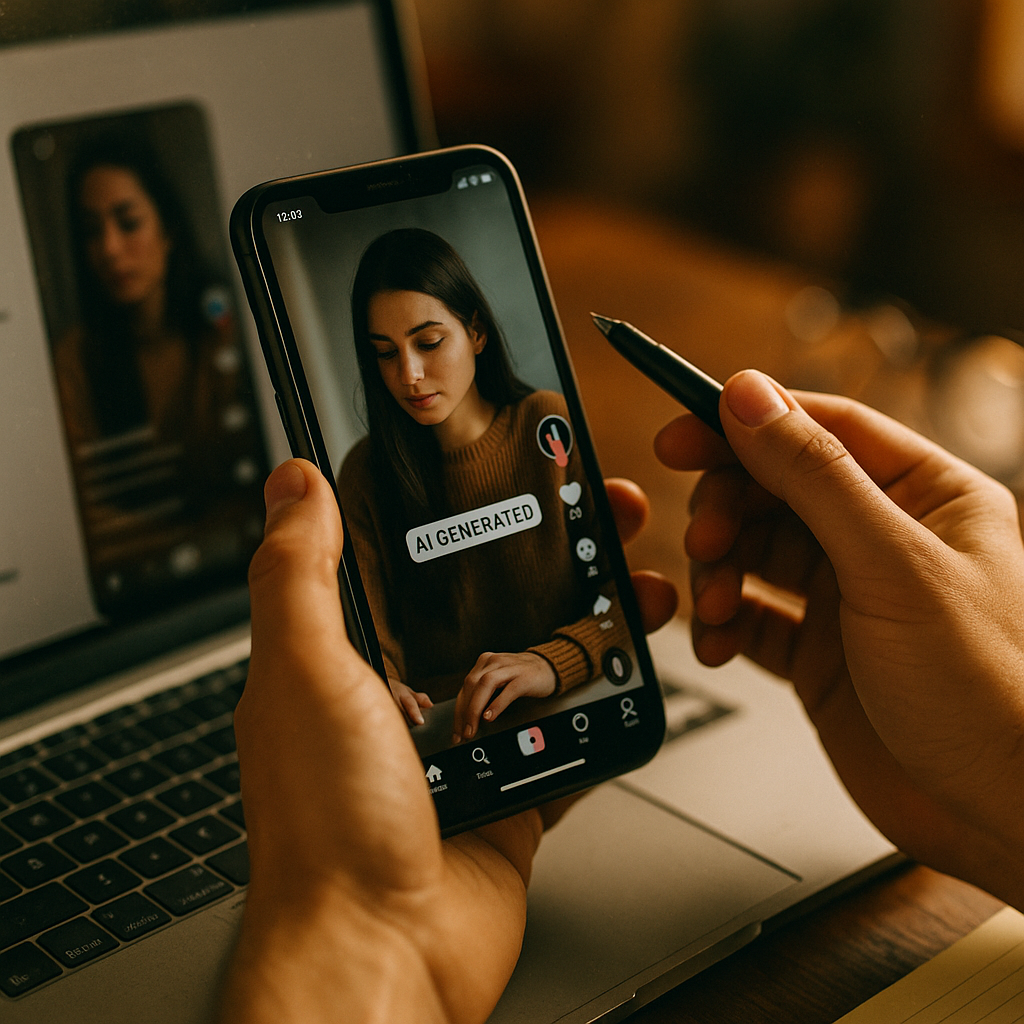
Every video TikTok’s classifier flags as AI-generated now gets a visible overlay label — and early data suggests these tagged videos see meaningfully lower completion rates. For brands running influencer campaigns with any AI-assisted production, that’s not a cosmetic detail. It’s a distribution risk hiding inside your media plan. If your creators use AI b-roll, voice cleanup, or generative backgrounds, you may be paying full CPMs for content that TikTok’s own labeling system is quietly suppressing.
What the Overlay Tag Actually Does
TikTok’s automatic AI-content labeling isn’t new in concept, but the enforcement has gotten sharper. The platform’s classifier scans uploaded video for signals of synthetic generation, tools like Sora, Runway, or CapCut’s AI effects, and slaps a visible “AI-generated” overlay directly on the video frame. Unlike the small disclosure tag creators can self-apply, this system-generated label appears without creator input and, in many cases, without much recourse.
The intent is reasonable. Platforms are under regulatory pressure to flag synthetic media, and TikTok has been more aggressive than most in building automated detection rather than relying solely on creator disclosure. But automated systems make mistakes, and the mistakes have commercial consequences. A branded video using AI-enhanced color grading or a synthetic voiceover for accessibility can get flagged the same way a fully AI-generated deepfake would.
Brands are discovering that automatic AI labels don’t just inform viewers — they measurably change how the algorithm distributes the content, often before anyone on the marketing team even knows the tag was applied.
Why Sponsored Content Takes the Bigger Hit
Organic creators absorb an overlay tag as a minor annoyance. Sponsored content is a different animal entirely. Branded videos already compete against a built-in skepticism discount — audiences scroll faster past anything that smells like an ad. Layer an “AI-generated” overlay on top, and you’ve stacked two credibility taxes on a single fifteen-second clip.
Internal brand-side testing shared informally across agency Slack channels (nothing TikTok has confirmed officially) suggests tagged sponsored videos see completion-rate drops in the double digits compared to identical untagged versions. That’s a real efficiency problem when you’re paying for reach through the TikTok Ads Manager on top of the organic post.
There’s also a compounding issue: TikTok’s recommendation system appears to weight tagged content differently in the For You feed. Whether that’s an explicit policy or an emergent side effect of how the classifier interacts with engagement signals, the practical result is the same. Less initial push, fewer completions, and a campaign report that undersells what the creative actually could have done untagged.
The False-Positive Problem
Ask any post-production team running AI upscaling or noise reduction, and they’ll tell you: the classifier isn’t precise. Videos with zero generative content, just AI-assisted editing, have been caught in the same net as fully synthetic clips. That’s a brand safety issue in reverse. You’re not worried about deceptive AI content slipping through; you’re worried about legitimate, human-shot footage getting mislabeled and throttled.
This matters especially for brands that used AI tools for translation or dubbing in international campaigns. If your workflow touches something like an AI voice clone clause for creator dubbing, you should assume the overlay classifier might trigger on that audio layer, even when the visuals are 100% human-shot.
Compliance Overlap: This Isn’t Just an Algorithm Problem
The overlay tag sits at the intersection of two separate obligations brands often treat as one. There’s the platform-level labeling requirement TikTok enforces automatically, and there’s the FTC-level disclosure obligation that falls on the brand and creator regardless of what the platform does. Getting the first one right doesn’t satisfy the second.
We’ve covered this gap before: TikTok’s own provenance coalition efforts won’t satisfy state-level AI disclosure laws on their own, and the same logic applies here. An automatic overlay tag is not a substitute for a proper #ad or #sponsored disclosure, and regulators have made clear they view platform labels and legal disclosures as separate tracks entirely.
Brands running multi-platform campaigns should already have a framework for this. If you’re comparing labeling logic across networks, our breakdown of AI ad labels across Google, Meta, and TikTok is worth revisiting, since the enforcement mechanics differ meaningfully by platform even when the underlying regulatory pressure is the same.
Where This Intersects With Scriptwriting Tools
A growing number of creators use AI scriptwriting tools to draft hooks and captions, even when the video itself is shot traditionally. TikTok’s classifier reportedly considers on-screen text and caption generation patterns as part of its detection signal, which means script-only AI use can trigger the same overlay as fully synthetic video. This is the same blind spot we flagged in our review of undisclosed AI scriptwriting as an FTC compliance risk — brands assume “we only used AI for the script” is a lower-risk use case. The labeling system doesn’t necessarily agree.
What a Brand Safety Audit Should Actually Check
Most brand safety reviews still focus on content adjacency, hate speech proximity, and platform policy violations. The overlay tag issue requires a different checklist, one built around production workflow transparency rather than content moderation. Here’s what belongs on it:
- Tool inventory per creator: Know exactly which AI tools each creator in your roster uses, for what (editing, voice, script, visuals), and how frequently.
- Pre-flight tagging tests: Upload draft cuts as unlisted or private content to see whether the overlay triggers before the sponsored post goes live.
- Performance benchmarking: Compare completion rates and CPM efficiency between tagged and untagged content within the same campaign to quantify the real discount.
- Contract language review: Confirm your creator agreements address who’s responsible if AI tool use triggers a label that suppresses paid performance.
- Escalation path: Document how to appeal a mislabel through TikTok’s creator support channels, and how long that typically takes.
That last point deserves attention. Appeals are slow, and campaigns don’t wait. If a sponsored post gets mislabeled three days into a two-week flight, you’re not getting that suppressed reach back. Build the audit into pre-production, not post-mortem.
Contract Language Brands Are Missing
Here’s where this gets financially real. If a creator’s AI-assisted editing choice triggers an overlay tag that tanks your paid performance, whose problem is that contractually? Right now, for most brands, the honest answer is: nobody’s, because nobody wrote it into the agreement.
This is functionally similar to the disputes we’ve seen emerge around who pays when AI picks the wrong ad format. The tool made a decision, the brand absorbed the consequence, and the contract was silent on liability. Overlay tags need the same treatment as the remix indemnification issue we’ve covered for AI-remixed content: a clear clause defining who’s accountable when automated platform behavior undercuts paid media performance.
Practical contract additions worth pushing for:
- A disclosure requirement for creators to flag any AI tool use in the production pipeline before final cut delivery.
- A right-to-test clause allowing brands to preview draft content for tagging risk before the sponsored flight begins.
- A performance floor or make-good provision if an automatic label materially suppresses agreed-upon reach or completion benchmarks.
None of this requires legal gymnastics. It requires brands to treat platform labeling systems as a measurable variable in campaign performance, the same way they’d treat a shadowban risk or an algorithm change. Our guide on platform algorithm change indemnification covers similar contractual ground and is a reasonable template to adapt.
How This Compares to Other Platforms
Meta’s approach to AI content labeling has been comparatively more permissive, focusing disclosure requirements more heavily on the advertiser side through its Meta Business tools rather than an automatic overlay slapped on the creative itself. Google has leaned into structured ad transparency reporting rather than visible on-asset tagging. TikTok’s overlay is more aggressive and more visible, which makes it both more compliant-looking to regulators and more disruptive to campaign performance.
If you’re running the same creative concept across platforms (a common efficiency play for mid-size brands), you need platform-specific expectations. What passes cleanly on Instagram Reels may get overlay-tagged on TikTok even with identical production methods, because the classifiers simply aren’t calibrated the same way.
Industry data on AI content adoption backs up why this matters at scale. Recent tracking from eMarketer shows generative AI tool usage in short-form video production climbing sharply year over year, and Statista figures on creator tool adoption tell a similar story. As adoption climbs, the overlay tag stops being an edge case and starts being a mainstream campaign variable every brand needs to model into media planning, not just legal review.
What This Means for Budget Allocation
If tagged content underperforms, the math on influencer spend shifts. Brands that have been allocating budget on a flat CPM basis across their creator roster may need to start weighting spend toward creators whose production workflows are AI-light, at least for TikTok specifically. That’s a real operational change, not a theoretical one.
It also raises a fair question for procurement teams: should AI-tool disclosure become a standard field in creator vetting, alongside audience demographics and engagement rate? Given what’s at stake for paid amplification budgets, the answer is increasingly yes. This connects directly to broader AI vendor due-diligence practices brands are already building for other parts of the marketing stack. Creator production tools shouldn’t be exempt from that scrutiny.
Start treating the overlay tag as a media-planning variable, not just a legal footnote: audit your top ten creators’ AI tool usage this quarter, benchmark tagged versus untagged performance, and get the liability language into your next contract cycle before the next flight goes live.
FAQs
Does TikTok’s AI overlay tag replace the need for an FTC disclosure?
No. The overlay tag is a platform-level content label, separate from the legal disclosure obligations creators and brands have under FTC guidelines. Both need to be handled independently, and satisfying one does not satisfy the other.
Can brands appeal a mislabeled sponsored video?
Yes, TikTok offers an appeal path through creator support, but the process is often slow relative to campaign timelines. Testing draft content before a paid flight begins is a more reliable way to avoid the issue than appealing after the fact.
Does the overlay tag affect organic reach the same way it affects paid amplification?
Both are affected, but the financial impact is more acute on paid sponsored content because brands are paying for distribution efficiency that the tag appears to undercut. Organic creators absorb the hit without a direct budget line attached.
What AI tools are most likely to trigger the overlay label?
Fully generative tools like Sora or Runway are the most obvious triggers, but reports suggest even AI-assisted editing, voice cleanup, and caption generation can activate the classifier. The detection system appears to cast a wide net rather than distinguishing cleanly between full synthesis and light AI assistance.
Should creator contracts require AI tool disclosure before content delivery?
Yes. Brands running paid amplification on sponsored content should require creators to disclose AI tool use in the production pipeline before final delivery, so the brand can assess overlay tagging risk before committing media spend.
FAQs
Does TikTok’s AI overlay tag replace the need for an FTC disclosure?
No. The overlay tag is a platform-level content label, separate from the legal disclosure obligations creators and brands have under FTC guidelines. Both need to be handled independently, and satisfying one does not satisfy the other.
Can brands appeal a mislabeled sponsored video?
Yes, TikTok offers an appeal path through creator support, but the process is often slow relative to campaign timelines. Testing draft content before a paid flight begins is a more reliable way to avoid the issue than appealing after the fact.
Does the overlay tag affect organic reach the same way it affects paid amplification?
Both are affected, but the financial impact is more acute on paid sponsored content because brands are paying for distribution efficiency that the tag appears to undercut. Organic creators absorb the hit without a direct budget line attached.
What AI tools are most likely to trigger the overlay label?
Fully generative tools like Sora or Runway are the most obvious triggers, but reports suggest even AI-assisted editing, voice cleanup, and caption generation can activate the classifier. The detection system appears to cast a wide net rather than distinguishing cleanly between full synthesis and light AI assistance.
Should creator contracts require AI tool disclosure before content delivery?
Yes. Brands running paid amplification on sponsored content should require creators to disclose AI tool use in the production pipeline before final delivery, so the brand can assess overlay tagging risk before committing media spend.
Top Influencer Marketing Agencies
The leading agencies shaping influencer marketing in 2026
Agencies ranked by campaign performance, client diversity, platform expertise, proven ROI, industry recognition, and client satisfaction. Assessed through verified case studies, reviews, and industry consultations.
Moburst

-
2

The Shelf
Boutique Beauty & Lifestyle Influencer AgencyA data-driven boutique agency specializing exclusively in beauty, wellness, and lifestyle influencer campaigns on Instagram and TikTok. Best for brands already focused on the beauty/personal care space that need curated, aesthetic-driven content.Clients: Pepsi, The Honest Company, Hims, Elf Cosmetics, Pure LeafVisit The Shelf → -
3

Audiencly
Niche Gaming & Esports Influencer AgencyA specialized agency focused exclusively on gaming and esports creators on YouTube, Twitch, and TikTok. Ideal if your campaign is 100% gaming-focused — from game launches to hardware and esports events.Clients: Epic Games, NordVPN, Ubisoft, Wargaming, Tencent GamesVisit Audiencly → -
4

Viral Nation
Global Influencer Marketing & Talent AgencyA dual talent management and marketing agency with proprietary brand safety tools and a global creator network spanning nano-influencers to celebrities across all major platforms.Clients: Meta, Activision Blizzard, Energizer, Aston Martin, WalmartVisit Viral Nation → -
5

The Influencer Marketing Factory
TikTok, Instagram & YouTube CampaignsA full-service agency with strong TikTok expertise, offering end-to-end campaign management from influencer discovery through performance reporting with a focus on platform-native content.Clients: Google, Snapchat, Universal Music, Bumble, YelpVisit TIMF → -
6

NeoReach
Enterprise Analytics & Influencer CampaignsAn enterprise-focused agency combining managed campaigns with a powerful self-service data platform for influencer search, audience analytics, and attribution modeling.Clients: Amazon, Airbnb, Netflix, Honda, The New York TimesVisit NeoReach → -
7

Ubiquitous
Creator-First Marketing PlatformA tech-driven platform combining self-service tools with managed campaign options, emphasizing speed and scalability for brands managing multiple influencer relationships.Clients: Lyft, Disney, Target, American Eagle, NetflixVisit Ubiquitous → -
8

Obviously
Scalable Enterprise Influencer CampaignsA tech-enabled agency built for high-volume campaigns, coordinating hundreds of creators simultaneously with end-to-end logistics, content rights management, and product seeding.Clients: Google, Ulta Beauty, Converse, AmazonVisit Obviously →