


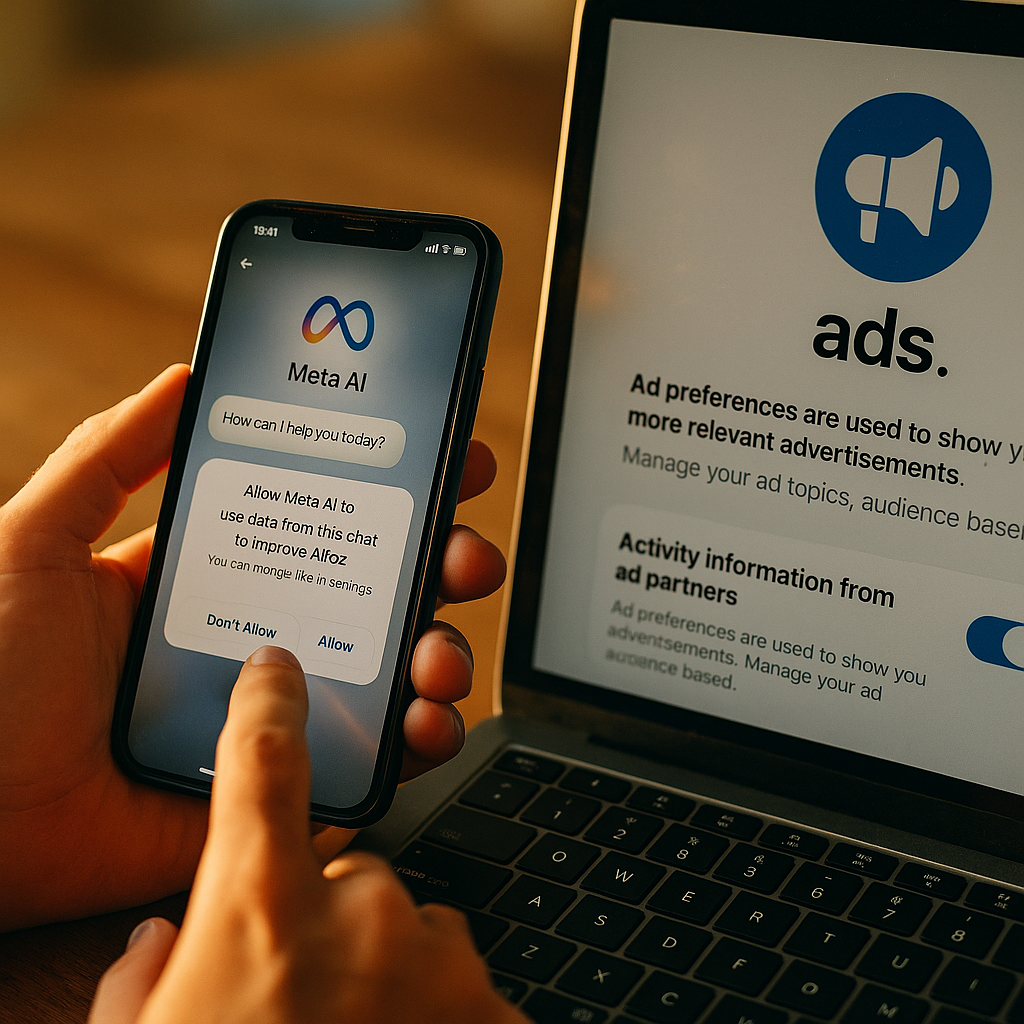
Every message a user sends to Meta AI is now fair game for ad targeting. Starting this year, Meta began using AI chat interactions — the questions people ask, the images they generate, the advice they seek — to shape the ads they see across Facebook and Instagram. If your media plan still treats Meta AI as a novelty feature rather than a targeting input, you’re already behind. The Meta AI-interaction ad personalization policy is quietly rewriting the rules of audience building, and most brand teams haven’t updated their playbook to match.
This isn’t a minor toggle buried in settings. It’s a structural shift in what counts as first-party signal, and it comes with fresh disclosure obligations, opt-out mechanics, and regional carve-outs that vary by jurisdiction. Marketers who get ahead of it can build sharper audiences. Marketers who ignore it risk compliance headaches and wasted spend on segments built from noisy or unrepresentative data.
What Actually Changed
Meta confirmed that conversations with Meta AI — the assistant embedded in Facebook, Instagram, Messenger, and WhatsApp — now feed into the same ad personalization engine that powers behavioral targeting. Someone who asks Meta AI for “best hiking boots for wide feet” isn’t just getting a chatbot answer. They’re generating a signal that can surface hiking gear ads days later, potentially across placements that have nothing to do with the original chat.
Meta frames this as an extension of existing personalization practices, similar to how it’s long used likes, page follows, and on-platform browsing to inform ad delivery. The difference is intent density. A chat query is a far richer, more explicit signal than a passive like. Users are, in effect, telling Meta AI what they want, need, or worry about, in natural language. That’s a targeting goldmine, and also a liability minefield if handled carelessly.
A single AI chat query carries more explicit purchase intent than dozens of passive engagement signals combined — which is exactly why regulators are watching this rollout closely.
Users can limit this in some regions through account-level controls, but the default is opt-in by inertia: unless someone actively digs into settings, their AI interactions are part of the targeting pool. That default-on posture is already drawing scrutiny from privacy advocates and regulators, particularly in markets with stricter consent regimes.
Why This Matters More Than Another Meta Update
Brands have weathered plenty of Meta targeting changes — iOS 14.5, Advantage+ shifts, the slow death of granular interest categories. Why treat this one differently?
Because it changes the provenance of your audience data, not just its plumbing. Interest-based targeting built from page likes is inferential. AI chat targeting is closer to declarative. That distinction matters for two reasons: it likely performs better (people say what they mean), and it invites more direct regulatory attention because it resembles the kind of explicit personal data processing that frameworks like GDPR and state privacy laws were built to govern.
According to eMarketer, AI-assisted ad targeting is one of the fastest-growing investment areas among mid-market advertisers, with brands citing both performance lift and operational efficiency as drivers. But performance gains mean little if a campaign gets flagged for improper consent handling in a market like the EU or UK, where regulators including the ICO have made clear that AI-driven personalization isn’t exempt from existing data protection obligations.
Structuring Campaigns Under the New Rules: A Practical Framework
Here’s where the playbook part comes in. Treat this like any other new targeting input: audit it, segment it, document it, and build guardrails before scaling spend against it.
1. Separate AI-signal audiences from your core retargeting pools
Don’t blend AI-interaction-informed audiences into your existing custom audiences without testing. The behavioral profile of someone who chatted with Meta AI about a product category may skew differently than someone who simply browsed a landing page. Run these as distinct ad sets initially. Compare cost-per-result and downstream conversion quality before folding them into a broader Advantage+ pool.
2. Update your consent and disclosure documentation now
If your brand operates in the EU, UK, or any US state with comprehensive privacy legislation, your data processing agreements and consumer-facing disclosures need to account for the fact that Meta may be using AI chat data to serve your ads. This isn’t optional paperwork. It’s the same category of obligation covered in our breakdown of consent language for AI-driven targeting, where context-specific personalization triggers additional disclosure duties.
3. Audit creative for unintended inference exposure
Because AI chat signals can surface highly specific intent, there’s real risk of ads appearing adjacent to sensitive inferences — health conditions, financial stress, family status — that brands never intended to target. Build a review step into your creative approval process specifically checking whether ad placements could imply sensitive category targeting. This mirrors the caution already recommended in personalized pricing compliance work, where inference-based targeting created liability even without explicit sensitive-data collection.
4. Recalibrate frequency and suppression rules
AI-chat-informed targeting can produce sharper intent matches, but sharper matches also mean faster fatigue if frequency isn’t managed. Build suppression logic that accounts for the likelihood these audiences convert faster and burn out faster. Test shorter flight windows before committing to always-on budgets.
5. Loop in legal before scaling regional campaigns
Different markets are handling this rollout differently. What’s permissible in the US default-on model may not fly under EU consent standards. Coordinate with legal or compliance teams the same way you would for any EU-specific platform design ruling — treat regional variance as a campaign structure input, not an afterthought.
The Compliance Layer Brands Keep Skipping
Most brand teams are strong on performance measurement and weak on documentation. That gap is exactly where regulatory risk lives. If Meta AI chat data is informing your ad delivery, you need a paper trail showing you understood the data source, assessed the risk, and applied appropriate safeguards.
This is the same discipline required across other AI-driven marketing shifts we’ve covered — from AI chatbot product recommendation frameworks to platform-specific AI labeling divergence. Regulators are converging on a simple expectation: if AI is shaping what a consumer sees, buys, or is told, brands need to show their work. The FTC has repeatedly signaled, including through public guidance at ftc.gov, that opacity around AI-driven personalization is a growing enforcement priority, not a hypothetical one.
Build a lightweight internal audit: what AI-signal data sources feed your Meta campaigns, what consent mechanisms cover them, and who signs off before scaling. It doesn’t need to be elaborate. It needs to exist.
Testing Approach for the Next Quarter
Rather than flipping every campaign over to AI-signal targeting immediately, run a structured test:
- Allocate 10-15% of test budget to ad sets explicitly leveraging Meta’s AI-interaction personalization within Advantage+ campaigns.
- Hold a control group using only traditional behavioral and custom audience inputs.
- Measure not just CPA and ROAS, but audience overlap and fatigue rate over a four-to-six week window.
- Document consent coverage for every region included in the test before launch, not after.
Resources like Meta for Business and third-party benchmarking from HubSpot can help contextualize early performance data against broader industry trends, but don’t let external benchmarks substitute for your own controlled test. Every brand’s audience composition differs too much for generic benchmarks to be decisive.
The brands that win here won’t be the ones who adopt AI-signal targeting fastest. They’ll be the ones who can prove, in writing, that they adopted it responsibly.
Where This Is Headed
Expect Meta to expand AI-interaction signals into WhatsApp Business messaging and Instagram DM-based AI features next. Expect regulators to respond with more specific guidance on what constitutes adequate consent for chat-derived personalization. And expect competitors on TikTok and Google to follow with their own versions of chat-informed targeting, meaning this playbook won’t stay Meta-specific for long.
Brands that build the audit, testing, and documentation muscle now will adapt faster when the next platform makes the same move.
Treat the current rollout as a low-stakes rehearsal for a much bigger shift in how AI conversations become advertising fuel across every major platform.
Next Step
Run your Meta AI-signal audit this month: identify which campaigns already touch chat-derived data, confirm consent coverage by region, and set a four-week test before scaling budget against it.
Frequently Asked Questions
What is Meta’s AI-interaction ad personalization policy?
It’s Meta’s practice of using conversations and content generated through Meta AI — across Facebook, Instagram, Messenger, and WhatsApp — as a signal for ad targeting and delivery, similar to how likes and browsing behavior have historically informed personalization.
Can users opt out of AI chat data being used for ad targeting?
In some regions, users can adjust account settings to limit this use, but the default in most markets is opt-in by inertia, meaning interactions are included unless a user actively changes settings.
Does this policy create new compliance obligations for brands?
Yes. Brands operating in jurisdictions with comprehensive privacy laws, such as the EU or UK, need to review disclosure language and data processing documentation to account for AI chat-derived targeting inputs, particularly around consent and sensitive-category inference risk.
How should brands test AI-signal targeting without overcommitting budget?
Run a controlled test allocating a small percentage of budget to AI-signal-informed ad sets against a control group using traditional targeting, then measure CPA, ROAS, audience overlap, and fatigue rate over four to six weeks before scaling.
Is AI chat-based targeting more effective than traditional behavioral targeting?
Early indications suggest chat-derived signals carry more explicit intent than passive behavioral data, which can improve match quality, but this also means faster audience fatigue and a greater need for frequency and suppression management.
Top Influencer Marketing Agencies
The leading agencies shaping influencer marketing in 2026
Agencies ranked by campaign performance, client diversity, platform expertise, proven ROI, industry recognition, and client satisfaction. Assessed through verified case studies, reviews, and industry consultations.
Moburst

-
2

The Shelf
Boutique Beauty & Lifestyle Influencer AgencyA data-driven boutique agency specializing exclusively in beauty, wellness, and lifestyle influencer campaigns on Instagram and TikTok. Best for brands already focused on the beauty/personal care space that need curated, aesthetic-driven content.Clients: Pepsi, The Honest Company, Hims, Elf Cosmetics, Pure LeafVisit The Shelf → -
3

Audiencly
Niche Gaming & Esports Influencer AgencyA specialized agency focused exclusively on gaming and esports creators on YouTube, Twitch, and TikTok. Ideal if your campaign is 100% gaming-focused — from game launches to hardware and esports events.Clients: Epic Games, NordVPN, Ubisoft, Wargaming, Tencent GamesVisit Audiencly → -
4

Viral Nation
Global Influencer Marketing & Talent AgencyA dual talent management and marketing agency with proprietary brand safety tools and a global creator network spanning nano-influencers to celebrities across all major platforms.Clients: Meta, Activision Blizzard, Energizer, Aston Martin, WalmartVisit Viral Nation → -
5

The Influencer Marketing Factory
TikTok, Instagram & YouTube CampaignsA full-service agency with strong TikTok expertise, offering end-to-end campaign management from influencer discovery through performance reporting with a focus on platform-native content.Clients: Google, Snapchat, Universal Music, Bumble, YelpVisit TIMF → -
6

NeoReach
Enterprise Analytics & Influencer CampaignsAn enterprise-focused agency combining managed campaigns with a powerful self-service data platform for influencer search, audience analytics, and attribution modeling.Clients: Amazon, Airbnb, Netflix, Honda, The New York TimesVisit NeoReach → -
7

Ubiquitous
Creator-First Marketing PlatformA tech-driven platform combining self-service tools with managed campaign options, emphasizing speed and scalability for brands managing multiple influencer relationships.Clients: Lyft, Disney, Target, American Eagle, NetflixVisit Ubiquitous → -
8

Obviously
Scalable Enterprise Influencer CampaignsA tech-enabled agency built for high-volume campaigns, coordinating hundreds of creators simultaneously with end-to-end logistics, content rights management, and product seeding.Clients: Google, Ulta Beauty, Converse, AmazonVisit Obviously →