


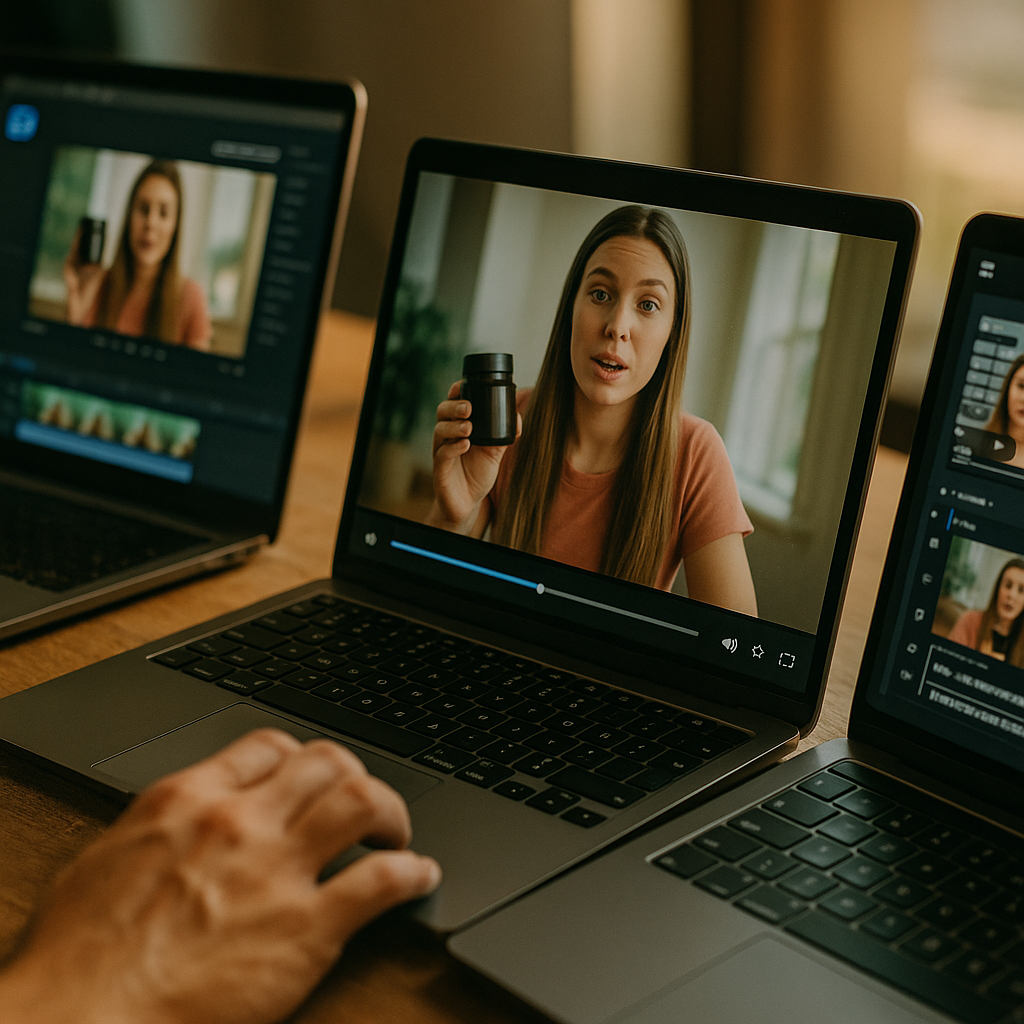
73% of shoppers say video helped them decide on a purchase, according to Wyzowl’s video marketing research — yet most e-commerce teams still treat video ad production as a bottleneck, not a pipeline. Choosing the right tool for automated product-link-to-ad video generation isn’t a nice-to-have anymore. It’s the difference between shipping 10 creatives a week and shipping 200.
This guide breaks down NemoVideo, Opus Clip, and Descript specifically for the use case that matters most to performance marketers: feeding a product URL in and getting a scroll-stopping, platform-ready ad video out, with minimal human touch and maximum repeatability.
Why This Comparison Matters Now
Three years ago, “automated video” meant templated slideshows with stock music. Today it means AI agents that scrape a product page, extract imagery and copy, generate a script, synthesize voiceover, and assemble a finished vertical ad in under five minutes. The category has matured fast, and the vendors have specialized in different directions.
NemoVideo built its product around the link-to-ad workflow natively. Opus Clip started as a long-form-to-short-form repurposing tool and has bolted on e-commerce features. Descript remains, at its core, an editing-first platform that power users have adapted into ad pipelines through scripting and templates. Same destination, three very different roads.
The real cost of the wrong tool isn’t the subscription fee — it’s the hours your team spends building workarounds for a workflow the vendor never designed for.
What “Product-Link-to-Ad” Actually Requires
Before comparing feature lists, it helps to define the pipeline stages a serious e-commerce team needs automated:
- URL ingestion and scraping: pulling product images, price, variants, and copy directly from a live listing (Shopify, Amazon, WooCommerce).
- Script generation: converting product data into ad-ready hooks and CTAs, ideally with brand-voice controls.
- Asset assembly: combining product shots, B-roll, UGC clips, or AI avatars into a coherent sequence.
- Voice and caption automation: synthetic voiceover, auto-captioning, and localization.
- Platform formatting: exporting to the aspect ratios and durations that TikTok, Meta, and YouTube Shorts actually reward.
- Batch and API access: the ability to run this at catalog scale, not one SKU at a time.
Any tool can do one or two of these well. The vendors that matter for e-commerce do most of them without a human stitching the gaps.
NemoVideo: Built for the Link, Not Retrofitted
NemoVideo’s entire pitch is the URL-in, ad-out workflow. Paste a product link, and it scrapes the page, identifies hero images, pulls pricing and key selling points, and drafts a script aligned to a chosen ad format (problem-solution, testimonial-style, listicle, etc.). It then assembles a video using stock or AI-generated B-roll, synced captions, and a synthetic voiceover.
Where NemoVideo stands out is catalog-scale automation. It supports bulk CSV or feed uploads, so a brand with 400 SKUs can queue an entire batch overnight and wake up to draft ads for review. That’s a meaningfully different use case than repurposing a single podcast episode into ten clips.
The tradeoffs: NemoVideo’s editing interface is thinner than Descript’s, and its stock footage library, while growing, doesn’t match Opus Clip’s polish for social-native aesthetics. Brand voice consistency across a large batch also requires careful prompt and template setup up front — skip that step and you’ll get serviceable but generic scripts.
Best fit: D2C and marketplace sellers running high-SKU catalogs who need volume over bespoke creative direction.
Opus Clip: Repurposing Power, E-Commerce as an Add-On
Opus Clip earned its reputation clipping long-form video (podcasts, webinars, livestreams) into short, engagement-optimized cuts. Its virality scoring model, which ranks clip segments by predicted engagement, is genuinely useful and still one of the best in the category for creator-style content.
For product-link workflows, though, Opus Clip is a step behind. It doesn’t natively scrape a product URL the way NemoVideo does. Instead, teams typically feed it existing footage — a founder demo, a UGC haul video, or a livestream clip — and let it identify and reformat the sellable moments. That works well if you already have raw video assets tied to a product. It works less well if you’re starting from a bare product listing with no footage at all.
Opus Clip’s caption styling and hook-detection are strong, and its ClipAnything feature (which finds relevant moments by prompt rather than just transcript) is a smart use of AI. But brands building a true “link-to-ad” pipeline will find themselves bolting on a separate scraping or scripting tool upstream, which adds friction and vendor sprawl.
Best fit: Brands with an existing library of creator or founder video who want to mine it for ad-worthy moments, rather than generate video from scratch off a listing.
Descript: Flexible, But You’re Building the Pipeline Yourself
Descript is the most editor-centric of the three, and that’s both its strength and its limitation for this specific use case. Its text-based editing (cut video by editing a transcript) remains best-in-class, and its Underlord AI features handle script generation, filler-word removal, and studio-quality voice cloning well.
But Descript doesn’t have a native “paste a product URL” ingestion step. Teams that use it for e-commerce ad pipelines typically build their own connective tissue: pulling product data via Zapier or a custom script, feeding it into Descript’s AI script tools, then assembling manually or through Descript’s template system. It’s powerful, but it’s DIY. You’re assembling a pipeline out of a very good editor, not buying a pipeline off the shelf.
That said, for teams with an internal ops or growth engineering resource, Descript’s flexibility and its Overdub voice technology can produce genuinely higher-craft output than either NemoVideo or Opus Clip’s automated scripts. The ceiling is higher. The floor requires more setup.
Best fit: Mid-to-large brands with in-house video ops talent who want maximum creative control and are willing to build custom integrations.
Side-by-Side: The Practical Differences
- Native URL scraping: NemoVideo (strong), Opus Clip (none), Descript (none, requires integration).
- Batch/catalog processing: NemoVideo (strong), Opus Clip (moderate, footage-dependent), Descript (weak, manual per asset).
- Editing depth and control: Descript (strongest), Opus Clip (moderate), NemoVideo (basic).
- Virality/hook scoring: Opus Clip (strongest), NemoVideo (basic scoring), Descript (none native).
- Voice synthesis quality: Descript (strongest, Overdub), NemoVideo (good, template-driven), Opus Clip (limited).
- Setup speed: NemoVideo (fastest for link-based workflow), Opus Clip (fast if footage exists), Descript (slowest, requires pipeline building).
If your team is optimizing for speed-to-first-draft on a catalog you haven’t shot footage for, NemoVideo wins on paper. If you’re sitting on a backlog of raw creator content and need to extract the best moments, Opus Clip is the sharper tool. If craft and control matter more than speed, and you have the engineering bandwidth, Descript gives you the best raw materials.
Governance and Attribution: The Part Vendors Don’t Advertise
None of these three tools solve for attribution out of the box. Generating hundreds of AI-assisted ad variants is only useful if you can tie performance back to the source SKU, script variant, and creative element that drove the result. Teams scaling automated video pipelines should pair vendor selection with a broader AI governance scorecard before signing a contract, particularly around training data provenance and output ownership.
There’s also a compliance angle marketers underweight: synthetic voice and AI-generated claims about product performance carry disclosure risk. The FTC’s endorsement guidelines increasingly apply to AI-generated marketing content, not just human influencers. Before you scale any of these tools across a catalog, get legal or compliance sign-off on how synthetic voiceover and auto-generated product claims are reviewed.
Automated video volume without attribution is just faster guessing. Pair your pipeline with measurement before you scale spend behind it.
For teams thinking beyond single-tool selection, it’s worth reviewing how viewability and sales-lift dashboards can close the loop between creative variant and revenue outcome. Similarly, if you’re feeding output from any of these tools into paid media, understanding how platform-native ad agents turn video into shoppable ads will help you avoid duplicating work the ad platform already automates.
Making the Call: A Practical Framework
Skip the feature-matrix paralysis. Ask three questions instead:
- Do you have existing video assets, or just product listings? Footage-rich brands lean Opus Clip. Listing-only brands lean NemoVideo.
- Do you have engineering resources to build integrations? If yes, Descript’s flexibility pays off. If no, NemoVideo’s native workflow saves weeks of setup.
- Is your bottleneck volume or craft? Volume favors NemoVideo’s batch processing. Craft favors Descript’s editing depth. Middle ground favors Opus Clip if footage exists.
Most mature e-commerce teams don’t end up with one tool. They end up with a primary generator (often NemoVideo for scale) and a secondary editor (often Descript) for the top 10% of creative that deserves human polish before it goes to paid spend. That hybrid model, cheap-and-fast for the long tail, high-craft for the hero SKUs, tends to outperform any single-vendor approach on both cost and conversion.
It’s also worth benchmarking spend against eMarketer’s e-commerce video ad spend data and HubSpot’s video marketing benchmarks before locking in a tool budget — the ROI math changes significantly depending on your average order value and catalog size.
Next Step
Run a two-week pilot: pick your 20 highest-revenue SKUs, generate ads through NemoVideo and Opus Clip in parallel, and measure hook rate and CPA before committing budget to either vendor long-term.
FAQs
Which tool is best for a brand with no existing product video footage?
NemoVideo is the strongest fit since it scrapes product listings directly and generates video without requiring source footage. Opus Clip and Descript both assume you already have raw video to work with.
Can Opus Clip generate ads directly from a product URL?
Not natively. Opus Clip is built to repurpose existing long-form or raw footage into short clips. You’ll need a separate scraping step or existing video assets to use it in a link-to-ad workflow.
Is Descript worth it for teams without dedicated video ops staff?
Probably not for full automation. Descript’s editing tools are powerful, but building a true product-link pipeline requires integrations (via Zapier or custom scripts) that need ongoing technical maintenance.
How do these tools handle disclosure and compliance for AI-generated ads?
None handle it automatically. Brands are responsible for reviewing AI-generated product claims and synthetic voiceover against FTC endorsement guidelines before publishing, regardless of which vendor is used.
Should brands use one tool or combine multiple vendors?
Many mature teams combine a fast, scalable generator (like NemoVideo) for catalog-wide volume with a higher-craft editor (like Descript) reserved for top-performing SKUs that justify manual polish.
FAQs
Which tool is best for a brand with no existing product video footage?
NemoVideo is the strongest fit since it scrapes product listings directly and generates video without requiring source footage. Opus Clip and Descript both assume you already have raw video to work with.
Can Opus Clip generate ads directly from a product URL?
Not natively. Opus Clip is built to repurpose existing long-form or raw footage into short clips. You’ll need a separate scraping step or existing video assets to use it in a link-to-ad workflow.
Is Descript worth it for teams without dedicated video ops staff?
Probably not for full automation. Descript’s editing tools are powerful, but building a true product-link pipeline requires integrations (via Zapier or custom scripts) that need ongoing technical maintenance.
How do these tools handle disclosure and compliance for AI-generated ads?
None handle it automatically. Brands are responsible for reviewing AI-generated product claims and synthetic voiceover against FTC endorsement guidelines before publishing, regardless of which vendor is used.
Should brands use one tool or combine multiple vendors?
Many mature teams combine a fast, scalable generator (like NemoVideo) for catalog-wide volume with a higher-craft editor (like Descript) reserved for top-performing SKUs that justify manual polish.
Top Influencer Marketing Agencies
The leading agencies shaping influencer marketing in 2026
Agencies ranked by campaign performance, client diversity, platform expertise, proven ROI, industry recognition, and client satisfaction. Assessed through verified case studies, reviews, and industry consultations.
Moburst

-
2

The Shelf
Boutique Beauty & Lifestyle Influencer AgencyA data-driven boutique agency specializing exclusively in beauty, wellness, and lifestyle influencer campaigns on Instagram and TikTok. Best for brands already focused on the beauty/personal care space that need curated, aesthetic-driven content.Clients: Pepsi, The Honest Company, Hims, Elf Cosmetics, Pure LeafVisit The Shelf → -
3

Audiencly
Niche Gaming & Esports Influencer AgencyA specialized agency focused exclusively on gaming and esports creators on YouTube, Twitch, and TikTok. Ideal if your campaign is 100% gaming-focused — from game launches to hardware and esports events.Clients: Epic Games, NordVPN, Ubisoft, Wargaming, Tencent GamesVisit Audiencly → -
4

Viral Nation
Global Influencer Marketing & Talent AgencyA dual talent management and marketing agency with proprietary brand safety tools and a global creator network spanning nano-influencers to celebrities across all major platforms.Clients: Meta, Activision Blizzard, Energizer, Aston Martin, WalmartVisit Viral Nation → -
5

The Influencer Marketing Factory
TikTok, Instagram & YouTube CampaignsA full-service agency with strong TikTok expertise, offering end-to-end campaign management from influencer discovery through performance reporting with a focus on platform-native content.Clients: Google, Snapchat, Universal Music, Bumble, YelpVisit TIMF → -
6

NeoReach
Enterprise Analytics & Influencer CampaignsAn enterprise-focused agency combining managed campaigns with a powerful self-service data platform for influencer search, audience analytics, and attribution modeling.Clients: Amazon, Airbnb, Netflix, Honda, The New York TimesVisit NeoReach → -
7

Ubiquitous
Creator-First Marketing PlatformA tech-driven platform combining self-service tools with managed campaign options, emphasizing speed and scalability for brands managing multiple influencer relationships.Clients: Lyft, Disney, Target, American Eagle, NetflixVisit Ubiquitous → -
8

Obviously
Scalable Enterprise Influencer CampaignsA tech-enabled agency built for high-volume campaigns, coordinating hundreds of creators simultaneously with end-to-end logistics, content rights management, and product seeding.Clients: Google, Ulta Beauty, Converse, AmazonVisit Obviously →