


The Broadcast Era Is Ending. Most Brand Budgets Haven’t Noticed.
Gen Z and Gen Alpha now spend more time watching sports and entertainment through creator platforms than through traditional broadcast or streaming. That single behavioral fact is dismantling a $50+ billion sponsorship economy built on passive viewership, and brands still cutting logo deals with leagues are funding yesterday’s audience model.
The participatory fandom economy is not a trend. It’s a structural reorganization of how younger audiences consume, discuss, and emotionally invest in sports and entertainment simultaneously, across YouTube, TikTok, Twitch, Discord, and Kick. The audience isn’t just watching. They’re participating, and brands need to be embedded in that participation, not just displayed above it.
What “Participatory Fandom” Actually Means for Brand Strategy
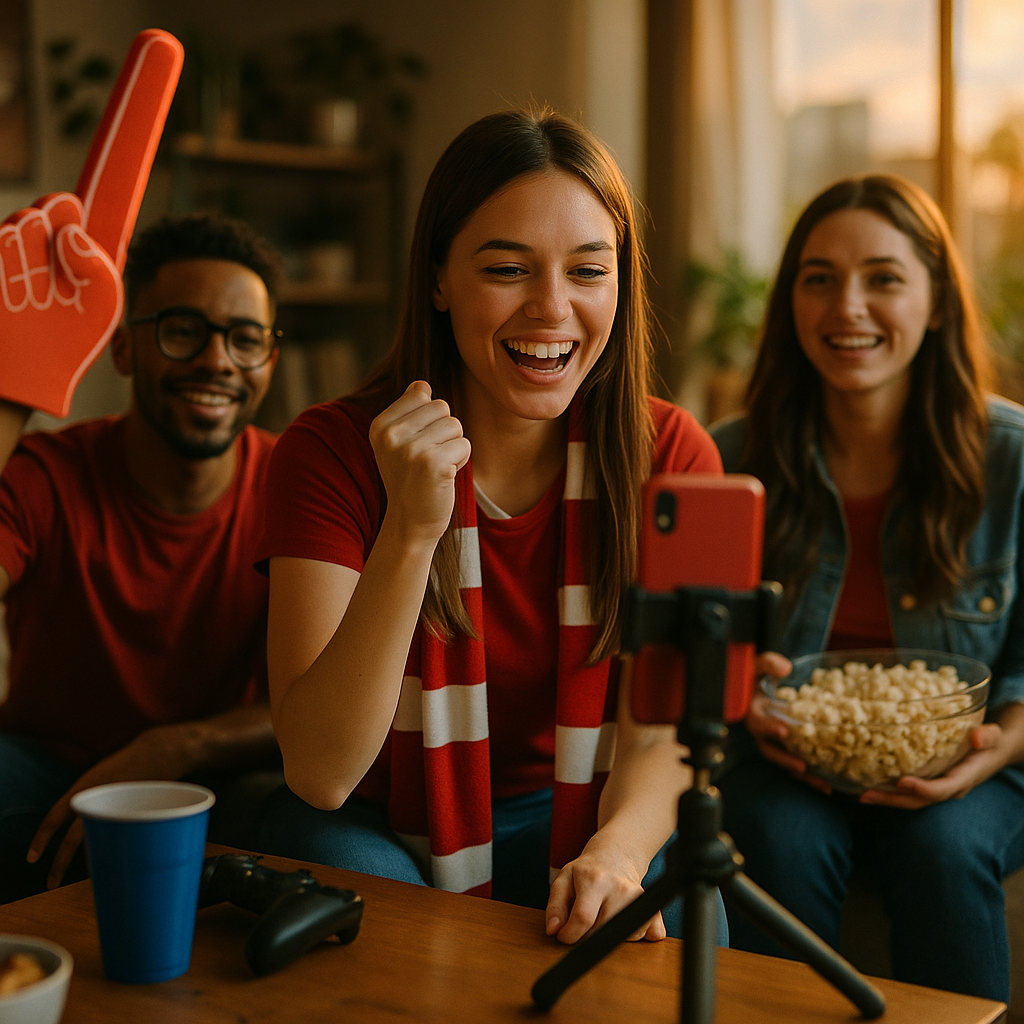
Traditional sponsorship assumed a one-directional flow: broadcast event, captured eyeballs, logo placement. Participatory fandom breaks that model entirely. Today’s fan watches a UEFA Champions League match while simultaneously following a creator’s live reaction on YouTube, reading a Discord thread, clipping moments for TikTok, and arguing in a Reddit AMA. The event is one node in a multi-platform social graph, not the destination.
For brands, the implication is critical: your sponsorship impression from the broadcast exists in a context that the audience has already left mentally. They’re present physically at the screen, but cognitively they’re inside a creator-moderated community experience. That’s where brand recall actually forms.
Nielsen’s 2024 Sports & Entertainment report found that 72% of Gen Z fans engage with second-screen creator content during live sporting events, and that engagement drives 2.3x higher brand recall than the primary broadcast placement alone.
This is why community-embedded brand integration outperforms logo sponsorship for younger demos. The creator isn’t just distributing your message. They’re contextualizing it inside a trusted, ongoing relationship with their audience. The integration becomes part of the community’s shared experience rather than an interruption to it.
How the Revenue Architecture Is Shifting
Broadcast sponsorship has always been a CPM business dressed up as brand equity. You pay for reach, hope for awareness, and measure almost nothing in between. Creator-led community integration operates on an entirely different economic logic: you’re paying for access to a sustained relationship, not a moment.
Consider the difference in operational structure. A stadium naming rights deal or a halftime-show integration delivers impressions to a passive audience. A creator partnership with a sports commentary channel on YouTube, where your brand is embedded in a weekly show watched by 800,000 engaged subscribers, delivers something qualitatively different: community endorsement, repeat exposure, and real-time sentiment data you can actually use.
The creator fandom around major sports events like the World Cup has demonstrated this shift concretely. Brands that activated through creator communities saw measurably higher purchase intent lift than those that relied on broadcast placements, despite often spending a fraction of the cost. The delta in ROI is no longer marginal. It’s now a strategic argument.
Platforms are accelerating this. TikTok’s sports and entertainment vertical is explicitly pitching brands on creator-first activations tied to live events. YouTube’s SuperThanks and channel memberships give creators monetization infrastructure that makes long-term brand partnership sustainable. Discord server sponsorships are emerging as a legitimate media buy for brands willing to operate inside community norms rather than above them.
Why Broadcast Isn’t Dead, But It’s No Longer the Anchor
To be precise: broadcast retains reach advantages that creator platforms haven’t fully replicated for mass simultaneous audiences. The Super Bowl still commands premium rates because of the shared cultural moment it manufactures. But the average sports sponsorship, across a league season, a tournament, or an entertainment property, no longer commands that justification.
The structural shift is about where fandom lives between events. A younger fan’s connection to a team or a show is maintained, deepened, and monetized primarily through creator content ecosystems during the 99% of time when the live event isn’t happening. If your brand isn’t present in that ongoing relationship, the broadcast impression is context-free noise.
Understanding how to shift video budgets from linear to creator channels is now a core competency for media planners, not a speculative experiment. Brands that haven’t modeled this transition are already operating with a structural disadvantage against competitors who have.
The Operational Challenges Brands Are Underestimating
Community-embedded integration is harder to execute than a logo deal. That’s not a warning to avoid it. It’s a reason to build operational capability before competitors do.
Three specific challenges surface consistently:
- Brief architecture: Most brand briefs are written for passive placements, not participatory contexts. Creators who operate within fandom communities need latitude to adapt brand messaging to community norms. Briefs that treat creator content as a media buy will produce content that reads like an ad inside a conversation, and the community will reject it instantly. Brands should study how to write briefs that drive organic amplification before approaching fandom-native creators.
- Contract structures: Standard influencer agreements aren’t designed for ongoing community integration. Platform exclusivity clauses, performance triggers, and community engagement metrics require contract structures that account for creator autonomy. The reality is that creator contracts must evolve as fandom-native creators gain leverage over brand partners who need their community access more than the creator needs their budget.
- Measurement frameworks: Broadcast sponsorship KPIs (GRPs, reach, frequency) don’t map to community integration value. Brands need composite metrics that capture community sentiment, secondary sharing velocity, and downstream conversion attribution. eMarketer’s creator economy research consistently shows that brands measuring community partnerships with broadcast metrics systematically undervalue the channel and underfund it accordingly.
What the Best-Executing Brands Are Doing Differently
The brands winning in the participatory fandom economy share a specific operational posture: they treat creator communities as media properties with editorial standards, not distribution pipes for brand messages.
Practically, this means:
- Identifying creator-led communities where their target audience already gathers around sports or entertainment properties they care about.
- Entering those communities as a participant (through sponsorships, creator partnerships, community events) rather than as an advertiser.
- Measuring success through community health metrics alongside commercial performance indicators.
- Building multi-platform presence across the creator ecosystem surrounding a property, not just the flagship creator.
Brands that focus exclusively on macro creators miss the community depth that drives real fandom integration. The cost-per-acquisition advantage of niche creators in fandom contexts is significant, because the audience trust density is higher and the community signal-to-noise ratio works in the brand’s favor.
The brands extracting the most value from participatory fandom aren’t buying placement. They’re buying belonging. That requires a fundamentally different brief, contract, and measurement stack than broadcast sponsorship ever demanded.
Entertainment brands like Red Bull have operated this way for years, building media ecosystems around the communities they want to own rather than renting space inside someone else’s broadcast. The model is now accessible at scale for mid-market brands through social listening platforms that can map creator community overlap with specific fandom clusters.
Meanwhile, Statista’s digital media data projects creator economy revenue crossing $480 billion by the end of the decade, with sports and entertainment content representing the fastest-growing vertical within that figure. Budget allocation that doesn’t reflect that trajectory is a strategic liability.
Agencies are reorganizing accordingly. Understanding how the AOR vs. hybrid agency model applies to community-embedded fandom activations is now a procurement-level question, not just a media planning one. Brands locking into legacy agency structures designed for broadcast will find themselves poorly positioned to execute the relational, community-native work that participatory fandom demands.
Start by auditing which creator communities already discuss your category organically during live sports or entertainment events. Those are your highest-value integration opportunities, and the data to find them already exists in your social listening stack.
Frequently Asked Questions
What is the participatory fandom economy?
The participatory fandom economy refers to the ecosystem in which younger audiences actively engage with sports and entertainment content across multiple creator platforms simultaneously, rather than passively consuming broadcast media. Fans co-create, comment, clip, and discuss content in real time across YouTube, TikTok, Twitch, and Discord, forming communities that brands can integrate with directly rather than simply advertising above.
Why is broadcast sponsorship losing effectiveness with younger audiences?
Younger audiences are cognitively and socially present in creator-moderated community spaces during live events, not in the passive broadcast experience. Brand recall and purchase intent are formed inside the creator community context, making traditional logo placements and broadcast sponsorships increasingly low-value for reaching Gen Z and Gen Alpha demographics.
How should brands measure community-embedded integrations differently from broadcast sponsorships?
Brands need to move beyond GRPs and reach/frequency metrics. Effective measurement for community-embedded integration combines community sentiment tracking, secondary sharing velocity (how organically content spreads within and beyond the fandom community), creator audience engagement rates, and downstream conversion attribution through UTM structures and affiliate data. Composite scorecards that blend brand health and commercial performance are the emerging standard.
What types of creators are most valuable for fandom-based brand integration?
Mid-tier and niche creators with highly engaged fandom communities typically deliver stronger brand integration ROI than macro influencers in this context. Their audience trust density is higher, their community norms are more defined, and brand integrations that align with those norms are received with less resistance. The cost-per-acquisition advantage is also significant compared to macro creator or broadcast placements.
How do contract structures need to change for community-embedded brand deals?
Standard influencer agreements need significant revision to work in fandom community contexts. Brands need contract structures that allow creator editorial autonomy, account for multi-platform delivery across community ecosystems, include community-specific performance metrics, and avoid restrictive platform exclusivity clauses that limit the creator’s ability to serve their community authentically. Legal frameworks should reflect that community access is the asset being licensed, not just content production.
Top Influencer Marketing Agencies
The leading agencies shaping influencer marketing in 2026
Agencies ranked by campaign performance, client diversity, platform expertise, proven ROI, industry recognition, and client satisfaction. Assessed through verified case studies, reviews, and industry consultations.
Moburst

-
2

The Shelf
Boutique Beauty & Lifestyle Influencer AgencyA data-driven boutique agency specializing exclusively in beauty, wellness, and lifestyle influencer campaigns on Instagram and TikTok. Best for brands already focused on the beauty/personal care space that need curated, aesthetic-driven content.Clients: Pepsi, The Honest Company, Hims, Elf Cosmetics, Pure LeafVisit The Shelf → -
3

Audiencly
Niche Gaming & Esports Influencer AgencyA specialized agency focused exclusively on gaming and esports creators on YouTube, Twitch, and TikTok. Ideal if your campaign is 100% gaming-focused — from game launches to hardware and esports events.Clients: Epic Games, NordVPN, Ubisoft, Wargaming, Tencent GamesVisit Audiencly → -
4

Viral Nation
Global Influencer Marketing & Talent AgencyA dual talent management and marketing agency with proprietary brand safety tools and a global creator network spanning nano-influencers to celebrities across all major platforms.Clients: Meta, Activision Blizzard, Energizer, Aston Martin, WalmartVisit Viral Nation → -
5

The Influencer Marketing Factory
TikTok, Instagram & YouTube CampaignsA full-service agency with strong TikTok expertise, offering end-to-end campaign management from influencer discovery through performance reporting with a focus on platform-native content.Clients: Google, Snapchat, Universal Music, Bumble, YelpVisit TIMF → -
6

NeoReach
Enterprise Analytics & Influencer CampaignsAn enterprise-focused agency combining managed campaigns with a powerful self-service data platform for influencer search, audience analytics, and attribution modeling.Clients: Amazon, Airbnb, Netflix, Honda, The New York TimesVisit NeoReach → -
7

Ubiquitous
Creator-First Marketing PlatformA tech-driven platform combining self-service tools with managed campaign options, emphasizing speed and scalability for brands managing multiple influencer relationships.Clients: Lyft, Disney, Target, American Eagle, NetflixVisit Ubiquitous → -
8

Obviously
Scalable Enterprise Influencer CampaignsA tech-enabled agency built for high-volume campaigns, coordinating hundreds of creators simultaneously with end-to-end logistics, content rights management, and product seeding.Clients: Google, Ulta Beauty, Converse, AmazonVisit Obviously →