


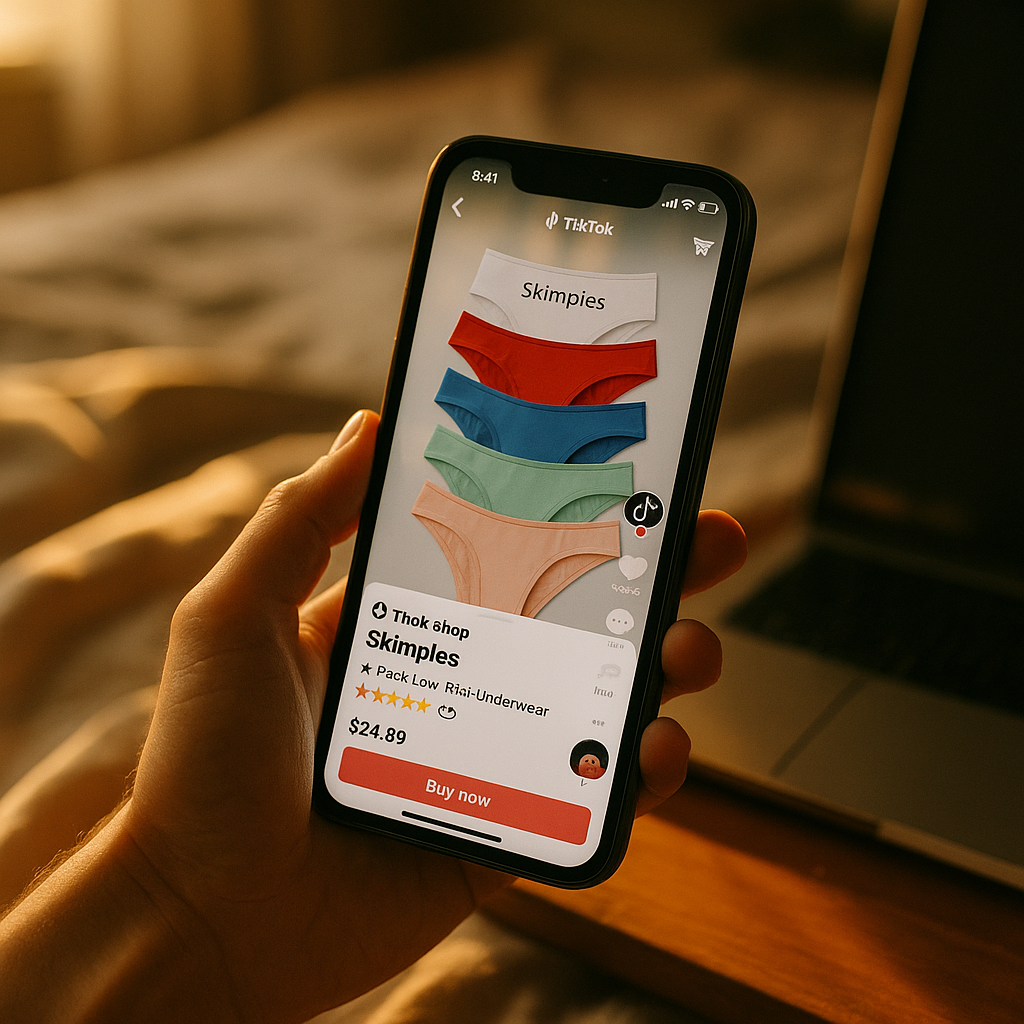
Zero dollars in paid media. One category-topping spot on TikTok Shop. When intimates brand Skimpies climbed to the number-one slot in its category without touching an ads dashboard, it wasn’t luck — it was a deliberate bet that watch-time-first seeding beats conversion-chasing every time the algorithm gets a vote. Here’s how they engineered it.
The Bet Nobody Else Was Making
Most brands seed product hoping for a sale. Skimpies seeded product hoping for a completed watch. That distinction sounds subtle. It isn’t.
TikTok’s recommendation system doesn’t primarily reward purchases — it rewards attention. Average watch time, replay rate, and completion percentage carry enormous weight in how the algorithm decides whether to push a video into more For You feeds. Skimpies’ growth team, a lean three-person unit, treated this as gospel rather than a footnote in a platform help doc. Every creative brief, every creator selection, every hook was built around one question: will someone watch this to the end?
Skimpies didn’t optimize for clicks. It optimized for the eight seconds before someone would normally scroll past — and let TikTok’s own algorithm do the selling.
That’s a meaningfully different operating model than the discount-and-boost playbook most TikTok Shop sellers default to. It’s closer to what worked for Ridge Wallet’s demo-first approach — product truth on camera, no coupon code required.
Why Watch Time Beats Conversion Rate as a Leading Indicator
Conversion rate tells you what happened after someone already decided to click. Watch time tells you whether the content itself is doing the persuading. For a category like intimates, where trust and fit anxiety are real purchase barriers, that persuasion has to happen inside the video, not on the product page.
Skimpies’ internal data showed a strong correlation between videos that hit 80%+ completion rate and videos that later drove organic Shop tab traffic — often 48 to 72 hours after posting, well after the original creator had moved on to other content. That lag is the tell. It means the algorithm was still surfacing the video on its own merit, not because a founder was refreshing analytics and boosting a post that dipped.
Building a Seeding Program Around Retention Metrics, Not Follower Count
Skimpies rejected the standard nano-versus-micro debate entirely. Instead, they built a scoring model where creators were evaluated almost entirely on historical average watch-time percentage across their last 20 posts, pulled via TikTok Creator Marketplace data and manual audits.
- Creators with under 5,000 followers but 65%+ average completion rate outranked creators with 200,000 followers and 30% completion.
- Video length was capped at 21 seconds for initial seeding drops — long enough to show product use, short enough to protect completion rate.
- Hooks were required to introduce a visual or verbal pattern interrupt within the first 1.5 seconds, not the first 3.
This mirrors a trend other DTC brands have quietly adopted. Chubbies leaned on comedic nano-creator content instead of discount codes for similar reasons — engagement quality outperformed reach when it came to sustained algorithmic push. Skimpies took that logic and applied it with more rigor, treating creator selection like a quant screens stocks: hard cutoffs, no gut-feel exceptions.
The Seeding Mechanics, Step by Step
The program ran in five-day sprints, not always-on campaigns. That cadence mattered.
- Day 1-2: Ship product to 15-25 creators selected purely on completion-rate history, with a one-line creative brief (no script, no required talking points).
- Day 3: Monitor early watch-time signals on TikTok’s Creator Marketplace dashboard within the first six hours of posting.
- Day 4: Reseed the top three performing creative angles to a second wave of creators, essentially cloning the winning hook structure rather than the winning creator.
- Day 5: Pull underperforming SKUs from the next sprint entirely. No sunk-cost posting.
Notice what’s missing: no paid boosting, no influencer whitelisting, no spark ads. The team’s stated internal rule was that if a video needed paid amplification to perform, the creative itself had failed. That’s a hard-line stance, and it wouldn’t work for every brand or every launch timeline — but it forced creative discipline that most seeding programs never develop because paid spend papers over weak hooks.
What the Data Actually Showed
Across a 90-day window, Skimpies logged:
- Average video completion rate of 71%, well above TikTok Shop category benchmarks that typically hover in the 35-45% range for apparel content, per industry estimates cited by eMarketer.
- Organic Shop tab impressions growing 6x month-over-month without a single dollar in Spark Ads or TikTok Shop ad campaigns.
- Category rank climbing from outside the top 50 to number one in intimates within roughly eleven weeks.
Is watch-time-first seeding replicable outside intimates? Probably, with caveats. Categories with high consideration friction — fit, comfort, fabric feel — benefit disproportionately from video that resolves doubt in real time. A commodity product with low purchase anxiety may not see the same lift from optimizing purely for completion rate, because there’s less anxiety to resolve on-screen in the first place.
The Compliance Angle Brands Keep Missing
Zero paid spend doesn’t mean zero regulatory exposure. Every seeded creator still received free product in exchange for content, which triggers disclosure obligations under FTC endorsement guidelines. Skimpies required #ad or #sponsored tagging on all seeded content regardless of whether the creator considered it a “real” partnership, and built that requirement into the product-shipment agreement rather than leaving it to creator discretion.
This is where a lot of seeding programs get sloppy. Brands assume that because no money changed hands beyond product cost, disclosure rules are optional. They aren’t. Free product in exchange for content is a material connection under FTC guidance, full stop. Skimpies’ legal review process added maybe a day to each sprint cycle — a small cost against the downside of an FTC inquiry mid-viral-moment.
Where the Algorithm and the Ops Playbook Meet
None of this works without operational speed. Skimpies’ five-day sprint cadence only functions if fulfillment, creator communication, and content review happen in near-lockstep. The brand used a lightweight creator CRM combined with manual completion-rate audits rather than a heavier enterprise platform, partly because the program’s speed requirements didn’t leave room for tool onboarding friction.
That’s worth flagging for brands scaling past the founder-led stage: watch-time-first seeding is a metrics discipline before it’s a tooling decision. You can run this on a spreadsheet if your team is small and moves fast. The moment you’re managing 200+ creators across a dozen SKUs simultaneously, though, manual tracking breaks down and you’ll need something closer to the vetting infrastructure described in how one supplement brand cut discovery costs with AI vetting.
There’s also a livestream layer worth noting. Skimpies didn’t lean heavily on TikTok Shop livestreams during this specific climb, but the same watch-time logic underpins livestream success elsewhere — Chagee’s livestream-driven category build and the fashion retailer that rebuilt its livestream schedule around data both show retention metrics mattering just as much in real-time formats as in short-form video.
What Brands Should Steal, and What They Shouldn’t
Steal the scoring discipline: rank creators on completion rate, not follower count. Steal the sprint cadence: five-day cycles force fast iteration and kill dead SKUs before they drain resources. Steal the hard rule about not propping up weak creative with paid spend, at least during a testing phase.
Don’t assume zero paid spend is the goal itself. Skimpies could likely have compounded results faster with modest Spark Ads support behind proven winners — the “zero ad spend” framing is a interesting proof point, not a permanent strategy. Once a hook is validated organically, most performance marketers would argue it’s malpractice not to put some budget behind it. The real lesson isn’t “never spend on ads.” It’s “never let ad spend substitute for creative validation.”
For more on how nano-creator economics compare against paid amplification more broadly, HubSpot’s marketing research and Sprout Social’s social benchmarking data both offer useful category context, though neither has published on this specific case.
Next Step for Brands Running Their Own Test
Pull your last 20 seeded videos and sort them by completion rate instead of likes or sales. If your best-performing creators by that metric aren’t the ones you’re prioritizing in your next sprint, that’s the gap costing you organic reach right now.
FAQs
What does “watch-time-first seeding” mean?
It’s a creator seeding strategy that prioritizes video completion rate and average watch time as the primary success metric, rather than immediate sales or follower count, on the theory that TikTok’s algorithm rewards retention above almost everything else.
Can a brand really hit number one on TikTok Shop with zero paid ad spend?
Yes, though it’s not typical. It requires disciplined creator selection, short high-completion-rate video formats, and a category where video content can meaningfully resolve purchase hesitation, such as fit or product feel.
How do you measure watch time when selecting creators to seed?
Review a creator’s historical average completion rate and watch-time percentage across recent posts, available through TikTok’s Creator Marketplace, rather than relying on follower count or engagement rate alone.
Do FTC disclosure rules apply to unpaid product seeding?
Yes. Any free product given in exchange for content creates a material connection that requires disclosure under FTC endorsement guidelines, regardless of whether cash changed hands.
Is this strategy repeatable outside the intimates or apparel category?
It’s most effective in categories with high consideration friction, where video can resolve doubt in real time. Commodity products with low purchase anxiety may see smaller gains from optimizing purely for completion rate.
Top Influencer Marketing Agencies
The leading agencies shaping influencer marketing in 2026
Agencies ranked by campaign performance, client diversity, platform expertise, proven ROI, industry recognition, and client satisfaction. Assessed through verified case studies, reviews, and industry consultations.
Moburst

-
2

The Shelf
Boutique Beauty & Lifestyle Influencer AgencyA data-driven boutique agency specializing exclusively in beauty, wellness, and lifestyle influencer campaigns on Instagram and TikTok. Best for brands already focused on the beauty/personal care space that need curated, aesthetic-driven content.Clients: Pepsi, The Honest Company, Hims, Elf Cosmetics, Pure LeafVisit The Shelf → -
3

Audiencly
Niche Gaming & Esports Influencer AgencyA specialized agency focused exclusively on gaming and esports creators on YouTube, Twitch, and TikTok. Ideal if your campaign is 100% gaming-focused — from game launches to hardware and esports events.Clients: Epic Games, NordVPN, Ubisoft, Wargaming, Tencent GamesVisit Audiencly → -
4

Viral Nation
Global Influencer Marketing & Talent AgencyA dual talent management and marketing agency with proprietary brand safety tools and a global creator network spanning nano-influencers to celebrities across all major platforms.Clients: Meta, Activision Blizzard, Energizer, Aston Martin, WalmartVisit Viral Nation → -
5

The Influencer Marketing Factory
TikTok, Instagram & YouTube CampaignsA full-service agency with strong TikTok expertise, offering end-to-end campaign management from influencer discovery through performance reporting with a focus on platform-native content.Clients: Google, Snapchat, Universal Music, Bumble, YelpVisit TIMF → -
6

NeoReach
Enterprise Analytics & Influencer CampaignsAn enterprise-focused agency combining managed campaigns with a powerful self-service data platform for influencer search, audience analytics, and attribution modeling.Clients: Amazon, Airbnb, Netflix, Honda, The New York TimesVisit NeoReach → -
7

Ubiquitous
Creator-First Marketing PlatformA tech-driven platform combining self-service tools with managed campaign options, emphasizing speed and scalability for brands managing multiple influencer relationships.Clients: Lyft, Disney, Target, American Eagle, NetflixVisit Ubiquitous → -
8

Obviously
Scalable Enterprise Influencer CampaignsA tech-enabled agency built for high-volume campaigns, coordinating hundreds of creators simultaneously with end-to-end logistics, content rights management, and product seeding.Clients: Google, Ulta Beauty, Converse, AmazonVisit Obviously →