


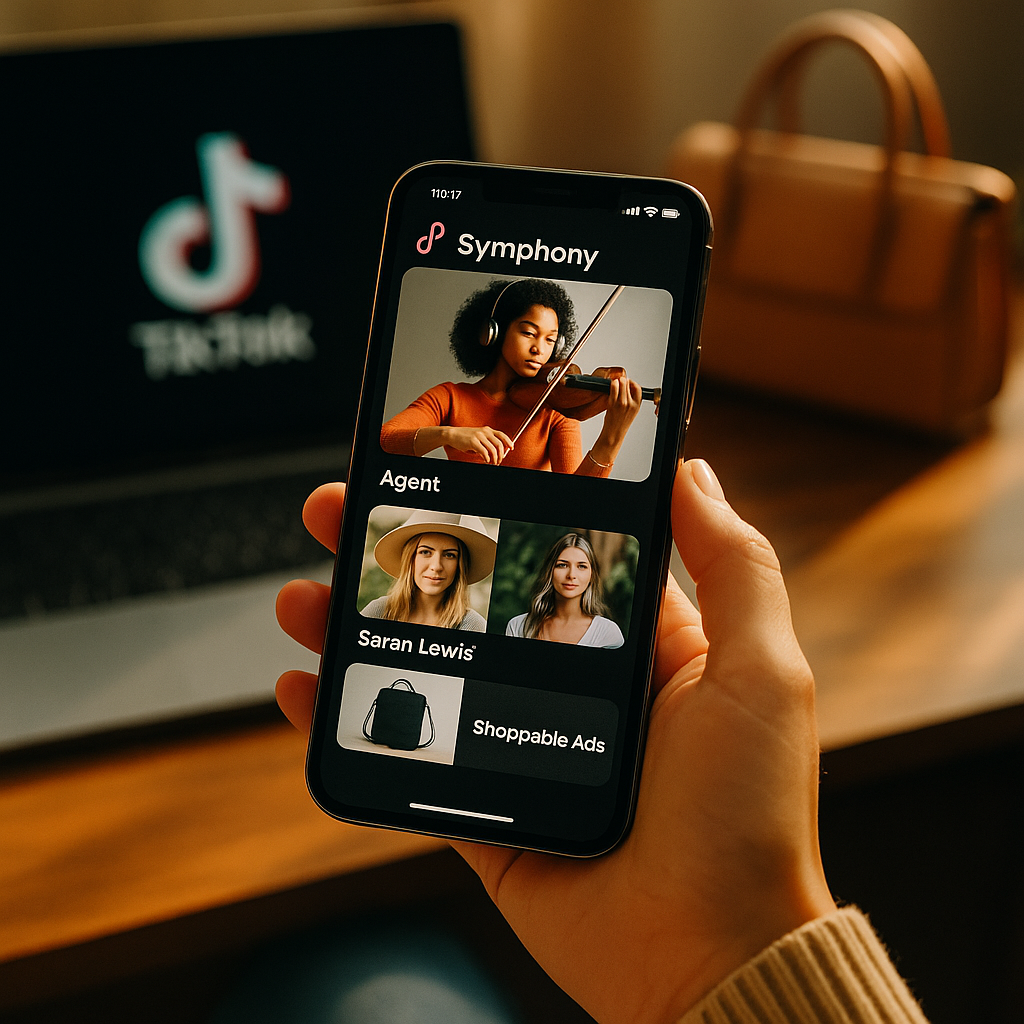
Brands using TikTok Symphony Agent are reporting 30–40% reductions in creative production cycles for shoppable ad formats. If your commerce team is still treating Symphony as a novelty, that efficiency gap is already costing you. Here’s what the platform’s TikTok Symphony Agent actually does at the operational level — and where the real leverage sits for brand teams serious about TikTok Shop performance.
What Symphony Agent Actually Is (And What It Isn’t)
Symphony Agent is TikTok’s AI-powered ad assistant embedded within TikTok Ads Manager. It’s not a content generator in the traditional sense. Think of it as an orchestration layer: it pulls from your existing brand video assets, matches them to relevant creator profiles, and outputs formats optimized for conversion within the TikTok Shop ecosystem.
The distinction matters for budget planning. Symphony Agent is not a replacement for a creator strategy. It’s a force multiplier for brands that already have raw video content, an active product catalog, and some baseline understanding of their TikTok audience. If those inputs are weak, the outputs will be too.
The tool operates across three primary capability areas: AI-assisted creator matching, brand video transformation into shoppable ad units, and custom creator network configuration. Each of these deserves scrutiny before you commit budget or restructure workflows around them.
Creator Matching Logic: What the Algorithm Is Actually Evaluating
Symphony’s creator matching doesn’t sort on follower count. That’s the first thing brand teams get wrong when they run their first briefing cycle through the tool. The matching engine weights content topology — specifically, how a creator’s historical video graph aligns with your product category’s interest clusters on TikTok’s For You feed.
Symphony Agent’s creator matching logic prioritizes interest graph alignment over audience size, which means a 45,000-follower food creator with deep beverage content history can outrank a 500,000-follower lifestyle creator for a CPG beverage brief.
This is consistent with the broader shift across platforms toward interest graph over follower count as the primary relevance signal. For commerce teams, the practical implication is that your creator shortlist will often look unfamiliar. Resist the instinct to override Symphony’s recommendations with vanity metrics. The matching is optimizing for conversion probability, not brand awareness optics.
The algorithm also factors in creator Shop history. Creators with verified TikTok Shop affiliate transactions in your vertical get a signal boost. Symphony cross-references product review cadence, comment sentiment on past sponsored content, and click-to-add-to-cart rates from prior affiliate campaigns. Brands don’t see all of this data directly, but it’s baked into the recommendation score.
One operational caution: the matching pool is currently weighted toward creators with existing TikTok Shop affiliate accounts. If your target niche skews toward creators who haven’t set up Shop affiliation yet, you’ll hit gaps. Build creator onboarding into your launch timeline, not as an afterthought.
Brand Video to Shoppable Ad: The Conversion Pipeline
This is where Symphony delivers the most immediate operational ROI for mid-to-large brand teams. The workflow is straightforward: upload existing brand video assets (product demos, lifestyle shoots, UGC footage), and Symphony’s AI layers in product tags, CTA overlays, and Shop catalog links to produce shoppable ad units without requiring a full creative rebuild.
The quality ceiling depends on your source material. Symphony performs well with video assets that already have strong hook structures in the first two seconds. It performs poorly with traditional 30-second brand spots built for broadcast logic. If your creative library is heavy on broadcast-style content, plan a reformat sprint before running Symphony’s conversion pipeline at scale.
Symphony also offers a video script generation layer, which suggests on-screen text, voiceover copy, and product placement cues tuned to TikTok’s engagement patterns. For teams that have read our analysis on Symphony Agent and creator briefs, the script logic has continued to improve on category-specific language — particularly for beauty, food and beverage, and home goods verticals.
The measurable output: Symphony-converted shoppable ads are consistently showing higher add-to-cart rates than static product ads in TikTok’s own benchmarks, largely because the format preserves the entertainment structure of the original video while appending purchase mechanics. You’re not running a product listing — you’re running a video that happens to have a buy button embedded in the right moment.
The Starbucks Model: Custom Creator Networks Explained
The most strategically significant feature in Symphony Agent’s commerce suite isn’t the AI matching or the video conversion. It’s the Custom Creator Network configuration, which TikTok has informally positioned using Starbucks as its flagship case study.
The model works like this: instead of running one-off creator campaigns through the open marketplace, brands build a curated roster of pre-vetted creators who are effectively on-call for content production tied to specific product SKUs, seasonal promotions, or campaign moments. Symphony Agent manages the briefing, asset delivery, posting schedule, and performance tracking for this roster from within Ads Manager.
Starbucks used this architecture to maintain always-on content velocity for its beverage launches without rebuilding a creator list from scratch for every campaign. The efficiency gain is real: brands report 50–60% faster campaign activation times compared to cold-start creator sourcing. For retail brands with frequent product rotation, this is operationally significant.
For a detailed comparison of how this stacks up against competing platforms’ proprietary networks, see our breakdown of Snap Creator Network vs TikTok Custom Creator Networks. The short version: TikTok’s Shop integration depth gives it a meaningful edge for commerce-first brands, but Snap’s demographic targeting is still stronger for Gen Z reach outside of purchase intent contexts.
Building your own custom network through Symphony requires deliberate creator relationship management. The tool handles logistics, but the brand still owns creator communication, rate negotiation, and contract compliance. Don’t confuse automation of workflow with automation of relationship. Those are different things.
Brand Safety and Compliance Considerations
Running AI-assisted creator matching at scale creates disclosure and brand safety surface area that compliance teams need to map before campaigns go live. TikTok’s FTC-aligned disclosure requirements for branded content still apply to Symphony-matched creator content. The tool does not automatically insert disclosure labels; that’s the creator’s responsibility, with the brand bearing accountability for ensuring it happens.
Symphony’s keyword filtering tools can flag creator content for brand safety review before amplification spend activates. We’ve covered the mechanics of TikTok’s keyword filter configuration in depth previously. The key update for Symphony users: the AI synonym-blocking layer now catches contextual brand safety violations that exact-match keyword lists miss. Set your filter thresholds conservatively in the first 30 days; you can always loosen them once you see how the AI interprets your category’s edge cases.
Compliance teams should treat Symphony’s AI matching as a first-pass filter, not a final brand safety gate. Human review of creator rosters before Custom Creator Network activation is non-negotiable for regulated categories.
For brands in regulated verticals (alcohol, supplements, financial services), Symphony’s matching logic does not currently apply vertical-specific compliance filters automatically. You need to layer those in manually through audience restriction settings and creator content category exclusions. TikTok for Business documentation covers these settings, but the practical configuration requires more granularity than the defaults suggest.
ROI Benchmarking: What to Measure and When
Commerce teams should measure Symphony campaigns against three primary metrics: cost-per-add-to-cart (not just CPM or CTR), creator content reuse rate (how many Symphony-converted assets generate acceptable performance without a full creative refresh), and custom network activation speed (time from brief to first live post).
Standard awareness metrics will undervalue Symphony. The tool is purpose-built for the bottom half of the purchase funnel. If your success metrics are anchored in reach and impressions, you’ll misread performance and potentially pull budget from campaigns that are actually converting efficiently.
TikTok’s own commerce data via eMarketer positions TikTok Shop as the fastest-growing social commerce channel by GMV growth rate, with Symphony-enabled campaigns showing higher conversion lift than non-Symphony shoppable ads in A/B tests. That’s a compelling efficiency story, but only if your measurement infrastructure can capture it end-to-end. Integrate TikTok Pixel properly before you scale.
Teams running community-based targeting strategies on TikTok will find Symphony’s matching logic reinforces and amplifies those signals. The two approaches are complementary, not competitive.
Who Should Prioritize This Now
Symphony Agent’s full feature suite is most valuable for three types of brand teams: retailers with high SKU velocity (fast fashion, CPG, DTC), brands with an existing video content library that’s underperforming on paid distribution, and any team that has already built a TikTok Shop affiliate program and wants to systematize creator activation at scale.
If you’re earlier in your TikTok commerce journey, focus first on building your product catalog integration and running a small creator cohort through the open marketplace before migrating to Custom Creator Network architecture. Symphony scales well-structured programs. It doesn’t rescue structurally weak ones.
For teams also evaluating cross-platform creator commerce, the Instagram GEM algorithm and commerce ROI analysis is worth reading alongside this. The comparison reveals where each platform’s AI tools are genuinely differentiated versus where they’re converging on similar output quality. Sprout Social’s social commerce benchmarks provide useful category-level context for setting realistic conversion rate expectations before you brief your finance team.
Start with a 60-day pilot: one product line, five Symphony-matched creators, and a structured A/B test between Symphony-converted assets and your standard paid creative. The data from that sprint will tell you more than any platform benchmark.
FAQs
What is TikTok Symphony Agent and how does it work for brand commerce teams?
TikTok Symphony Agent is an AI-powered ad assistant within TikTok Ads Manager that helps brand commerce teams by matching creators to product briefs, converting brand video assets into shoppable ad formats, and managing custom creator networks. It uses content topology and interest graph data rather than follower count to recommend creators, and integrates with TikTok Shop to enable end-to-end purchase mechanics within the ad unit.
How does Symphony Agent’s creator matching logic differ from manual creator sourcing?
Symphony’s matching weights a creator’s content history, interest graph alignment with your product category, Shop affiliate transaction history, and comment sentiment on past sponsored content. It deprioritizes raw follower count in favor of conversion probability signals. This means recommended creators may have smaller audiences than brands expect, but often show stronger add-to-cart and purchase completion rates for commerce campaigns.
What is the Starbucks custom creator network model in Symphony Agent?
The Custom Creator Network feature allows brands to build a curated, always-on roster of pre-vetted creators managed through Symphony Agent’s logistics layer. Starbucks used this model to maintain content velocity across beverage launches without rebuilding creator lists for each campaign. Symphony handles briefing, asset delivery, scheduling, and performance tracking, while the brand retains responsibility for creator relationships, rate negotiation, and compliance oversight.
Does TikTok Symphony Agent handle FTC disclosure requirements automatically?
No. Symphony Agent does not automatically insert branded content disclosure labels on creator posts. FTC disclosure compliance remains the creator’s operational responsibility and the brand’s legal accountability. Brands should build disclosure verification into their creator brief templates and campaign review workflows, particularly when activating Symphony-matched creators at scale through Custom Creator Networks.
What metrics should brand teams use to evaluate Symphony Agent campaign performance?
Commerce teams should prioritize cost-per-add-to-cart, creator content reuse rate, and custom network activation speed over traditional awareness metrics like reach and CPM. Symphony is optimized for lower-funnel conversion performance. Standard brand awareness KPIs will systematically undervalue Symphony’s output. TikTok Pixel integration is essential for capturing full-funnel conversion data accurately.
Top Influencer Marketing Agencies
The leading agencies shaping influencer marketing in 2026
Agencies ranked by campaign performance, client diversity, platform expertise, proven ROI, industry recognition, and client satisfaction. Assessed through verified case studies, reviews, and industry consultations.
Moburst

-
2

The Shelf
Boutique Beauty & Lifestyle Influencer AgencyA data-driven boutique agency specializing exclusively in beauty, wellness, and lifestyle influencer campaigns on Instagram and TikTok. Best for brands already focused on the beauty/personal care space that need curated, aesthetic-driven content.Clients: Pepsi, The Honest Company, Hims, Elf Cosmetics, Pure LeafVisit The Shelf → -
3

Audiencly
Niche Gaming & Esports Influencer AgencyA specialized agency focused exclusively on gaming and esports creators on YouTube, Twitch, and TikTok. Ideal if your campaign is 100% gaming-focused — from game launches to hardware and esports events.Clients: Epic Games, NordVPN, Ubisoft, Wargaming, Tencent GamesVisit Audiencly → -
4

Viral Nation
Global Influencer Marketing & Talent AgencyA dual talent management and marketing agency with proprietary brand safety tools and a global creator network spanning nano-influencers to celebrities across all major platforms.Clients: Meta, Activision Blizzard, Energizer, Aston Martin, WalmartVisit Viral Nation → -
5

The Influencer Marketing Factory
TikTok, Instagram & YouTube CampaignsA full-service agency with strong TikTok expertise, offering end-to-end campaign management from influencer discovery through performance reporting with a focus on platform-native content.Clients: Google, Snapchat, Universal Music, Bumble, YelpVisit TIMF → -
6

NeoReach
Enterprise Analytics & Influencer CampaignsAn enterprise-focused agency combining managed campaigns with a powerful self-service data platform for influencer search, audience analytics, and attribution modeling.Clients: Amazon, Airbnb, Netflix, Honda, The New York TimesVisit NeoReach → -
7

Ubiquitous
Creator-First Marketing PlatformA tech-driven platform combining self-service tools with managed campaign options, emphasizing speed and scalability for brands managing multiple influencer relationships.Clients: Lyft, Disney, Target, American Eagle, NetflixVisit Ubiquitous → -
8

Obviously
Scalable Enterprise Influencer CampaignsA tech-enabled agency built for high-volume campaigns, coordinating hundreds of creators simultaneously with end-to-end logistics, content rights management, and product seeding.Clients: Google, Ulta Beauty, Converse, AmazonVisit Obviously →