


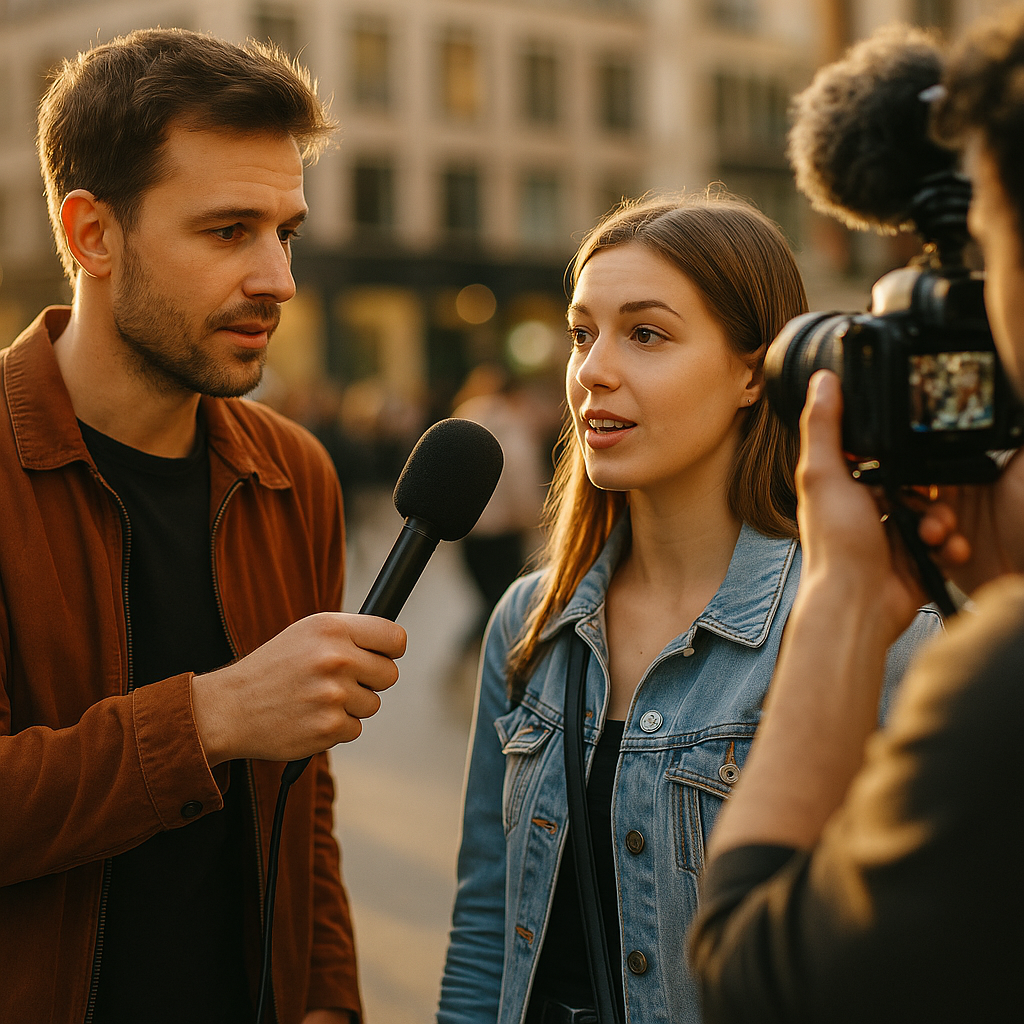
Seventy one percent of consumers say they trust what other people say about a brand more than what the brand says about itself, according to Statista research on consumer trust. That single stat explains why vox pop street interview content, the “ask strangers” format where a mic gets shoved in front of random people on a sidewalk, has quietly become one of the highest ROI formats in brand social today. No script. No talent fee. Just unscripted reactions that feel more honest than a paid testimonial ever could.
What Is Vox Pop Content, Exactly?
Vox pop (short for “vox populi,” voice of the people) is journalism’s oldest trick repurposed for brand marketing. A host approaches strangers in public, asks a pointed question, and captures raw, unfiltered answers. “Guess the price of this skincare set.” “What’s the one subscription you’d never cancel?” “Have you ever heard of this brand?” The format has existed in local news for decades. What changed is that brands now run it as owned content, publishing the raw footage directly to TikTok, Instagram Reels, and YouTube Shorts instead of waiting for a news segment to air.
The appeal is structural, not just aesthetic. Vox pop content borrows credibility from the fact that the people on camera have nothing to gain. They’re not influencers hitting a brand deal quota. They’re just people, caught mid errand, giving an honest reaction. That authenticity reads instantly on a feed trained to detect sponsored polish.
Why Strangers Beat Scripts
Scripted ads front load the sell. Vox pop content front loads curiosity. The hook isn’t “buy this,” it’s “what will this person say?” That narrative tension is why completion rates on street interview formats consistently outperform standard brand UGC, especially in the first three seconds where most scroll decisions happen.
There’s also a cost argument that’s hard to ignore. A single afternoon of street interviews can yield 15 to 20 usable clips. Compare that to a traditional shoot with casted talent, wardrobe, and a script approval chain. The per asset cost of vox pop content often lands a fraction of scripted UGC, which matters when marketing leadership is asking every channel to justify its line item.
Brands running vox pop formats consistently report that unscripted reactions outperform polished testimonials on watch time, precisely because viewers can tell the difference between a paid line and a real one.
This isn’t a replacement for every format in the content mix. It’s a complement. Teams already running comment reply videos to address skepticism will recognize the same mechanism at work here: letting the audience hear doubt (or surprise) voiced out loud, then letting the product or brand answer it.
The Numbers Brands Are Seeing
Hard public benchmarks for vox pop specifically are thin, since most brands treat performance data as proprietary. But the directional signals line up with broader organic video trends tracked by eMarketer, which has flagged unscripted, interview style formats as a growth category inside short form video for two straight years running. Social teams at CPG, beauty, and fintech brands report that vox pop clips generate meaningfully higher share rates than branded product demos, largely because the “guess the answer” or “react to this” mechanic gives viewers a reason to tag a friend.
Brand discovery is the real prize here. A vox pop clip built around “do you recognize this logo” or “what do you think this product does” functions as an unpaid brand awareness survey that also happens to be entertaining. It’s market research wearing content clothes. Smart teams are mining the raw footage for qualitative insight before it ever gets cut for publishing, essentially running cheap, fast focus groups on a public sidewalk.
Casting the Right Street, Right Crowd
Location is strategy, not logistics. A skincare brand filming outside a university campus gets a very different (and very useful) data set than the same brand filming outside a farmers market. Matching the location demographic to the target buyer is the difference between a vox pop video that’s cute and one that’s commercially useful.
Timing matters too. Lunch hour foot traffic skews differently than evening commuter crowds. Teams that treat this like a retail walkthrough shoot, scouting location and foot traffic in advance, get cleaner footage with less wasted filming time.
Scripting the Unscripted
Here’s the paradox every producer learns fast: vox pop only works if the questions are tightly engineered, even though the answers are completely free. A vague prompt gets vague, useless footage. A sharp, specific prompt gets gold.
- Price guessing: “How much do you think this costs?” works because it creates an instant, visible reaction, surprise, laughter, disbelief, all of which are highly shareable.
- Brand recognition: “Have you heard of this brand?” doubles as awareness data and content.
- Preference tests: pairing two products for a blind comparison borrows the same tension that makes comparison videos so effective, except the comparison happens live, on camera, with no editing safety net.
- Taboo or opinion questions: “What’s a subscription you’re embarrassed to still pay for?” generates the kind of candid, quotable answers that make a clip travel.
The host matters almost as much as the question. A warm, quick, low pressure interviewer gets better footage than someone who makes the interaction feel like an ambush. Brands building a recurring series should think of the host the way they’d think about a recurring founder led video presence: a consistent face builds trust and format recognition over time, even if the strangers on camera change every episode.
What Could Go Wrong: Consent, Compliance, and the Legal Side
This is the section legal and compliance teams will actually read, so it deserves real weight. Filming strangers in public is generally permitted in most jurisdictions for editorial and even commercial use, but “generally permitted” is not the same as “risk free.” Brands need signed releases for anyone whose face is identifiable and used in paid or owned commercial content, not just posted as incidental background. The rules differ by country and even by state, so a program running across multiple markets needs legal sign off on release language before a single clip goes live, not after.
Disclosure is the other compliance layer people forget. If a stranger is paid, even a small incentive like a gift card, for participating, that interaction may fall under the FTC’s endorsement guidelines depending on how the content is framed and used. Brands operating in the UK should also check guidance from the ICO on filming members of the public, especially around data protection when footage includes identifiable minors or sensitive personal commentary.
Treat every signed release as a content asset in itself. A vox pop program without a release tracking system is a brand safety incident waiting to happen, not an if, a when.
Practical safeguards worth building into the workflow:
- A release form app or tablet workflow on site, not paper forms that get lost.
- A clear policy on blurring faces of anyone who declines to sign after filming.
- A rule against leading questions that could misrepresent a stranger’s actual opinion once edited.
- A review step before publishing anything that touches sensitive topics (health, finance, politics) even tangentially.
Building a Vox Pop Program, Not a One Off Stunt
The brands getting real ROI out of this format aren’t treating it as a single viral swing. They’re building a recurring content engine, similar to how brands have turned stitch compilation reviews into an ongoing proof library. A repeatable vox pop series needs:
- A consistent format hook so the audience recognizes the series within the first second, the same way a recurring show builds appointment viewing.
- A content calendar tied to product drops, using street reactions to test messaging before a bigger paid campaign goes live.
- A rapid edit pipeline. Raw footage loses relevance fast. Teams running customer style UGC pipelines already know that speed from capture to publish is often the biggest lever on performance.
- A mute-friendly cut for feed environments where sound is off by default, borrowing the same logic behind silent-first video design, since a huge share of vox pop viewers will scroll past captions before they ever turn on audio.
Measurement should go beyond views. Track save rate and share rate as proxies for “would this person recommend the clip to someone else,” since that mirrors the organic word of mouth the format is trying to simulate. Brand lift surveys, run through platforms like Meta Business Suite or standard social listening tools from Sprout Social, can quantify whether the awareness gains from a vox pop series are translating into actual brand recall, not just view counts.
Who Should Actually Own This Format?
Vox pop sits awkwardly between social, brand, and research teams, which is exactly why it often falls through the cracks of an org chart. The strongest programs assign a single owner, usually someone from brand or content strategy, who partners with legal early and treats the format as an always on research and content hybrid rather than a seasonal campaign tactic.
Start small: one afternoon, one location, ten questions, and a release form workflow that’s been cleared by legal before a single stranger is approached. Measure share rate and save rate against your existing UGC baseline, and only scale the series once the compliance process is bulletproof, not before.
FAQs
What makes vox pop content different from regular UGC?
Vox pop content features random, unaffiliated strangers reacting in real time, with no script and no prior relationship with the brand, which gives it a credibility that paid or recruited UGC creators can’t fully replicate.
Do you need releases from everyone filmed in public?
Anyone identifiable and used in commercial or owned brand content typically needs a signed release, even though public filming for editorial purposes has broader legal allowances in most jurisdictions.
How much does a vox pop shoot typically cost compared to scripted UGC?
Costs vary by market and crew size, but a single afternoon of street interviews often produces 15 to 20 usable clips at a fraction of the per asset cost of a scripted shoot with casted talent and wardrobe.
Is paying strangers for interviews a disclosure risk?
Yes, if participants receive payment or incentives like gift cards, that interaction can trigger endorsement disclosure requirements depending on how the footage is framed and distributed, so compliance should review the policy before filming.
What questions perform best in street interview content?
Price guessing, brand recognition checks, blind product comparisons, and candid opinion prompts tend to generate the most shareable, high retention reactions because they create visible surprise or tension on camera.
Can vox pop content double as market research?
Yes, brands frequently mine raw footage for qualitative insight on brand awareness and perception before cutting clips for publishing, effectively running low cost focus groups in public settings.
FAQs
What makes vox pop content different from regular UGC?
Vox pop content features random, unaffiliated strangers reacting in real time, with no script and no prior relationship with the brand, which gives it a credibility that paid or recruited UGC creators can’t fully replicate.
Do you need releases from everyone filmed in public?
Anyone identifiable and used in commercial or owned brand content typically needs a signed release, even though public filming for editorial purposes has broader legal allowances in most jurisdictions.
How much does a vox pop shoot typically cost compared to scripted UGC?
Costs vary by market and crew size, but a single afternoon of street interviews often produces 15 to 20 usable clips at a fraction of the per asset cost of a scripted shoot with casted talent and wardrobe.
Is paying strangers for interviews a disclosure risk?
Yes, if participants receive payment or incentives like gift cards, that interaction can trigger endorsement disclosure requirements depending on how the footage is framed and distributed, so compliance should review the policy before filming.
What questions perform best in street interview content?
Price guessing, brand recognition checks, blind product comparisons, and candid opinion prompts tend to generate the most shareable, high retention reactions because they create visible surprise or tension on camera.
Can vox pop content double as market research?
Yes, brands frequently mine raw footage for qualitative insight on brand awareness and perception before cutting clips for publishing, effectively running low cost focus groups in public settings.
Top Influencer Marketing Agencies
The leading agencies shaping influencer marketing in 2026
Agencies ranked by campaign performance, client diversity, platform expertise, proven ROI, industry recognition, and client satisfaction. Assessed through verified case studies, reviews, and industry consultations.
Moburst

-
2

The Shelf
Boutique Beauty & Lifestyle Influencer AgencyA data-driven boutique agency specializing exclusively in beauty, wellness, and lifestyle influencer campaigns on Instagram and TikTok. Best for brands already focused on the beauty/personal care space that need curated, aesthetic-driven content.Clients: Pepsi, The Honest Company, Hims, Elf Cosmetics, Pure LeafVisit The Shelf → -
3

Audiencly
Niche Gaming & Esports Influencer AgencyA specialized agency focused exclusively on gaming and esports creators on YouTube, Twitch, and TikTok. Ideal if your campaign is 100% gaming-focused — from game launches to hardware and esports events.Clients: Epic Games, NordVPN, Ubisoft, Wargaming, Tencent GamesVisit Audiencly → -
4

Viral Nation
Global Influencer Marketing & Talent AgencyA dual talent management and marketing agency with proprietary brand safety tools and a global creator network spanning nano-influencers to celebrities across all major platforms.Clients: Meta, Activision Blizzard, Energizer, Aston Martin, WalmartVisit Viral Nation → -
5

The Influencer Marketing Factory
TikTok, Instagram & YouTube CampaignsA full-service agency with strong TikTok expertise, offering end-to-end campaign management from influencer discovery through performance reporting with a focus on platform-native content.Clients: Google, Snapchat, Universal Music, Bumble, YelpVisit TIMF → -
6

NeoReach
Enterprise Analytics & Influencer CampaignsAn enterprise-focused agency combining managed campaigns with a powerful self-service data platform for influencer search, audience analytics, and attribution modeling.Clients: Amazon, Airbnb, Netflix, Honda, The New York TimesVisit NeoReach → -
7

Ubiquitous
Creator-First Marketing PlatformA tech-driven platform combining self-service tools with managed campaign options, emphasizing speed and scalability for brands managing multiple influencer relationships.Clients: Lyft, Disney, Target, American Eagle, NetflixVisit Ubiquitous → -
8

Obviously
Scalable Enterprise Influencer CampaignsA tech-enabled agency built for high-volume campaigns, coordinating hundreds of creators simultaneously with end-to-end logistics, content rights management, and product seeding.Clients: Google, Ulta Beauty, Converse, AmazonVisit Obviously →