


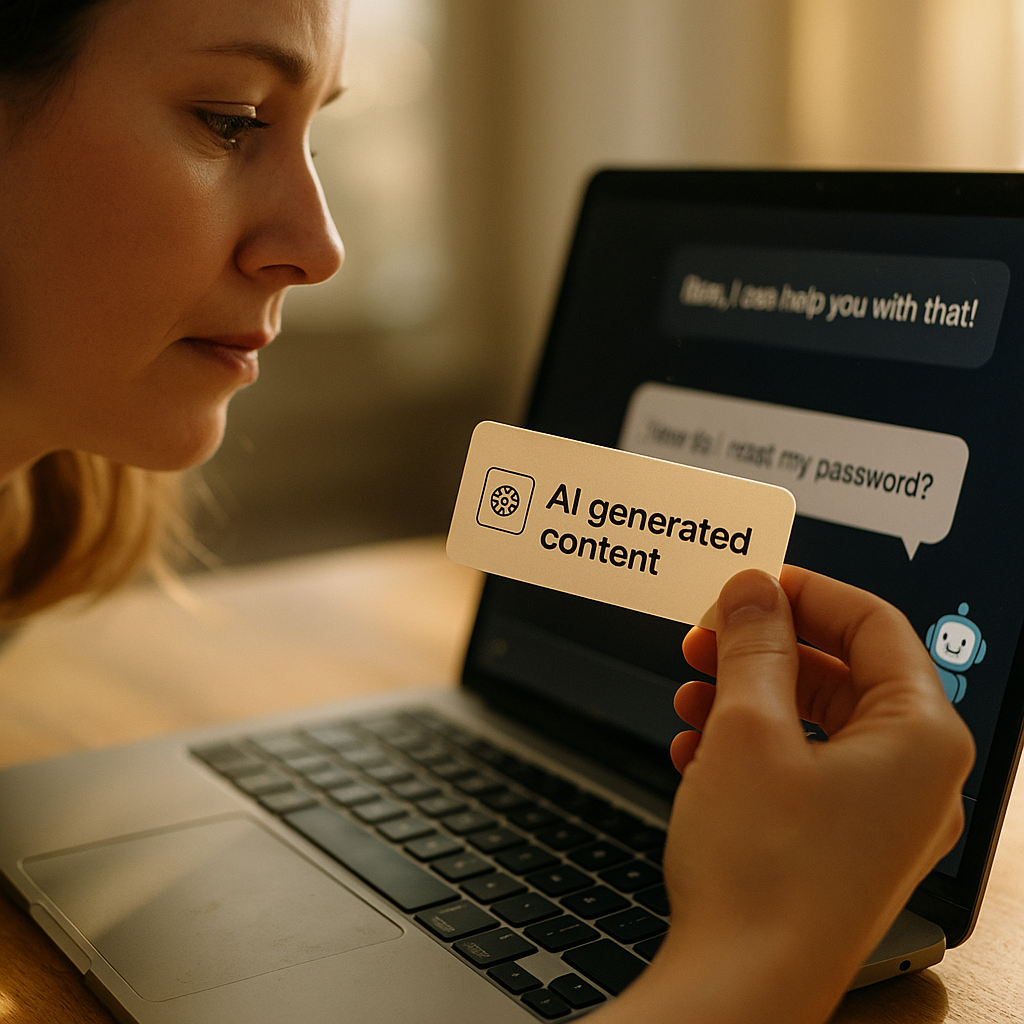
72% of consumers say they trust a brand more when it discloses limits on its own AI use — yet fewer than one in five brands publish anything resembling an AI usage policy. That gap is either your biggest liability or your next differentiator. Consumer preference for brands that publicly limit their AI use isn’t a fringe sentiment anymore. It’s showing up in purchase data, trust surveys, and churn metrics.
The Trust Premium Is Real, and It’s Growing
Marketers spent the last two years chasing AI efficiency — faster copy, cheaper video, infinite creative variants. Somewhere in that rush, a counter-trend emerged. Consumers started rewarding restraint.
Surveys from firms tracking brand trust consistently show a pattern: people don’t hate AI. They hate opacity. A brand that says “we use AI for X, not Y, and here’s why” scores higher on trust metrics than one that says nothing at all, and dramatically higher than one caught using AI without disclosure. This isn’t about being anti-AI. It’s about being pro-transparency, and the two get conflated constantly by marketing teams who assume any AI guardrail signals weakness.
Brands that publish specific, verifiable limits on AI use are outperforming silent competitors on trust scores by double digits — even when both brands use similar amounts of AI internally.
The disclosure itself is the product. Consumers can’t audit your tech stack. They can audit your promises.
Why Silence Reads as Deception Now
Five years ago, saying nothing about AI was neutral. Today it reads as evasive. Why the shift? Because consumers have been burned. AI-generated customer service responses that hallucinate. Chatbots that can’t resolve simple requests, a frustration well documented in why consumers abandon AI chatbots so fast. Influencer content that turns out to be synthetic. Each incident raises baseline suspicion for every brand, guilty or not.
That suspicion has a name in research circles: “AI opacity penalty.” Brands that don’t address their AI use at all get lumped in with the worst offenders, purely by default. Silence used to be safe. Now it’s a liability that compounds with every news cycle about deepfakes or algorithmic bias.
Consider the parallel to food labeling. Nobody assumed harmful ingredients before mandatory labeling laws. Once labeling became standard, unlabeled products started looking suspicious by comparison. AI disclosure is following the same trajectory, just without the regulation forcing it (yet).
What “Publicly Limiting AI” Actually Looks Like
This isn’t about slapping a disclaimer on your footer. The brands winning trust points are specific. A few patterns showing up repeatedly:
- Human-verified creative claims: “All product photography is unedited by AI” or “This review was written by a real customer, not generated.”
- Bounded chatbot scope: Publicly stating what the AI assistant can and cannot do, and when it hands off to a human.
- Creator content labeling: Explicit disclosure when influencer content involves AI-assisted editing versus fully organic capture, a trend covered in why sensory UGC beats studio content.
- No-AI zones: Some brands now specify categories (customer complaints, medical advice, financial guidance) where AI is explicitly excluded from the workflow.
None of this requires abandoning AI. It requires drawing a line and publishing it.
The Data: Where the Preference Shows Up in Behavior, Not Just Surveys
Stated preference is one thing. Behavior is another. The interesting part of this trend is that it’s starting to show up in retention and conversion data, not just brand-trust surveys.
eMarketer data on consumer sentiment toward AI-generated marketing shows a consistent split: younger consumers are more comfortable with AI in general but simultaneously more likely to penalize brands for undisclosed use. That’s not a contradiction. It’s a preference for control, not avoidance. People want to opt into the AI experience, not be tricked into it.
Retention data tells a similar story. Brands that faced public backlash over undisclosed AI use — synthetic influencers passed off as real people, AI-written reviews, chatbots pretending to be human agents — saw measurable spikes in churn and negative sentiment in the weeks following exposure. The cost isn’t hypothetical. It shows up in the same CAC and retention math marketers are already worrying about, a pressure explored in rising CAC and retention budgets.
Meanwhile, HubSpot research on buyer trust consistently ranks transparency above almost every other brand attribute when B2B and DTC buyers are asked what drives repeat purchase. AI disclosure is quickly becoming a subset of that broader transparency expectation, not a separate category.
The Influencer Marketing Angle Nobody’s Pricing In Yet
This is where it gets uncomfortable for a lot of brand and agency teams. Influencer marketing has quietly become one of the biggest blind spots in AI disclosure. Brands will publish a careful AI policy for their website copy while letting creator content run wild with undisclosed AI editing, AI-written captions, or fully synthetic UGC.
Consumers don’t separate the two. If they discover a brand’s “authentic creator content” was AI-touched without disclosure, the trust damage transfers straight to the brand, not just the creator.
This matters more as branded UGC gets standardized into contract terms, a shift documented in branded UGC standardization. If disclosure clauses aren’t built into those contracts now, brands are exposed later. The FTC has already signaled it’s watching this space closely, and guidance on endorsement disclosure is only going to get stricter as AI-generated content proliferates.
Smart agencies are starting to add “AI-assistance disclosure” as a standard line item in creator briefs, right next to usage rights and whitelisting terms. It’s cheap insurance against a very expensive trust problem.
Why This Ties Back to the AI Fluency Gap Inside Marketing Teams
Here’s the internal wrinkle most CMOs aren’t addressing: your team’s comfort with AI tools doesn’t match your customer’s comfort with AI outputs. That mismatch is exactly what’s described in the AI fluency gap splitting marketing teams. Teams that are deep in AI tooling internally sometimes lose sight of how exposed and skeptical their audience actually is. The people building your AI-assisted campaigns are often the least representative sample of how your customers feel about AI.
That’s a governance problem as much as a creative one. It means someone — legal, brand, or comms — needs veto power over how much AI touches customer-facing output, independent of how efficient it makes the internal workflow.
What This Means for Budget and Governance Decisions
If public AI limits genuinely move trust and retention metrics, that changes how brands should think about governance spend. It’s no longer just a legal or compliance checkbox. It’s a marketing asset.
Treat your AI disclosure policy as a piece of brand content, not a legal disclaimer buried three clicks deep. The brands winning trust points are the ones putting it where customers actually look.
Practical moves worth testing:
- Publish a plain-language AI use policy on your site, written for customers, not lawyers.
- Audit creator contracts for AI disclosure clauses, especially around UGC and testimonials.
- Set explicit no-AI zones for high-trust touchpoints: complaints handling, medical or financial claims, personal testimonials.
- Train customer-facing teams to explain the policy consistently, so it doesn’t collapse under scrutiny the first time a journalist or customer asks a follow-up question.
None of this is about slowing AI adoption internally. Operational efficiency gains from AI aren’t going anywhere, and rightly so — the energy and infrastructure costs behind those gains are a whole separate budget conversation, one covered in AI data center energy costs. The point is that internal AI use and public AI disclosure are two different levers. Pulling one doesn’t require pulling the other.
The brands that figure this out first won’t be the ones using the least AI. They’ll be the ones who are the most specific, most consistent, and most honest about where the line sits — publish that line before a customer, journalist, or regulator finds it for you.
FAQs
Does limiting AI use actually hurt marketing efficiency?
Not necessarily. Most brands seeing trust gains aren’t reducing AI use broadly, they’re restricting it in specific high-trust categories like customer complaints, testimonials, and medical or financial claims while keeping AI fully deployed elsewhere.
What’s the difference between an AI policy and an AI disclosure?
A policy is internal governance, it dictates how your team uses AI. Disclosure is the public-facing communication of specific limits, written for customers, not compliance teams. Both matter, but disclosure is what moves trust metrics.
Should influencer content require AI disclosure too?
Yes. Consumers don’t distinguish between brand-owned content and creator content when assessing trust. If AI-assisted creator content is discovered without disclosure, the reputational damage transfers directly to the brand.
How do I know if my audience actually cares about this?
Test it directly. Run A/B messaging with and without AI disclosure language on key pages, or survey customers post-purchase about trust drivers. Don’t assume internal AI enthusiasm mirrors customer sentiment.
Is this trend regulatory or purely reputational right now?
Mostly reputational, but regulatory pressure is building. The FTC has already issued guidance on AI-related endorsement disclosure, and stricter rules are likely as synthetic content becomes harder to detect.
Top Influencer Marketing Agencies
The leading agencies shaping influencer marketing in 2026
Agencies ranked by campaign performance, client diversity, platform expertise, proven ROI, industry recognition, and client satisfaction. Assessed through verified case studies, reviews, and industry consultations.
Moburst

-
2

The Shelf
Boutique Beauty & Lifestyle Influencer AgencyA data-driven boutique agency specializing exclusively in beauty, wellness, and lifestyle influencer campaigns on Instagram and TikTok. Best for brands already focused on the beauty/personal care space that need curated, aesthetic-driven content.Clients: Pepsi, The Honest Company, Hims, Elf Cosmetics, Pure LeafVisit The Shelf → -
3

Audiencly
Niche Gaming & Esports Influencer AgencyA specialized agency focused exclusively on gaming and esports creators on YouTube, Twitch, and TikTok. Ideal if your campaign is 100% gaming-focused — from game launches to hardware and esports events.Clients: Epic Games, NordVPN, Ubisoft, Wargaming, Tencent GamesVisit Audiencly → -
4

Viral Nation
Global Influencer Marketing & Talent AgencyA dual talent management and marketing agency with proprietary brand safety tools and a global creator network spanning nano-influencers to celebrities across all major platforms.Clients: Meta, Activision Blizzard, Energizer, Aston Martin, WalmartVisit Viral Nation → -
5

The Influencer Marketing Factory
TikTok, Instagram & YouTube CampaignsA full-service agency with strong TikTok expertise, offering end-to-end campaign management from influencer discovery through performance reporting with a focus on platform-native content.Clients: Google, Snapchat, Universal Music, Bumble, YelpVisit TIMF → -
6

NeoReach
Enterprise Analytics & Influencer CampaignsAn enterprise-focused agency combining managed campaigns with a powerful self-service data platform for influencer search, audience analytics, and attribution modeling.Clients: Amazon, Airbnb, Netflix, Honda, The New York TimesVisit NeoReach → -
7

Ubiquitous
Creator-First Marketing PlatformA tech-driven platform combining self-service tools with managed campaign options, emphasizing speed and scalability for brands managing multiple influencer relationships.Clients: Lyft, Disney, Target, American Eagle, NetflixVisit Ubiquitous → -
8

Obviously
Scalable Enterprise Influencer CampaignsA tech-enabled agency built for high-volume campaigns, coordinating hundreds of creators simultaneously with end-to-end logistics, content rights management, and product seeding.Clients: Google, Ulta Beauty, Converse, AmazonVisit Obviously →