


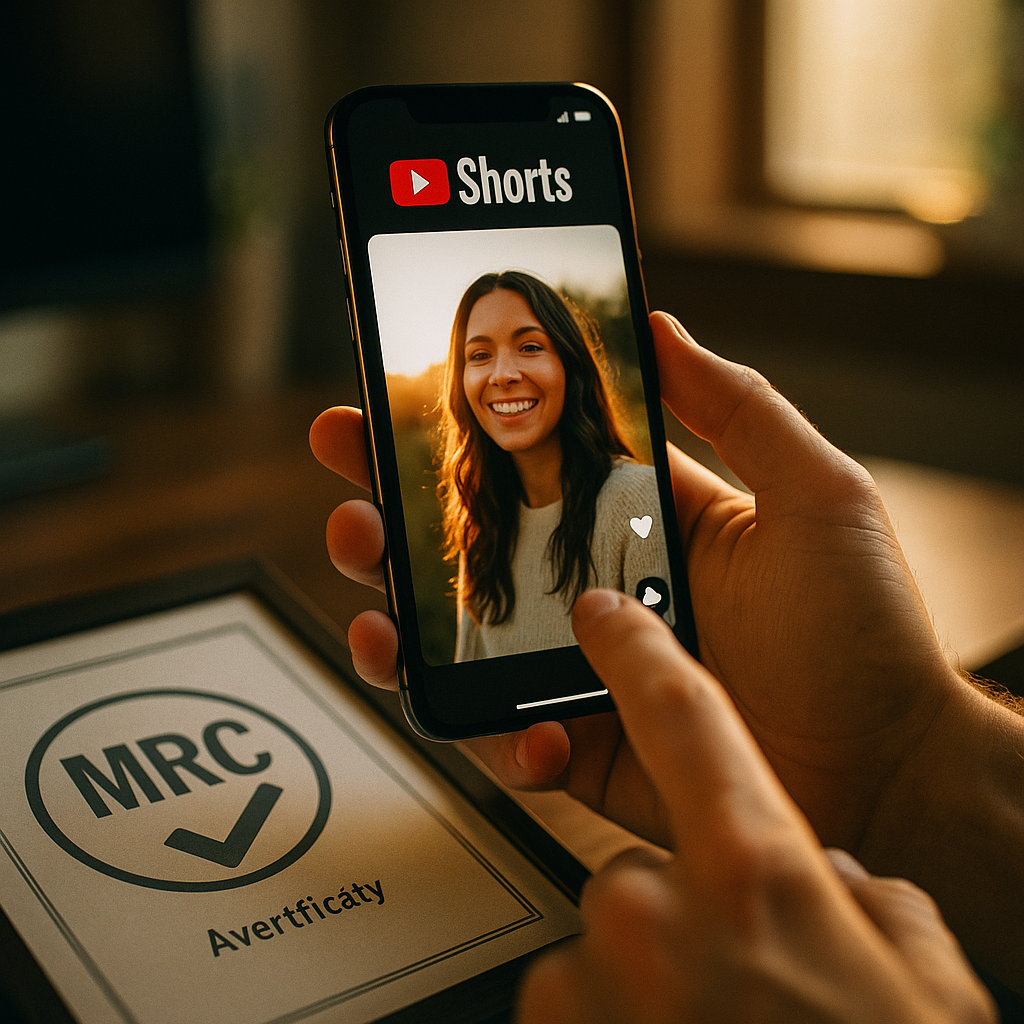
The Certification Short-Form Video Has Needed for Years
Brand safety in short-form video has operated largely on trust and hope. YouTube Shorts’ MRC brand safety accreditation changes that — making it the first short-form video environment to earn independent, third-party certification for content quality and ad placement standards.
That’s not a minor procedural milestone. For brand teams allocating meaningful budget to Shorts placements, it’s the compliance anchor they’ve been waiting for.
What MRC Accreditation Actually Certifies
The Media Rating Council doesn’t hand out accreditations for good intentions. MRC audits measure whether a platform’s viewability, brand safety, and invalid traffic (IVT) detection methodologies meet the council’s published standards. For YouTube Shorts, this means the MRC has reviewed and validated how Google classifies content, how adjacency signals are generated, and how placement controls are enforced at scale across vertical video inventory.
The practical implication: brand safety claims on Shorts are no longer self-reported. They’re independently verified. That distinction matters enormously when you’re presenting a media plan to a risk-conscious CMO or a legal team with questions about suitability standards.
Self-reported brand safety is an assertion. MRC accreditation is evidence. For regulated-industry brands, that difference can determine whether a Shorts budget line gets approved or killed.
It’s worth understanding what accreditation doesn’t cover. MRC certification validates measurement methodology, not individual content moderation decisions. A brand appearing next to an inappropriate video is still possible. What accreditation confirms is that the system designed to prevent that is operating to independently verified standards.
How This Shifts Brand Placement Decisions
Before this accreditation, many brand safety officers treated Shorts placements with the same caution they applied to TikTok or Instagram Reels: cautious allowlisting, heavy exclusion lists, and conservative content category targeting. The reasoning was sound. Without third-party verification, you were relying on Google’s self-certification.
That calculus changes now. Specifically, three placement decisions shift:
- Allowlist expansion: Brands that previously restricted Shorts to a narrow set of pre-vetted creator channels can now extend reach more confidently using Google’s broader inventory, knowing placement controls are MRC-audited rather than just platform-promised.
- Category unlocking: Verticals like financial services, pharma, and alcohol that maintain strict adjacency policies can use the accreditation as documented due diligence when justifying expanded Shorts investment to compliance teams.
- Programmatic confidence: Programmatic buying against Shorts inventory has been limited by IVT concerns specific to short-form scroll environments. MRC IVT accreditation directly addresses this, giving programmatic teams a defensible position.
For context on how amplification budget is already shifting toward creator-originated short-form content, the spending patterns covered in creator amplification spend trends show why brands need this kind of structural validation to continue scaling.
Redesigning Creator Briefs Around an Accredited Environment
MRC accreditation doesn’t just affect paid media teams. It has direct implications for how brand teams brief creators producing Shorts content.
Here’s the logic: if your paid amplification relies on Shorts inventory meeting MRC brand safety standards, then the organic creator content you’re amplifying needs to be produced with those same standards in mind. A brief that doesn’t account for the platform’s content classification signals is a brief that will create friction between your creative and your compliance posture.
Practically, this means briefs should now specify:
- Content category signals that align with your desired placement tier (avoiding ambiguous topic coverage that could trigger reclassification)
- Audio and visual elements that don’t inadvertently trigger sensitive category flags (background imagery, referenced topics, overlaid text)
- Clear disclosure language positioned to survive vertical video cropping without disappearing from the visible frame
- Explicit guidance on what not to include, not just what to feature, so creators understand the adjacency logic behind the restrictions
This is a significant maturation step. Creator briefs historically focused on creative direction and brand messaging. Now they need to embed platform compliance logic. Teams managing this well are building brief templates that include a “platform classification guidance” section alongside the usual brand voice and visual identity notes.
If your organization is still treating creator contracts and briefs as separate from measurement strategy, the framework described in creator ecosystems and measurement is worth reviewing before your next Shorts campaign kicks off.
Paid Amplification Confidence: What Changes for Buying Teams
The most immediate operational impact lands with paid social and programmatic buying teams. MRC accreditation gives YouTube Shorts a verifiable advantage over competing short-form environments when it comes to brand safety documentation.
IAB standards and MRC accreditation aren’t the same thing, but they’re complementary. IAB sets the framework; MRC validates execution. Having both gives brands a documentation chain that satisfies most advertiser due diligence requirements.
For agencies managing spend on behalf of brands, this changes the client conversation. You can now present Shorts as a certified environment rather than a monitored one. That’s a meaningful distinction in agency presentations, particularly when competing for budget that’s currently allocated to display or connected TV.
The MRC accreditation gives YouTube Shorts a seat at the table in brand safety conversations where it previously had to argue for its own credibility. That’s a structural advantage that won’t be matched by unaccredited short-form environments any time soon.
The YouTube vs. linear TV upfront dynamic is already reshaping how brand teams allocate video budgets. Shorts accreditation strengthens the YouTube side of that argument further, particularly for brands that previously held back from Shorts due to safety concerns.
One operational change buying teams should implement immediately: update your brand safety vendor reporting to include MRC accreditation status as a documented input in your media plan audit trail. Tools like DoubleVerify and Integral Ad Science integrate with YouTube’s ad serving and can now reference accredited standards in their reporting outputs. Make sure your agency or in-house team is capturing that.
The Competitive Landscape Implication
TikTok and Instagram Reels remain unaccredited by MRC for brand safety in short-form video. That’s not a permanent state, and both platforms are likely pursuing similar certifications. But right now, YouTube Shorts holds a differentiated position.
For brands with diversified short-form strategies, this creates a tiering opportunity: treat Shorts as your compliance-anchored short-form environment while maintaining presence on Reels and TikTok for reach and cultural relevance. Different budget allocation logic applies to each tier.
This is also relevant for brands in the creator economy professionalization wave who are formalizing their influencer programs. Accreditation standards are part of what “professional” looks like in short-form video investment. Building your program around certified environments from the start saves painful compliance retrofitting later.
The FTC’s disclosure requirements for influencer content don’t change with MRC accreditation, but having an accredited placement environment makes your overall compliance documentation cleaner and more defensible.
What Brand Teams Should Do Right Now
Update your brand safety policy documentation to reflect YouTube Shorts’ MRC accreditation status as a verified placement environment. Then brief your creators on the content classification logic that supports that standard, and make sure your buying team is capturing accreditation status in media plan audit records. That three-step sequence is the immediate operational response — everything else builds from it.
Frequently Asked Questions
What does MRC brand safety accreditation mean for YouTube Shorts?
MRC (Media Rating Council) accreditation means that YouTube Shorts’ brand safety, viewability, and invalid traffic detection methodologies have been independently audited and verified to meet the MRC’s published standards. Unlike self-reported brand safety claims, MRC accreditation provides third-party validated evidence that placement controls are operating to a documented standard.
How does this accreditation affect paid amplification of creator content on Shorts?
It gives buying teams a defensible compliance position when allocating programmatic or direct budgets to Shorts inventory. Brands in regulated industries can reference the accreditation as documented due diligence, and agencies can present Shorts as a certified environment rather than a monitored one, strengthening the case for increased investment.
Do creator briefs need to change because of MRC accreditation?
Yes. Because paid amplification on Shorts now relies on MRC-audited placement standards, the organic creator content being amplified should be produced to align with the platform’s content classification signals. Briefs should include guidance on topic coverage, audio-visual elements, and disclosure positioning that supports clean content classification.
Is YouTube Shorts the only short-form platform with MRC brand safety accreditation?
As of the current period, YouTube Shorts is the first short-form video environment to achieve MRC brand safety accreditation. TikTok and Instagram Reels have not yet received equivalent third-party certification, which gives Shorts a differentiated compliance position for brands with strict adjacency requirements.
Does MRC accreditation guarantee no inappropriate ad placements will occur?
No. MRC accreditation validates that the systems and methodologies designed to prevent inappropriate placements meet independent standards. It does not guarantee zero errors. What it confirms is that the brand safety infrastructure is operating to verified, auditable standards, which is meaningfully different from a platform’s self-reported safety claims.
Top Influencer Marketing Agencies
The leading agencies shaping influencer marketing in 2026
Agencies ranked by campaign performance, client diversity, platform expertise, proven ROI, industry recognition, and client satisfaction. Assessed through verified case studies, reviews, and industry consultations.
Moburst

-
2

The Shelf
Boutique Beauty & Lifestyle Influencer AgencyA data-driven boutique agency specializing exclusively in beauty, wellness, and lifestyle influencer campaigns on Instagram and TikTok. Best for brands already focused on the beauty/personal care space that need curated, aesthetic-driven content.Clients: Pepsi, The Honest Company, Hims, Elf Cosmetics, Pure LeafVisit The Shelf → -
3

Audiencly
Niche Gaming & Esports Influencer AgencyA specialized agency focused exclusively on gaming and esports creators on YouTube, Twitch, and TikTok. Ideal if your campaign is 100% gaming-focused — from game launches to hardware and esports events.Clients: Epic Games, NordVPN, Ubisoft, Wargaming, Tencent GamesVisit Audiencly → -
4

Viral Nation
Global Influencer Marketing & Talent AgencyA dual talent management and marketing agency with proprietary brand safety tools and a global creator network spanning nano-influencers to celebrities across all major platforms.Clients: Meta, Activision Blizzard, Energizer, Aston Martin, WalmartVisit Viral Nation → -
5

The Influencer Marketing Factory
TikTok, Instagram & YouTube CampaignsA full-service agency with strong TikTok expertise, offering end-to-end campaign management from influencer discovery through performance reporting with a focus on platform-native content.Clients: Google, Snapchat, Universal Music, Bumble, YelpVisit TIMF → -
6

NeoReach
Enterprise Analytics & Influencer CampaignsAn enterprise-focused agency combining managed campaigns with a powerful self-service data platform for influencer search, audience analytics, and attribution modeling.Clients: Amazon, Airbnb, Netflix, Honda, The New York TimesVisit NeoReach → -
7

Ubiquitous
Creator-First Marketing PlatformA tech-driven platform combining self-service tools with managed campaign options, emphasizing speed and scalability for brands managing multiple influencer relationships.Clients: Lyft, Disney, Target, American Eagle, NetflixVisit Ubiquitous → -
8

Obviously
Scalable Enterprise Influencer CampaignsA tech-enabled agency built for high-volume campaigns, coordinating hundreds of creators simultaneously with end-to-end logistics, content rights management, and product seeding.Clients: Google, Ulta Beauty, Converse, AmazonVisit Obviously →