


Most Sponsored Creator Content Is Invisible to AI Answer Engines. Here’s Why That’s a Budget Problem.
Over 40% of consumers now start product research inside ChatGPT or Gemini rather than a traditional search engine, according to data tracked by eMarketer. Yet the overwhelming majority of sponsored short-form video is structured to satisfy platform algorithms, not AI retrieval systems. That gap is costing brands real discovery surface. Designing creator content for AI answer engine discovery isn’t a future-state initiative. It’s a production brief problem you can solve right now.
Why AI Answer Engines Ignore Most Creator Content
ChatGPT, Gemini, and Perplexity don’t index content the way Google’s crawler does. They surface content that training data and live retrieval systems have identified as authoritative, specific, and conversationally useful. Most sponsored creator videos fail all three tests simultaneously.
The typical influencer brief asks a creator to “speak authentically” about a product. That produces content like: “I’ve been absolutely obsessed with this serum.” Lovely. Useless to an AI shopping assistant trying to answer “What’s the best hydrating serum under $40 for combination skin?” The AI needs facts, comparisons, and structured reasoning. It needs the content to behave like a credible answer, not a testimonial.
The fix isn’t to make creator content robotic. It’s to build the production brief so that factual specificity and conversational answer structure are baked into the creative before the camera rolls.
AI answer engines reward content that functions as a complete answer to a specific question. Briefs that leave product specificity to creator improvisation are structurally incapable of producing that content.
The Four Structural Layers Your Brief Must Address
Think of AI-optimized creator content as requiring four embedded layers. Miss any one of them and the content degrades toward invisibility in AI shopping responses.
Layer 1: Factual Product Specificity. The brief must hardcode verifiable product claims the creator states on camera. Not talking points. Specific facts: the SKU name, the key active ingredient and its concentration, the price point, the primary use case. When Gemini or ChatGPT processes a shopping query, it’s pattern-matching against factual anchors. If those anchors don’t exist in the content (or its associated metadata), the content doesn’t surface. Your brief should include a “Required Fact Statements” section, listing five to eight non-negotiable claims the creator must deliver verbatim or near-verbatim.
Layer 2: Conversational Answer Structure. AI retrieval systems favor content structured as question-and-answer pairs. This means briefing creators to open their video by stating a problem or question explicitly, then answering it with the product as the solution. “If you have dry, dehydrated skin and you’re looking for something that actually works under a full face of makeup, here’s what I switched to” is an infinitely more retrievable opening than “okay guys, PR package!” The brief should specify the exact question the video is designed to answer, and require the creator to verbalize it.
Layer 3: Authority Signals. AI systems weight content from sources with demonstrated expertise and corroborating signals. For creator content, this means the brief should instruct creators to cite verifiable third-party proof: clinical study results the brand can legally reference, awards, press mentions, or dermatologist endorsements. It also means ensuring the content is posted to creator channels with strong engagement rates and topical authority in the relevant category. A skincare creator with 200k engaged followers in the beauty niche carries more retrievable authority signal than a lifestyle creator with 2M followers who posts about everything.
Layer 4: Metadata and Caption Architecture. The video itself isn’t the only retrievable asset. Captions, video descriptions, and pinned comments are text-readable. Your brief must include caption templates that mirror the conversational answer structure of the video, include the product’s full name and key claims in plain text, and use natural-language question phrasing rather than hashtag-stuffed keyword blocks. This is especially relevant on YouTube Shorts, where video descriptions are indexed more aggressively. For more on structuring briefs for AI and algorithm discovery simultaneously, see this piece on AI and algorithm discovery briefs.
The Production Brief Template: Section by Section
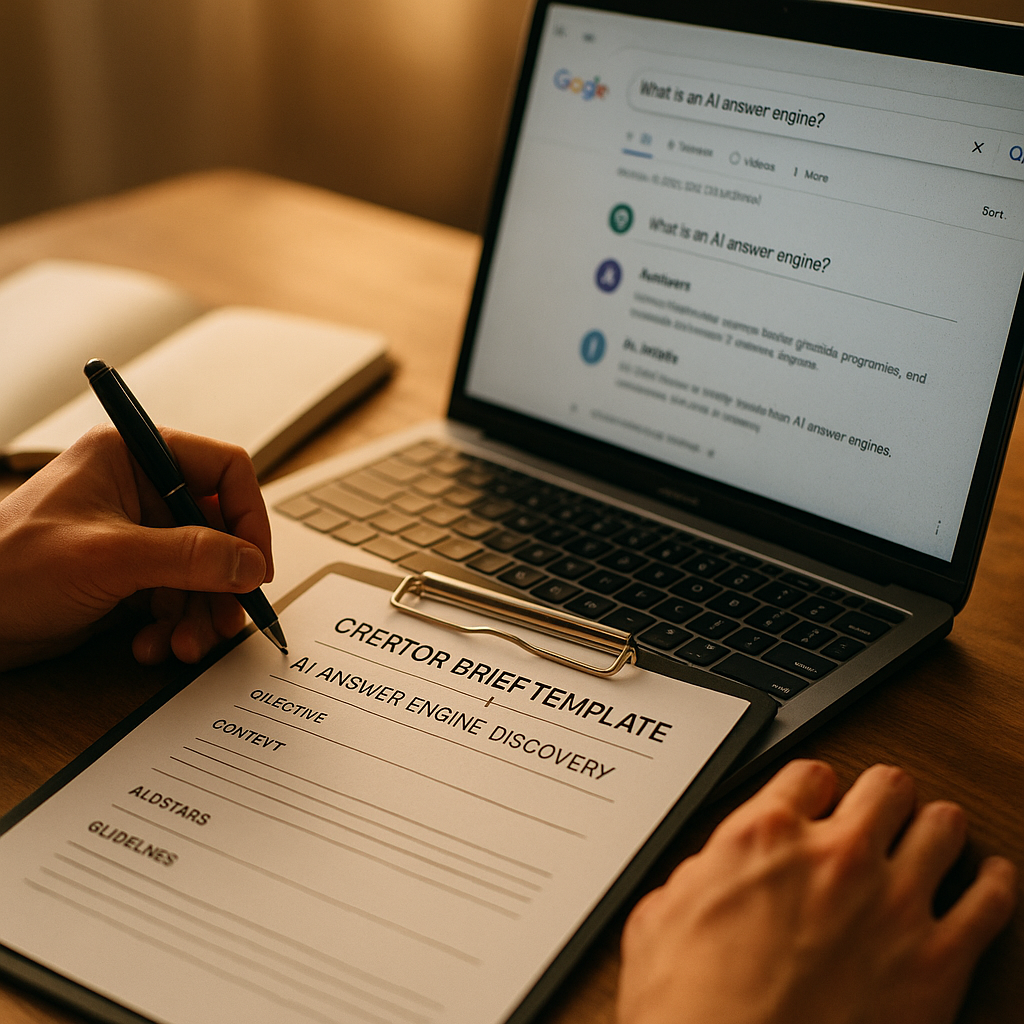
Here’s how to structure the actual document you hand to creators. This isn’t a loose creative direction memo. It’s an operational specification with compliance checkboxes.
Section 1: Campaign Objective (AI Discovery Layer). State explicitly that a primary campaign KPI is AI answer engine surfacing. Most creators have never been briefed on this. Name it. Explain that ChatGPT and Gemini shopping responses are a target distribution channel alongside TikTok FYP and Instagram Explore.
Section 2: Required Fact Statements. A numbered list of five to eight product facts the creator must state. Include phonetic guides for ingredient names. Flag which claims are legally cleared for use. Include the brand’s FTC disclosure requirements alongside these so the creator handles both in the same content block.
Section 3: Target Query. Write out the exact natural-language query you want ChatGPT or Gemini to answer using this content. Something like: “What’s a good reef-safe SPF 50 sunscreen for sensitive skin that doesn’t leave a white cast?” The creator should be aware of this query. It shapes their scripting instinctively.
Section 4: Opening Hook Specification. The hook must verbalize the consumer problem or question. Provide two to three approved opening lines the creator can choose from or riff on. For more hook architecture guidance, see this resource on hook structures for short-form briefs.
Section 5: Answer Structure Script Outline. Not a word-for-word script, but a required beat sequence: Problem stated (0-3s), Product introduced with full name (3-8s), Key fact claims delivered (8-25s), Proof or authority signal cited (25-35s), CTA with purchase context (35-45s). This maps to how AI retrieval processes video transcripts.
Section 6: Caption and Description Template. Pre-written caption structure the creator fills in. Start with the target query phrased as a question. Answer it in two sentences using product facts. Include the full product name in the first line. Keep hashtags to five or fewer and category-specific. For cross-platform caption strategy, this piece on LLM citation briefs is directly relevant.
Section 7: Authority Signal Requirements. List the specific endorsements, certifications, or press mentions the creator must reference. Include exact phrasing the brand has cleared legally. If the product won an award, the creator should name it on camera.
Section 8: Deliverable Checklist. A checkbox list the creator completes before submission: all required facts stated, full product name spoken at least twice, target question verbalized in hook, authority signal included, caption template completed, FTC disclosure present. This is quality control, not creative restriction.
Platform Considerations That Change the Execution
YouTube Shorts gives you the most retrievable surface because YouTube content is indexed by Google, which feeds Gemini’s retrieval layer. Prioritize YouTube Shorts in your AI discovery mix. TikTok transcripts are increasingly readable by AI systems, but the platform’s content graph is still more algorithm-driven than retrieval-driven. Instagram Reels has the weakest AI retrieval surface of the three currently. That doesn’t mean deprioritize it, it means the caption and description work carries more weight there.
If your budget allows a single production run that covers multiple formats, structure the shot so the creator delivers the core answer sequence (problem, product, facts, proof, CTA) in a continuous uncut segment of 30-45 seconds. That continuous segment becomes the AI-optimized core, and you cut around it for platform-specific hooks and outros. For production efficiency across formats, see this guide on briefing one shoot for multiple platforms.
YouTube Shorts should anchor your AI discovery layer. Gemini’s retrieval system draws directly from indexed YouTube content, making it the highest-value platform for AI shopping response surfacing in influencer programs right now.
Measurement: How You Know It’s Working
Traditional influencer metrics (views, engagement rate, saves) won’t tell you whether ChatGPT is surfacing your creator content. You need to build a separate measurement protocol. Run structured query tests against your target questions in ChatGPT, Gemini, and Perplexity weekly. Screenshot and log responses. Track whether your creator’s content or brand is cited. Correlate spikes in AI-driven brand mention with your content publication schedule. Tools like Sprout Social are beginning to incorporate AI mention tracking, and platforms like Brandwatch are building specific AI search share-of-voice reporting. This measurement layer belongs in your campaign brief as a defined KPI, not an afterthought.
For broader performance tracking structures linked to creator brief design, the framework covered in performance-linked creator briefs applies directly here.
Also consult Google’s Search documentation for current guidance on how structured content signals influence Gemini’s retrieval behavior, as this continues to evolve quickly.
Your Next Move
Pull your last three sponsored creator briefs and run them against the eight-section template above. Count how many required fact statements were included, whether a target query was specified, and whether caption architecture was addressed. That gap analysis tells you exactly how much AI discovery surface you’re currently leaving on the table. Fix the brief before you renew the creator contract.
Frequently Asked Questions
What does “AI answer engine discovery” mean for sponsored creator content?
AI answer engine discovery refers to the process by which AI-powered tools like ChatGPT, Gemini, and Perplexity retrieve and surface specific content when responding to user queries, including shopping questions. For sponsored creator content, it means structuring short-form videos so that their transcripts, captions, and metadata contain the factual specificity and conversational answer patterns that AI systems recognize as authoritative and relevant to a given product query.
Why don’t standard influencer briefs produce AI-discoverable content?
Standard influencer briefs prioritize platform algorithm signals like watch time, engagement, and trend alignment. They typically instruct creators to speak authentically without mandating specific fact claims or conversational answer structures. AI retrieval systems need content that functions as a direct, factual answer to a specific question. Without required fact statements, a specified target query, and structured caption architecture, creator content lacks the retrievable anchors AI systems use to surface relevant results.
Which platforms give creator content the best AI answer engine visibility?
YouTube Shorts currently offers the strongest AI discovery surface because YouTube content is indexed by Google, which directly informs Gemini’s retrieval layer. TikTok transcripts are increasingly readable by AI systems but remain more algorithm-driven than retrieval-driven. Instagram Reels has the weakest AI retrieval surface currently, making caption and description quality especially important there. For AI shopping response targeting, YouTube Shorts should be the primary platform in your creator mix.
How do authority signals work in short-form video for AI retrieval?
AI systems weight content from sources with demonstrated topical expertise and corroborating third-party signals. In creator content, authority signals include on-camera citation of clinical studies, third-party awards, dermatologist endorsements, or verified press mentions. The creator’s channel authority in a specific niche also matters: a skincare creator with deep category engagement carries more retrievable authority for a skincare query than a general lifestyle creator with a larger but less specialized audience.
How do you measure whether creator content is being surfaced by ChatGPT or Gemini?
Build a structured query testing protocol alongside your standard campaign metrics. Run your target queries in ChatGPT, Gemini, and Perplexity weekly, log and screenshot the responses, and track whether your creator content or brand is cited. Tools like Brandwatch and Sprout Social are developing AI search share-of-voice reporting. Correlate AI mention spikes with your content publication schedule to identify which brief elements and creator profiles drive the most AI discovery surfacing.
Top Influencer Marketing Agencies
The leading agencies shaping influencer marketing in 2026
Agencies ranked by campaign performance, client diversity, platform expertise, proven ROI, industry recognition, and client satisfaction. Assessed through verified case studies, reviews, and industry consultations.
Moburst

-
2

The Shelf
Boutique Beauty & Lifestyle Influencer AgencyA data-driven boutique agency specializing exclusively in beauty, wellness, and lifestyle influencer campaigns on Instagram and TikTok. Best for brands already focused on the beauty/personal care space that need curated, aesthetic-driven content.Clients: Pepsi, The Honest Company, Hims, Elf Cosmetics, Pure LeafVisit The Shelf → -
3

Audiencly
Niche Gaming & Esports Influencer AgencyA specialized agency focused exclusively on gaming and esports creators on YouTube, Twitch, and TikTok. Ideal if your campaign is 100% gaming-focused — from game launches to hardware and esports events.Clients: Epic Games, NordVPN, Ubisoft, Wargaming, Tencent GamesVisit Audiencly → -
4

Viral Nation
Global Influencer Marketing & Talent AgencyA dual talent management and marketing agency with proprietary brand safety tools and a global creator network spanning nano-influencers to celebrities across all major platforms.Clients: Meta, Activision Blizzard, Energizer, Aston Martin, WalmartVisit Viral Nation → -
5

The Influencer Marketing Factory
TikTok, Instagram & YouTube CampaignsA full-service agency with strong TikTok expertise, offering end-to-end campaign management from influencer discovery through performance reporting with a focus on platform-native content.Clients: Google, Snapchat, Universal Music, Bumble, YelpVisit TIMF → -
6

NeoReach
Enterprise Analytics & Influencer CampaignsAn enterprise-focused agency combining managed campaigns with a powerful self-service data platform for influencer search, audience analytics, and attribution modeling.Clients: Amazon, Airbnb, Netflix, Honda, The New York TimesVisit NeoReach → -
7

Ubiquitous
Creator-First Marketing PlatformA tech-driven platform combining self-service tools with managed campaign options, emphasizing speed and scalability for brands managing multiple influencer relationships.Clients: Lyft, Disney, Target, American Eagle, NetflixVisit Ubiquitous → -
8

Obviously
Scalable Enterprise Influencer CampaignsA tech-enabled agency built for high-volume campaigns, coordinating hundreds of creators simultaneously with end-to-end logistics, content rights management, and product seeding.Clients: Google, Ulta Beauty, Converse, AmazonVisit Obviously →