


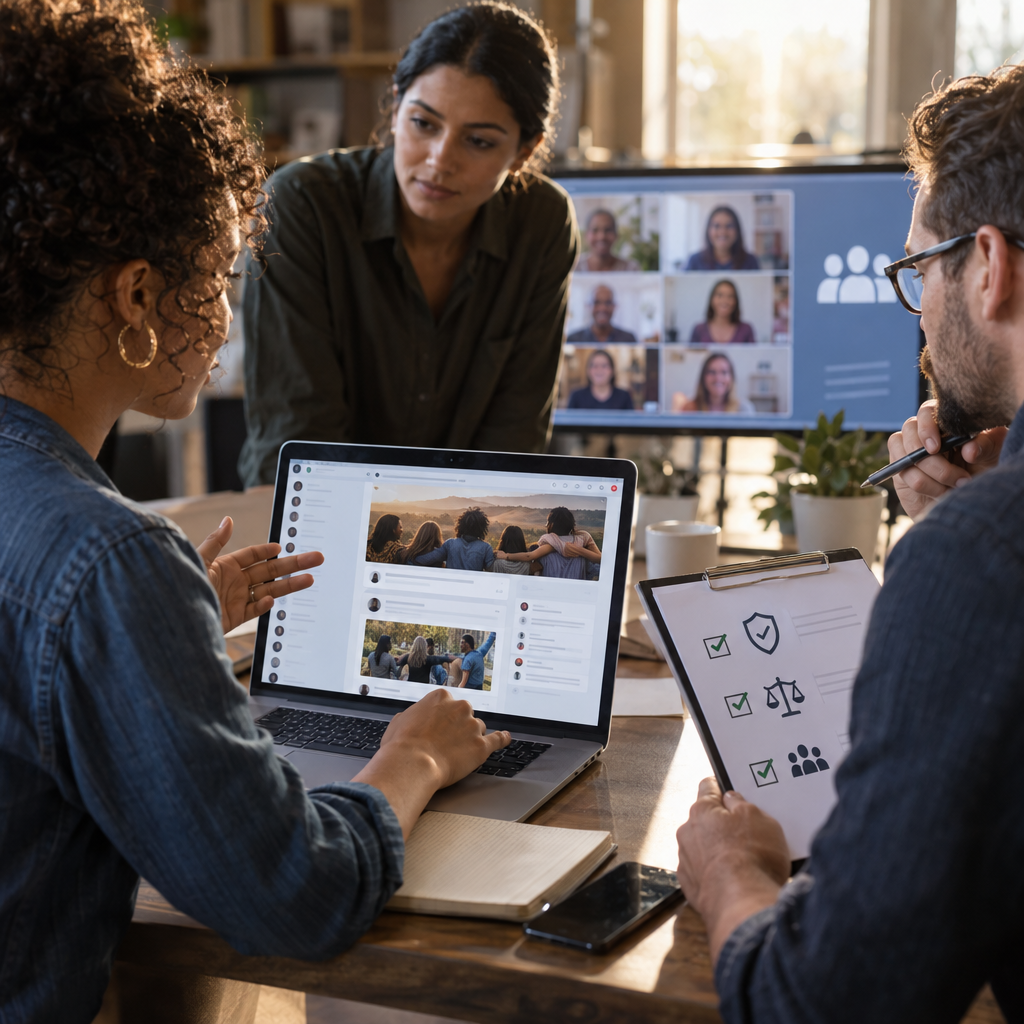
Facebook Pages now reach roughly 2 to 6 percent of their own followers organically. Meanwhile, almost 1.8 billion people use Facebook Groups every month, and that number keeps climbing while Page reach keeps shrinking. If your brand is still pouring budget into a Page and ignoring Groups, you’re optimizing for a channel that’s already dying.
For legacy brands sitting on decades of customer loyalty, that’s not a minor inefficiency. It’s a wasted asset. The brands getting this right aren’t running Groups like broadcast channels. They’re handing the mic to creators and superfans, then managing the risk from the back seat.
The Shift Nobody Put in the Strategy Deck
Groups weren’t supposed to be the comeback story. For years, Facebook Groups were the domain of local parenting forums, garage sale networks, and the occasional MLM pitch disguised as “support.” Then organic Page reach collapsed, and marketers went looking for anywhere people still talked to each other without an algorithm throttling the conversation.
Legacy brands have an advantage here that newer DTC upstarts don’t: decades of product loyalty baked into households. The question is whether that loyalty gets expressed in a space the brand controls, or in a dozen unofficial fan groups the brand doesn’t even know exist.
Cast iron cookware maker Lodge built its own branded Facebook Group specifically because superfan conversation was already happening in Groups the company couldn’t see, track, or participate in.
Lodge Cast Iron now maintains a community of 800,000 followers and 40,000 Group members, and the Group has become a direct line to product feedback that used to require formal research budgets. That’s the model: a legacy brand didn’t try to out-shout existing fan communities. It absorbed the function those communities were already serving.
Why “Creator-Led” Beats “Brand-Run” Every Time
Here’s the uncomfortable truth for brand marketers used to controlling the narrative: the Groups that actually work are rarely run like corporate content calendars. The admin matters more than the logo.
Look at how other established consumer brands have structured this. Instant Pot’s public Facebook Group has grown to roughly 3 million users swapping recipes, while Peloton runs a private group approaching half a million members. Neither group functions as a sales channel. They function as a hangout that happens to be sponsored.
Portland Leather Goods took it further with its “Insiders” community, which has grown to more than 122,000 members who post about their collections while brand admins handle updates on new drops. The brand shows up, but it doesn’t dominate. That’s the creator-led distinction: the brand funds and moderates the space, but the energy, the UGC, and the social proof come from the community itself.
For legacy brands used to top-down campaign control, this is a mindset shift as much as a tactical one. You’re not briefing a creator to produce content. You’re empowering a creator, or a cluster of engaged superfans, to run a room and letting the brand’s job shrink to moderation, insight-gathering, and the occasional perk drop.
What a Creator-Led Group Actually Requires
This isn’t a “set it and forget it” play. A Group with no active moderation turns into spam within weeks. A Group where the brand posts every day turns into a Page with extra steps. The functional model sits in between, and it requires real operational structure:
- A named community lead, whether that’s an internal community manager, an external creator, or a hybrid admin team that includes both.
- A content cadence that’s mostly prompts, not pitches: polls, AMAs, and member-generated threads instead of product push posts.
- A clear escalation path for when conversations drift into customer service, legal risk, or brand safety territory.
- A documented incentive structure for the creator or superfan admins, whether that’s early product access, a stipend, or a revenue-share arrangement.
That last point is where a lot of legacy brands stumble. Budgeting for a creator-led Group looks nothing like budgeting for a paid social campaign, and tiering those incentives by community size and engagement is a discipline brands have already had to build for other platforms. The tiered budget logic used for whitelisting programs translates directly here: pay more for admins managing larger, higher-engagement rooms, and treat smaller pilot groups as lower-cost tests before scaling spend.
The Compliance Question Legal Will Ask Anyway
If a creator is being compensated, directly or in product, to run or post in a brand-affiliated Group, that’s a material connection. Full stop. The FTC’s own guidance is unambiguous on this point: if you work with brands to recommend or endorse products, you need to comply with the law when making those recommendations, including a good disclosure of your relationship to the brand.
This gets murkier inside a Group than it does on a public feed, because the “endorsement” isn’t always a single post. It’s an ongoing presence, an admin role, a pinned welcome message. Brands running creator-led Groups need disclosure baked into the Group description, the admin’s pinned introduction, and any individual post where the admin is clearly steering members toward a purchase. Treat it the same way you’d treat a long-running ambassador relationship rather than a one-off sponsored post. If your legal team has already built a governance model for regulated ambassador programs, that same rigor around disclosure language, review cadence, and audit rights applies almost one-to-one. Brands in tightly regulated categories have already had to formalize this; the compliance playbook built for bank ambassador programs is a useful template even outside financial services.
Measuring Something Other Than Member Count
Member count is a vanity metric for Groups the same way follower count is for a Page. What actually matters: post frequency from members (not admins), response time to member questions, and the ratio of organic member-generated threads to brand-initiated ones. A Group with 5,000 highly active members generating daily feedback is worth more to a legacy brand’s product and insights team than a Group with 50,000 members and a dead feed.
Tie this back to the same ROI discipline you’d apply to any owned-audience channel. Brands that have had to defend creator-hub spend internally have already built the measurement frameworks for this kind of shift, and the reach-shift measurement approach used for creator hub programs maps well onto Groups: track distribution quality over raw reach, and weight engagement from your target customer segment over total volume.
Budget allocation deserves the same scrutiny. If you’re piloting a creator-led Group as a new owned-community channel, benchmark the spend against other emerging creator monetization formats rather than against legacy Page advertising. The budget allocation logic for creator monetization programs and the subreddit pilot framework for testing community spend both offer useful comparison points for staging a Facebook Group investment: start small, validate engagement quality, then scale the admin incentive once retention proves out.
Where This Goes Wrong
The most common failure mode isn’t under-investment. It’s over-control. A legacy brand hands a creator admin rights, then insists on approving every post, every poll, every reply. That kills the exact dynamic that made the Group valuable in the first place. Members join Groups to avoid talking to a corporate account. If the corporate account is quietly rewriting every admin post, members notice, and engagement cratering follows within a quarter.
The second failure mode is treating the Group as a dumping ground for the same promotional content already running on the Page and in paid social. Groups reward restraint. The brands winning here post rarely and prompt often.
The Next Move
Pick one existing fan community already talking about your brand in an unofficial Facebook Group, identify its most active unpaid admin, and offer that person a formal, disclosed partnership to co-run an official brand Group before a competitor does it first.
FAQs
Do Facebook Groups still matter for brands when Meta keeps pushing Reels and video?
Yes. Video distribution and community distribution serve different goals. Reels drive discovery and reach; Groups drive retention, feedback, and advocacy among people who already know the brand. Legacy brands sitting on existing customer bases generally get more long-term value from a well-run Group than from chasing another short-form video trend.
Can a brand legally pay a creator to run its Facebook Group?
Yes, but the arrangement is a material connection under FTC rules and must be disclosed clearly within the Group itself, not buried in a bio or terms page. Treat it like any paid ambassador relationship: documented disclosure language, consistent placement, and periodic audits of compliance.
How big does a Facebook Group need to be before it’s worth a brand’s investment?
Size matters less than activity. A smaller, highly engaged Group focused on a specific product line or customer segment typically delivers better insight and advocacy value than a larger, passive one. Start with a pilot cohort of your most engaged existing customers rather than trying to recruit broadly from day one.
Should the brand’s own social team be the Group admin, or should it be an outside creator?
Both models work, and many successful brand Groups use a hybrid: an internal community manager handling moderation and escalation, paired with one or more creator or superfan co-admins who generate the day-to-day conversation. The internal team provides governance; the creator provides authenticity.
What’s the biggest risk in letting a creator run a brand-affiliated community?
Off-brand or non-compliant commentary happening at scale before anyone on the brand side notices. Mitigate it with a clear escalation protocol, documented content guidelines for the admin, and routine audits of pinned posts and recurring threads, the same oversight structure used in regulated ambassador programs.
Top Influencer Marketing Agencies
The leading agencies shaping influencer marketing in 2026
Agencies ranked by campaign performance, client diversity, platform expertise, proven ROI, industry recognition, and client satisfaction. Assessed through verified case studies, reviews, and industry consultations.
Moburst

-
2

The Shelf
Boutique Beauty & Lifestyle Influencer AgencyA data-driven boutique agency specializing exclusively in beauty, wellness, and lifestyle influencer campaigns on Instagram and TikTok. Best for brands already focused on the beauty/personal care space that need curated, aesthetic-driven content.Clients: Pepsi, The Honest Company, Hims, Elf Cosmetics, Pure LeafVisit The Shelf → -
3

Audiencly
Niche Gaming & Esports Influencer AgencyA specialized agency focused exclusively on gaming and esports creators on YouTube, Twitch, and TikTok. Ideal if your campaign is 100% gaming-focused — from game launches to hardware and esports events.Clients: Epic Games, NordVPN, Ubisoft, Wargaming, Tencent GamesVisit Audiencly → -
4

Viral Nation
Global Influencer Marketing & Talent AgencyA dual talent management and marketing agency with proprietary brand safety tools and a global creator network spanning nano-influencers to celebrities across all major platforms.Clients: Meta, Activision Blizzard, Energizer, Aston Martin, WalmartVisit Viral Nation → -
5

The Influencer Marketing Factory
TikTok, Instagram & YouTube CampaignsA full-service agency with strong TikTok expertise, offering end-to-end campaign management from influencer discovery through performance reporting with a focus on platform-native content.Clients: Google, Snapchat, Universal Music, Bumble, YelpVisit TIMF → -
6

NeoReach
Enterprise Analytics & Influencer CampaignsAn enterprise-focused agency combining managed campaigns with a powerful self-service data platform for influencer search, audience analytics, and attribution modeling.Clients: Amazon, Airbnb, Netflix, Honda, The New York TimesVisit NeoReach → -
7

Ubiquitous
Creator-First Marketing PlatformA tech-driven platform combining self-service tools with managed campaign options, emphasizing speed and scalability for brands managing multiple influencer relationships.Clients: Lyft, Disney, Target, American Eagle, NetflixVisit Ubiquitous → -
8

Obviously
Scalable Enterprise Influencer CampaignsA tech-enabled agency built for high-volume campaigns, coordinating hundreds of creators simultaneously with end-to-end logistics, content rights management, and product seeding.Clients: Google, Ulta Beauty, Converse, AmazonVisit Obviously →