


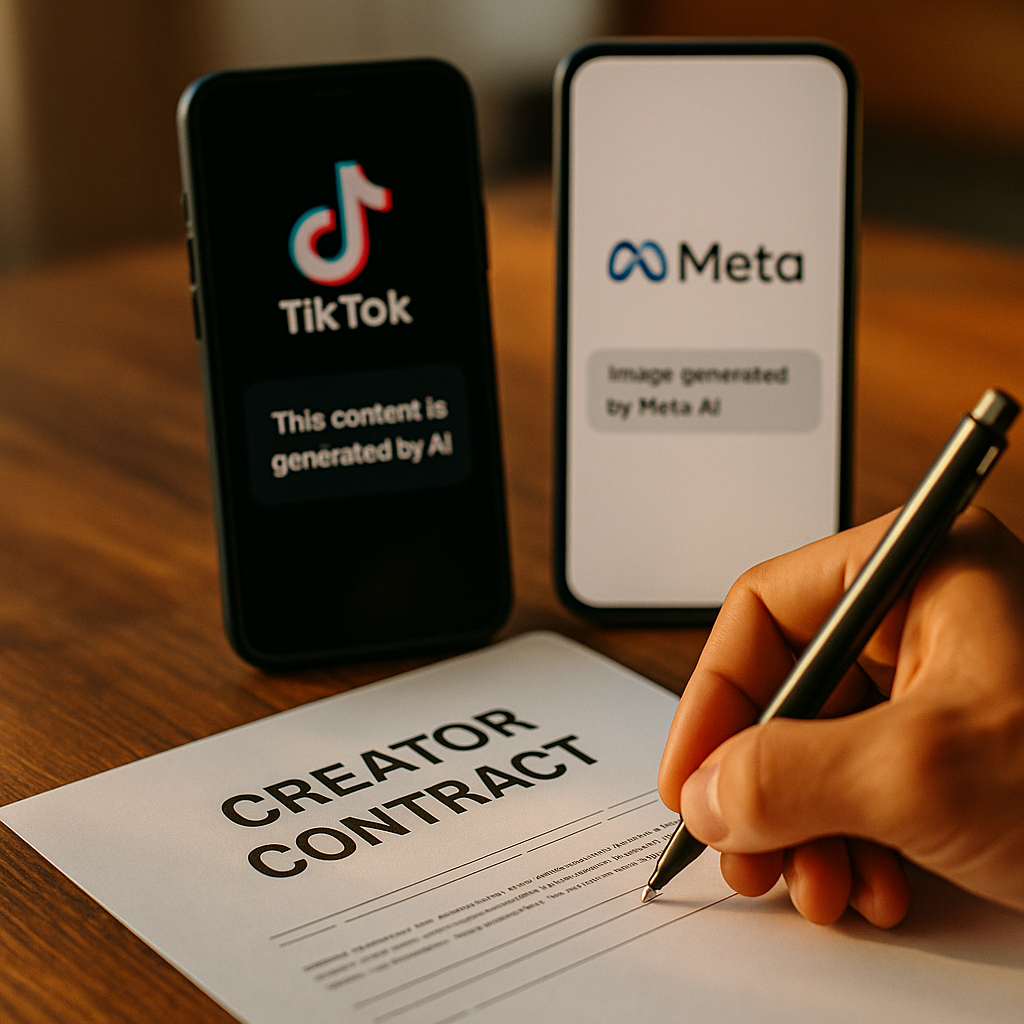
Two platforms just rewrote the rules on synthetic media, and most brand-creator contracts are still written for a world that no longer exists. TikTok and Meta have both rolled out mandatory AI disclosure infrastructure — automated detection, standing labels, and metadata requirements that apply whether a creator opts in or not. If your creator contracts don’t address creator contracts for TikTok and Meta AI disclosure obligations, you’re carrying risk you didn’t know you signed up for.
The uncomfortable truth: platform-level labeling doesn’t replace your legal exposure. It just makes the gaps more visible.
What Changed, and Why Your Old Templates Won’t Cut It
TikTok now applies AI-generated labels automatically when it detects synthetic media, and it also requires creators to self-disclose using built-in tools when they upload AI-assisted content. Meta has rolled out a similar dual-track system across Instagram and Facebook, layering “AI Info” labels onto content that trips its detection models or carries C2PA metadata. Neither system asks permission. Neither waits for a brand’s sign-off.
That’s the shift. Disclosure used to be something brands negotiated into a contract as a nice-to-have compliance clause, often copied wholesale from an FTC boilerplate template. Now it’s infrastructure. The platform decides what gets labeled, when, and how prominently, based on detection models and metadata standards that are frequently updated without much notice. Brands who haven’t read the fine print on TikTok’s AI-generated label rules or Meta’s AI disclosure menu are going to get surprised by a label appearing on paid content they never flagged as synthetic.
Platform detection systems don’t care whose fault the mislabeling was. They just apply the label — and your brand’s name is still on the post.
This matters more than it sounds. A slapped-on “AI Info” tag on a product demo can shift consumer perception of authenticity instantly, and if that tag appears because a creator used an AI voice cleanup tool they never disclosed to you, you’re now explaining a compliance gap to legal with zero paper trail.
The Contract Gap Nobody’s Closing
Most influencer agreements still treat AI disclosure as a single boilerplate line: “Creator agrees to comply with all applicable platform disclosure requirements.” That sentence used to be enough. It isn’t anymore, for three reasons.
- Detection is retroactive. TikTok and Meta can apply labels after publication, based on later model updates or user reports. Your contract needs to define who owns the response when that happens — not just who owns the upload.
- Self-disclosure and platform detection can conflict. A creator might tag content as “not AI-generated” while the platform’s classifier flags it anyway. That contradiction becomes a brand safety headache, and most contracts don’t say who resolves it.
- Tool-level AI use is often invisible to brands. Voice enhancement, background generation, auto-captioning with synthetic voiceover — these are AI-assisted edits creators make routinely, often without realizing they trigger disclosure thresholds.
None of this is theoretical. Brands running multi-creator campaigns are already seeing inconsistent labeling across the same campaign, some assets tagged, others not, because creators used different editing stacks. That inconsistency is a legal liability multiplier, not just a UX quirk.
Five Clauses to Add Before Your Next Campaign Cycle
If you’re revising creator agreements this quarter, here’s where to start. These aren’t theoretical additions — they map directly to how TikTok and Meta’s systems actually behave.
- AI-use disclosure at the point of contracting, not just at publication. Require creators to declare, before content is created, whether they intend to use AI tools for voice, image, script, or editing. Retrofit disclosures after the fact are unreliable.
- A defined response protocol for post-publication labeling. Specify who edits captions, who contacts the platform for a label review, and what the turnaround time is. Thirty minutes of ambiguity here can turn into a week of brand safety scrambling.
- Metadata compliance requirements. If a creator’s editing software supports C2PA content credentials, require it to be preserved through export. Many creators strip metadata unintentionally when compressing files for upload.
- Indemnification tied specifically to non-disclosure, not general platform violations. Generic “creator indemnifies brand for platform violations” language is too broad to enforce cleanly. Tie it to the specific act of failing to disclose AI use when required.
- Audit rights over creator tool stacks. This sounds aggressive, but it’s increasingly standard in multi-creator network deals. If a creator uses an AI dubbing tool or synthetic voice clone, brands need visibility into that before the content goes live, not after a regulator asks.
This isn’t about micromanaging creative process. It’s about making sure the paper trail exists when TikTok’s classifier or Meta’s detection model does what it’s designed to do: label things automatically, without asking either party first.
Where This Intersects With FTC Exposure
Platform labeling and federal disclosure law are related but not identical. The FTC’s Section 5 authority still applies to deceptive or unfair practices regardless of what label TikTok or Meta slaps on a post. A brand can be platform-compliant and still face an FTC inquiry if the underlying disclosure was inadequate or misleading to consumers.
That’s why contracts written purely around platform mechanics tend to underperform legally. The strongest agreements treat platform labels as one layer in a stack that also includes FTC-compliant disclosure language, state-level advertising rules, and increasingly, state AG scrutiny of platform practices themselves. Brands that have been tracking state AG lawsuits against Meta already know regulators are treating platform infrastructure as evidence, not just a compliance shield. If your contract only references platform rules and not the underlying FTC standard, you’ve built a structure with a hole in the foundation.
The same logic applies to TikTok Shop and social commerce specifically, where AI-generated product demos and synthetic reviews carry heightened scrutiny. Reviewing your FTC AI disclosure rules for TikTok Shop alongside your general creator contract template will reveal gaps most legal teams miss on first pass.
Multi-Creator Campaigns Make This Exponentially Harder
Single-creator deals are manageable. Multi-creator network campaigns are where this gets genuinely difficult. If you’re running twenty creators across a campaign, each with different editing habits and different comfort levels with AI tools, you’re managing twenty separate disclosure risk profiles simultaneously.
Standardizing this requires network-level contract language, not creator-by-creator negotiation. That means building disclosure and AI-use standards into your master services agreement with the network or agency, then flowing those terms down to individual creator riders. Brands already doing this well have borrowed structure from multi-creator network contract frameworks that were originally built for attribution and revenue share, then adapted the same centralized-compliance logic for AI disclosure.
A campaign with twenty creators isn’t one compliance risk — it’s twenty, running in parallel, each capable of triggering a platform label independently.
Multilingual campaigns add another layer entirely. AI dubbing and translation tools are common in cross-border creator work, and both TikTok and Meta’s detection systems don’t always distinguish between synthetic translation and misleading synthetic content. If you’re running international campaigns, your multilingual creator contract terms need explicit language covering AI-assisted dubbing disclosure, since a label applied in one market can create reputational spillover in others.
What Brands Are Actually Doing Right Now
Talk to compliance leads at agencies handling large creator rosters and a pattern emerges. The ones ahead of this aren’t waiting for legal to draft perfect language. They’re running quarterly contract audits specifically targeting AI disclosure clauses, treating it the same way they’d treat a data privacy addendum refresh.
Some are borrowing from adjacent frameworks that already solved similar coordination problems, like the audit structures used for Google’s AI ad disclosure rules, which forced advertisers to build documentation workflows for AI-generated ad creative well before TikTok and Meta caught up on the creator side. Others are pulling from the broader AI social commerce compliance stack that already accounts for FTC, state law, and platform requirements simultaneously, rather than treating each as a separate checklist.
According to industry benchmarking from eMarketer, AI-assisted content creation among creators has grown fast enough that platform detection infrastructure is now playing catch-up rather than getting ahead of usage. That gap is exactly where contract risk lives. Brands relying on Sprout Social or similar social listening tools to monitor labeling inconsistencies across campaigns are finding real value, but tooling alone doesn’t fix contracts that were never built for this.
The Practical Next Step
Don’t wait for a mislabeled post to force the issue. Pull your current creator contract template this week, check whether it addresses pre-publication AI-use disclosure, post-publication label response, and metadata preservation, and if it’s silent on any of the three, that’s your first fix before your next campaign brief goes out.
Frequently Asked Questions
Do brands need to update every existing creator contract immediately?
Not retroactively for content already published, but any contract being renewed or any new campaign brief going out should include updated AI disclosure clauses. Prioritize high-visibility campaigns and multi-creator deals first, since they carry the most compliance surface area.
What happens if a platform labels content as AI-generated but the creator disagrees?
This is exactly why contracts need a defined dispute and response protocol. Without one, brands are left negotiating in real time during a live campaign, which is the worst possible moment to figure out who’s responsible for contacting the platform or editing captions.
Does platform-level AI labeling satisfy FTC disclosure requirements?
No. Platform labels and FTC disclosure obligations are separate, though related, requirements. A post can carry a compliant platform label and still fail FTC standards if the underlying disclosure isn’t clear and conspicuous to the average consumer.
How should brands handle AI disclosure across multi-creator or multilingual campaigns?
Build standardized AI-use and disclosure language into the master agreement with the network or agency, then flow it down to individual creator riders rather than negotiating terms creator-by-creator. This keeps disclosure consistent across markets and languages.
What’s the biggest mistake brands make with AI disclosure contract language?
Treating it as one generic boilerplate clause referencing “platform compliance” instead of specifying pre-publication disclosure, post-publication response protocols, metadata handling, and indemnification tied specifically to AI non-disclosure.
Top Influencer Marketing Agencies
The leading agencies shaping influencer marketing in 2026
Agencies ranked by campaign performance, client diversity, platform expertise, proven ROI, industry recognition, and client satisfaction. Assessed through verified case studies, reviews, and industry consultations.
Moburst

-
2

The Shelf
Boutique Beauty & Lifestyle Influencer AgencyA data-driven boutique agency specializing exclusively in beauty, wellness, and lifestyle influencer campaigns on Instagram and TikTok. Best for brands already focused on the beauty/personal care space that need curated, aesthetic-driven content.Clients: Pepsi, The Honest Company, Hims, Elf Cosmetics, Pure LeafVisit The Shelf → -
3

Audiencly
Niche Gaming & Esports Influencer AgencyA specialized agency focused exclusively on gaming and esports creators on YouTube, Twitch, and TikTok. Ideal if your campaign is 100% gaming-focused — from game launches to hardware and esports events.Clients: Epic Games, NordVPN, Ubisoft, Wargaming, Tencent GamesVisit Audiencly → -
4

Viral Nation
Global Influencer Marketing & Talent AgencyA dual talent management and marketing agency with proprietary brand safety tools and a global creator network spanning nano-influencers to celebrities across all major platforms.Clients: Meta, Activision Blizzard, Energizer, Aston Martin, WalmartVisit Viral Nation → -
5

The Influencer Marketing Factory
TikTok, Instagram & YouTube CampaignsA full-service agency with strong TikTok expertise, offering end-to-end campaign management from influencer discovery through performance reporting with a focus on platform-native content.Clients: Google, Snapchat, Universal Music, Bumble, YelpVisit TIMF → -
6

NeoReach
Enterprise Analytics & Influencer CampaignsAn enterprise-focused agency combining managed campaigns with a powerful self-service data platform for influencer search, audience analytics, and attribution modeling.Clients: Amazon, Airbnb, Netflix, Honda, The New York TimesVisit NeoReach → -
7

Ubiquitous
Creator-First Marketing PlatformA tech-driven platform combining self-service tools with managed campaign options, emphasizing speed and scalability for brands managing multiple influencer relationships.Clients: Lyft, Disney, Target, American Eagle, NetflixVisit Ubiquitous → -
8

Obviously
Scalable Enterprise Influencer CampaignsA tech-enabled agency built for high-volume campaigns, coordinating hundreds of creators simultaneously with end-to-end logistics, content rights management, and product seeding.Clients: Google, Ulta Beauty, Converse, AmazonVisit Obviously →