


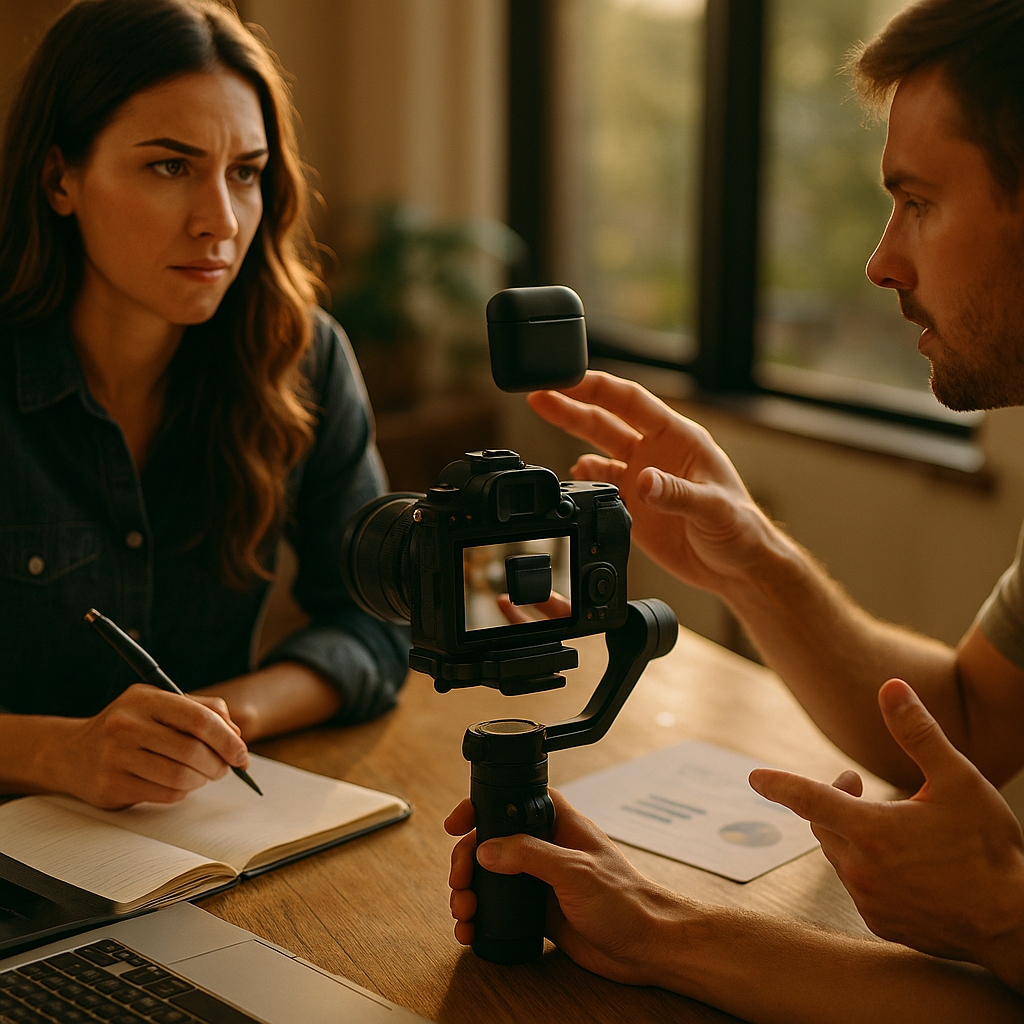
Scroll-stopping isn’t the same as sales-driving. But brands running slow-motion product reveal creative are seeing both: engagement rates climbing past 8% on some platforms while a $12 candle suddenly looks like it belongs in a luxury boutique. The technique is simple. The payoff is not.
Why does dragging out a three-second unboxing into eight cinematic seconds work so well? Because slowing time signals value. Our brains associate deliberate pacing with craftsmanship, rarity, ceremony. Marketers have known this since the days of perfume commercials shot on film. What’s changed is who can access the technique, and how cheaply.
The Psychology Behind the Slow Reveal
Humans process fast-moving footage as disposable. Fast food ads, discount retail spots, clearance sales — they all move quickly because urgency sells at the bottom of the funnel. Slow motion does the opposite. It tells the viewer: this moment deserves your attention. That’s why jewelry, spirits, and skincare brands have used slow-motion pours and macro close-ups for decades.
The shift now is that this technique has migrated from $50,000 TV production budgets to $500 creator briefs shot on an iPhone with a gimbal. Creators are learning to replicate high-end commercial pacing using consumer gear, and brands are capitalizing on it to reposition ordinary SKUs as premium objects.
Slow motion doesn’t just show a product — it performs a ritual around it. That ritual is what makes a $9 SKU feel like a $90 experience.
Consider a protein powder brand. Filmed at normal speed, a scoop dropping into a shaker bottle is unremarkable. Filmed at 120fps with backlighting and a shallow depth of field, that same scoop becomes a small event. The product hasn’t changed. The perceived value has.
What Actually Makes the Shot Work
Not every slow-motion clip lands. Plenty look like a filter slapped onto a dull demo. The difference between forgettable and aspirational usually comes down to five production choices:
- Frame rate discipline: 120fps to 240fps for true slow motion; anything less looks like a stutter, not a stylistic choice.
- Light quality over quantity: Diffused, directional light (think window light at a 45-degree angle) creates the texture that makes slow motion worth watching.
- Micro-movement, not macro-action: A cap unscrewing, condensation forming, powder settling — small physical events read better in slow motion than big gestures.
- Sound design in post: A satisfying click, hiss, or pour sound, even if resynced afterward, does as much work as the visual.
- A clean payoff moment: The reveal needs an endpoint — product fully visible, label readable, no ambiguity about what’s being sold.
This is exactly the kind of granular brief detail brands often skip, then wonder why the creator’s version looks amateurish. If you want a tactical, shot-by-shot framework for this, our companion piece on briefing the shot and payoff breaks down exactly how to spec this for a creator who isn’t a trained DP.
Why Brands Are Shifting Budget Here
Short-form video ad spend keeps climbing, and platforms are rewarding watch-time and completion rate more than raw impressions. eMarketer data has repeatedly shown that short-form video now commands the largest share of social ad budgets among marketers under 45, and creative quality is the differentiator once budgets get there. A slow-motion reveal, done well, increases average watch time simply because the pacing forces the viewer to stay on the moment a beat longer than a jump-cut edit would.
There’s also a compliance and brand-safety angle marketers underrate. Slow-motion reveal content is, by nature, low-claim. You’re not making performance statements, you’re not saying “clinically proven” or “guaranteed results.” You’re showing a product exist beautifully in space. That’s a lower-risk creative format from an FTC disclosure standpoint compared to testimonial or before-and-after formats, which require more careful substantiation. If you’re building a content mix that balances aspirational visuals with performance claims, it’s worth comparing this format against something like our guide to before-and-after briefs, which carries different compliance weight entirely.
Everyday Items, Elevated: What’s Actually Working
Categories that had no business feeling “luxury” are now leaning hard into cinematic pacing:
- Grocery and CPG: Brands like olive oil, coffee, and condiment companies are shooting pour shots in slow motion to imply quality and origin.
- Office supplies and stationery: Pen clicks, notebook page turns, and highlighter strokes get the ASMR-meets-slow-motion treatment.
- Cleaning products: Spray mist suspended mid-air, suds forming, a cloth wiping a surface clean in one continuous slow arc.
- Pet products: Kibble dropping into a bowl, a leash clip snapping shut — small, ordinary moments reframed as ritual.
None of these categories are inherently glamorous. That’s the point. Slow motion is a repositioning tool, not just a visual style. It tells the audience this item is worth pausing for, regardless of price point.
This overlaps closely with the ASMR trend, and honestly the two formats are converging. If you’re briefing sensory-first content already, it’s worth reading our breakdown on ASMR product demos alongside this piece, since many of the same lighting and sound principles apply.
The Brief Is Where This Usually Falls Apart
Here’s the uncomfortable truth: most creators can shoot beautiful slow-motion footage. Very few can shoot it on brief without direction. Give a creator a vague instruction like “make it feel premium” and you’ll get wildly inconsistent results — some cinematic, some just slowed-down normal footage that looks laggy.
What works instead is treating the reveal like a three-act structure, even if it’s only six seconds long:
- Anticipation: A hand approaching the product, a box lid lifting, a cap turning — the setup.
- The moment: The actual reveal, slowed to the point where texture and detail become visible.
- The payoff: Product in full view, ideally with a label or logo moment that isn’t jarring or overly branded.
Skipping any of these three beats is usually why a slow-motion clip feels flat. Anticipation without payoff feels like a tease with no reward. Payoff without anticipation feels abrupt, like the video started mid-thought.
A slow-motion reveal without a clear three-act structure is just a slowed-down video. The structure is what turns it into a reveal.
Where This Fits in a Broader Content Strategy
Slow-motion reveals aren’t a standalone strategy. They’re one format in a taxonomy that should include product-as-character storytelling, day-in-the-life integration, and comparison-driven trust content. If you’re mapping out format mix and budget allocation across a quarter, our format taxonomy and budget guide is a useful reference point for where reveal content should sit relative to spend on other formats.
It also pairs surprisingly well with product-as-character approaches, where the item itself becomes a recurring “personality” across a creator’s content calendar. Our piece on product-as-character content covers how to keep that consistent without it feeling gimmicky, and slow-motion reveals often serve as the “hero” moment within that broader arc.
Platforms are also increasingly favoring longer watch-through on Reels and TikTok, and Sprout Social research on short-form engagement patterns consistently shows completion rate as one of the stronger predictors of algorithmic reach. A well-paced reveal, with its built-in anticipation-payoff structure, is almost engineered to hold attention through to the end card.
Measuring Whether It’s Actually Working
Vanity metrics won’t tell you if the aspirational repositioning is landing. Track these instead:
- Completion rate against your account or category benchmark, not just views.
- Save and share rate, which tends to spike on aesthetically driven content more than on direct-response creative.
- Comment sentiment — are people commenting on the product itself, or on the cinematography? Both are useful signals, but they tell you different things about what’s resonating.
- Downstream conversion lift on retargeted audiences who saw the reveal content versus a control group who didn’t.
If completion rate is high but conversion lift is flat, you’ve made something beautiful but not persuasive. That’s a signal to tighten the payoff frame, add a clearer product benefit callout, or test a stronger CTA overlay without ruining the aesthetic.
FAQs
Frequently Asked Questions
What frame rate should brands request for slow-motion product reveals?
Most brands should brief creators for 120fps to 240fps capture, then let editors slow the footage to roughly 25-50% of original speed in post. Anything below 120fps often looks choppy rather than cinematic once slowed down.
Does slow-motion content work for low-cost, everyday products?
Yes, and arguably it works better there. Premium products already carry aspirational cues. Everyday items — cleaning supplies, snacks, office goods — benefit more from the repositioning effect because the format does the heavy lifting the price point can’t.
How long should a slow-motion reveal clip be?
Most effective reveals run between five and twelve seconds. Longer than that and you risk losing viewers before the payoff, especially on TikTok and Reels where average watch time is short.
Is slow-motion reveal content compliant with FTC disclosure rules?
The format itself carries lower compliance risk since it typically avoids performance claims, but standard influencer disclosure rules still apply if the content is sponsored. Always confirm creators are following current FTC guidance on clear and conspicuous disclosure.
Can this format be shot on a smartphone, or does it require professional equipment?
Modern smartphones handle 120fps to 240fps slow motion well enough for social feeds. A basic gimbal, a diffused light source, and attention to composition matter more than expensive camera gear for this specific format.
Frequently Asked Questions
What frame rate should brands request for slow-motion product reveals?
Most brands should brief creators for 120fps to 240fps capture, then let editors slow the footage to roughly 25-50% of original speed in post. Anything below 120fps often looks choppy rather than cinematic once slowed down.
Does slow-motion content work for low-cost, everyday products?
Yes, and arguably it works better there. Premium products already carry aspirational cues. Everyday items — cleaning supplies, snacks, office goods — benefit more from the repositioning effect because the format does the heavy lifting the price point can’t.
How long should a slow-motion reveal clip be?
Most effective reveals run between five and twelve seconds. Longer than that and you risk losing viewers before the payoff, especially on TikTok and Reels where average watch time is short.
Is slow-motion reveal content compliant with FTC disclosure rules?
The format itself carries lower compliance risk since it typically avoids performance claims, but standard influencer disclosure rules still apply if the content is sponsored. Always confirm creators are following current FTC guidance on clear and conspicuous disclosure.
Can this format be shot on a smartphone, or does it require professional equipment?
Modern smartphones handle 120fps to 240fps slow motion well enough for social feeds. A basic gimbal, a diffused light source, and attention to composition matter more than expensive camera gear for this specific format.
The next brief you write should treat the slow-motion reveal as a three-act structure, not a filter. Nail anticipation, moment, and payoff, and even your least glamorous SKU starts looking like something worth wanting.
Top Influencer Marketing Agencies
The leading agencies shaping influencer marketing in 2026
Agencies ranked by campaign performance, client diversity, platform expertise, proven ROI, industry recognition, and client satisfaction. Assessed through verified case studies, reviews, and industry consultations.
Moburst

-
2

The Shelf
Boutique Beauty & Lifestyle Influencer AgencyA data-driven boutique agency specializing exclusively in beauty, wellness, and lifestyle influencer campaigns on Instagram and TikTok. Best for brands already focused on the beauty/personal care space that need curated, aesthetic-driven content.Clients: Pepsi, The Honest Company, Hims, Elf Cosmetics, Pure LeafVisit The Shelf → -
3

Audiencly
Niche Gaming & Esports Influencer AgencyA specialized agency focused exclusively on gaming and esports creators on YouTube, Twitch, and TikTok. Ideal if your campaign is 100% gaming-focused — from game launches to hardware and esports events.Clients: Epic Games, NordVPN, Ubisoft, Wargaming, Tencent GamesVisit Audiencly → -
4

Viral Nation
Global Influencer Marketing & Talent AgencyA dual talent management and marketing agency with proprietary brand safety tools and a global creator network spanning nano-influencers to celebrities across all major platforms.Clients: Meta, Activision Blizzard, Energizer, Aston Martin, WalmartVisit Viral Nation → -
5

The Influencer Marketing Factory
TikTok, Instagram & YouTube CampaignsA full-service agency with strong TikTok expertise, offering end-to-end campaign management from influencer discovery through performance reporting with a focus on platform-native content.Clients: Google, Snapchat, Universal Music, Bumble, YelpVisit TIMF → -
6

NeoReach
Enterprise Analytics & Influencer CampaignsAn enterprise-focused agency combining managed campaigns with a powerful self-service data platform for influencer search, audience analytics, and attribution modeling.Clients: Amazon, Airbnb, Netflix, Honda, The New York TimesVisit NeoReach → -
7

Ubiquitous
Creator-First Marketing PlatformA tech-driven platform combining self-service tools with managed campaign options, emphasizing speed and scalability for brands managing multiple influencer relationships.Clients: Lyft, Disney, Target, American Eagle, NetflixVisit Ubiquitous → -
8

Obviously
Scalable Enterprise Influencer CampaignsA tech-enabled agency built for high-volume campaigns, coordinating hundreds of creators simultaneously with end-to-end logistics, content rights management, and product seeding.Clients: Google, Ulta Beauty, Converse, AmazonVisit Obviously →