


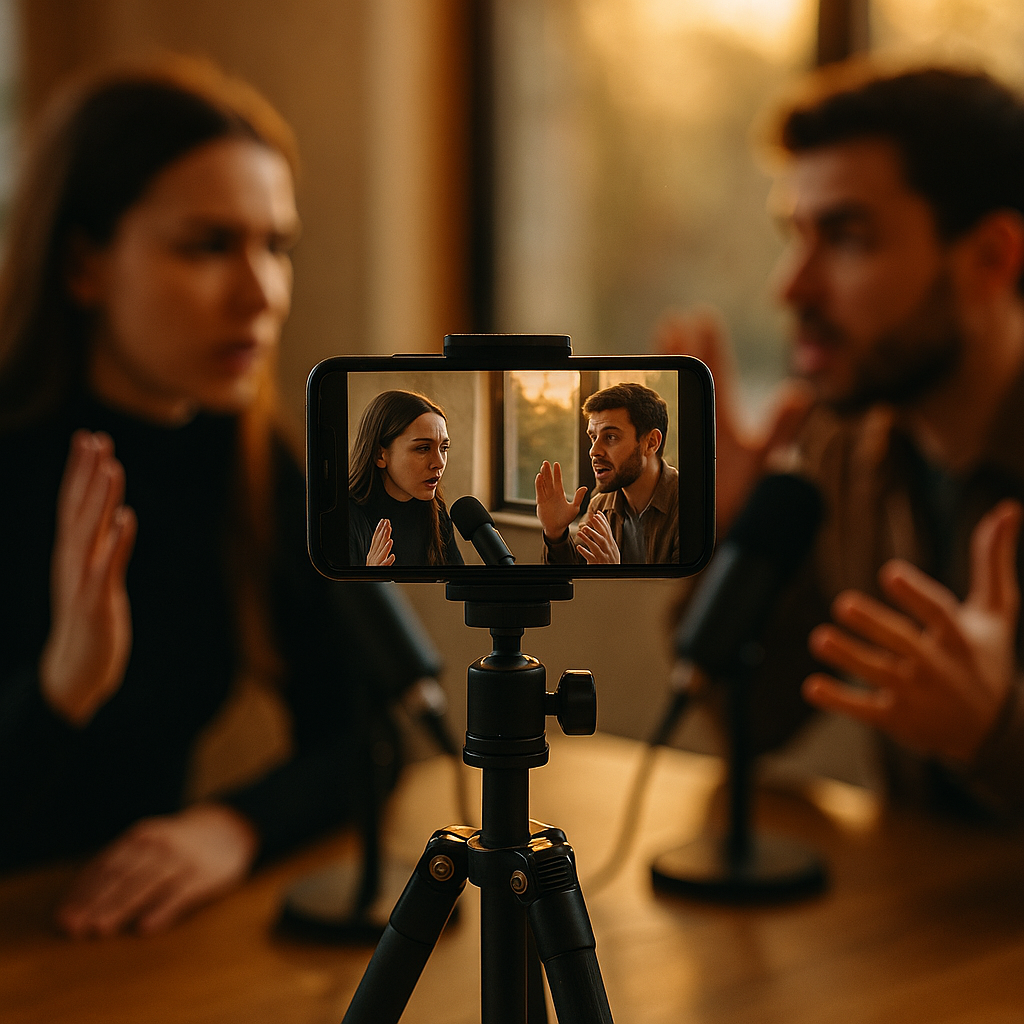
Audiences trust creators 63% more than brands, according to Edelman’s trust research — but they trust an argument even more than a recommendation. The two-creator debate format is quietly becoming the highest-converting content structure nobody’s briefing correctly. Get the setup wrong, and it reads like a courtroom skit. Get it right, and it feels like eavesdropping on the truth.
Why Disagreement Sells Better Than Agreement
Single-creator reviews have a credibility ceiling. The audience knows the video exists because a brand paid for it, and no amount of “honestly, I love this” changes that math. Two creators disagreeing on camera resets the frame entirely. Suddenly there’s tension, stakes, a reason to keep watching past the hook.
This isn’t new psychology. It’s the same reason debate shows outperform panel discussions, and why courtroom dramas beat monologues. Conflict — even mild, friendly conflict — signals that nobody’s reading from a script. That perception is the entire value proposition of this format.
The two-creator debate format works because disagreement is the one thing scripted ads can’t fake convincingly. Audiences have gotten good at spotting fake harmony; fake friction is much harder to pull off badly.
What “Perceived Neutrality” Actually Means
Neutrality here doesn’t mean the brand has no opinion. It means the video’s structure allows for the possibility that the product could lose the argument. That possibility — real or engineered — is what makes viewers lean in.
Compare this to split-test reaction formats, where two products go head-to-head. The two-creator debate applies the same comparative trust mechanic, but to opinions rather than products. Instead of “which formula performs better,” it’s “is this actually worth the price,” or “is this brand overhyped.” The disagreement itself becomes the content hook, and the product becomes evidence in the argument rather than the subject of it.
The Three Debate Structures That Actually Work
- The Skeptic vs. the Convert: One creator starts unconvinced, the other has already bought in. The video tracks whether the skeptic gets won over by the end — and crucially, sometimes they shouldn’t be, fully.
- The Use-Case Split: Both creators like the product but disagree on who it’s actually for. “This is great for X, terrible for Y” versus “no, it’s the opposite.” Lower risk, still generates genuine tension.
- The Price/Value Argument: One creator thinks it’s worth the cost, the other thinks a cheaper alternative does 90% of the job. This format performs exceptionally well because price skepticism is the most common objection brands need to preempt anyway.
Briefing Without Killing the Spontaneity
Here’s the operational tension every brand manager runs into: you need enough structure to stay compliant and on-message, but too much structure kills the “unscripted” feeling that makes the format work. The fix isn’t less briefing. It’s briefing the boundaries, not the lines.
Give each creator a private one-pager with their assigned position, three supporting points, and one thing they’re explicitly allowed to concede. That last part matters more than people think. A debate where nobody concedes anything doesn’t feel like a debate — it feels like two ad reads stitched together. Concession is what sells authenticity.
Don’t let creators see each other’s briefs. This isn’t about deception; it’s about preserving the reactive quality that makes the format work. If both creators know exactly what the other will say, the “disagreement” flattens into performance almost instantly, and audiences can tell.
Where This Format Breaks (and How to Avoid It)
The most common failure mode: the debate resolves too neatly, with the skeptic doing a full 180 in the final ten seconds. Audiences have seen this enough times to smell it coming. Real disagreements rarely end in total agreement — they end in “I still think X, but I get why you like it.” Brief for the messier, more credible ending.
The second failure mode is uneven creator weight. If one creator is clearly the “brand’s” creator (heavy history of sponsored posts, obvious enthusiasm) and the other is a ringer brought in just to disagree, audiences catch on fast. Comment sections are unforgiving about this. Pick creators who both have some documented history of criticism or skepticism toward products in this category — receipts matter for perceived neutrality.
Third: pacing. A debate that resolves in the first 20 seconds isn’t a debate, it’s a disclaimer. Give it room to breathe across 45-90 seconds on TikTok and Reels, longer on YouTube. This pairs well with the pacing lessons in split-screen reaction videos, where timing between reveal and reaction determines whether the moment lands.
FTC and Disclosure: The Part Brands Skip
Both creators are compensated. Both must disclose, regardless of which “side” of the debate they’re on. This trips up teams constantly — there’s a mistaken belief that the skeptical creator needs less disclosure because they’re “not really promoting it.” Wrong. If money changed hands for the appearance, FTC guidelines apply equally to both parties, full stop.
Build disclosure into the format itself rather than bolting it on. A quick “we were both paid to have this conversation, here’s what we actually think” at the top does double duty: it satisfies compliance and it reinforces the neutrality premise. Audiences respect the honesty more than you’d expect. This is the same logic behind the approach in before-and-after compliance briefs — disclosure as trust signal, not legal afterthought.
Measuring What Actually Matters
Standard engagement metrics undersell this format. Comments are the real signal here — specifically, how many comments take a side. If viewers are arguing with each other in the replies about who “won,” the format is working. Sprout Social’s engagement benchmarks show comment-to-like ratios spike meaningfully on debate-structured content compared to standard testimonial formats, often 2-3x higher.
Watch completion rate against a slightly different benchmark than usual. Because the format relies on withheld resolution, drop-off in the middle third is a bigger red flag than it would be for, say, a day-in-the-life post. If viewers are leaving before the “verdict,” the tension isn’t landing, and the brief needs sharper stakes, not more length.
A debate video with zero comments taking sides isn’t neutral — it’s just boring. The whole point is provoking an audience into having the argument themselves.
Casting Is the Real Brief
Most of the work happens before a single word is written. The two creators need enough of a relationship (or public rapport) that the disagreement reads as genuine rather than assembled by a casting call. Real friends, co-hosts, or even friendly rivals with an established dynamic outperform two strangers matched by an agency for the shoot.
This is where a lot of programs cut corners, pairing two creators who’ve never spoken before the call sheet. It shows. Audiences pick up on unfamiliar chemistry within seconds — stilted pauses, over-polite deferring, nobody willing to actually push back. If you’re building this format into an always-on program, invest in creator pairs who already have a rapport, even if it costs more upfront. It pays back in believability, which is the entire currency of this format.
Consider borrowing structure from expert takeover formats, where credibility is loaned rather than manufactured. Pairing a category expert with a general lifestyle creator often produces sharper, more legitimate disagreement than two similar creators debating from the same vantage point.
Platform Fit and Format Length
TikTok and Reels reward the compressed version: 45-60 seconds, hook-disagreement-partial resolution. YouTube Shorts can stretch slightly longer if the topic has enough substance. Long-form YouTube is where this format actually shines brightest — a 6-8 minute debate with real back-and-forth, b-roll cutaways, and a genuine unresolved ending performs remarkably well for consideration-stage content, per eMarketer’s creator content benchmarks on long-form engagement.
Don’t force this format onto every platform uniformly. A debate that needs nuance shouldn’t be crammed into 30 seconds just because that’s the TikTok norm. Match the format’s complexity to the platform’s attention economy, not the other way around.
The Takeaway
Brief for genuine stakes, not performed harmony: give each creator a real position, a real concession, and room to disagree past the tidy ending. Then measure success by how much your comment section argues with itself, not just how many likes the video gets.
FAQs
What is the two-creator debate format in influencer marketing?
It’s a video structure where two paid creators take differing positions on a product or claim, creating perceived neutrality through visible disagreement rather than uniform endorsement.
Does the two-creator debate format require FTC disclosure from both creators?
Yes. Any compensated creator must disclose the material connection, regardless of whether their role in the video is skeptical or supportive.
How long should a two-creator debate video be?
Short-form platforms like TikTok and Reels perform best at 45-90 seconds; long-form YouTube can extend to 6-8 minutes when the topic supports deeper back-and-forth.
What’s the biggest mistake brands make with this format?
Resolving the disagreement too cleanly. A neat 180-degree conversion at the end undermines the authenticity that makes the format work; leave some genuine disagreement unresolved.
How do you choose the right creator pair for a debate video?
Prioritize creators with existing rapport or public familiarity over strangers matched for the shoot. Genuine chemistry is what makes on-camera disagreement read as real rather than staged.
Top Influencer Marketing Agencies
The leading agencies shaping influencer marketing in 2026
Agencies ranked by campaign performance, client diversity, platform expertise, proven ROI, industry recognition, and client satisfaction. Assessed through verified case studies, reviews, and industry consultations.
Moburst

-
2

The Shelf
Boutique Beauty & Lifestyle Influencer AgencyA data-driven boutique agency specializing exclusively in beauty, wellness, and lifestyle influencer campaigns on Instagram and TikTok. Best for brands already focused on the beauty/personal care space that need curated, aesthetic-driven content.Clients: Pepsi, The Honest Company, Hims, Elf Cosmetics, Pure LeafVisit The Shelf → -
3

Audiencly
Niche Gaming & Esports Influencer AgencyA specialized agency focused exclusively on gaming and esports creators on YouTube, Twitch, and TikTok. Ideal if your campaign is 100% gaming-focused — from game launches to hardware and esports events.Clients: Epic Games, NordVPN, Ubisoft, Wargaming, Tencent GamesVisit Audiencly → -
4

Viral Nation
Global Influencer Marketing & Talent AgencyA dual talent management and marketing agency with proprietary brand safety tools and a global creator network spanning nano-influencers to celebrities across all major platforms.Clients: Meta, Activision Blizzard, Energizer, Aston Martin, WalmartVisit Viral Nation → -
5

The Influencer Marketing Factory
TikTok, Instagram & YouTube CampaignsA full-service agency with strong TikTok expertise, offering end-to-end campaign management from influencer discovery through performance reporting with a focus on platform-native content.Clients: Google, Snapchat, Universal Music, Bumble, YelpVisit TIMF → -
6

NeoReach
Enterprise Analytics & Influencer CampaignsAn enterprise-focused agency combining managed campaigns with a powerful self-service data platform for influencer search, audience analytics, and attribution modeling.Clients: Amazon, Airbnb, Netflix, Honda, The New York TimesVisit NeoReach → -
7

Ubiquitous
Creator-First Marketing PlatformA tech-driven platform combining self-service tools with managed campaign options, emphasizing speed and scalability for brands managing multiple influencer relationships.Clients: Lyft, Disney, Target, American Eagle, NetflixVisit Ubiquitous → -
8

Obviously
Scalable Enterprise Influencer CampaignsA tech-enabled agency built for high-volume campaigns, coordinating hundreds of creators simultaneously with end-to-end logistics, content rights management, and product seeding.Clients: Google, Ulta Beauty, Converse, AmazonVisit Obviously →