


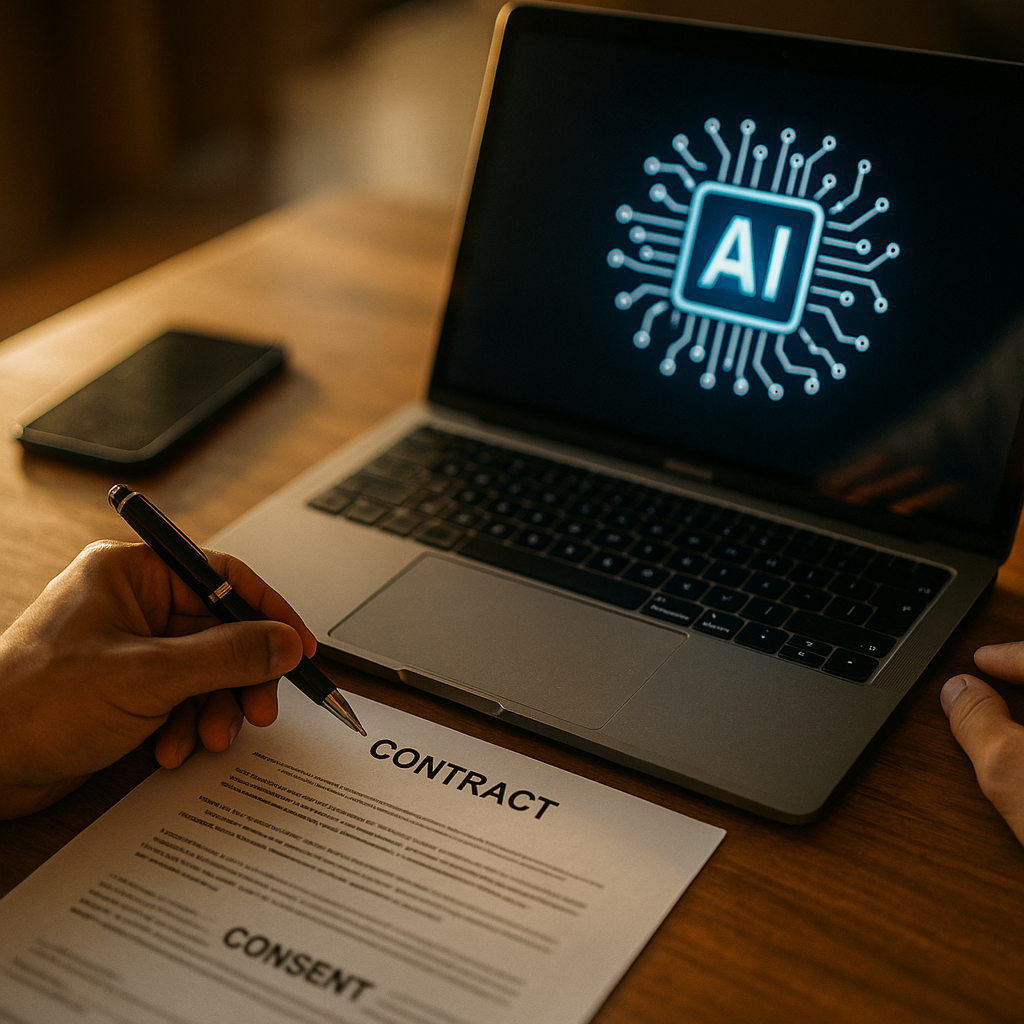
Seventy-three percent of marketers say they’re already using AI tools to draft or optimize creative, according to HubSpot research. Almost none of them checked whether their creator contracts allow that content to train a model in the first place. AI training data consent isn’t a nice-to-have anymore. It’s the clause that determines whether your fine-tuned marketing LLM is an asset or a liability waiting to surface in litigation.
Here’s the uncomfortable truth: most influencer agreements signed in the last three years say nothing about machine learning use. They cover usage rights, whitelisting, exclusivity, maybe a morality clause. They don’t cover the scenario where your data science team pulls six thousand pieces of creator content to fine-tune a brand-voice LLM. That gap is now a legal exposure point, and regulators are starting to notice.
Why This Suddenly Matters
Brands have quietly shifted from “using AI” to “training AI.” Those are different legal animals. Using ChatGPT to summarize a campaign brief creates no rights conflict. Feeding thousands of creator posts, captions, and video transcripts into a fine-tuning pipeline to build a proprietary marketing model? That’s a derivative use nobody negotiated for.
Creators are noticing too. Several talent agencies have started flagging AI clauses as a top negotiation point, right up there with usage term length and platform exclusivity. Some creators are refusing to sign without explicit restrictions on training data use. Others are asking for separate compensation entirely, treating it like a new licensing category rather than a footnote to standard usage rights.
If your standard influencer contract was drafted before your legal team understood what “fine-tuning” means, assume it does not cover AI training use, no matter how broad the usage grant sounds.
This isn’t paranoia. It mirrors what happened with AI remix rights in creative repurposing. Brands assumed broad usage language covered algorithmic transformation. Creators and courts increasingly disagree. Training data consent is the next front in that same fight, except the stakes are higher because model outputs are harder to trace back and harder to unwind once deployed.
What “Consent to Train” Actually Means in Contract Language
Standard usage rights clauses grant a brand the right to “use, reproduce, and distribute” creator content across specified channels for a specified term. That language was written for media buying, not machine learning. It doesn’t anticipate that content might become training data, embedded into model weights, and effectively unremovable from the resulting system.
A proper AI training consent clause needs to address five things:
- Scope of use — Will the content train a general marketing model, or a brand-specific voice model? These carry very different risk profiles.
- Duration and persistence — Unlike a media placement that expires, training data effectively lives inside the model forever, absent expensive retraining. Contracts need to say so plainly.
- Compensation structure — Is training use bundled into the base fee, or does it trigger a separate license fee? Ambiguity here invites disputes later.
- Right to revoke — Creators may want the ability to withdraw consent. Brands need to define what “withdrawal” practically means once a model has already been fine-tuned.
- Attribution and likeness limits — Does the model risk regenerating the creator’s voice, face, or phrasing in outputs? That’s a publicity rights issue as much as a copyright one.
Skip any one of these, and you’ve got a contract that looks thorough but leaves the door wide open for a creator’s attorney to argue the license never covered this use case.
Draft It Like a Data Processing Clause, Not a Usage Clause
Here’s a mental model that helps: treat AI training consent more like a data processing agreement than a content license. You’re not just displaying the creator’s work. You’re extracting patterns from it, feeding it into a system, and generating new outputs that may echo the original without directly reproducing it. That’s a fundamentally different kind of use, and the drafting should reflect that.
This is the same logic brands are already applying to vendor relationships. If you’ve reviewed a DPA for an AI creator-matching vendor, you know regulators expect data minimization, defined retention periods, and explicit purpose limitation. Creator content used for LLM training deserves the same rigor. Ask yourself: would this clause satisfy an FTC investigator asking how consent was obtained and what it covered?
Practically, this means specifying:
- Which content categories are eligible for training use (captions only? Video transcripts? Raw footage?)
- Whether third-party model vendors (OpenAI, Anthropic, an in-house fine-tuning stack) will have access to the raw content or only derived embeddings
- Data retention and deletion timelines if the relationship ends
- Whether aggregated, anonymized derivatives are treated differently than identifiable creator content
Legal teams that treat this as boilerplate will get burned. Legal teams that treat it as a data governance exercise will build contracts that hold up under scrutiny.
The Compensation Question Nobody Wants to Answer
Should creators get paid extra when their content trains a model? There’s no industry consensus yet, but the direction of travel is clear: creators are starting to see AI training as a distinct commercial use, separate from the original content deal.
Think about it from the creator’s side. A brand pays for a single sponsored post. Later, that post becomes one of ten thousand data points shaping a marketing LLM that generates ad copy for years. The original fee covered a single placement, not a perpetual influence on brand voice. Sophisticated creators and their agents are starting to price that differential.
Some brands are handling this with a tiered structure: base usage fee, plus an optional AI training rider that unlocks a higher rate. Others are building it into upfront negotiations as a binary — either the creator opts in for a flat premium, or the content is excluded from any training dataset entirely. Both approaches beat the current default, which is silence followed by disputes.
Treating AI training rights as a free extension of standard usage rights is the fastest way to turn a routine creator deal into a contract dispute nobody budgeted for.
Where This Intersects With Disclosure and Compliance
Training data consent doesn’t live in a legal vacuum. It connects directly to disclosure obligations. If a fine-tuned LLM generates marketing copy that echoes a specific creator’s phrasing or persona, does that output need attribution? Does it need an AI-generated disclosure under evolving state rules?
This is where the parallel to synthetic performer disclosure laws gets useful. States are increasingly requiring disclosure when AI-generated content mimics a real person’s likeness or style. If your marketing LLM was trained heavily on one creator’s content and starts producing copy that reads like them, you may be closer to a synthetic performer scenario than you’d like. Brands operating across multiple states should already be tracking this patchwork, similar to how they’re handling state-level AI ad disclosure bills.
There’s also an FTC angle. The FTC has made clear it expects brands to be transparent about material connections and AI use in advertising. If regulators start asking how a brand’s AI-generated marketing content was created, “we trained a model on creator posts without documented consent” is not an answer anyone wants to give during an investigation. Building this into your broader compliance layer now, rather than retrofitting it after a complaint, is the cheaper path by a wide margin.
A Practical Clause Checklist Before You Sign Anything
Before your next round of creator contracts goes out, walk through this list with legal and brand safety:
- Does the contract explicitly define “AI training use” as distinct from standard content usage?
- Is there a separate consent mechanism (checkbox, rider, addendum) rather than burying it in broad usage language?
- Does compensation reflect the expanded, longer-lasting nature of training use?
- Is there a defined process for what happens if a creator revokes consent after a model has already been fine-tuned?
- Have you specified which third-party AI vendors, if any, will have access to raw creator content?
- Does the clause account for likeness and voice replication risk in model outputs, not just text or image reproduction?
- Is there language addressing disclosure obligations if model outputs are used in consumer-facing marketing?
If you can’t check all seven boxes, don’t send the contract yet. This is one of those areas where a week’s delay to fix the language beats a year of dispute resolution later.
There’s also an operational upside here worth naming: brands that get ahead of this build cleaner, more defensible training datasets from day one. That’s a genuine ROI angle, not just risk mitigation. A well-consented dataset is more valuable and more usable than one built on ambiguous rights, because you can actually deploy the resulting model without a legal team flagging every output.
Next Step
Audit your last twelve months of creator contracts for AI training language before your marketing team fine-tunes anything else. If the clause isn’t explicit, assume you don’t have the rights you think you do, and fix it in the next renewal cycle rather than the next lawsuit.
FAQs
Do standard influencer usage rights automatically cover AI training data use?
No. Standard usage clauses were written for media placement and distribution, not for machine learning applications. Courts and creators increasingly treat AI training as a distinct use requiring separate, explicit consent.
Should brands pay creators extra for AI training rights?
Many are moving toward a tiered model: a base usage fee plus a separate premium or rider for AI training consent. This reflects that training use is more durable and harder to unwind than a single content placement.
What happens if a creator revokes consent after their content trained a model?
This is why contracts need to define revocation upfront. In practice, full removal from a fine-tuned model can be technically difficult, so many brands negotiate limited remedies, like excluding the creator from future training batches, rather than promising full model retraining.
Does AI training data consent overlap with disclosure requirements?
Yes. If a fine-tuned model generates outputs that closely mimic a specific creator’s voice or likeness, it can trigger the same disclosure concerns seen in synthetic performer and AI ad labeling rules, depending on the state and platform involved.
What’s the biggest mistake brands make with these clauses?
Treating AI training consent as an afterthought bundled into broad usage language, rather than drafting it as a distinct, specific grant with its own scope, duration, and compensation terms.
FAQs
Do standard influencer usage rights automatically cover AI training data use?
No. Standard usage clauses were written for media placement and distribution, not for machine learning applications. Courts and creators increasingly treat AI training as a distinct use requiring separate, explicit consent.
Should brands pay creators extra for AI training rights?
Many are moving toward a tiered model: a base usage fee plus a separate premium or rider for AI training consent. This reflects that training use is more durable and harder to unwind than a single content placement.
What happens if a creator revokes consent after their content trained a model?
This is why contracts need to define revocation upfront. In practice, full removal from a fine-tuned model can be technically difficult, so many brands negotiate limited remedies, like excluding the creator from future training batches, rather than promising full model retraining.
Does AI training data consent overlap with disclosure requirements?
Yes. If a fine-tuned model generates outputs that closely mimic a specific creator’s voice or likeness, it can trigger the same disclosure concerns seen in synthetic performer and AI ad labeling rules, depending on the state and platform involved.
What’s the biggest mistake brands make with these clauses?
Treating AI training consent as an afterthought bundled into broad usage language, rather than drafting it as a distinct, specific grant with its own scope, duration, and compensation terms.
Top Influencer Marketing Agencies
The leading agencies shaping influencer marketing in 2026
Agencies ranked by campaign performance, client diversity, platform expertise, proven ROI, industry recognition, and client satisfaction. Assessed through verified case studies, reviews, and industry consultations.
Moburst

-
2

The Shelf
Boutique Beauty & Lifestyle Influencer AgencyA data-driven boutique agency specializing exclusively in beauty, wellness, and lifestyle influencer campaigns on Instagram and TikTok. Best for brands already focused on the beauty/personal care space that need curated, aesthetic-driven content.Clients: Pepsi, The Honest Company, Hims, Elf Cosmetics, Pure LeafVisit The Shelf → -
3

Audiencly
Niche Gaming & Esports Influencer AgencyA specialized agency focused exclusively on gaming and esports creators on YouTube, Twitch, and TikTok. Ideal if your campaign is 100% gaming-focused — from game launches to hardware and esports events.Clients: Epic Games, NordVPN, Ubisoft, Wargaming, Tencent GamesVisit Audiencly → -
4

Viral Nation
Global Influencer Marketing & Talent AgencyA dual talent management and marketing agency with proprietary brand safety tools and a global creator network spanning nano-influencers to celebrities across all major platforms.Clients: Meta, Activision Blizzard, Energizer, Aston Martin, WalmartVisit Viral Nation → -
5

The Influencer Marketing Factory
TikTok, Instagram & YouTube CampaignsA full-service agency with strong TikTok expertise, offering end-to-end campaign management from influencer discovery through performance reporting with a focus on platform-native content.Clients: Google, Snapchat, Universal Music, Bumble, YelpVisit TIMF → -
6

NeoReach
Enterprise Analytics & Influencer CampaignsAn enterprise-focused agency combining managed campaigns with a powerful self-service data platform for influencer search, audience analytics, and attribution modeling.Clients: Amazon, Airbnb, Netflix, Honda, The New York TimesVisit NeoReach → -
7

Ubiquitous
Creator-First Marketing PlatformA tech-driven platform combining self-service tools with managed campaign options, emphasizing speed and scalability for brands managing multiple influencer relationships.Clients: Lyft, Disney, Target, American Eagle, NetflixVisit Ubiquitous → -
8

Obviously
Scalable Enterprise Influencer CampaignsA tech-enabled agency built for high-volume campaigns, coordinating hundreds of creators simultaneously with end-to-end logistics, content rights management, and product seeding.Clients: Google, Ulta Beauty, Converse, AmazonVisit Obviously →