


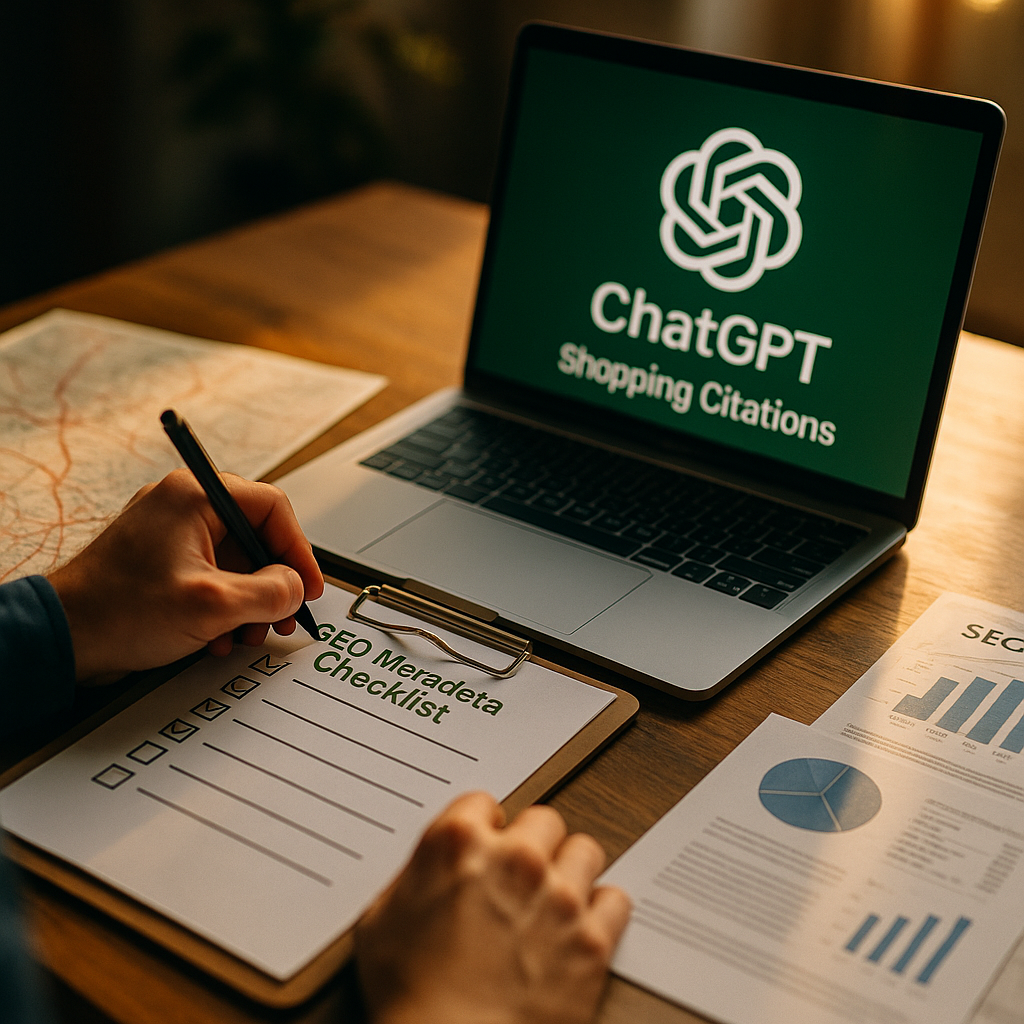
Only one product gets quoted when ChatGPT answers “best running shoes for flat feet.” Not five. Not ten. One, maybe two, with a couple of runner-ups mentioned in passing. If your product page isn’t structured for machine comprehension, you’re invisible in that answer no matter how good the product is. GEO metadata — generative engine optimization metadata — is quickly becoming the difference between winning that citation and never showing up at all.
Why Product Pages Need a Different Metadata Strategy Now
Traditional SEO metadata was built for crawlers indexing pages and ranking them in a list. ChatGPT Shopping, Perplexity Shopping, and Google’s AI Mode don’t rank ten blue links. They synthesize an answer, cite a handful of sources, and move on. That’s a fundamentally different retrieval problem, and most product pages are still optimized for the old one.
OpenAI’s shopping integration pulls structured product data, reviews, pricing, and availability signals through a retrieval layer, then decides which sources are trustworthy enough to cite. If your metadata is thin, outdated, or inconsistent across pages, the model has no reason to pick you over a competitor with cleaner structured data. This isn’t speculative. eMarketer has flagged AI-driven shopping discovery as one of the fastest-growing referral channels for retail brands, and early movers are already seeing outsized citation share relative to their organic search rank.
Ranking #3 in Google no longer guarantees relevance in AI answers. Citation odds are decided by structured data completeness, not domain authority alone.
The Core Metadata Fields That Actually Move the Needle
Forget the kitchen-sink approach. Generative engines weight a specific set of signals heavily. Here’s what to prioritize, in rough order of impact:
- Product schema (schema.org/Product): Name, brand, SKU, GTIN/MPN, and category must be complete and machine-readable. Missing GTINs are a silent killer — they’re how engines cross-reference your product against price comparison and review datasets.
- Offer schema with live pricing and availability: Price, currency, priceValidUntil, and availability status (InStock, OutOfStock, PreOrder) need to update in near real time. Stale pricing gets your page deprioritized fast, similar to how real-time availability signals now decide local search visibility.
- AggregateRating and Review schema: Star ratings and review counts are heavily weighted trust signals. A product with 4.6 stars and 800 reviews, properly marked up, beats a 5-star product with three reviews almost every time.
- Detailed product attributes: Material, dimensions, color variants, size ranges, compatibility. These attributes let the model match your product to specific query intent (“waterproof hiking boots under $150 for wide feet”).
- FAQPage schema on the product page itself: Answering common pre-purchase questions directly on the page, marked up properly, gives the model pre-packaged answer chunks it can lift almost verbatim.
- Merchant/organization identity markup: sameAs links to verified social profiles, Organization schema with consistent NAP data, and a clear return/shipping policy schema all contribute to the trust threshold engines apply before citing a merchant.
Don’t Skip the Boring Stuff
Canonical tags, hreflang for multi-region catalogs, and clean sitemaps still matter. AI crawlers (GPTBot, PerplexityBot, ClaudeBot) respect robots.txt directives, and if your product feed is buried behind JavaScript rendering with no server-side fallback, plenty of these bots simply won’t see it. Test your rendering with a plain HTTP fetch, not just a browser. If the product name and price aren’t in the raw HTML response, you have a problem.
A Practical Technical Checklist
Here’s the audit sequence we’d recommend running across your top revenue-driving SKUs before rolling it out catalog-wide:
- Validate Product, Offer, and Review schema using Google’s Rich Results Test and Schema.org’s validator, not just visually inspecting the page.
- Confirm GTIN/MPN presence for every SKU — audit for gaps in your PIM, not just spot checks.
- Set up automated price and availability sync so priceValidUntil never drifts more than 24 hours stale.
- Add FAQPage schema addressing the 5-8 most common pre-purchase objections per product category.
- Ensure server-side rendering (or dynamic rendering) so bots without full JS execution still see complete product data.
- Cross-check NAP and brand entity consistency across your site, Google Business Profile, and third-party marketplaces.
- Monitor citation frequency manually by running your top 20 category queries in ChatGPT Shopping monthly and logging which competitors get cited.
That last step matters more than people think. Nobody’s built a mature rank-tracking tool for AI shopping citations yet (the space is moving too fast for tooling to catch up), so manual query auditing is still the most reliable signal you have.
Structured Data Isn’t a One-Time Project
Retailers treat schema markup like a launch checklist item, then forget it. That’s a mistake. Product attributes change, prices fluctuate, reviews accumulate. If your metadata pipeline isn’t refreshing automatically, you’ll drift out of citation contention within a quarter. This mirrors what we’ve seen in local search, where content decay kills AI search visibility faster than most teams expect. The same decay dynamic applies to product metadata: what was accurate in Q1 can be stale enough to hurt you by Q3.
Update cadence, not just initial accuracy, is what keeps a product page eligible for citation over time.
What About Brand Voice and Content Signals?
Metadata gets you into the retrieval pool. Content quality determines whether you get quoted or paraphrased into obscurity. Product descriptions written for SEO keyword density (remember “best affordable waterproof hiking boots for men and women 2024”?) read as spammy to LLMs and get filtered. Write descriptions the way you’d explain the product to a knowledgeable friend: specific, honest about tradeoffs, and free of superlative-stuffing.
This is the same principle governing how AI Overviews quote brand content in editorial contexts — clarity and directness outperform keyword stuffing every time. Product pages aren’t exempt from that rule just because they’re transactional.
Governance: Who Owns This Inside Your Org?
GEO metadata work sits awkwardly between SEO, e-commerce ops, and data engineering. Most brands don’t have a clear owner, which is exactly why it gets neglected. If you’re running AI-assisted content or pricing pipelines already, this should plug into the same oversight structure you use for AI governance in marketing automation. Someone needs to own schema QA, price feed accuracy, and citation monitoring as an ongoing operational function, not a project with an end date.
Budget for this the way you’d budget for any compliance-adjacent function: recurring, not one-off. Teams that treat structured data like a static asset lose visibility quietly, then scramble when a competitor’s citation share triples in a quarter.
Risk and Compliance Angles Brands Overlook
There’s a legal wrinkle worth flagging. If your Offer schema states a price or availability status that doesn’t match checkout reality, and an AI assistant cites that stale data to a consumer, you’re exposed to the same deceptive pricing scrutiny the FTC already applies to traditional advertising. AI citation doesn’t create a new legal category, but it does create a new surface area for the same old risk. Sync errors that used to be a minor UX annoyance are now a compliance issue when a chatbot repeats them as fact to a shopper mid-purchase-decision.
Build price and stock validation into your QA process the same way you’d validate any customer-facing claim. It’s cheap insurance against a problem that’s about to get more visible, not less.
Next Step
Run the Rich Results Test on your top 20 revenue SKUs this week, fix the schema gaps you find, and check back monthly on citation frequency in ChatGPT Shopping. Small, consistent metadata hygiene beats a one-time overhaul every time.
FAQs
What is GEO metadata for product pages?
GEO metadata refers to the structured data and content signals — Product schema, Offer schema, reviews, FAQs — that generative engines like ChatGPT use to identify, verify, and cite a product in AI-generated shopping answers.
How is GEO different from traditional e-commerce SEO?
Traditional SEO optimizes for ranking in a list of search results. GEO optimizes for being selected as one of a handful of sources an AI model cites directly in a synthesized answer, which weights schema completeness and trust signals more heavily than backlinks or keyword density.
Which schema types matter most for ChatGPT Shopping citations?
Product, Offer, AggregateRating, Review, and FAQPage schema carry the most weight. GTIN/MPN identifiers and real-time price and availability data are especially critical because they let engines cross-reference your listing against other data sources.
How often should product metadata be updated?
Price and availability should sync near real-time (within 24 hours). Review counts, ratings, and attribute data should be refreshed at least monthly. Treat it as an ongoing operational task, not a one-time setup.
Can small or mid-market retailers compete with major brands for AI citations?
Yes. Citation odds depend more on structured data completeness and content clarity than domain authority or ad spend, which levels the playing field for smaller retailers willing to invest in metadata hygiene.
What tools can I use to validate product schema?
Google’s Rich Results Test and the Schema.org validator are the standard starting points. Beyond that, manual query testing in ChatGPT Shopping and Perplexity Shopping remains the most reliable way to track actual citation performance.
Top Influencer Marketing Agencies
The leading agencies shaping influencer marketing in 2026
Agencies ranked by campaign performance, client diversity, platform expertise, proven ROI, industry recognition, and client satisfaction. Assessed through verified case studies, reviews, and industry consultations.
Moburst

-
2

The Shelf
Boutique Beauty & Lifestyle Influencer AgencyA data-driven boutique agency specializing exclusively in beauty, wellness, and lifestyle influencer campaigns on Instagram and TikTok. Best for brands already focused on the beauty/personal care space that need curated, aesthetic-driven content.Clients: Pepsi, The Honest Company, Hims, Elf Cosmetics, Pure LeafVisit The Shelf → -
3

Audiencly
Niche Gaming & Esports Influencer AgencyA specialized agency focused exclusively on gaming and esports creators on YouTube, Twitch, and TikTok. Ideal if your campaign is 100% gaming-focused — from game launches to hardware and esports events.Clients: Epic Games, NordVPN, Ubisoft, Wargaming, Tencent GamesVisit Audiencly → -
4

Viral Nation
Global Influencer Marketing & Talent AgencyA dual talent management and marketing agency with proprietary brand safety tools and a global creator network spanning nano-influencers to celebrities across all major platforms.Clients: Meta, Activision Blizzard, Energizer, Aston Martin, WalmartVisit Viral Nation → -
5

The Influencer Marketing Factory
TikTok, Instagram & YouTube CampaignsA full-service agency with strong TikTok expertise, offering end-to-end campaign management from influencer discovery through performance reporting with a focus on platform-native content.Clients: Google, Snapchat, Universal Music, Bumble, YelpVisit TIMF → -
6

NeoReach
Enterprise Analytics & Influencer CampaignsAn enterprise-focused agency combining managed campaigns with a powerful self-service data platform for influencer search, audience analytics, and attribution modeling.Clients: Amazon, Airbnb, Netflix, Honda, The New York TimesVisit NeoReach → -
7

Ubiquitous
Creator-First Marketing PlatformA tech-driven platform combining self-service tools with managed campaign options, emphasizing speed and scalability for brands managing multiple influencer relationships.Clients: Lyft, Disney, Target, American Eagle, NetflixVisit Ubiquitous → -
8

Obviously
Scalable Enterprise Influencer CampaignsA tech-enabled agency built for high-volume campaigns, coordinating hundreds of creators simultaneously with end-to-end logistics, content rights management, and product seeding.Clients: Google, Ulta Beauty, Converse, AmazonVisit Obviously →