


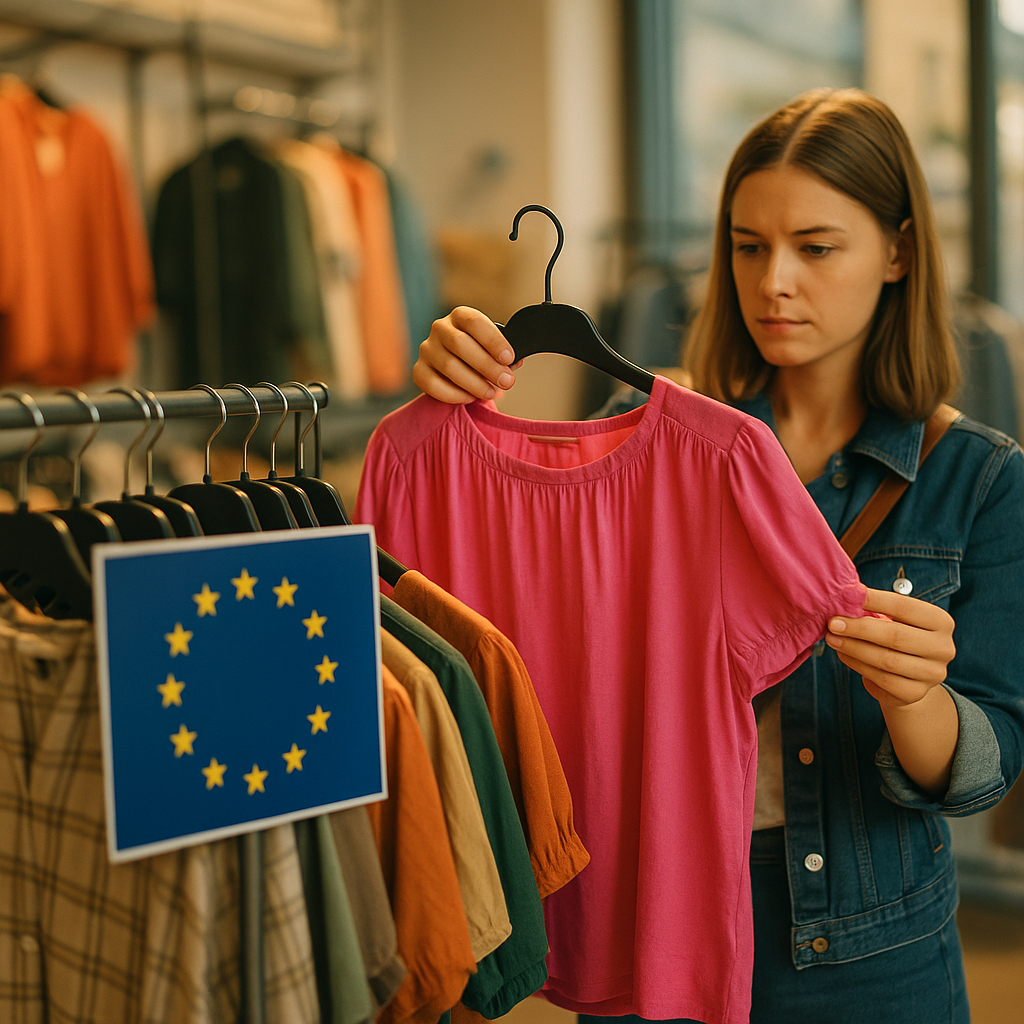
France now fines ultra-fast-fashion advertising up to 50% of the ad spend itself. Meanwhile, Germany and Spain are drafting sustainability marketing rules that don’t quite match Paris’s playbook. If your apparel brand sells across all three markets, you’re not dealing with one ultra-fast-fashion ad law — you’re juggling three overlapping, occasionally contradictory rulebooks, and the gaps between them are where the real risk lives.
France Drew First Blood, But It’s Not the Only Regulator in the Room
France’s loi anti-fast-fashion, passed in stages and now fully biting on enforcement, does two things that matter to marketers. First, it bans influencer and paid promotion of designated ultra-fast-fashion platforms outright. Second, it layers an environmental penalty (a malus) onto individual garments from companies that meet volume and turnover thresholds, and requires that penalty to be disclosed at the point of sale and in advertising claims.
Shein and Temu were the obvious targets. But the statutory language is broad enough to capture any brand producing high volumes of low-cost, rapidly-cycled apparel, and France’s consumer protection body (DGCCRF) has signaled it will look at business model, not just brand name, when deciding who’s in scope.
A brand that’s compliant in France because it avoided the fast-fashion designation can still trip Germany’s supply-chain disclosure rules or Spain’s greenwashing standard on the exact same product line.
Germany’s Angle: Supply Chain Truth, Not Just Ad Bans
Germany hasn’t copied France’s advertising ban. Instead, it’s leaning on the Lieferkettensorgfaltspflichtengesetz (supply chain due diligence act) and emerging guidance from the Wettbewerbszentrale, Germany’s competition watchdog, that treats unsubstantiated sustainability claims in marketing as unfair competition. The practical effect: German regulators care less about whether you advertised a fast-fashion drop and more about whether every “eco,” “sustainable,” or “responsibly made” claim in that ad can be backed by verifiable, auditable data.
This is a documentation problem as much as a creative one. A claim like “made with recycled materials” needs a percentage, a certification body, and ideally a batch-level audit trail. Germany’s approach mirrors the EU’s broader Green Claims Directive trajectory, which is pushing every member state toward substantiation requirements even where local statutes lag.
For brands running influencer campaigns, this means briefing documents need a claims-substantiation layer that didn’t exist two years ago. If a creator says “this dress is sustainable” in a sponsored TikTok, and you can’t produce the backup data on request, that’s a liability that sits with the brand, not the creator. The parallels to how the FTC treats substantiation in the US are worth studying, even though the legal mechanisms differ.
Spain Is Building a Third Model Entirely
Spain’s approach, still taking shape through its Ministry of Consumer Affairs, blends elements of both neighbors but adds its own wrinkle: mandatory environmental impact labeling tied to garment lifecycle data, plus restrictions on advertising that implies disposability or “wear once” positioning. Spain’s draft rules specifically flag advertising language that encourages frequent replacement or normalizes low-cost, single-season wear, a much broader net than France’s platform-specific ban.
Where Spain gets interesting is enforcement philosophy. Early guidance suggests Spanish regulators will weight audience perception heavily, similar to how the FTC evaluates whether a “reasonable consumer” would be misled. That’s a familiar concept for brands who’ve already built review processes around audience-perception testing for AI content, and the muscle memory transfers directly.
Three Rulebooks, One Campaign: Where Brands Actually Get Tripped Up
Here’s the operational headache. A single pan-European apparel campaign, run through the same creator network, now has to satisfy:
- France: No promotion of designated ultra-fast-fashion platforms or products; mandatory environmental penalty disclosure where applicable.
- Germany: Full substantiation for any sustainability or eco-related claim, documented and auditable.
- Spain: No language implying disposability or frequent-replacement wear cycles; lifecycle labeling requirements pending finalization.
Run the same 15-second UGC ad in all three markets without localization, and you’re almost guaranteed to violate at least one rule. A “grab five new looks for spring” caption that’s fine in isolation becomes a disposability problem in Spain. A “sustainably made” claim that’s fine in France becomes a substantiation gap in Germany if you can’t produce the certification.
Cross-border apparel campaigns can no longer run on a single master creative with translated captions. Regulatory divergence has made localization a compliance requirement, not just a cultural nicety.
This isn’t unique to fashion, either. Marketers dealing with US state-by-state patchworks, like the segmentation forced by Texas and Florida’s parental consent laws, will recognize the pattern: divergent state or national rules force brands to build modular compliance layers instead of one-size-fits-all creative.
What a Working Compliance Framework Looks Like
Brands that are getting ahead of this aren’t waiting for full harmonization (which, realistically, may never come; the EU has shown no urgency in forcing member states to align). Instead, they’re building three things:
- A claims library, market-tagged. Every sustainability or production claim gets logged with its supporting evidence, then tagged for which markets it’s cleared to run in. If Germany requires a certification number and France doesn’t, the claim gets flagged accordingly before it ever reaches a creator brief.
- Creator briefs with jurisdiction-specific script guardrails. This looks a lot like the script-approval discipline already being built for FTC risk in the US — see the frameworks around script approval and FTC liability and the deeper dive on script approval depth. The same logic applies here: the more control a brand exerts over creator language, the more liability it assumes, so the guardrails need to be precise rather than vague.
- A pre-flight legal gate for each market. Not a single global sign-off, but three separate checkpoints, each testing against that country’s specific statute or guidance. Brands already doing this for AI-generated content, per the legal review gate model for AI-dubbed ads, can extend the same workflow to sustainability claims with minimal retooling.
None of this is cheap. But the alternative is a fine calculated as a percentage of ad spend, in France’s case, which scales with campaign size in exactly the wrong direction.
Contract Language Nobody Was Writing a Few Years Ago
Agencies negotiating creator and vendor contracts for apparel clients should be adding jurisdiction-specific compliance warranties now. If a creator or production vendor is generating claims language, the contract needs to specify who bears responsibility if that claim fails a German substantiation audit or a Spanish disposability review. This mirrors the thinking behind vendor contract clauses for AI model changes: build the failure mode into the contract before it happens, not after a regulator calls.
It’s also worth revisiting how brands structure creator payments and cross-border compliance more broadly. The EU creator payment compliance matrix built after the VAT exemption changes is a useful template for how to think about multi-country regulatory overlays generally, even though the subject matter differs.
Is Harmonization Coming, or Should Brands Stop Waiting?
The EU’s Green Claims Directive was supposed to be the unifying mechanism here. Progress has been slower than expected, and even once finalized, individual member states retain latitude in enforcement style and penalty structure. France will keep its ad-spend-based fines. Germany will keep leaning on unfair competition law. Spain will keep building its own labeling regime. Waiting for Brussels to smooth this out is not a viable compliance strategy for a brand running campaigns this quarter.
Data from Statista shows fast-fashion’s European market value continuing to climb even as regulatory pressure mounts, which tells you enforcement is chasing growth, not the other way around. Brands that treat compliance as a cost center will keep losing ground to those that treat it as a creative constraint worth building into the brief from day one.
Marketing teams should also watch how retail media and disclosure standards evolve in parallel. The discipline being built around retail media disclosure audits in the US shows how quickly platforms start enforcing their own layer of rules on top of government regulation, something European retail media networks are likely to replicate as sustainability claims come under scrutiny.
The practical next step: audit every sustainability and production claim currently running in French, German, and Spanish apparel campaigns against each market’s specific standard, not a single EU-wide assumption, and build market-tagged creative variants before your next cross-border flight goes live.
Frequently Asked Questions
Does France’s ultra-fast-fashion ad law apply to all apparel brands, or just Shein and Temu?
The law targets companies meeting specific volume and turnover thresholds tied to rapid product cycling, not brand names directly. Any brand producing high volumes of low-cost apparel with fast turnover should assess whether it meets the designation criteria, since French regulators have signaled they’ll evaluate business model over brand identity.
Can a single ad creative be compliant in France but non-compliant in Germany?
Yes. France focuses on platform bans and penalty disclosure, while Germany requires full substantiation for any sustainability claim. An ad clean of French fast-fashion triggers can still fail in Germany if it makes an unverified “eco-friendly” or “sustainable” claim without supporting documentation.
What counts as a “disposability” claim under Spain’s emerging rules?
Early guidance flags language encouraging frequent replacement, single-season wear, or “wear once” positioning. Captions like “grab a new look every week” or campaigns built around rapid wardrobe turnover are likely to draw scrutiny once Spain’s rules finalize.
Who is liable if a creator makes an unsubstantiated sustainability claim in a sponsored post?
Liability generally sits with the brand, particularly under Germany’s unfair competition framework, since the brand commissioned and approved the content. This mirrors FTC substantiation expectations in the US, where brands can’t outsource claims liability to creators.
Is EU-wide harmonization on sustainability marketing rules coming soon?
The Green Claims Directive is meant to create baseline standards, but progress has been slow and member states retain enforcement discretion. Brands shouldn’t wait for harmonization before building market-specific compliance processes.
Top Influencer Marketing Agencies
The leading agencies shaping influencer marketing in 2026
Agencies ranked by campaign performance, client diversity, platform expertise, proven ROI, industry recognition, and client satisfaction. Assessed through verified case studies, reviews, and industry consultations.
Moburst

-
2

The Shelf
Boutique Beauty & Lifestyle Influencer AgencyA data-driven boutique agency specializing exclusively in beauty, wellness, and lifestyle influencer campaigns on Instagram and TikTok. Best for brands already focused on the beauty/personal care space that need curated, aesthetic-driven content.Clients: Pepsi, The Honest Company, Hims, Elf Cosmetics, Pure LeafVisit The Shelf → -
3

Audiencly
Niche Gaming & Esports Influencer AgencyA specialized agency focused exclusively on gaming and esports creators on YouTube, Twitch, and TikTok. Ideal if your campaign is 100% gaming-focused — from game launches to hardware and esports events.Clients: Epic Games, NordVPN, Ubisoft, Wargaming, Tencent GamesVisit Audiencly → -
4

Viral Nation
Global Influencer Marketing & Talent AgencyA dual talent management and marketing agency with proprietary brand safety tools and a global creator network spanning nano-influencers to celebrities across all major platforms.Clients: Meta, Activision Blizzard, Energizer, Aston Martin, WalmartVisit Viral Nation → -
5

The Influencer Marketing Factory
TikTok, Instagram & YouTube CampaignsA full-service agency with strong TikTok expertise, offering end-to-end campaign management from influencer discovery through performance reporting with a focus on platform-native content.Clients: Google, Snapchat, Universal Music, Bumble, YelpVisit TIMF → -
6

NeoReach
Enterprise Analytics & Influencer CampaignsAn enterprise-focused agency combining managed campaigns with a powerful self-service data platform for influencer search, audience analytics, and attribution modeling.Clients: Amazon, Airbnb, Netflix, Honda, The New York TimesVisit NeoReach → -
7

Ubiquitous
Creator-First Marketing PlatformA tech-driven platform combining self-service tools with managed campaign options, emphasizing speed and scalability for brands managing multiple influencer relationships.Clients: Lyft, Disney, Target, American Eagle, NetflixVisit Ubiquitous → -
8

Obviously
Scalable Enterprise Influencer CampaignsA tech-enabled agency built for high-volume campaigns, coordinating hundreds of creators simultaneously with end-to-end logistics, content rights management, and product seeding.Clients: Google, Ulta Beauty, Converse, AmazonVisit Obviously →