


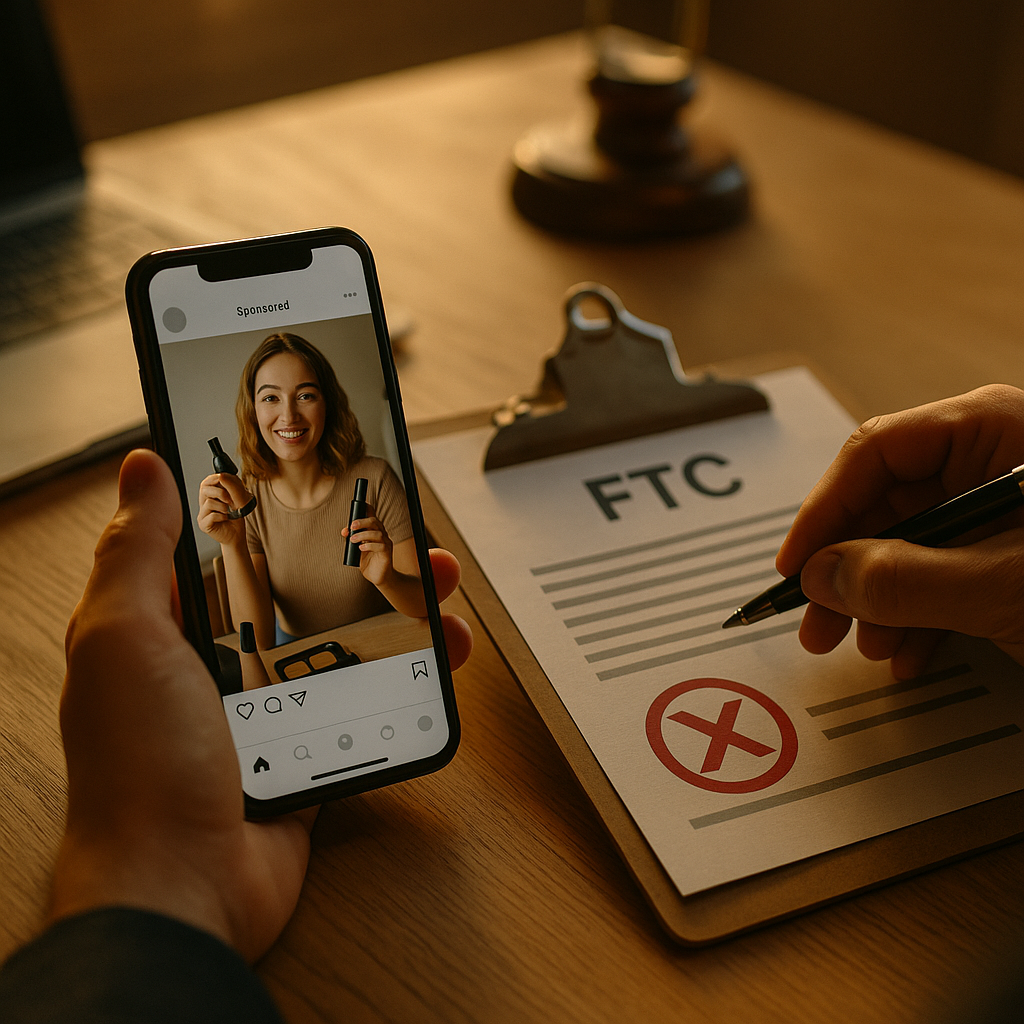
Whitelisted creator ads sit in a compliance blind spot most legal teams still haven’t mapped. The FTC settled with advertisers over deceptive endorsement practices in whitelisted campaigns, and platform policy teams have quietly rewritten disclosure rules three times in the past two years. If your audit checklist treats “FTC-compliant” and “platform-approved” as the same thing, you’re already exposed. They’re not the same thing. They never were.
Whitelisting — running paid media through a creator’s handle using their granted ad account access — collapses the usual chain of custody. The brand controls targeting and spend. The creator’s name is still on the post. Regulators look at one set of rules. Meta, TikTok, and YouTube each enforce another. A legal team auditing only one side of that ledger is signing off on ads that can get pulled, demonetized, or subpoenaed.
Why Whitelisting Breaks the Usual Compliance Model
Standard influencer compliance review assumes a simple structure: creator posts organically, brand reviews for #ad disclosure, everyone moves on. Whitelisting scrambles that. The ad now runs as a paid unit through Meta Advantage+ placements, TikTok Spark Ads, or YouTube’s brand-connected accounts, often optimized, A/B tested, and refreshed by a media buyer who never spoke to the creator.
That’s the operational reality legal teams need to internalize first: the disclosure that satisfied the FTC on day one may not survive the fifth creative iteration a media buyer pushes live without re-review.
A disclosure compliant at launch can become non-compliant within 48 hours if a media buyer swaps creative, trims captions, or reformats for a new placement — with no legal touchpoint in between.
This is the same failure pattern seen with AI remix tools breaking disclosure chains on TikTok Shop content. Whitelisting has a nearly identical mechanism: someone downstream alters the asset, and the original compliance sign-off no longer applies.
The Two Rulebooks, Side by Side
Here’s where most audits go wrong: they check for a disclosure hashtag and call it done. The FTC’s Endorsement Guides require disclosures to be clear and conspicuous — unavoidable, unambiguous, not buried under a “see more” fold. Platform policy operates on a completely different axis: it cares about whether the correct ad account attribution is used, whether the “Paid Partnership” label is technically applied, and whether the creator’s business account settings match what the ad delivery system expects.
A creator can tick every platform box (paid partnership tag active, brand tagged, business account verified) and still fail FTC scrutiny if the disclosure is visually swallowed by a busy thumbnail or a caption cut off mid-sentence in feed view. The reverse happens too: an ad can satisfy FTC disclosure standards in the raw creative file, then lose that disclosure entirely when reformatted for a placement the platform’s own tools don’t support cleanly.
Paid partnership labels alone no longer satisfy FTC requirements, and that gap is exactly where whitelisted campaigns get exposed. Legal teams need a matrix, not a checklist — one axis for FTC clarity standards, another for platform mechanical requirements, reviewed as two separate passes on the same asset.
Build the Matrix: What Each Axis Actually Checks
- FTC axis: Is the disclosure unavoidable regardless of device, placement, or feed compression? Does it appear before the “swipe up” or “shop now” moment, not after? Would a reasonable consumer scrolling fast still catch it?
- Platform axis: Is the paid partnership tag active on the specific ad unit (not just the organic post it was spawned from)? Does the whitelisted account’s disclosed relationship match what’s on file with the platform’s brand safety tools? Has the ad account’s authorization been renewed if the campaign flight extends past the original grant window?
- Overlap failures: Cases where a fix for one axis breaks the other. Adding a large on-screen disclosure banner to satisfy FTC clarity, for instance, can push a video out of a platform’s auto-caption safe zone, triggering a policy flag for obscured content.
Run both passes on every unique creative variant, not just the master file. Media buying teams routinely spin up five to ten variants for testing. Each one needs its own disclosure check, because short-hook edits routinely strip disclosure language that existed in the original cut.
Where the Audit Actually Has to Live: Pre-Flight, Not Post-Mortem
Most legal reviews happen too late — after the campaign has run, when a complaint or platform strike forces a look back. That’s reactive, and reactive compliance in whitelisting is expensive. The FTC doesn’t care that your media buyer changed the creative without telling legal; the brand is still the advertiser of record.
Build a pre-flight gate instead. Before any whitelisted ad account access is granted, legal should require:
- A disclosure style guide baked into the creator contract, specifying font size minimums, placement timing, and language (“Paid partnership” versus “Ad” versus “#sponsored” — platforms and regulators don’t always treat these as interchangeable).
- A change-log requirement from the media buying team: any creative swap, caption trim, or reformat triggers automatic re-routing to legal, not a silent push-live.
- A platform-specific compliance snapshot taken at ad launch, timestamped, and archived — proof of what the disclosure looked like at go-live, since platform UI updates can visually alter how a label renders weeks later.
This mirrors the approach recommended for livestream countdown timer audits, where the FTC’s deceptive-urgency concerns and platform mechanics diverge in similar ways. The lesson transfers directly: audit the live rendering, not the source file.
Cross-Border Whitelisting Adds a Third Layer
If your whitelisted creators run across US, UK, or EU audiences, the two-rulebook problem becomes three or four. The UK’s ASA has its own conspicuousness standard, distinct from the FTC’s, and the EU’s approach under national advertising codes (see the disclosure frameworks referenced in France, Germany, and Spain’s ad law guidance) can require different label language entirely.
Platform policy doesn’t localize automatically either. A “Paid Partnership” tag renders the same way globally on most platforms, but the underlying legal disclosure text a legal team drafts needs jurisdiction-specific variants layered into the same ad unit. Whitelisted campaigns that run cross-border without geo-targeted disclosure variants are quietly non-compliant somewhere, even when the platform mechanics pass every test.
AI-Assisted Media Buying Makes This Worse, Not Better
AI-driven optimization tools now handle creative refresh and placement decisions with minimal human review, and that includes whitelisted ad accounts. If an AI agent auto-generates new creative variants to fight ad fatigue, does it know to preserve disclosure placement? Almost certainly not, unless someone built that constraint into the system.
This is the same liability gap covered in AI agent media-buying liability riders — legal teams need contractual language assigning responsibility when an automated system strips or relocates a disclosure during optimization. Without an indemnification clause covering AI media-buying errors, the brand absorbs both the FTC risk and the platform strike, even though no human made the compliance-breaking decision.
Ask your ad tech vendor directly: does the optimization engine treat disclosure text as a locked, non-editable layer? If they can’t answer clearly, that’s your answer.
Practical Audit Cadence
A one-time pre-launch check isn’t enough for campaigns that run for weeks with rotating creative. Set a cadence:
- Weekly: Spot-check five live ad units per active whitelisted account for disclosure rendering across at least two placements each (feed, Stories/Reels, in-stream).
- At every creative refresh: Full dual-axis check before the new variant goes live, not after.
- Quarterly: Full account-level review of ad account authorization status, since expired or partially revoked access can trigger platform policy violations even on previously approved creative.
Document everything. When the FTC or a state AG comes asking, a timestamped audit trail showing active, ongoing review is the difference between a warning letter and a consent decree. According to the FTC’s own enforcement guidance, demonstrated good-faith compliance processes materially affect outcomes.
Platforms are moving toward their own verification layers too — Meta and TikTok have both signaled stricter automated disclosure detection, a shift covered in AI-verified disclosure standards moving beyond static labels. That’s good news long-term, but it means today’s manual audit gaps become tomorrow’s automated rejections. Build the process now, before the platforms build it for you.
Industry benchmarking from eMarketer and social platform data available via Sprout Social both point to accelerating creator ad spend, which means the audit burden only grows from here.
FAQs
Frequently Asked Questions
What’s the difference between FTC compliance and platform compliance for whitelisted ads?
FTC compliance focuses on whether a disclosure is clear and conspicuous to a reasonable consumer, regardless of format. Platform compliance checks mechanical requirements — correct tags, verified ad account attribution, and proper labeling tools — which can technically pass while the actual disclosure remains legally inadequate.
Who is legally responsible when a whitelisted ad’s disclosure fails — the brand or the creator?
The brand, as the advertiser running paid media, typically bears primary FTC liability in whitelisting arrangements, since it controls targeting, spend, and often the creative itself. Contracts should still assign creator-side responsibilities, but regulators generally look first at who paid for and directed the placement.
How often should legal teams audit whitelisted creator ads?
At minimum, before every creative refresh and on a weekly spot-check basis for active campaigns, with a full quarterly review of ad account authorization status and disclosure rendering across all active placements.
Can AI-driven creative optimization break FTC disclosure compliance without anyone noticing?
Yes. Automated systems optimizing for engagement or ad fatigue can reposition, resize, or remove disclosure text entirely if that layer isn’t explicitly locked or protected in the ad tech configuration, creating compliance gaps with no human decision point to trace.
Does a “Paid Partnership” label satisfy FTC disclosure requirements on its own?
Not necessarily. The FTC requires disclosures to be clear and conspicuous in context, meaning placement, timing, and visibility matter beyond simply activating a platform’s built-in label tool.
Stop auditing whitelisted creative once and calling it compliant. Build a dual-axis review into every pre-flight and refresh cycle, assign clear ownership when AI tools touch the creative, and archive timestamped proof of what actually rendered live — that’s the difference between a documentation trail and a consent decree.
Top Influencer Marketing Agencies
The leading agencies shaping influencer marketing in 2026
Agencies ranked by campaign performance, client diversity, platform expertise, proven ROI, industry recognition, and client satisfaction. Assessed through verified case studies, reviews, and industry consultations.
Moburst

-
2

The Shelf
Boutique Beauty & Lifestyle Influencer AgencyA data-driven boutique agency specializing exclusively in beauty, wellness, and lifestyle influencer campaigns on Instagram and TikTok. Best for brands already focused on the beauty/personal care space that need curated, aesthetic-driven content.Clients: Pepsi, The Honest Company, Hims, Elf Cosmetics, Pure LeafVisit The Shelf → -
3

Audiencly
Niche Gaming & Esports Influencer AgencyA specialized agency focused exclusively on gaming and esports creators on YouTube, Twitch, and TikTok. Ideal if your campaign is 100% gaming-focused — from game launches to hardware and esports events.Clients: Epic Games, NordVPN, Ubisoft, Wargaming, Tencent GamesVisit Audiencly → -
4

Viral Nation
Global Influencer Marketing & Talent AgencyA dual talent management and marketing agency with proprietary brand safety tools and a global creator network spanning nano-influencers to celebrities across all major platforms.Clients: Meta, Activision Blizzard, Energizer, Aston Martin, WalmartVisit Viral Nation → -
5

The Influencer Marketing Factory
TikTok, Instagram & YouTube CampaignsA full-service agency with strong TikTok expertise, offering end-to-end campaign management from influencer discovery through performance reporting with a focus on platform-native content.Clients: Google, Snapchat, Universal Music, Bumble, YelpVisit TIMF → -
6

NeoReach
Enterprise Analytics & Influencer CampaignsAn enterprise-focused agency combining managed campaigns with a powerful self-service data platform for influencer search, audience analytics, and attribution modeling.Clients: Amazon, Airbnb, Netflix, Honda, The New York TimesVisit NeoReach → -
7

Ubiquitous
Creator-First Marketing PlatformA tech-driven platform combining self-service tools with managed campaign options, emphasizing speed and scalability for brands managing multiple influencer relationships.Clients: Lyft, Disney, Target, American Eagle, NetflixVisit Ubiquitous → -
8

Obviously
Scalable Enterprise Influencer CampaignsA tech-enabled agency built for high-volume campaigns, coordinating hundreds of creators simultaneously with end-to-end logistics, content rights management, and product seeding.Clients: Google, Ulta Beauty, Converse, AmazonVisit Obviously →