


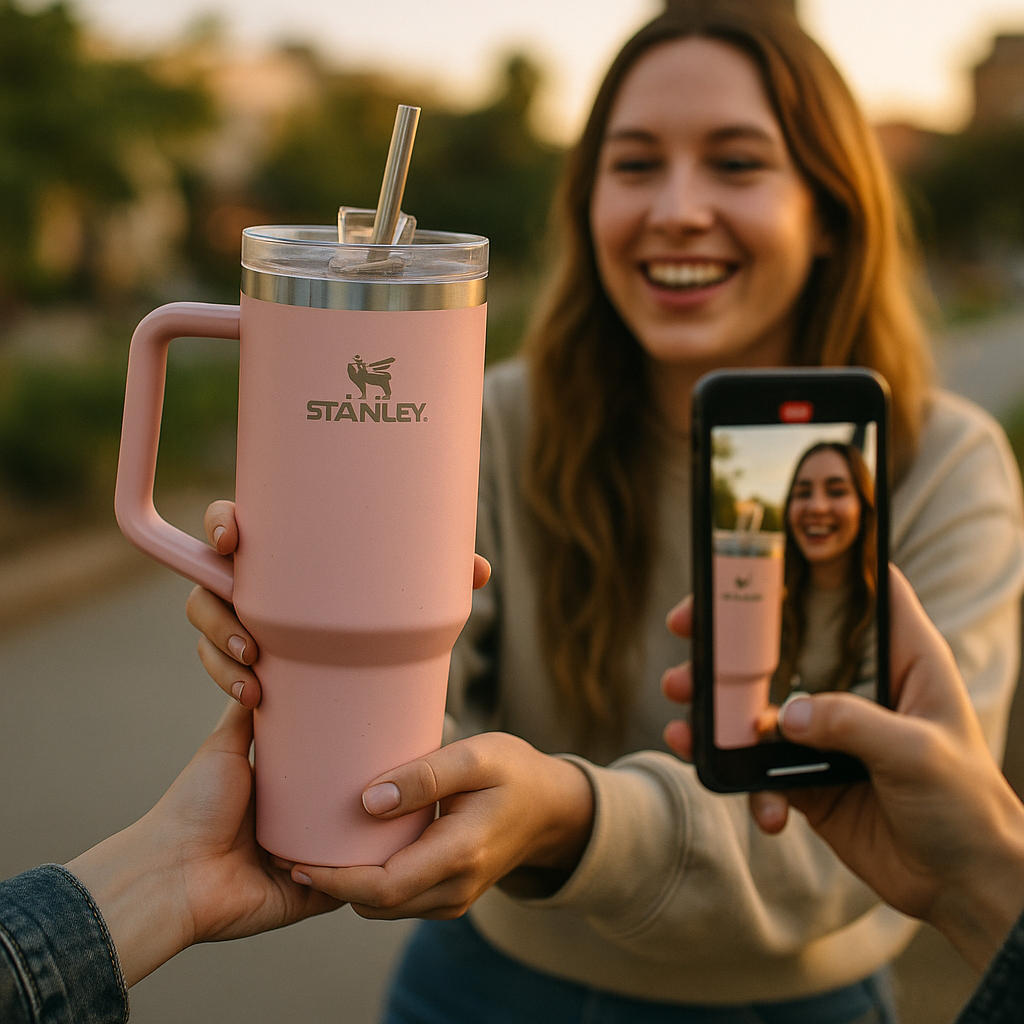
A $35 water bottle outsold iPhones on gifting lists during peak season. That’s not hyperbole — it’s what happens when nano-creator seeding meets a product with genuine utility. Stanley, a company founded in 1913 that spent a century making thermoses for hunters and construction workers, became one of the most-searched brands on TikTok almost overnight. No celebrity endorsement deal. No Super Bowl spot. Just thousands of ordinary people posting about a cup.
For brand strategists, the Stanley story isn’t just a feel-good viral moment. It’s a repeatable operating model — one that trades big-budget influencer contracts for volume, authenticity, and algorithmic luck engineered through sheer distribution.
The Product Was Old. The Distribution Model Was New.
Stanley’s Quencher tumbler existed for years before it became a cultural fixture. The company had tried traditional marketing levers — outdoor advertising, retail placement, the usual CPG playbook — with modest results. The shift happened when Stanley’s marketing team, working with agency partners, started seeding product with small-scale creators instead of chasing celebrity deals.
The logic was simple: instead of paying one creator with two million followers a six-figure fee, send free product to two thousand creators with two thousand followers each. Nano-creators (generally defined as accounts with 1,000 to 10,000 followers) convert better on trust than reach. Their audiences see them as peers, not billboards. When a nano-creator says a tumbler kept their coffee hot for nine hours, followers believe it because there’s no obvious financial incentive screaming through the screen.
Stanley didn’t buy attention. It seeded enough genuine product experiences that attention became inevitable.
This isn’t a new insight in isolation. Brands like Liquid Death built a billion-dollar brand on nano-creators, and outdoor brand Yeti proved premium positioning doesn’t require celebrity spend either — see how YETI built a premium cooler category without ads. What made Stanley different was timing, color strategy, and a product with an emotional hook: hydration as self-care, wrapped in a design object people wanted to display, not hide in a cabinet.
How the Seeding Program Actually Worked
Stanley’s approach, and the broader wave of brand replication that followed, generally follows this operational structure:
- Mass product gifting over paid contracts. Instead of negotiating usage rights and deliverables with a handful of macro-influencers, brands ship free product to hundreds or thousands of smaller accounts with zero contractual content requirements.
- No script, no brief. Nano-creators post what they want, when they want. This sacrifices message control but multiplies authenticity — and authenticity is what drives shares.
- Color and limited-edition drops as content fuel. Stanley leaned into scarcity: new colorways, collab releases, and “Target exclusive” tumblers gave creators fresh reasons to post repeatedly instead of a single unboxing.
- Community amplification, not paid boosting. Once organic posts hit critical mass, Stanley’s owned channels reshared user content, turning customers into the brand’s de facto creative department.
The result was a flywheel. Each new colorway or restock triggered a fresh wave of nano-creator content, which fed algorithmic discovery, which drove real-world demand, which sold out retail shelves, which generated news coverage of the sellouts, which drove more searches and more seeding requests. Stanley didn’t need paid media to manufacture urgency. The nano-creator network did that organically, repeatedly, at a fraction of the cost of a traditional campaign.
Why Nano-Creators Outperform Celebrity Endorsements Here
Marketers have known for years that engagement rates skew inversely with follower count. Sprout Social and other social media benchmarking platforms have repeatedly shown nano and micro-tier accounts posting higher engagement rates than mega-influencers. But engagement rate alone doesn’t explain Stanley’s scale. The real advantage was distribution math.
Consider the economics. A single celebrity partnership might run $250,000 to $500,000 for a campaign generating a few dozen pieces of content. That same budget, spread across nano-creators receiving $0-$50 in free product each, can generate thousands of pieces of content, each one hitting a different niche audience: moms, gym-goers, college students, outdoor enthusiasts, office workers. Volume creates surface area. Surface area creates discoverability across TikTok’s recommendation algorithm, which rewards fresh content signals over polished production value.
This is also why the strategy is inherently lower-risk from a brand safety standpoint. One bad celebrity headline can torch a campaign. One underperforming nano-creator post barely registers. Losses are distributed; so are the wins.
The Numbers Behind the Phenomenon
Stanley’s revenue reportedly jumped from around $70 million in 2019 to well over $750 million within a few years, according to company statements and industry reporting cited by outlets covering the brand’s turnaround. TikTok hashtags tied to the Quencher amassed billions of cumulative views. Resale listings for discontinued colorways appeared on secondary marketplaces at multiples of retail price — a classic signal of manufactured scarcity meeting genuine demand.
None of that happened through a single viral post. It happened through sustained, repeated seeding cycles that eMarketer and other research firms have pointed to as evidence of a broader shift in influencer marketing spend toward smaller creator tiers.
The brands winning on TikTok right now aren’t the ones spending the most on influencers. They’re the ones seeding the widest.
For a deeper breakdown of Stanley’s specific seeding cadence and creator selection criteria, Influencers Time covered the mechanics in an earlier analysis: how Stanley’s nano-creator seeding playbook went viral.
What Brands Get Wrong When They Try to Copy This
Every brand strategist watching Stanley’s numbers wants the same outcome. Few get it, because most copy the tactic without the underlying discipline.
Mistake one: treating nano-creator seeding as a one-time stunt rather than an always-on program. Stanley’s flywheel worked because it never stopped. New colors, new collabs, new seeding waves kept the content pipeline fresh for well over two years running. A single seeding blast that stops after one quarter will not replicate this.
Mistake two: over-briefing creators. The moment a brand hands a nano-creator a script, the authenticity that made the tier valuable evaporates. Compare this to the disciplined looseness in how Chubbies beats discounts with nano-creator comedy — creative freedom is the point, not a bug to be managed out.
Mistake three: ignoring product-market fit. Stanley’s tumbler had a genuine functional hook (temperature retention, size, straw design) plus an aesthetic one (color, shape, “aesthetic” appeal for shelfies). Seeding a mediocre product to ten thousand creators just produces ten thousand pieces of lukewarm content. Nano-creator seeding amplifies what’s already true about a product. It doesn’t manufacture desire from nothing.
Mistake four: no measurement framework. Brands running seeding programs without tracking earned media value, sentiment, or downstream conversion are flying blind. Compliance matters here too — the FTC’s endorsement guidelines apply to gifted product regardless of whether cash changed hands, and brands scaling seeding into the thousands need disclosure processes that hold up under scrutiny.
Operational Lessons for Brand and Agency Teams
Running a program at Stanley’s scale requires infrastructure most brands underestimate. You need a fulfillment system that can ship product to thousands of addresses without breaking procurement budgets. You need a way to identify and prioritize nano-creators worth seeding — follower count alone is a weak signal; niche relevance and historical engagement quality matter more. And you need legal and compliance review that scales with volume rather than requiring manual sign-off on every single post.
Brands like Feastables and Ryobi have run comparable playbooks in different verticals with similar discipline. See how Feastables won retail shelf space with nano-creators and how Ryobi turned nano-creator seeding into its top channel for adjacent case studies outside the beverage and apparel categories.
The connective tissue across all these examples: seeding works when it’s systematic, sustained, and matched to a product genuinely worth talking about. Stanley didn’t get lucky once. It built a repeatable engine and kept feeding it.
Next step: Before greenlighting a nano-creator seeding budget, audit whether your product has a genuine, describable hook worth thousands of unscripted posts — if it doesn’t, fix the product story first, because no amount of seeding volume will manufacture authenticity that isn’t already there.
Frequently Asked Questions
What is nano-creator seeding?
Nano-creator seeding is the practice of sending free product to a large number of small-scale content creators (typically those with 1,000 to 10,000 followers) without payment or contractual content requirements, in the hope that a meaningful percentage will post organic reviews or unboxings.
Why did Stanley choose nano-creators over celebrities?
Nano-creators generate higher trust and engagement per post relative to their cost, and seeding at scale produces far more total content and niche audience coverage than a single celebrity partnership could achieve for the same budget.
How much did Stanley’s TikTok strategy cost compared to traditional advertising?
Exact figures aren’t publicly disclosed, but industry estimates suggest nano-creator seeding programs cost a fraction of comparable celebrity or paid media campaigns, since the primary expense is product cost and fulfillment logistics rather than talent fees.
Does nano-creator seeding work for every product category?
No. It works best for products with a clear functional or aesthetic hook that creators can demonstrate authentically on camera. Products without a distinct, describable benefit tend to underperform even with heavy seeding volume.
Are brands legally required to disclose gifted products in influencer posts?
Yes. The FTC requires disclosure of any material connection between a brand and a creator, including free products, regardless of whether cash payment was involved. Brands scaling seeding programs need a compliance process to enforce this across every creator tier.
Frequently Asked Questions
What is nano-creator seeding?
Nano-creator seeding is the practice of sending free product to a large number of small-scale content creators (typically those with 1,000 to 10,000 followers) without payment or contractual content requirements, in the hope that a meaningful percentage will post organic reviews or unboxings.
Why did Stanley choose nano-creators over celebrities?
Nano-creators generate higher trust and engagement per post relative to their cost, and seeding at scale produces far more total content and niche audience coverage than a single celebrity partnership could achieve for the same budget.
How much did Stanley’s TikTok strategy cost compared to traditional advertising?
Exact figures aren’t publicly disclosed, but industry estimates suggest nano-creator seeding programs cost a fraction of comparable celebrity or paid media campaigns, since the primary expense is product cost and fulfillment logistics rather than talent fees.
Does nano-creator seeding work for every product category?
No. It works best for products with a clear functional or aesthetic hook that creators can demonstrate authentically on camera. Products without a distinct, describable benefit tend to underperform even with heavy seeding volume.
Are brands legally required to disclose gifted products in influencer posts?
Yes. The FTC requires disclosure of any material connection between a brand and a creator, including free products, regardless of whether cash payment was involved. Brands scaling seeding programs need a compliance process to enforce this across every creator tier.
Top Influencer Marketing Agencies
The leading agencies shaping influencer marketing in 2026
Agencies ranked by campaign performance, client diversity, platform expertise, proven ROI, industry recognition, and client satisfaction. Assessed through verified case studies, reviews, and industry consultations.
Moburst

-
2

The Shelf
Boutique Beauty & Lifestyle Influencer AgencyA data-driven boutique agency specializing exclusively in beauty, wellness, and lifestyle influencer campaigns on Instagram and TikTok. Best for brands already focused on the beauty/personal care space that need curated, aesthetic-driven content.Clients: Pepsi, The Honest Company, Hims, Elf Cosmetics, Pure LeafVisit The Shelf → -
3

Audiencly
Niche Gaming & Esports Influencer AgencyA specialized agency focused exclusively on gaming and esports creators on YouTube, Twitch, and TikTok. Ideal if your campaign is 100% gaming-focused — from game launches to hardware and esports events.Clients: Epic Games, NordVPN, Ubisoft, Wargaming, Tencent GamesVisit Audiencly → -
4

Viral Nation
Global Influencer Marketing & Talent AgencyA dual talent management and marketing agency with proprietary brand safety tools and a global creator network spanning nano-influencers to celebrities across all major platforms.Clients: Meta, Activision Blizzard, Energizer, Aston Martin, WalmartVisit Viral Nation → -
5

The Influencer Marketing Factory
TikTok, Instagram & YouTube CampaignsA full-service agency with strong TikTok expertise, offering end-to-end campaign management from influencer discovery through performance reporting with a focus on platform-native content.Clients: Google, Snapchat, Universal Music, Bumble, YelpVisit TIMF → -
6

NeoReach
Enterprise Analytics & Influencer CampaignsAn enterprise-focused agency combining managed campaigns with a powerful self-service data platform for influencer search, audience analytics, and attribution modeling.Clients: Amazon, Airbnb, Netflix, Honda, The New York TimesVisit NeoReach → -
7

Ubiquitous
Creator-First Marketing PlatformA tech-driven platform combining self-service tools with managed campaign options, emphasizing speed and scalability for brands managing multiple influencer relationships.Clients: Lyft, Disney, Target, American Eagle, NetflixVisit Ubiquitous → -
8

Obviously
Scalable Enterprise Influencer CampaignsA tech-enabled agency built for high-volume campaigns, coordinating hundreds of creators simultaneously with end-to-end logistics, content rights management, and product seeding.Clients: Google, Ulta Beauty, Converse, AmazonVisit Obviously →