


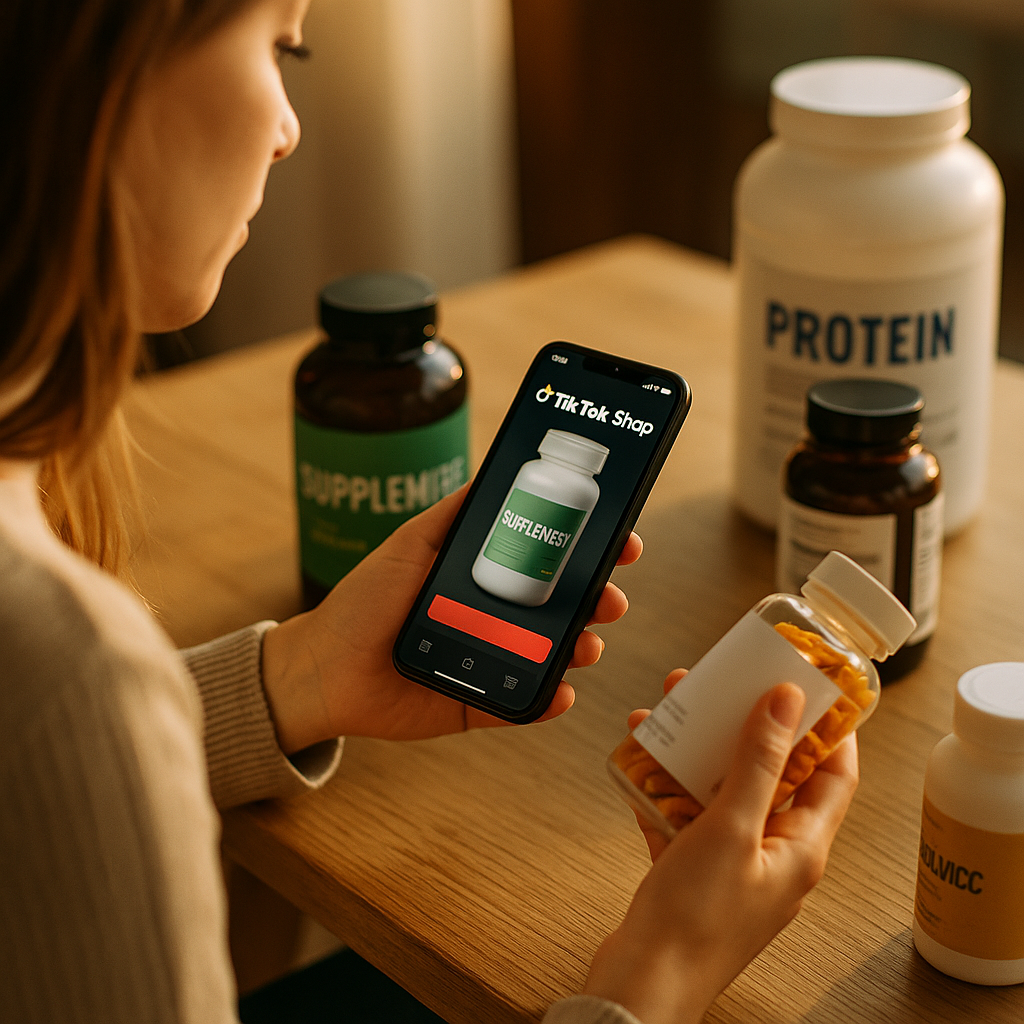
A single TikTok Shop livestream can move more supplement inventory in three hours than a brand’s entire DTC site moves in a month. That’s not hyperbole — it’s the new baseline for TikTok Shop supplement marketing, and it’s forcing brand teams, legal counsel, and creator managers into rooms together for the first time. The category is booming. It’s also one FTC warning letter away from a very public mess.
The Impulse-Buy Machine Nobody Fully Planned For
Supplements were never supposed to be an impulse category. High consideration, health-adjacent, often expensive relative to a candy bar or phone case — the traditional funnel assumed research, comparison, maybe a doctor’s nod. TikTok Shop broke that assumption.
Scroll-stop, demo, discount code, checkout — all inside the app, all in under sixty seconds. Gummy vitamins, greens powders, magnesium blends, and “cortisol cocktail” mixers have become some of the platform’s fastest-moving SKUs. eMarketer has repeatedly flagged health and wellness as one of TikTok Shop’s highest-growth verticals, and internal brand data circulating among agency partners suggests conversion rates on supplement livestreams can run several multiples higher than static product pages.
When checkout friction disappears, purchase intent gets manufactured in real time by the creator, not researched in advance by the customer.
That’s the core shift. Brands used to build trust, then ask for the sale. On TikTok Shop, the sale happens mid-trust-build, often before the claim has been fact-checked by anyone but the algorithm’s engagement signals.
Why Conversion Data Looks So Good (And Why That’s the Problem)
Marketers love a good conversion number, and TikTok Shop supplement campaigns generate plenty. Affiliate creators pushing a joint-support formula or a sleep gummy can post GMV numbers that dwarf paid social benchmarks. Commission structures reward volume, and volume rewards bold claims. That’s the uncomfortable math.
Brands running affiliate programs at scale — hundreds of creators, tiered commissions, leaderboard incentives — often don’t review every video before it goes live. They can’t. The affiliate leaderboard model is built for speed and volume, not pre-clearance. A creator chasing a commission bump has every incentive to say “cures anxiety” instead of “may support relaxation.” One phrasing converts better. The other one is legally defensible.
This is where conversion data and compliance risk start pulling in opposite directions. The videos generating the best ROAS are frequently the ones making the claims your legal team would never approve in a written brief.
What the Compliance Exposure Actually Looks Like
The FTC has been explicit about endorsement guidelines for years, and supplement marketing sits in one of its most scrutinized categories. Structure/function claims (“supports immune health”) are generally permissible without FDA pre-approval. Disease claims (“treats depression,” “reverses inflammation”) are not — and creators, chasing watch time and commission, blur that line constantly.
- Unsubstantiated health claims: Creators making medical claims the brand never approved, exposing the brand to FTC action regardless of who said it.
- Missing disclosure: Paid partnerships or affiliate links not properly flagged, which now carries reach penalties on top of legal risk — see how labeling rules throttle reach when disclosure is sloppy.
- Ingredient misrepresentation: Dosages, sourcing, or third-party testing claims that don’t match what’s on the actual label.
- Before/after implication: Weight loss or skin transformation content implying guaranteed results from a supplement.
Brands are on the hook for affiliate claims even when they didn’t write the script. The FTC’s position, reiterated across multiple enforcement actions, is that brands bear responsibility for material misrepresentations made by their marketing partners — including unpaid or commission-only affiliates. Ignorance isn’t a defense; it’s a liability multiplier. Review the FTC’s endorsement guidance directly if your legal team hasn’t updated its playbook this year.
Where the Money Actually Comes From: Livestream, Not Feed
Feed content builds awareness. Livestream builds the register receipt. Supplement brands running continuous livestream formats report that a disproportionate share of GMV comes from a small number of high-frequency streaming hosts, not from viral one-off videos.
Why does livestream convert so much harder for this category? A few reasons stack together:
- Scarcity mechanics — countdown timers and limited-stock call-outs create urgency that a static product page can’t replicate. See the mechanics breakdown in countdown livestream strategy.
- Real-time objection handling — hosts answer “will this interact with my meds” on the spot, removing friction that would otherwise kill the sale.
- Social proof compounding — viewer count and live purchase notifications stack credibility signals faster than reviews ever could.
- Checkout speed — TikTok’s in-app purchase flow removes almost every step between “I want this” and “I bought this.” The mechanics are covered well in the checkout speed research on how fast paths change creative strategy.
Compare that to Instagram Shopping or YouTube Shopping, where the path to purchase still involves more taps and less real-time persuasion. The checkout speed comparison across platforms makes clear that TikTok’s advantage isn’t audience size — it’s friction removal.
The Risk Nobody Prices In: Reputational, Not Just Legal
Fines are one risk. Brand equity damage is the quieter, more expensive one. A viral “this brand’s affiliate said their gummy cured my panic attacks” screenshot doesn’t need an FTC letter to do damage — it just needs a few thousand shares and a skeptical comment section.
Supplement categories already carry inherent skepticism. Consumers have seen enough MLM-adjacent wellness grifts to have their guard up. When a brand’s affiliate program produces content that reads like a scam ad, it doesn’t just hurt that one creator’s credibility — it drags the brand’s entire TikTok Shop storefront down with it, including organic search visibility inside the app. That matters more than most teams realize, given how TikTok search behavior now drives product discovery independent of the For You feed.
One bad claim doesn’t just risk a fine — it can poison how the algorithm and consumers perceive the entire storefront.
Building a Compliance Layer Without Killing Velocity
The instinct for legal and compliance teams is to slow everything down: pre-approve every script, mandate review windows, cap affiliate counts. That instinct, applied bluntly, kills the exact velocity that makes TikTok Shop valuable in the first place. Smarter brands are building lighter, faster guardrails instead.
- Claims libraries, not full script approval. Give affiliates a pre-cleared list of approved phrases and a clear list of banned words (“cure,” “treat,” “reverse,” “guaranteed”). This scales faster than line-by-line review.
- Tiered vetting by commission level. Your highest-earning affiliates — the ones driving real GMV — get more scrutiny and direct relationship management. Long-tail micro-affiliates get automated claim-scanning tools instead. This mirrors the broader shift toward trust-based creator vetting rather than blanket rules.
- Post-publish monitoring, not just pre-publish gates. Tools that scan live and recently posted content for flagged language let brands catch problems within hours instead of finding out from a regulator months later.
- Disclosure templates baked into the affiliate onboarding flow. Make #ad and #partner tagging a non-negotiable step before commission tracking even activates.
None of this is exotic. It’s the same operational discipline that social media governance frameworks have pushed for years, just applied to a much faster, higher-stakes commerce channel.
What Good Creator Vetting Looks Like for Supplements Specifically
Generic creator vetting checks engagement rate and audience fit. Supplement vetting needs an extra layer: does this creator have a history of medical-claim violations, MLM affiliations, or “miracle cure” content patterns? A quick content audit before onboarding catches most of the obvious risks before they become the brand’s problem.
Brands running nano creator amplification programs for supplements should apply the same claims discipline even at small scale — a nano creator’s video getting boosted into paid media inherits all the same FTC exposure as a top affiliate’s, just with less oversight typically applied.
Where This Category Goes Next
Expect three things to accelerate. First, TikTok itself will likely tighten enforcement on health claims proactively, given regulatory pressure and the platform’s own interest in avoiding a supplement-fraud narrative. Second, brands will increasingly build in-house compliance tooling rather than relying on TikTok’s native reporting, because reactive moderation is too slow for a live-commerce environment. Third, the winners in this category will be brands that treat compliance as a creative constraint, not a blocker — the same way strong copywriters treat a word count limit.
The brands getting this right aren’t the ones with the flashiest livestream production. They’re the ones who built the claims library before the first affiliate went live, and who treat every commission spike as a signal to check content, not just celebrate revenue. That discipline is the actual moat in a category this easy to enter and this easy to get burned in.
Frequently Asked Questions
Is TikTok Shop actually profitable for supplement brands, or just high-volume?
Many supplement brands report strong short-term GMV on TikTok Shop, but margin depends heavily on commission tiers and discount depth used to drive livestream urgency. Profitability requires modeling affiliate commission costs alongside product margin, not just tracking top-line sales.
Who is legally responsible when an affiliate makes a false health claim?
Under FTC guidance, the brand can be held responsible for material misrepresentations made by its marketing partners, including unpaid or commission-based affiliates, even without direct brand involvement in the script.
What supplement claims are considered high-risk on TikTok Shop?
Disease claims (curing, treating, or reversing a medical condition), guaranteed outcome language, and unverified before/after transformation claims carry the highest regulatory and reputational risk.
Does compliance review slow down TikTok Shop performance?
Heavy-handed, script-by-script approval can slow velocity significantly. Lighter frameworks like pre-approved claims libraries and post-publish monitoring maintain speed while reducing exposure.
How is TikTok Shop different from Instagram Shopping for supplements?
TikTok Shop’s in-app checkout and livestream urgency mechanics generally produce faster, more impulse-driven conversion than Instagram Shopping, which typically involves more steps between discovery and purchase.
The next audit worth running isn’t of your top creators’ follower counts — it’s of their last ten videos’ claims language. Do that before your legal team finds a problem for you.
Top Influencer Marketing Agencies
The leading agencies shaping influencer marketing in 2026
Agencies ranked by campaign performance, client diversity, platform expertise, proven ROI, industry recognition, and client satisfaction. Assessed through verified case studies, reviews, and industry consultations.
Moburst

-
2

The Shelf
Boutique Beauty & Lifestyle Influencer AgencyA data-driven boutique agency specializing exclusively in beauty, wellness, and lifestyle influencer campaigns on Instagram and TikTok. Best for brands already focused on the beauty/personal care space that need curated, aesthetic-driven content.Clients: Pepsi, The Honest Company, Hims, Elf Cosmetics, Pure LeafVisit The Shelf → -
3

Audiencly
Niche Gaming & Esports Influencer AgencyA specialized agency focused exclusively on gaming and esports creators on YouTube, Twitch, and TikTok. Ideal if your campaign is 100% gaming-focused — from game launches to hardware and esports events.Clients: Epic Games, NordVPN, Ubisoft, Wargaming, Tencent GamesVisit Audiencly → -
4

Viral Nation
Global Influencer Marketing & Talent AgencyA dual talent management and marketing agency with proprietary brand safety tools and a global creator network spanning nano-influencers to celebrities across all major platforms.Clients: Meta, Activision Blizzard, Energizer, Aston Martin, WalmartVisit Viral Nation → -
5

The Influencer Marketing Factory
TikTok, Instagram & YouTube CampaignsA full-service agency with strong TikTok expertise, offering end-to-end campaign management from influencer discovery through performance reporting with a focus on platform-native content.Clients: Google, Snapchat, Universal Music, Bumble, YelpVisit TIMF → -
6

NeoReach
Enterprise Analytics & Influencer CampaignsAn enterprise-focused agency combining managed campaigns with a powerful self-service data platform for influencer search, audience analytics, and attribution modeling.Clients: Amazon, Airbnb, Netflix, Honda, The New York TimesVisit NeoReach → -
7

Ubiquitous
Creator-First Marketing PlatformA tech-driven platform combining self-service tools with managed campaign options, emphasizing speed and scalability for brands managing multiple influencer relationships.Clients: Lyft, Disney, Target, American Eagle, NetflixVisit Ubiquitous → -
8

Obviously
Scalable Enterprise Influencer CampaignsA tech-enabled agency built for high-volume campaigns, coordinating hundreds of creators simultaneously with end-to-end logistics, content rights management, and product seeding.Clients: Google, Ulta Beauty, Converse, AmazonVisit Obviously →