


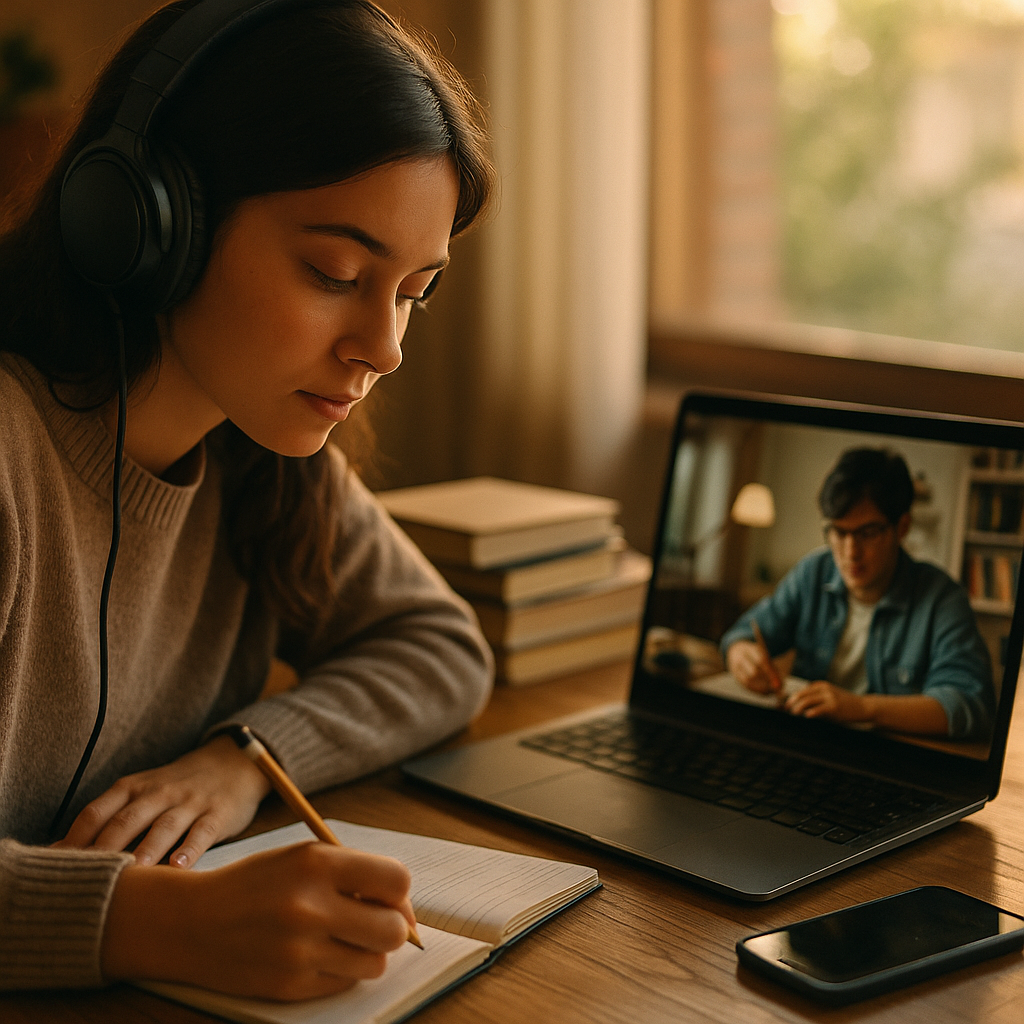
Twitch and YouTube “study with me” streams routinely run four to ten hours. Viewers leave them open in a second tab for an entire workday. No other ad format buys that kind of dwell time — and almost none of it is being monetized well. The ambient workspace format is quietly becoming one of the most efficient placements in the creator economy, precisely because it doesn’t ask for attention. It just asks to be present.
That’s the pitch. It’s also the risk. Brands used to fifteen-second hooks and hard CTAs tend to overproduce these streams, and overproduction kills the entire appeal. Here’s how to think about the format if you’re the one signing off on the brief.
What Is an Ambient Workspace Stream, Exactly?
Study-with-me and work-with-me content is exactly what it sounds like: a creator sits at a desk, works or studies in near-silence (sometimes with lo-fi beats, sometimes with a Pomodoro timer overlay), and streams it live or as a long-form VOD. No commentary. No jump cuts. The entire value proposition is co-presence — viewers feel like they’re grinding alongside someone else.
The genre exploded out of Korean and Japanese YouTube (“공부 브이로그” study vlogs) and has since become a staple across Twitch’s “Just Chatting” category and YouTube Live. Some channels run 24/7 rotating streams. Others post nightly two-hour sessions timed to exam season or fiscal quarter-end crunch.
The audience is dense with exactly the demographic brands overpay to reach elsewhere: students, freelancers, remote workers, job seekers — people voluntarily building a habit loop around focus and productivity content.
An ambient stream doesn’t compete for attention against fifty other tabs. It is one of the tabs the viewer chooses to keep open for hours — which makes low-friction, high-frequency brand exposure possible in a way a 30-second pre-roll never could.
Why Traditional Product Placement Breaks This Format
Drop a scripted read into a study-with-me stream and you’ve broken the spell. The entire appeal is that nothing is performing for the camera. Viewers who tune into ambient content are explicitly opting out of high-energy marketing content — they’re there for the opposite of a TikTok Shop live sale.
This is the same trap brands fell into with early ASMR and slow-content briefs: treat it like a normal ad slot, and the format collapses. We’ve seen the identical failure mode in ASMR ingredient pour content, where a hard sell mid-pour tanks retention instantly. Ambient workspace content has an even lower tolerance threshold because the viewer’s brain is in a low-arousal state. A jarring CTA doesn’t just annoy — it feels like an intrusion into someone else’s workspace, which is uncomfortable in a way a skippable pre-roll isn’t.
So what actually works? Placement, not pitch.
- Desk real estate: A branded water bottle, notebook, or supplement bottle visibly in frame, used naturally over the session, not gestured at.
- Tool integration: The creator genuinely uses a productivity app, noise-canceling headset, or desk lamp on camera because it’s part of their actual setup.
- Soft overlays: A small, static sponsor bug or “today’s session brought to you by” caption card at stream start and during scheduled breaks — never mid-flow.
- Break-segment mentions: Most study-with-me formats build in five-minute break intervals (Pomodoro-style). That’s the only natural window for a 10-15 second verbal mention.
The Break-Segment Is Your Only Real Ad Unit
If you brief nothing else correctly, brief the break segment. Pomodoro-format streams (25 minutes on, 5 minutes off) create a built-in, expected interruption point. Viewers anticipate it. It doesn’t feel like an ad break because the format already trained them to expect a pause.
This is where a brand can get an actual verbal mention, a product demo, or a short screen-share without breaking immersion. Treat the other 25-minute blocks as sacred and untouchable. That discipline is the entire negotiation with the creator — and it’s worth putting in writing.
Building the Brief Without Killing Authenticity
Most influencer briefs are built for short-form hooks: strong opener, mid-roll reveal, CTA in the last three seconds. None of that logic applies here. A workable ambient brief needs to specify:
Frequency, not scripting. Tell the creator how many times the product should appear in frame or get mentioned per hour-long session — not what to say. One or two natural touchpoints per session is usually the ceiling before it reads as sponsored content dressed up as ambient content.
Duration of exposure over intensity of pitch. A protein shaker sitting on the desk for a three-hour stream delivers more actual impressions than a ten-second callout. This is a passive-exposure model closer to stadium signage than a traditional creator ad read — measure it accordingly.
Disclosure placement that doesn’t disrupt the mood. The FTC’s endorsement guidance still applies in full to livestreams, including ambient ones. A static #ad tag in the stream overlay, present for the full session, satisfies “clear and conspicuous” far better than a single spoken disclosure buried in hour two. Persistent on-screen disclosure is the safest default for any long-form live format — a lesson brands have already learned the hard way in livestream commerce brief frameworks.
A no-go list, not a talking-points list. Give the creator boundaries (no disparaging competitor tools, no health claims on supplements, no pricing promises that might change) and then let them integrate the product in their own words during the break window.
Compliance Risk Is Different Here — and Underestimated
Because there’s no script and minimal direct interaction, brands sometimes assume ambient placements carry lower compliance risk. That’s backwards. Long, unscripted live formats are actually harder to monitor in real time, and a creator who goes off-brief for three hours unsupervised is a bigger liability than one reading a 30-second script.
Build monitoring into the brief itself: require a mid-stream check-in, request VOD delivery within 24 hours for review, and set clear expectations before the disclosure discussion happens, not after a complaint. The same operational logic that governs compliance-heavy livestream formats applies here — just stretched across a much longer runtime.
There’s also a subtler risk: viewer trust erosion over time. An audience that watches the same creator’s stream nightly will notice if sponsor placements escalate week over week. Cap the cadence contractually. A single brand shouldn’t sponsor more than two or three sessions per week with the same creator, or the “ambient” framing starts to look like a permanent infomercial.
Measuring a Format That Wasn’t Built for Metrics
Standard influencer KPIs — click-through rate, swipe-ups, immediate conversion — don’t map cleanly onto ambient content. Nobody’s clicking a link while they’re deep in a study session. What you’re actually buying is:
- Average concurrent viewers × session length as a proxy for total exposure minutes, closer to a broadcast impressions model than a social engagement one.
- Branded search lift during and after stream windows — Google Trends and internal search data are more useful here than platform analytics.
- Discount code or affiliate link usage logged post-stream, since conversion is delayed, not immediate.
- Repeat exposure rate — how many viewers return across multiple sponsored sessions, which platforms like Sprout Social and native creator dashboards can help track over time.
Set expectations with stakeholders before the campaign, not after. This is a brand-awareness and habitual-exposure play, closer in spirit to eMarketer’s reporting on connected-TV ad tolerance than to short-form influencer benchmarks. If your CFO wants same-week ROAS, this isn’t the budget line to pitch it against.
One more practical note: ambient streams generate enormous amounts of raw footage that go mostly unused. Smart teams are already clipping highlight moments, break-segment mentions, and desk-setup B-roll into short-form cutdowns for other channels — a tactic covered in depth in turning one livestream into a week of content. A three-hour ambient stream can quietly fund five or six pieces of secondary content without any additional production spend.
Who Should Actually Run This Play
This format rewards categories with genuine desk or study relevance: productivity software, note-taking apps, beverage and supplement brands, headphones, desk hardware, online course platforms, and financial services targeting students or early-career professionals. It works poorly for anything that requires visual demonstration or urgency — flash sales, fashion drops, anything impulse-driven.
If your brand doesn’t have a natural reason to be on someone’s desk for three hours, this isn’t your format. Force it, and you’ll get the same backlash brands see when they misjudge tone in low-intervention creator formats — viewers notice when a placement doesn’t belong.
Start small: one creator, one week, break-segment placements only, and a VOD-review clause in the contract. Measure exposure minutes and branded search lift before scaling spend, and resist the urge to script what should stay ambient.
FAQs
What counts as an ambient workspace stream?
Long-form, low-energy livestream content — typically study-with-me or work-with-me formats — where a creator works quietly on camera for extended periods, often several hours, with minimal commentary or scripted content.
How do brands disclose sponsorships in a format with no dialogue?
A persistent on-screen overlay or caption card stating the sponsorship, visible for the full stream duration, is the safest approach under FTC guidance. It satisfies “clear and conspicuous” disclosure without requiring the creator to break the ambient mood verbally.
What’s a realistic budget benchmark for this format?
Rates vary widely by platform and audience size, but ambient placements typically price lower per session than scripted short-form content because production demands are minimal. Brands should negotiate based on average concurrent viewers and total session length rather than per-post rates.
Can this format work outside Twitch and YouTube?
Yes, though those two platforms dominate the category currently. Instagram Live and TikTok Live have shorter typical session lengths, which limits the exposure-minutes advantage, but shorter ambient formats (60-90 minute “focus sessions”) are emerging there too.
How many sponsor mentions per session is too many?
One to two natural touchpoints per hour-long block is generally the ceiling. Beyond that, viewers start perceiving the stream as sponsored content rather than ambient content, which undermines the trust the format depends on.
FAQs
What counts as an ambient workspace stream?
Long-form, low-energy livestream content — typically study-with-me or work-with-me formats — where a creator works quietly on camera for extended periods, often several hours, with minimal commentary or scripted content.
How do brands disclose sponsorships in a format with no dialogue?
A persistent on-screen overlay or caption card stating the sponsorship, visible for the full stream duration, is the safest approach under FTC guidance. It satisfies “clear and conspicuous” disclosure without requiring the creator to break the ambient mood verbally.
What’s a realistic budget benchmark for this format?
Rates vary widely by platform and audience size, but ambient placements typically price lower per session than scripted short-form content because production demands are minimal. Brands should negotiate based on average concurrent viewers and total session length rather than per-post rates.
Can this format work outside Twitch and YouTube?
Yes, though those two platforms dominate the category currently. Instagram Live and TikTok Live have shorter typical session lengths, which limits the exposure-minutes advantage, but shorter ambient formats (60-90 minute “focus sessions”) are emerging there too.
How many sponsor mentions per session is too many?
One to two natural touchpoints per hour-long block is generally the ceiling. Beyond that, viewers start perceiving the stream as sponsored content rather than ambient content, which undermines the trust the format depends on.
Top Influencer Marketing Agencies
The leading agencies shaping influencer marketing in 2026
Agencies ranked by campaign performance, client diversity, platform expertise, proven ROI, industry recognition, and client satisfaction. Assessed through verified case studies, reviews, and industry consultations.
Moburst

-
2

The Shelf
Boutique Beauty & Lifestyle Influencer AgencyA data-driven boutique agency specializing exclusively in beauty, wellness, and lifestyle influencer campaigns on Instagram and TikTok. Best for brands already focused on the beauty/personal care space that need curated, aesthetic-driven content.Clients: Pepsi, The Honest Company, Hims, Elf Cosmetics, Pure LeafVisit The Shelf → -
3

Audiencly
Niche Gaming & Esports Influencer AgencyA specialized agency focused exclusively on gaming and esports creators on YouTube, Twitch, and TikTok. Ideal if your campaign is 100% gaming-focused — from game launches to hardware and esports events.Clients: Epic Games, NordVPN, Ubisoft, Wargaming, Tencent GamesVisit Audiencly → -
4

Viral Nation
Global Influencer Marketing & Talent AgencyA dual talent management and marketing agency with proprietary brand safety tools and a global creator network spanning nano-influencers to celebrities across all major platforms.Clients: Meta, Activision Blizzard, Energizer, Aston Martin, WalmartVisit Viral Nation → -
5

The Influencer Marketing Factory
TikTok, Instagram & YouTube CampaignsA full-service agency with strong TikTok expertise, offering end-to-end campaign management from influencer discovery through performance reporting with a focus on platform-native content.Clients: Google, Snapchat, Universal Music, Bumble, YelpVisit TIMF → -
6

NeoReach
Enterprise Analytics & Influencer CampaignsAn enterprise-focused agency combining managed campaigns with a powerful self-service data platform for influencer search, audience analytics, and attribution modeling.Clients: Amazon, Airbnb, Netflix, Honda, The New York TimesVisit NeoReach → -
7

Ubiquitous
Creator-First Marketing PlatformA tech-driven platform combining self-service tools with managed campaign options, emphasizing speed and scalability for brands managing multiple influencer relationships.Clients: Lyft, Disney, Target, American Eagle, NetflixVisit Ubiquitous → -
8

Obviously
Scalable Enterprise Influencer CampaignsA tech-enabled agency built for high-volume campaigns, coordinating hundreds of creators simultaneously with end-to-end logistics, content rights management, and product seeding.Clients: Google, Ulta Beauty, Converse, AmazonVisit Obviously →