


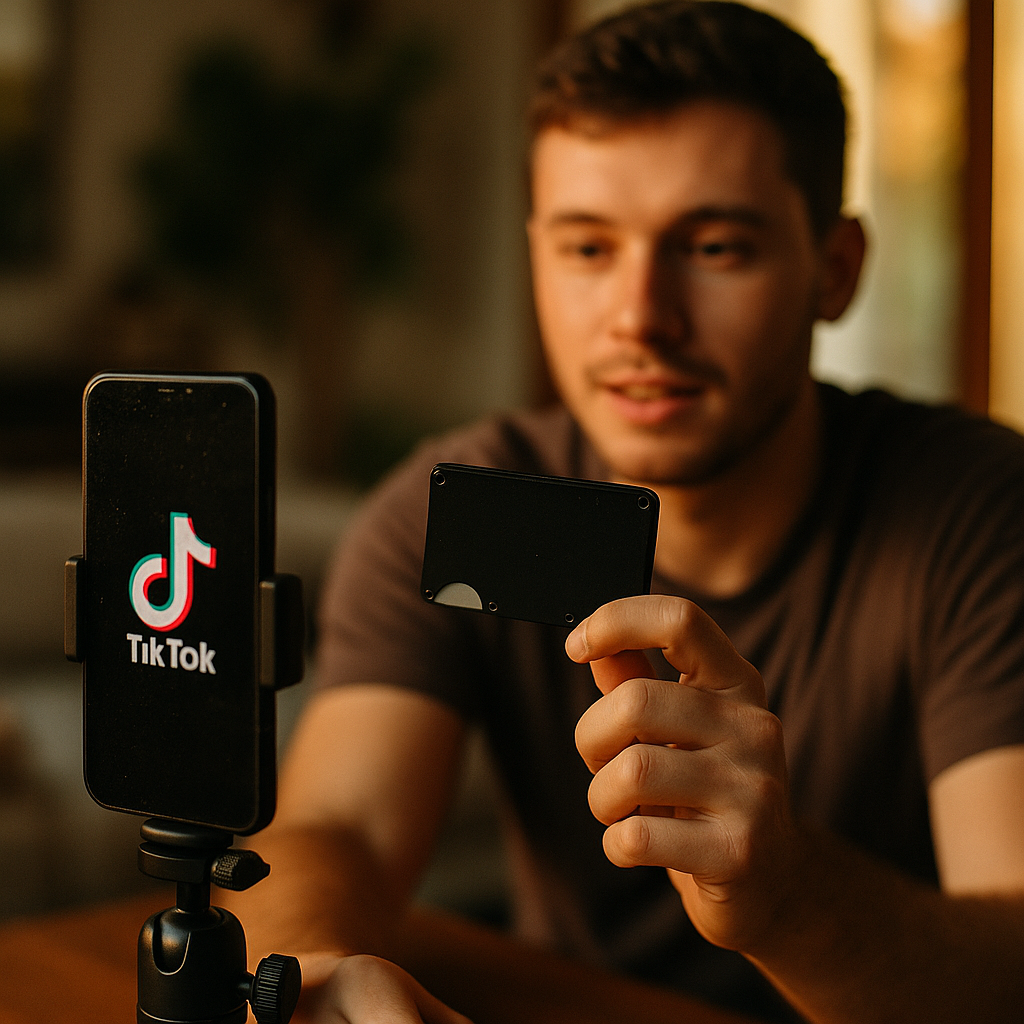
Wallets don’t sell themselves. Or so the accessories category believed, right up until a bald guy filming himself in a garage started moving millions of units without ever running a sitewide sale. Ridge Wallet’s founder-led TikTok strategy is now one of the clearest case studies in DTC of how product-first content beats discount-first marketing in a category everyone assumed was commoditized.
The men’s accessories space is brutal. Margins are thin, differentiation is hard, and every brand from Bellroy to generic Amazon knockoffs is fighting for the same “minimalist wallet” search terms. Ridge didn’t win by undercutting price. It won by making the founder the product demo.
A Category Built on Sameness
Minimalist wallets look alike. Metal card holder, RFID blocking, a strap or a clip. Consumers can’t tell brands apart from a product photo, and that’s exactly the trap most accessories companies fall into: they spend on paid social to explain features nobody can differentiate at a glance.
Ridge Wallet, founded by Sean Frank and Paul Kenny, faced this exact problem when it launched. Rather than compete on spec sheets, the brand leaned into founder visibility. Frank — who also runs growth for other DTC brands — became a recognizable face doing unboxings, teardown videos, and “why I built this” narratives directly on TikTok.
That’s a meaningfully different approach than the influencer-seeding model used by brands like Stanley’s tumbler push. Ridge didn’t outsource its story to hundreds of creators first. It proved the story worked with its own face before scaling distribution.
Why Founder-Led Demos Outperform Paid Discounts
Here’s the uncomfortable truth for a lot of brand marketers: discounting trains customers to wait for the next sale. It doesn’t build brand equity, and it erodes margin on a product that already has thin markup once you account for manufacturing and fulfillment.
Ridge’s founder-led demos did something discounts can’t. They built trust through repetition and specificity. A founder holding the wallet, showing exactly how the cash strap works, explaining the machining tolerances on the aluminum shell — that’s information a discount code never communicates.
Founder-led product demos convert skepticism into credibility faster than any promo code, because the person selling has visibly built the thing, not just marked it down.
TikTok data backs this up structurally, even if Ridge doesn’t publish granular numbers. Content featuring founders or clearly identifiable brand figures tends to outperform generic UGC on watch time and comment engagement, according to patterns Sprout Social has documented across creator-economy benchmarking. Viewers stick around longer when they believe they’re watching a real person stake their name on a claim.
This mirrors what Scrub Daddy did with founder-led TikTok content to hit nine figures in revenue. Both brands realized the founder’s credibility was a growth lever, not just a PR asset.
The Demo Format That Made the Difference
Ridge’s TikTok content follows a repeatable structure that any brand strategist can reverse-engineer:
- Cold open with a problem: bulky wallet, torn pockets, lost cards — visceral, relatable friction within the first two seconds.
- Physical demonstration: the founder handles the actual product on camera, no B-roll substitutes, no stock footage.
- Specific claims, not vague ones: “holds up to 12 cards,” “aircraft-grade aluminum,” “lifetime warranty” — details that survive a skeptical comment section.
- No urgency language: no “today only,” no countdown timers. The pitch is durability and design, not scarcity.
Compare that to the typical accessories ad: a model holding a wallet next to a “30% off” banner. Ridge’s format works because it treats the viewer like a buyer doing due diligence, not a bargain hunter waiting to be triggered by a discount.
It’s a similar demo-first logic to what powered Vessi’s TikTok Shop demo strategy and the supplement brand that tripled conversion with product demos. Show the thing working. Let the product do the persuading.
What This Means for Margin Protection
Discounting is a margin problem disguised as a growth tactic. Every dollar knocked off price is a dollar the brand can’t reinvest in production quality, customer service, or content. Ridge’s refusal to discount aggressively kept its average order value stable while competitors raced each other to the bottom during Black Friday and back-to-school promo cycles.
There’s a compliance angle here too, one brand teams underweight. Heavy reliance on discount codes tied to influencer affiliate links creates FTC disclosure complexity — every promo has to be tracked, tagged, and disclosed correctly under FTC endorsement guidelines. Founder-led organic content sidesteps a chunk of that operational overhead because it’s brand-owned, not creator-negotiated.
That doesn’t mean Ridge ignores affiliate or creator partnerships entirely. It means the foundation of the brand’s TikTok presence isn’t rented credibility from paid creators. It’s owned credibility from the person who built the product. Brands scaling affiliate programs on top of that foundation, similar to the layered approach in HelloFresh’s dual-strategy model, get the best of both: organic trust plus paid distribution efficiency.
Breaking Into Saturation Without a Blue Ocean
Every accessories brand claims to be “disrupting” a saturated category. Most aren’t. Ridge’s actual disruption wasn’t the product — RFID-blocking metal wallets existed before Ridge did. The disruption was distribution mechanics: turning a founder into a recurring content format that TikTok’s algorithm rewarded with organic reach.
This is a lesson other saturated categories keep relearning. YETI built a premium cooler category without heavy ad spend, and Aritzia sold out a core product line without discounting. None of these brands invented a new product category. They invented a new way to make an old category feel urgent again, without cutting price.
For marketing leads evaluating whether this playbook fits their own brand, the diagnostic question is simple: does your founder or a credible internal voice have the standing to demo the product convincingly on camera, repeatedly, without it feeling like a stunt? If yes, that’s a channel worth testing before reaching for another promo calendar.
Where AI and Creator Vetting Fit In
Ridge’s model is founder-first, but that doesn’t mean brands without a charismatic founder are locked out of the strategy. The underlying principle — demo-driven, low-discount content — scales through vetted nano-creators who can replicate the demo format at volume. Brands increasingly use AI tools to identify creators whose audience and content style match a founder-led tone, cutting the guesswork out of casting.
That’s the same efficiency logic behind AI-driven creator vetting cutting discovery costs by 40%. Once a demo format proves itself with the founder, AI-assisted vetting helps brands find creators who can extend that format without diluting the message. According to eMarketer, brands using structured creator vetting report materially lower cost-per-acquisition than those relying on broad influencer outreach.
The infrastructure question marketing teams should be asking isn’t “how many creators can we sign this quarter.” It’s “does our content format actually survive being repeated by someone other than the founder.” If the demo only works because of one person’s charisma, it’s not a scalable channel. If the format itself, the problem-solution-proof structure, is what converts, then it’s replicable across a creator roster.
The Takeaway
Ridge Wallet didn’t out-discount a saturated market; it out-demonstrated it. Brands sitting in commoditized categories should treat founder-led product demos as a credibility-building test before defaulting to markdowns, then use AI-assisted creator vetting to scale whatever format proves itself organically.
FAQs
Why did Ridge Wallet avoid heavy discounting on TikTok?
Discounting trains customers to wait for sales and erodes margin without building lasting brand trust. Ridge used founder-led product demos to build credibility instead, which protected pricing power and average order value.
What makes founder-led content more effective than paid influencer ads in this case?
Founder-led demos carry inherent credibility because the person on camera has a direct stake in the product’s quality. Viewers perceive this as lower-risk information than a paid endorsement, which tends to drive longer watch time and higher trust signals.
Can brands without a well-known founder replicate this strategy?
Yes. The core mechanic is a repeatable demo format, not celebrity. Brands can test the format with an internal voice or vetted nano-creators once the structure (problem, demonstration, specific claims, no artificial urgency) proves effective.
How does this approach affect compliance and disclosure requirements?
Founder-owned content reduces the disclosure complexity that comes with affiliate-driven discount codes, since it isn’t a third-party paid endorsement. Brands still running creator or affiliate programs alongside it must follow FTC endorsement guidelines for any compensated content.
What metrics should marketers track to know if a founder-led demo strategy is working?
Watch time, comment sentiment, saves, and organic reach are early signals. Longer-term, track average order value and repeat purchase rate to confirm the strategy is building brand equity rather than just short-term views.
FAQs
Why did Ridge Wallet avoid heavy discounting on TikTok?
Discounting trains customers to wait for sales and erodes margin without building lasting brand trust. Ridge used founder-led product demos to build credibility instead, which protected pricing power and average order value.
What makes founder-led content more effective than paid influencer ads in this case?
Founder-led demos carry inherent credibility because the person on camera has a direct stake in the product’s quality. Viewers perceive this as lower-risk information than a paid endorsement, which tends to drive longer watch time and higher trust signals.
Can brands without a well-known founder replicate this strategy?
Yes. The core mechanic is a repeatable demo format, not celebrity. Brands can test the format with an internal voice or vetted nano-creators once the structure proves effective.
How does this approach affect compliance and disclosure requirements?
Founder-owned content reduces the disclosure complexity that comes with affiliate-driven discount codes, since it isn’t a third-party paid endorsement. Brands still running creator or affiliate programs alongside it must follow FTC endorsement guidelines for any compensated content.
What metrics should marketers track to know if a founder-led demo strategy is working?
Watch time, comment sentiment, saves, and organic reach are early signals. Longer-term, track average order value and repeat purchase rate to confirm the strategy is building brand equity rather than just short-term views.
Top Influencer Marketing Agencies
The leading agencies shaping influencer marketing in 2026
Agencies ranked by campaign performance, client diversity, platform expertise, proven ROI, industry recognition, and client satisfaction. Assessed through verified case studies, reviews, and industry consultations.
Moburst

-
2

The Shelf
Boutique Beauty & Lifestyle Influencer AgencyA data-driven boutique agency specializing exclusively in beauty, wellness, and lifestyle influencer campaigns on Instagram and TikTok. Best for brands already focused on the beauty/personal care space that need curated, aesthetic-driven content.Clients: Pepsi, The Honest Company, Hims, Elf Cosmetics, Pure LeafVisit The Shelf → -
3

Audiencly
Niche Gaming & Esports Influencer AgencyA specialized agency focused exclusively on gaming and esports creators on YouTube, Twitch, and TikTok. Ideal if your campaign is 100% gaming-focused — from game launches to hardware and esports events.Clients: Epic Games, NordVPN, Ubisoft, Wargaming, Tencent GamesVisit Audiencly → -
4

Viral Nation
Global Influencer Marketing & Talent AgencyA dual talent management and marketing agency with proprietary brand safety tools and a global creator network spanning nano-influencers to celebrities across all major platforms.Clients: Meta, Activision Blizzard, Energizer, Aston Martin, WalmartVisit Viral Nation → -
5

The Influencer Marketing Factory
TikTok, Instagram & YouTube CampaignsA full-service agency with strong TikTok expertise, offering end-to-end campaign management from influencer discovery through performance reporting with a focus on platform-native content.Clients: Google, Snapchat, Universal Music, Bumble, YelpVisit TIMF → -
6

NeoReach
Enterprise Analytics & Influencer CampaignsAn enterprise-focused agency combining managed campaigns with a powerful self-service data platform for influencer search, audience analytics, and attribution modeling.Clients: Amazon, Airbnb, Netflix, Honda, The New York TimesVisit NeoReach → -
7

Ubiquitous
Creator-First Marketing PlatformA tech-driven platform combining self-service tools with managed campaign options, emphasizing speed and scalability for brands managing multiple influencer relationships.Clients: Lyft, Disney, Target, American Eagle, NetflixVisit Ubiquitous → -
8

Obviously
Scalable Enterprise Influencer CampaignsA tech-enabled agency built for high-volume campaigns, coordinating hundreds of creators simultaneously with end-to-end logistics, content rights management, and product seeding.Clients: Google, Ulta Beauty, Converse, AmazonVisit Obviously →